


Publish date:
- 20th October, 2026
Disclaimer
This list is based on publicly available information, including company websites, Salesforce AppExchange listings, and independent review platforms, checked as of [Month 2026]. We’ve worked to keep every detail accurate, but partner tiers, team sizes, and services change, so please confirm current information directly with each firm. Codleo Consulting publishes this guide and is included in the list. Inclusion doesn’t imply endorsement of, or a partnership with, any other company. All trademarks and brand names belong to their respective owners.
Introduction
Salesforce is still the fastest-growing CRM, and enterprise companies are building around it in 2026 to help teams bring customer data together, automate routine work, and deliver faster, more personal service. But buying Salesforce is the easy part. Getting real value from it depends on how well it’s implemented, and that depends on who implements it. The right Salesforce implementation partner understands your industry, fits the platform to how your teams actually work, and turns configuration into results you can measure.
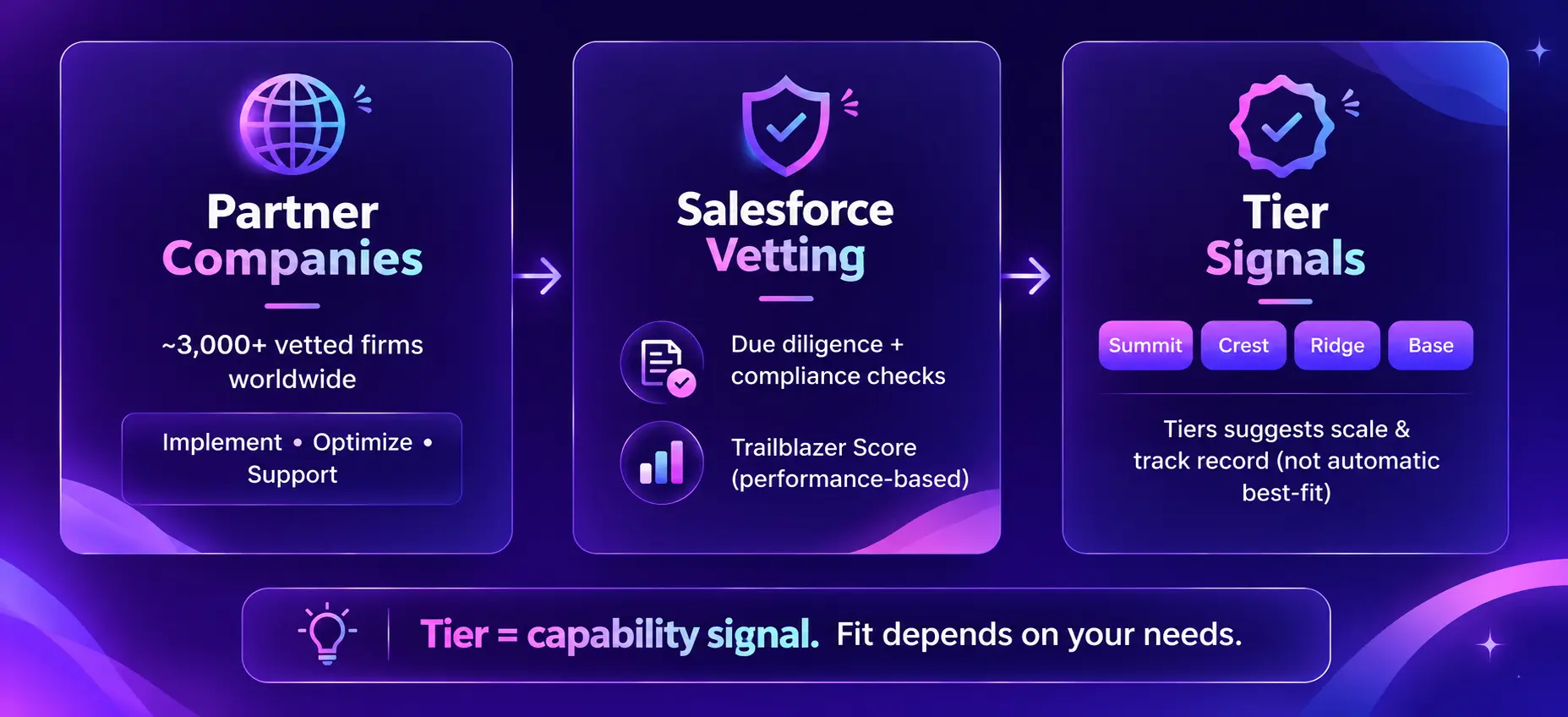
This guide covers the top 14 Salesforce implementation partners in the USA, chosen for their Salesforce expertise, partner status, client reviews, and track record of delivered projects. We looked at each firm’s current Salesforce partner tier (Select or Summit), industry focus, range of Salesforce implementation services, and experience with newer capabilities such as Data 360, Agentforce, and MuleSoft integration.
You’ll find everything from large consultancies built for enterprise-wide programs to smaller, specialist firms known for speed and hands-on attention, so you can shortlist the Salesforce consulting partner that fits your size, industry, and goals.
Understanding Salesforce Partner Service Models
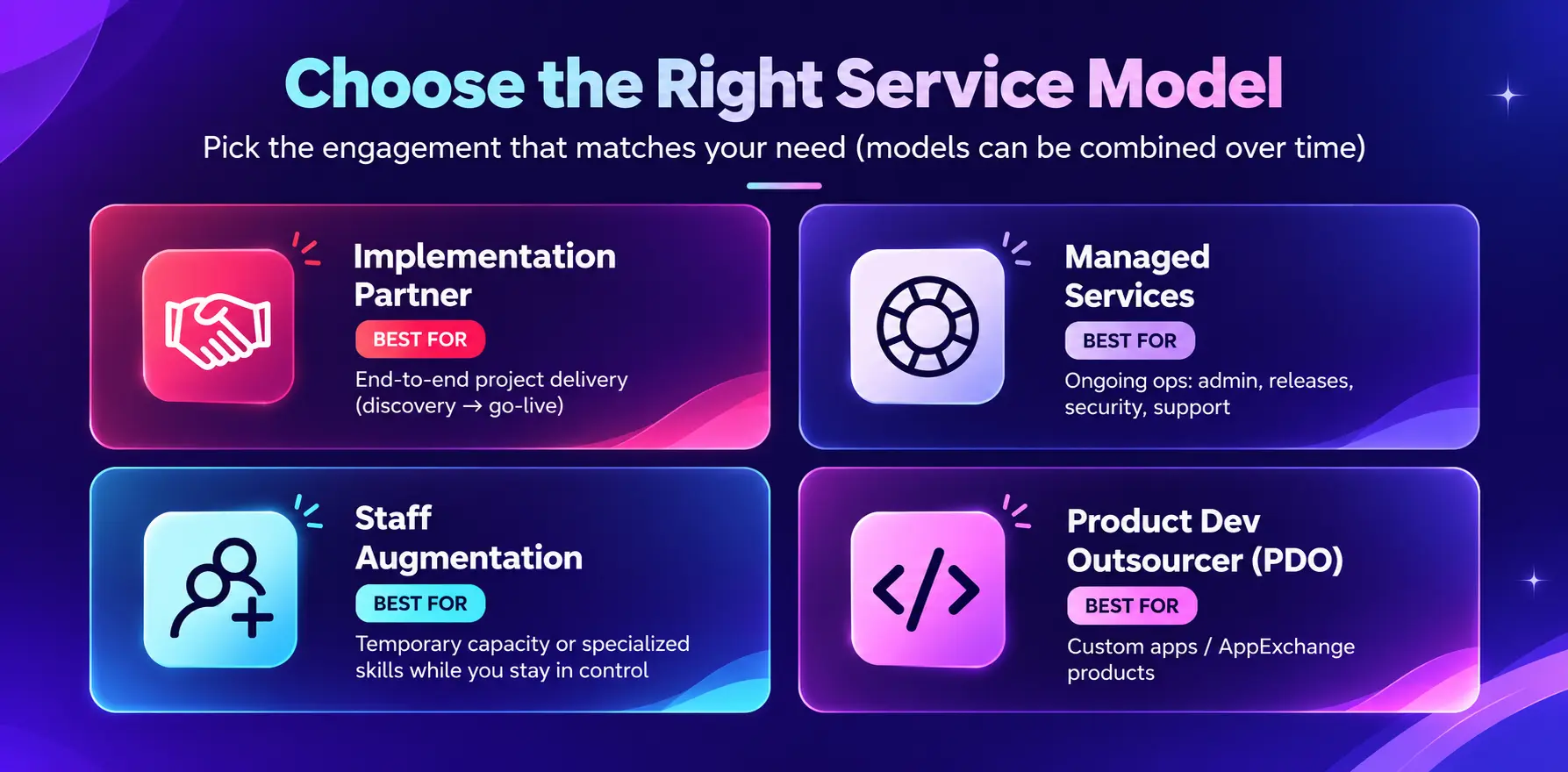
Salesforce partners usually work through four service models: implementation projects, managed services, staff augmentation, and product development outsourcing. Knowing which one you need before you start shortlisting makes it much easier to compare firms, because each model suits a different stage of your Salesforce journey.
The Four Main Service Models
1. Implementation Partner
An implementation partner delivers a defined project, from discovery and design through build, testing, data migration, training, and go-live. These engagements are usually fixed-scope or delivered in phases, with clear milestones and deliverables.
This is the model to choose when you’re rolling out Salesforce for the first time, adding a new cloud such as Service Cloud or Marketing Cloud, connecting Salesforce to an ERP, or redesigning an org that has outgrown its original setup. Strong Salesforce implementation services include not just configuration, but solution architecture, integrations, data migration, and a plan for user adoption.
2. Managed Services
Managed services pick up where implementation ends. A managed services provider looks after your org month to month: user requests, administration, release testing, health checks, performance tuning, and small enhancements.
Instead of paying per project, you usually pay a monthly retainer for a dedicated team or a set block of support hours, with agreed response times. It’s a strong fit for companies without a full in-house Salesforce team, or for teams that want their own people focused on strategy rather than daily platform upkeep.
3. Staff Augmentation
Staff augmentation adds certified Salesforce specialists to your own team for a period of time. They work under your direction, follow your processes, and fill specific gaps, while you keep control of priorities and delivery.
Typical examples include bringing in a Marketing Cloud consultant for a campaign build, a CPQ specialist for complex pricing rules, or extra developers during a busy release cycle. It’s flexible and cost-effective, but it works best when you already have someone internally who can lead and review the work.
4. Product Development Outsourcer (PDO)
Product development outsourcers focus on building software on the Salesforce platform: AppExchange apps, managed packages, custom Lightning applications, and complex integrations that go beyond standard configuration. They bring strong skills in Apex, Lightning Web Components, API design, and AppExchange security review packaging.
This model suits ISVs launching AppExchange products, enterprises that need sophisticated custom solutions, and companies building their own Salesforce-native tools.
Which Model Fits You?
| Your Situation | Model to Look For |
|---|---|
| First Salesforce rollout, new cloud, or major redesign | Implementation partner |
| Live org that needs ongoing admin, support, and improvements | Managed services |
| Internal team that needs extra skills or capacity | Staff augmentation |
| Building an AppExchange app or a custom Salesforce product | Product development outsourcer |
Many Salesforce consulting partners offer more than one of these models, so you can start with an implementation and move straight into managed services or add specialists later, without changing vendors.
Looking for a Trusted Salesforce Implementation Partner?
From planning and implementation to integration and ongoing support, Codleo Consulting helps businesses build Salesforce solutions that fit their goals and drive measurable results.
Explore Our Salesforce Implementation Services →Choosing the Right Model for Your Needs
Most companies don’t stay in one service model forever. The best fit depends on where you are today: your Salesforce maturity, the skills already on your team, and what you want to achieve over the next year or two. Many Salesforce partners combine models so your engagement can change as your needs do.
Here’s how that often looks in practice. A partner leads your Commerce Cloud or Service Cloud implementation, then moves into a managed services plan to keep the org healthy and improving after launch. Later, when you start an AI or integration project, the same partner adds one or two specialists to your team through staff augmentation. You keep one partner who already knows your org, instead of re-explaining your business to a new vendor at every stage.
Three Questions to Ask Before You Shortlist
1. What do we need right now?
A full build, ongoing support, extra hands, or a custom product?
2. What can our team handle internally?
If you have a strong Salesforce lead, augmentation may be enough. If not, an implementation partner or managed services will carry more of the load.
3. Where are we heading?
If new clouds, integrations, or Agentforce are on the roadmap, choose a partner that can grow with you across several models.
As you review the Salesforce implementation partners below, look for the firms whose service models match those answers. The right partner should strengthen what your team already does well and cover the gaps without adding unnecessary cost.
1. Codleo Consulting
Codleo Consulting is a USA-based Salesforce Summit Partner with a presence in Delaware and Dallas, Texas, delivering end-to-end Salesforce implementation, consulting, integration, development, staff augmentation, and managed services for businesses across the United States and international markets.
Founded in 2019, Codleo Consulting helps organizations implement, customize, integrate, and optimize Salesforce solutions to improve business operations, customer engagement, and long-term CRM performance.
The company specializes in Salesforce Sales Cloud, Service Cloud, Marketing Cloud, Experience Cloud, and industry-specific CRM solutions, with additional expertise in Agentforce, Data Cloud, Salesforce automation, custom development, and third-party integrations.
Codleo delivers comprehensive Salesforce implementation services , covering business requirement analysis, solution architecture, platform configuration, data migration, system integration, testing, user training, and post-implementation support.
Through its Salesforce staff augmentation services, Codleo enables businesses to extend their internal teams with Salesforce developers, administrators, consultants, and architects based on project requirements.
The company also provides Salesforce support services to help organizations maintain platform performance, resolve technical issues, manage enhancements, and adapt their Salesforce environments as business needs evolve.
With experience across healthcare, education, retail, manufacturing, real estate, financial services, and nonprofit organizations, Codleo Consulting focuses on delivering scalable Salesforce solutions aligned with business objectives. Its implementation expertise, flexible engagement models, and ongoing support make it a strong option for US businesses seeking a long-term Salesforce consulting partner.
Key Strengths
- Salesforce Expertise: Sales Cloud, Service Cloud, Marketing Cloud, Experience Cloud, Agentforce, Data Cloud, Salesforce Integration, Apex, Lightning Web Components, and CRM Automation.
- Core Services: Salesforce Implementation, Salesforce Consulting, Salesforce Development, Salesforce Integration, Staff Augmentation, Managed Services, and Salesforce Support.
- Industries: Healthcare, Education, Retail, Manufacturing, Real Estate, Financial Services, and Nonprofit.
- Engagement Models: Project-Based Implementation, Dedicated Salesforce Teams, Staff Augmentation, and Ongoing Managed Support.
- Partner Recognition: Salesforce Summit Partner.
Looking for a Salesforce Implementation Partner in the USA?
Work with Codleo Consulting to implement, integrate, and optimize Salesforce for your business goals.
Explore Salesforce Implementation Services →2. ForteNext
ForteNext is a Florida-based Salesforce partner focused on B2B implementations, with services spanning implementation, integration, staff augmentation, and managed services for mid-market and enterprise companies across North America.
The company says it has more than 20 years of experience implementing, integrating, and optimizing Salesforce for businesses in complex, regulated industries. It’s best known for B2B Commerce Cloud, having delivered more than 60 B2B storefront projects, and for a hybrid delivery model that combines US-based leadership with flexible delivery capacity.
Core Expertise
Commerce Cloud, Sales Cloud, Service Cloud, Marketing Cloud, Account Engagement, Experience Cloud, CPQ, MuleSoft, Agentforce, and Pimly for product information management.
Industries
Manufacturing, distribution, healthcare, fintech, retail, and higher education.
What Stands Out
Deep B2B commerce experience, plus ERP and finance integrations with platforms such as Oracle NetSuite that connect storefronts, sales, and back-office operations. Its staff augmentation service also lets companies add certified Salesforce specialists quickly without long hiring cycles.
Best For
Mid-market and enterprise B2B companies, especially manufacturers and distributors, planning a Commerce Cloud storefront or an ERP-connected Salesforce rollout.
Keep in Mind
ForteNext has the strongest track record in B2B commerce. If your project centers on another area, such as nonprofit or highly specialized healthcare workflows, ask for case studies in that specific domain.
3. Bounteous
Bounteous is a digital experience consultancy that combines creative strategy, data, and technology to help enterprises grow through better customer experiences.
Its Salesforce practice focuses on designing and running customer journeys across Marketing Cloud, Experience Cloud, and Commerce Cloud. The company describes its approach as “co-innovation,” with Bounteous teams working side by side with client stakeholders rather than handing over a finished system.
Core Expertise
Marketing Cloud, Experience Cloud, Commerce Cloud, MuleSoft, Data 360, and Salesforce AI.
Industries
Retail, consumer goods, financial services, travel, and media.
What Stands Out
Experience-led personalization at enterprise scale, including connecting Salesforce data with platforms such as Adobe, Google Cloud, and Snowflake, and using Data 360 for segmentation and predictive models.
Best For
Large consumer brands that want marketing, commerce, and data working together around the customer journey.
Keep in Mind
Bounteous is built for enterprise-scale programs. Smaller companies with a focused CRM project may find a mid-size partner more cost-effective.
4. VRP Consulting
Founded in 1998, VRP Consulting provides Salesforce consulting, implementation, and managed services, with a strong reputation for multi-cloud programs and complex integrations.
The company delivers through onshore and nearshore teams across the US, Europe, and Latin America, which gives clients long working-hour coverage. VRP describes its delivery governance as a Center of Excellence model focused on quality and Salesforce best practices.
Core Expertise
Sales Cloud, Service Cloud, Marketing Cloud, MuleSoft, Tableau, Heroku, Data 360, and Salesforce AI.
Industries
Manufacturing, healthcare, education, and financial services.
What Stands Out
Technical depth for large, integration-heavy programs and multi-year modernization projects.
Best For
Enterprises running complex, multi-cloud Salesforce programs with global delivery needs.
Keep in Mind
Its strength is large, technical engagements. For a simple, single-cloud rollout, confirm you’ll get senior attention at your project size.
5. OSF Digital
Founded in 2003, OSF Digital is one of the best-known Salesforce Commerce Cloud implementers, helping brands connect online, mobile, and in-store experiences.
Its services cover consulting, implementation, and managed services, with a focus on Commerce Cloud, Experience Cloud, and Marketing Cloud. Acquisitions in Europe, Asia-Pacific, and Latin America have expanded its global delivery and local presence.
Core Expertise
Commerce Cloud, Experience Cloud, Marketing Cloud, MuleSoft, and Data 360.
Industries
Retail, consumer goods, manufacturing, financial services, and travel.
What Stands Out
Deep omnichannel commerce experience for both B2B and B2C, including its Connected4Commerce framework, plus growing Data 360 and MuleSoft practices for AI-driven personalization.
Best For
Global retailers and brands with complex commerce and omnichannel requirements.
Keep in Mind
OSF is headquartered in Canada. US buyers should confirm US-hours coverage and the location of the delivery team assigned to their project.
6. LevelShift (formerly DemandBlue)
LevelShift, formerly DemandBlue, is known for its “On Demand” model, which lets clients use certified Salesforce experts as their needs change instead of committing to a large fixed-scope project.
Clients can use that capacity for implementation, customization, administration, or ongoing enhancements, which suits organizations that want continuous improvement without long-term lock-in.
Core Expertise
Sales Cloud, Service Cloud, Marketing Cloud, Account Engagement, CPQ, MuleSoft, CRM Analytics, and Data 360.
Industries
Education, nonprofit, healthcare, manufacturing, and public sector.
What Stands Out
A flexible, consumption-based engagement model and transparent pricing that work for SMBs, nonprofits, and enterprises alike.
Best For
Organizations with changing priorities that want ongoing Salesforce help without a big upfront project.
Keep in Mind
On-demand models work best when someone internally can prioritize requests. For a major new implementation, confirm how the project will be scoped and governed.
7. Saltbox Mgmt
Saltbox Mgmt is a boutique Salesforce consultancy that combines CRM strategy with process design, data governance, and change management to drive strong user adoption.
The firm provides implementation, integration, and managed services, focusing on keeping solutions simple enough for teams to use. Training, documentation, and governance are core parts of its work, not an afterthought.
Core Expertise
Sales Cloud, Service Cloud, Experience Cloud, Marketing Cloud, MuleSoft, and Data 360.
Industries
Education, professional services, nonprofit, and healthcare.
What Stands Out
A human-centered approach that pairs technical delivery with adoption, governance, and long-term ownership.
Best For
Mid-sized organizations that care as much about adoption and governance as about the build itself.
Keep in Mind
As a boutique firm, confirm capacity and team continuity for large or multi-region programs.
8. Zaelab
Zaelab is a digital commerce consultancy specializing in Salesforce B2B Commerce, helping manufacturers and distributors move from traditional sales channels to modern digital buying experiences.
Its Commerce Accelerator is designed to launch Salesforce-powered storefronts quickly while still supporting deep integration with ERP, PIM, and order management systems.
Core Expertise
B2B Commerce, Experience Cloud, CPQ, MuleSoft, and Salesforce AI personalization.
Industries
Manufacturing, distribution, industrial supply, healthcare, and technology.
What Stands Out
Specialist in B2B commerce, including composable and headless commerce architectures.
Best For
Manufacturers, distributors, and wholesalers building or modernizing B2B digital sales channels.
Keep in Mind
Zaelab’s focus is commerce. If your project is mainly sales or service CRM, a broader Salesforce partner may be a better fit.
9. 6Street Digital (6ST)
Founded by former Salesforce architects, 6Street Digital focuses on commerce transformation, combining strategy, design, and engineering for B2B and B2C companies.
The firm specializes in Commerce Cloud, Experience Cloud, and Marketing Cloud, with strong API-first and headless commerce skills. Its FastTrack Commerce accelerator speeds storefront launches and offers post-launch optimization.
Core Expertise
Commerce Cloud, Experience Cloud, Marketing Cloud, Data 360, and Salesforce AI personalization.
Industries
Retail, apparel, consumer goods, manufacturing, and automotive.
What Stands Out
Senior, architect-led delivery in a small, focused team.
Best For
Brands that want a hands-on, boutique commerce partner with great technical skills.
Keep in Mind
With a small team, check availability and backup coverage for large or long-running programs.
10. Itransition
Itransition is a global technology consultancy with more than 25 years of experience, delivering large Salesforce implementations that connect closely with existing enterprise systems.
Its Salesforce work covers Sales, Service, Marketing, and Experience Cloud, alongside MuleSoft, Tableau, and CPQ. The company has deep experience in complex data migrations, legacy modernization, and multi-org consolidation, backed by ISO-certified delivery processes.
Core Expertise
Sales Cloud, Service Cloud, Marketing Cloud, Experience Cloud, MuleSoft, Tableau, and CPQ.
Industries
Financial services, healthcare, retail, telecommunications, and energy.
What Stands Out
Deep engineering expertise for migrations and integrations, with global delivery across North America, Europe, and Asia.
Best For
Enterprises with complex legacy systems, large migrations, or multi-org consolidation.
Keep in Mind
Itransition is a broad technology firm, not Salesforce-only. Ask to see the Salesforce-specific team and case studies for your project.
11. Royal Cyber
Royal Cyber is a digital transformation firm offering multi-cloud Salesforce services backed by strong enterprise integration skills.
It connects Salesforce with ERP, analytics, and AI tools using MuleSoft and Tableau, and offers QuickStart accelerators for faster commerce and CPQ deployments. Its managed services include 24/7 Salesforce support across multiple time zones.
Core Expertise
Sales Cloud, Service Cloud, Commerce Cloud, Marketing Cloud, MuleSoft, Tableau, and Data 360.
Industries
Retail, manufacturing, logistics, banking, and financial services.
What Stands Out
Integration-led delivery combined with round-the-clock managed services.
Best For
Large companies that need Salesforce connected to many enterprise systems, with ongoing support after launch.
Keep in Mind
Royal Cyber works across many technologies beyond Salesforce, so confirm the Salesforce certifications of the team assigned to you.
12. RedTag
Founded in 2013, RedTag specializes in Salesforce analytics and data strategy, helping companies turn scattered data into dashboards and insights teams can act on.
Its team brings deep expertise in Tableau, CRM Analytics, and Data 360, and often combines Salesforce implementation with predictive models that improve sales and marketing decisions. RedTag also designs governance frameworks to keep data consistent across business units.
Core Expertise
Data 360, CRM Analytics, Tableau, Sales Cloud, and Service Cloud.
Industries
Financial services, healthcare, retail, technology, and telecommunications.
What Stands Out
A data-first approach that connects CRM, analytics, and AI.
Best For
Organizations that want better reporting, forecasting, and data-driven decisions from Salesforce.
Keep in Mind
RedTag’s strength is analytics. For a broad, multi-cloud implementation, confirm its delivery depth beyond data and reporting.
13. CUBE84
CUBE84 delivers custom Salesforce implementations and managed services built around clear processes, user adoption, and measurable return, an approach it calls “Design for Impact.”
Its work spans Sales Cloud, Service Cloud, Revenue Cloud, and Experience Cloud, and it also offers staff augmentation for ongoing optimization and governance. Consultants combine business analysis with technical skills to align solutions with business goals.
Core Expertise
Sales Cloud, Service Cloud, Revenue Cloud, Experience Cloud, and Data 360.
Industries
Technology, healthcare, manufacturing, financial services, and media.
What Stands Out
Flexible engagement models and transparent delivery for mid-market organizations.
Best For
Mid-market companies that want a partner for both implementation and ongoing optimization.
Keep in Mind
Ask for examples in your specific industry, especially if you need specialized industry clouds.
14. VML (formerly Wunderman Thompson)
Wunderman Thompson merged with VMLY&R to form VML, a global marketing and technology agency within WPP. Its Salesforce practice combines creative strategy with CRM and marketing technology to build personalized, data-driven customer experiences.
The team works with enterprise clients on Marketing Cloud, Commerce Cloud, and Data 360, using Salesforce AI to support personalization and journey orchestration.
Core Expertise
Marketing Cloud, Commerce Cloud, Data 360, and Salesforce AI for marketing.
Industries
Retail, automotive, financial services, consumer goods, and media.
What Stands Out
A rare mix of brand strategy, creative, and Salesforce technology under one roof.
Best For
Global brands that want marketing creativity and CRM technology tightly connected.
Keep in Mind
VML is a large agency network. Mid-sized companies or CRM-focused projects may get more hands-on attention from a specialist Salesforce partner.
Finding the Right Salesforce Partner
The right Salesforce implementation partner is the one whose strengths match your project, not the one at the top of a list. Start with your goal- commerce, marketing, analytics, integration, or ongoing support- then shortlist firms with proven experience in that area and your industry.
The partners in this guide show how varied Salesforce expertise has become in 2026. Some lead with commerce, some with marketing and customer experience, some with data and analytics, and others with flexible delivery or ongoing support. That variety is good news for buyers, as long as you match the partner to the job.
Compare Salesforce Partners by Your Business Priority
| If Your Priority Is... | Partners Worth Comparing |
|---|---|
| B2B or B2C commerce | ForteNext, OSF Digital, Zaelab, 6Street Digital |
| Marketing and customer experience | Bounteous, VML |
| Large, integration-heavy enterprise programs | VRP Consulting, Itransition, Royal Cyber |
| Flexible support and strong adoption | LevelShift, Saltbox Mgmt, CUBE84 |
| Analytics, data, and AI-ready reporting | RedTag |
| End-to-end delivery from strategy to 24x7 support | Codleo Consulting |
How to Narrow Your Shortlist
Define the outcome first.
A faster quote-to-cash process, a new storefront, better service, or cleaner reporting each points to different partners.
Check proof, not promises.
Ask for case studies in your industry and verified reviews on Salesforce AppExchange.
Meet the delivery team.
Make sure the people who’ll build your solution are the ones you speak with during evaluation.
Plan beyond go-live.
Choose a partner that can support and improve your org after launch, not just deliver the first release.
Salesforce projects are heading toward connected, AI-ready systems built around clear business outcomes. The partners above can all help you get there. The best choice is simply the one whose experience, delivery model, and support approach fit your business today and where you want to be next.
Not sure which partner fits your project?
Talk to Codleo, a Salesforce Summit Partner. We’ll give you an honest view of your scope, timeline, and budget, and tell you plainly if another firm on this list would be a better fit.
Get an Unbiased Salesforce Assessment →Frequently Asked Questions
Answers to common questions about Salesforce implementation partners, pricing, timelines, and services.
How much does it cost to hire a Salesforce implementation partner?
Salesforce implementation costs depend on your scope, the number of clouds involved, integrations, data migration, and the partner’s delivery model. As a general guide, small business implementations usually cost $10,000–$30,000, mid-market projects typically range from $40,000–$150,000, and enterprise programs often start around $150,000 and can exceed $500,000 for multi-cloud, multi-region rollouts. These figures cover services only; Salesforce licenses are billed separately.
The biggest cost drivers are the number of Salesforce clouds you’re implementing, how complex your ERP and third-party integrations are, the volume and quality of data to migrate, how much custom development you need, and whether you add managed services after go-live. Hourly rates also vary: certified Salesforce partners in the US commonly charge $100–$250 per hour, large global systems integrators often charge $250–$500+, and global delivery teams usually offer lower blended rates. A higher rate doesn’t always mean a higher total bill, because experienced teams often finish faster and need less rework. For a full breakdown, see our Salesforce implementation cost guide .
What’s the difference between Salesforce Select and Summit partners?
Salesforce has simplified its consulting partner program. The older Base, Ridge, Crest, and Summit structure has been replaced by two main tiers: Select and Summit. If a partner still describes itself using the old tier names, check its current status on Salesforce AppExchange.
Select Partners are established consulting partners that meet Salesforce’s requirements for certified talent, delivery, and customer satisfaction. They’re often a strong fit for well-defined projects and specialist work. Summit Partners sit at the top tier, recognized for deep expertise, strong customer success, and significant delivery across Salesforce products. They’re commonly chosen for complex, multi-cloud, or business-critical programs.
Salesforce also recognizes partners through competencies in specific products and industries, such as Sales Cloud, Service Cloud, Data 360, or Agentforce. Tier is a useful starting point, but competencies, industry experience, and the quality of the team assigned to your project usually matter more. For more detail, read our guide to Salesforce Select vs. Summit Partners .
How long does a typical Salesforce implementation take?
Timelines depend on scope and complexity. A focused, single-cloud implementation for a small business often takes 6–10 weeks. Mid-market projects with several integrations and a data migration usually take 3–6 months, while enterprise and multi-cloud programs commonly run 6–12 months or longer, often delivered in phases.
The main factors that affect your timeline are the number of users and departments, how complex your data migration is, integrations with ERP or legacy systems, the amount of customization, how quickly decisions are made, and the time needed for training and change management.
Many partners offer accelerators or fixed-scope starter packages that shorten time to value for standard setups. Codleo, for example, offers a fixed-price Salesforce QuickStart for straightforward implementations. Larger organizations usually benefit from a phased rollout: launching the most valuable processes first, then expanding once teams are using the system confidently.
Should I choose a large enterprise partner or a boutique Salesforce consultancy?
It depends on your project’s complexity, budget, industry, internal skills, and growth plans. Large partners, typically with 1,000 or more employees, bring global scale, broad service portfolios, large delivery teams, and experience with complex multinational deployments. They’re often a good fit for enterprises running programs across many clouds, regions, and business units.
Boutique and mid-size partners, often under a few hundred employees, usually offer more senior attention, faster decisions, more flexible pricing, and deep specialization in particular industries or Salesforce products. They’re frequently the better choice for mid-market companies or projects that need focused expertise.
When deciding, weigh breadth against depth of attention. Ask who will actually work on your project, how much senior involvement you’ll get, and whether the partner can support you after go-live. Many companies find that a mid-size partner with strong industry experience gives them the best balance of capability, responsiveness, and cost.
Which Salesforce certifications should I look for in an implementation partner?
Start with the certifications held by the people assigned to your project, not the company’s total count. Useful certifications include Salesforce Administrator for core configuration, Platform App Builder for declarative customization, Platform Developer I and II for Apex and Lightning Web Components, and product-specific consultant certifications that match your scope, such as Sales Cloud, Service Cloud, Marketing Cloud, Commerce Cloud, Experience Cloud, Data Cloud, or Agentforce.
For complex or multi-cloud projects, look for architect-level credentials such as Application Architect, System Architect, or the rare Certified Technical Architect (CTA), held by only a small number of professionals worldwide. If integration is a major part of your project, MuleSoft and Integration Architect certifications are worth checking too.
A large certification total doesn’t guarantee the right expertise for your project. Ask for the names, roles, and certifications of the people who’ll do the work, and verify them through Salesforce’s public credential verification.
Do I need a Salesforce partner, or can I implement it myself?
You can implement Salesforce yourself if you have experienced internal Salesforce expertise, straightforward requirements with little customization, few integrations, and enough time to learn as you go. Many small teams launch a basic Sales Cloud setup this way.
Most organizations, however, benefit from a partner because partners bring proven implementation methods, experience avoiding common mistakes, scalable architecture, integration skills, change management, and faster time to value. These advantages matter most when you’re connecting Salesforce to an ERP, migrating from another CRM, rolling out several clouds, or working in a regulated industry.
A popular middle path is a partner-led implementation with knowledge transfer, where the partner builds the foundation and trains your team to manage day-to-day administration. That approach often gives you the best balance of expertise now and lower long-term costs later. For a deeper look, see Why Hire a Salesforce Consulting Partner .
What industries do Salesforce implementation partners typically specialize in?
Many Salesforce partners focus on industries with complex processes or regulatory requirements, where experience shortens projects and reduces risk. Common specializations include:
- Manufacturing: B2B Commerce, CPQ, dealer and distributor management, and ERP integration
- Healthcare: Health Cloud, patient engagement, and HIPAA-aware design
- Financial services: Financial Services Cloud, compliance, audit trails, and data security
- Retail and consumer goods: Commerce Cloud, Marketing Cloud, and omnichannel experiences
- Distribution and wholesale: B2B Commerce, order management, and inventory integration
- Higher education: Education Cloud and student lifecycle management
- Nonprofit: Nonprofit Cloud, donor management, and program tracking
- Real estate: inventory, lead management, and customer feedback journeys
Industry experience matters because partners already understand your workflows, regulations, and common pitfalls. When comparing firms, prioritize those with case studies and references from your sector.
What’s the difference between Salesforce implementation and managed services?
Salesforce implementation is a project to deploy, configure, and customize Salesforce for your organization. It covers discovery, requirements, solution architecture, data migration, integrations, testing, user training, and go-live support, with a defined scope, timeline, and deliverables.
Salesforce managed services provide ongoing support and improvement after implementation. That typically includes administration, user support, health checks, small enhancements, release management for Salesforce’s three annual releases, performance optimization, and continuous improvement, usually with agreed response times.
Most organizations start with an implementation and then move to managed services so the system keeps improving. Managed services are usually priced as a monthly plan, often around $2,500–$15,000+ per month depending on scope, rather than as a one-time project fee.
How do I evaluate Salesforce partner proposals and pricing?
Look beyond the headline price and compare proposals on the same scope. Check the team composition (experience and certifications of the people assigned), methodology and timeline (realistic phases and clear milestones), scope clarity (what’s included and what costs extra), integration approach, data migration plan, change management and training, post-launch support (hypercare length, warranty, and knowledge transfer), references and case studies from similar projects, and communication style during the sales process.
Ask for itemized pricing showing rates by role, estimated hours by phase, assumptions, and exclusions. Be cautious of bids that are much lower than the rest. They often leave out discovery, testing, data migration, or training, or rely heavily on junior staff, and those gaps tend to return as change requests later.
The strongest proposal balances fair pricing with a complete approach, relevant experience, and transparent communication. Always speak with two or three references before signing.
What are the most common reasons Salesforce implementations fail?
Most failed implementations share a few causes: no clear goals or KPIs, rushed requirements that don’t reflect how teams actually work, weak change management and user resistance, over-customization that creates technical debt, limited executive sponsorship, unrealistic timelines, poor data quality and migration planning, no integration strategy, choosing a partner without proper vetting, scope creep without a change process, and too little training.
Successful projects usually have a dedicated internal owner, a phased plan with early wins, strong communication and change management, realistic expectations, data cleanup before migration, user-centric design and testing, role-based training, and a plan for optimization after go-live.
The right partner helps you avoid these problems by insisting on proper discovery, using standard features before custom code, flagging risks early, and staying involved after launch. For a practical checklist, see How to Choose a Salesforce Consulting Partner .




 16192 Coastal Highway Lewes, Delaware 19958 USA


