


Publish date:
Salesforce has become much more than a CRM. With Sales Cloud, Service Cloud, Data Cloud, Agentforce, integrations, automation, and industry-specific products, businesses now have more opportunities—and more complexity—to manage.
This guide explains how Salesforce consulting works in 2026, what consultants actually help with, what affects cost and implementation timelines, where AI and Agentforce fit in, and how to evaluate the right consulting partner for your business.
Table of Contents
-
What Are Salesforce Consulting Services?
-
Why Salesforce Consulting Matters More Than Ever in 2026
-
The Full Range of Salesforce Consulting Services Explained
-
Industry-Specific Salesforce Consulting: Who Benefits and How
-
Salesforce Agentforce & AI Consulting: The 2026 Game-Changer
-
What Real ROI Looks Like: Case Studies and Numbers
-
In-House vs. Salesforce Consulting Partner: Which Makes More Sense?
-
How to Choose the Right Salesforce Consulting Partner in 2026
-
Red Flags: Signs You're Working With the Wrong Consultant
-
How Much Does Salesforce Consulting Cost in 2026?
-
What Does a Salesforce Implementation Timeline Look Like?
-
Why Businesses Choose Codleo as a Salesforce Consulting Partner
-
Frequently Asked Questions About Salesforce Consulting
-
Need Help With Your Salesforce Strategy?
What Are Salesforce Consulting Services?
Salesforce consulting services are expert-led engagements that help businesses plan, implement, customize, integrate, and optimize Salesforce around their specific processes and goals. A Salesforce consultant can assess existing workflows, identify gaps, recommend the right Salesforce products, and help ensure the platform supports business growth, user adoption, and customer experience.
Think of it this way — Salesforce is not a plug-and-play tool. It's a powerful engine. A Salesforce consultant is the person who configures that engine specifically for your business, whether you're a 10-person startup or a 500-person enterprise.
The scope of Salesforce consulting covers everything from strategy and roadmap planning, to technical implementation, third-party integrations, custom app development, end-user training, and ongoing managed support. Every business uses it differently — which is exactly why you need an expert in your corner.
Why Salesforce Consulting Matters More Than Ever in 2026
In 2026, Salesforce extends far beyond traditional CRM. With Agentforce, Data Cloud, Einstein capabilities, automation, integrations, and an expanding portfolio of cloud products, businesses have more opportunities to connect data, automate processes, and improve customer experiences. But that flexibility also makes Salesforce strategy, architecture, implementation, and ongoing optimization more complex.
Here's the context that makes this critical:
-
Salesforce generated $37.9 billion in revenue in fiscal year 2025, holding the #1 CRM market position for the 12th consecutive year with 20.7% global market share (IDC, 2025).
-
Agentforce, Salesforce's AI agent platform, surpassed $500 million in annual recurring revenue in Q3 FY2026 — up 330% year-over-year. It's the fastest-growing product in Salesforce's 26-year history.
-
There are over 4,000 consulting and service partners on the Salesforce AppExchange, with more than 170,000 certified experts worldwide. Choosing the wrong one is a real risk.
The businesses winning with Salesforce in 2026 are not the ones who bought the most licenses. They're the ones who partnered with the right consultant from day one.
The Full Range of Salesforce Consulting Services Explained
A full-service Salesforce consulting partner covers the entire lifecycle of your CRM — from the initial strategy through to long-term optimization. This isn't a one-time engagement; the best partnerships evolve as your business grows.
Here’s what a comprehensive Salesforce consulting engagement typically includes:
1. Salesforce Strategy & CRM Roadmap
Before a single configuration begins, a good consultant takes time to understand your business. They map your existing processes, identify gaps, interview stakeholders, and build a Salesforce roadmap aligned to your actual KPIs — not a template. According to Codleo Consulting, skipping this step is the single most common reason Salesforce projects fail.
2. Salesforce Implementation Services
This is the core of most engagements. A certified team sets up your Salesforce environment from scratch — configuring objects, workflows, page layouts, user profiles, permission sets, and data models. Implementation typically follows an agile methodology, with incremental delivery to keep projects on time and within budget.
Implementation covers the key clouds:
-
Sales Cloud — Pipeline management, lead tracking, opportunity scoring, forecasting
-
Service Cloud — Case management, omnichannel support, knowledge base, field service
-
Marketing Cloud / Account Engagement — Email campaigns, lead nurturing, journey builder, scoring
-
Experience Cloud — Customer and partner portals
-
Health Cloud / Financial Services Cloud — Industry-specific modules
-
CPQ (Configure, Price, Quote) — Complex quoting and pricing automation
3. Data Migration
Moving your existing data — from spreadsheets, legacy CRMs, or ERP systems — into Salesforce without errors is one of the most technically demanding parts of any project. Consultants handle data cleansing, field mapping, deduplication, and validation to ensure your org starts clean.
4. Salesforce Integration Services
Most businesses run 5–10+ software tools. A Salesforce consultant integrates your CRM with ERP systems (SAP, Oracle), accounting tools (QuickBooks, Xero), marketing platforms (HubSpot, Mailchimp), communication tools (WhatsApp, Slack, Zoom), project management (Jira, Asana), and more — using APIs, MuleSoft, or middleware connectors.
5. Salesforce Customization & Development
When out-of-the-box Salesforce doesn't fit your specific workflow, developers build custom solutions using Apex (Salesforce's programming language), Lightning Web Components (LWC), and Visualforce. This includes custom objects, automation flows, triggers, and AppExchange-listed apps.
6. Salesforce Support & Managed Services
Post go-live, Salesforce requires ongoing attention as business processes, user needs, integrations, and platform features evolve. Managed services can include troubleshooting, user support, configuration enhancements, security reviews, release readiness, automation improvements, and regular CRM health checks.
7. CRM Health Check & Org Optimization
If your Salesforce is already live but underperforming, a health check is the starting point. Consultants audit your org configuration, data quality, automation logic, security settings, and user adoption — then deliver a prioritized action plan.
8. Salesforce Training & User Adoption Programs
A Salesforce org that nobody uses is money wasted. Consultants design role-specific training programs for sales reps, service agents, marketers, and admins. Training formats range from live workshops and recorded videos to Trailhead-guided learning paths.
9. Agentforce & AI Implementation
The newest and fastest-growing service area. Consultants help businesses define AI agent use cases, build Agentforce configurations, ground agents on your Data Cloud, and deploy autonomous AI agents for service, sales, and operations. More on this in the dedicated section below.
Industry-Specific Salesforce Consulting: Who Benefits and How
Salesforce isn't a one-size-fits-all platform — and neither is consulting. The most valuable partners bring deep industry expertise alongside technical skills. Here's how Salesforce consulting delivers results across key verticals.
Healthcare & Life Sciences
Salesforce Health Cloud gives healthcare providers, hospitals, insurance companies, and pharmaceutical firms a 360° view of patients and members. Consultants configure Health Cloud for care coordination, patient journey tracking, appointment scheduling, and HIPAA-compliant data management.
-
Example: In healthcare environments, Salesforce Health Cloud can help connect patient information, care coordination, follow-up workflows, and communications in one system. With the right implementation approach, healthcare organizations can reduce manual work and give care teams better visibility into patient interactions.
Financial Services
Banks, wealth management firms, insurance companies, and fintech startups use Salesforce Financial Services Cloud to manage client relationships, track portfolios, automate compliance workflows, and accelerate lead-to-policy cycles.
-
Key use cases: KYC automation, client onboarding, AUM tracking, advisor productivity, claims processing.
Manufacturing & Industrial
Manufacturers use Salesforce to bridge the gap between their CRM, ERP, and field service operations. Sales Cloud manages dealer and distributor relationships; Field Service Lightning coordinates on-site technicians; MuleSoft connects Salesforce to SAP or Oracle ERP.
-
Key use cases: Dealer management, warranty tracking, spare parts ordering, preventive maintenance scheduling.
Retail & E-Commerce
Retailers use Salesforce Marketing Cloud for personalized customer journeys — from abandoned cart emails to loyalty programs and post-purchase nurture sequences. Commerce Cloud powers online storefronts. Service Cloud handles returns, exchanges, and support tickets.
-
Key use cases: Omnichannel customer experience, loyalty program management, seasonal campaign automation, customer service deflection.
Education
Schools, universities, and edtech companies use Salesforce Education Cloud (formerly Education Data Architecture) to manage student recruitment, enrollment, alumni relations, and financial aid processes.
-
Key use cases: Enrollment pipeline management, student success tracking, alumni fundraising, scholarship management.
Nonprofit Organizations
Nonprofits get access to Salesforce NPSP (Nonprofit Success Pack) and the Power of Us program — up to 10 free Salesforce licenses. Consultants configure NPSP for donor management, grant tracking, volunteer coordination, and program outcome measurement.
-
Key use cases: Donor pipeline, recurring gift automation, program impact reporting, grant management.
Technology & SaaS
B2B tech companies use Salesforce as their revenue operations backbone — integrating it with HubSpot, Marketo, Outreach, and billing tools like Zuora. CPQ automates complex pricing. Slack integration enables internal deal coordination.
-
Key use cases: Pipeline management, revenue forecasting, customer success tracking, renewal automation.
Agentforce Results and Adoption: What the Data Shows
Agentforce is Salesforce’s platform for building and deploying AI agents that can support customer service, sales, marketing, and internal business workflows. These agents can use business data and configured actions to answer questions, assist users, automate selected tasks, and escalate work to people when appropriate. Implementing Agentforce effectively requires more than enabling AI features—it depends on clear use cases, reliable data, appropriate permissions, integrations, testing, and governance
Unlike a basic FAQ chatbot, an AI agent can be designed to work with Salesforce data, follow defined instructions, use approved actions, and participate in multi-step workflows. The quality of the experience depends heavily on the data, business rules, security controls, and actions available to the agent.
What the Data Says
-
Agentforce adoption has accelerated as businesses move from AI experimentation toward real-world use cases. Salesforce reported that Agentforce annual recurring revenue surpassed $500 million in Q3 FY2026, representing 330% year-over-year growth. Salesforce also reported more than 18,500 Agentforce deals since launch, including over 9,500 paid deals.
-
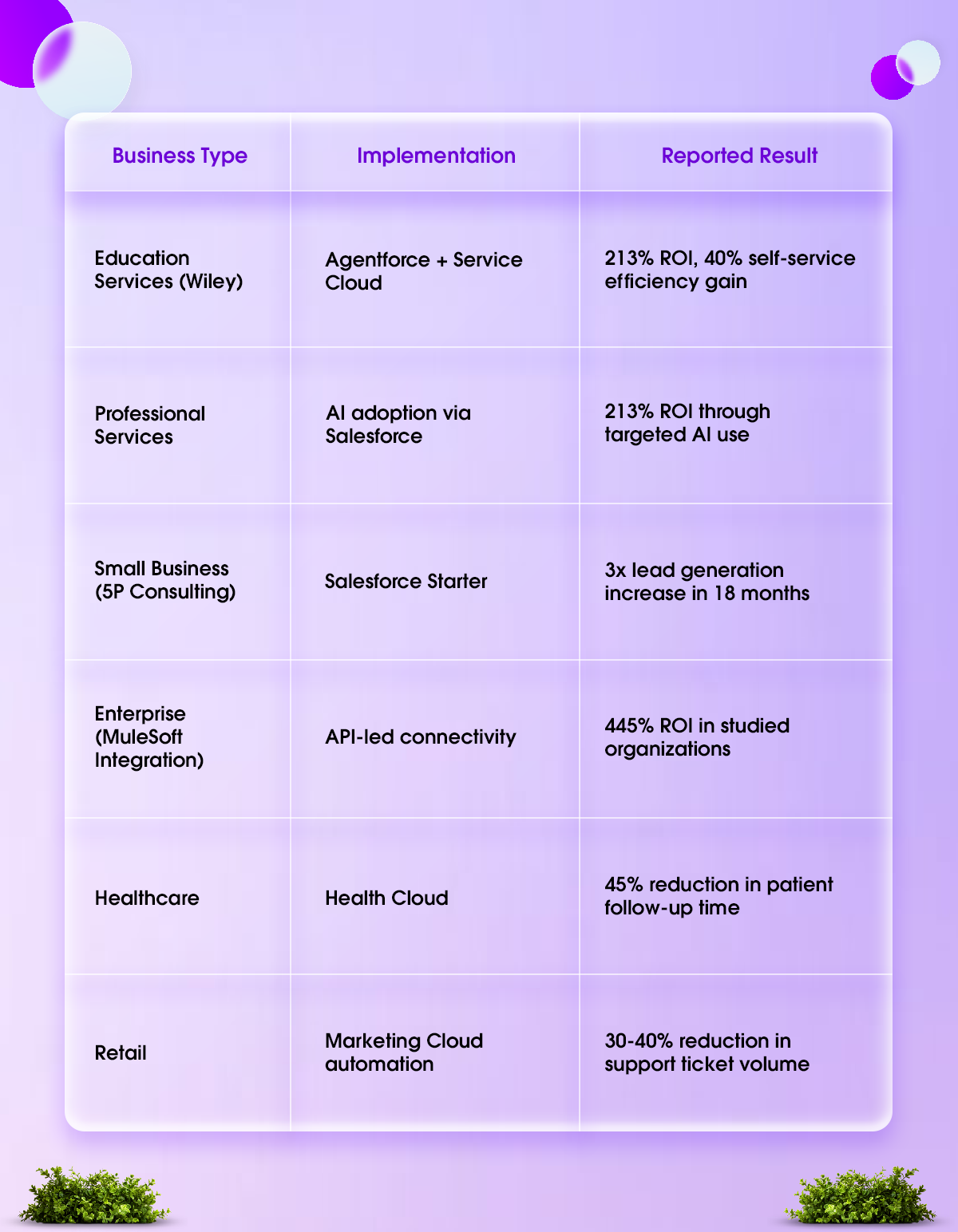
Wiley: Salesforce reports that Wiley achieved a 213% ROI and approximately $230,000 in annual cost savings through its Service Cloud implementation. During the initial Agentforce deployment, Wiley also reported more than 40% higher case resolution compared with its previous chatbot.
-
Salesforce: Salesforce reports that its Agentforce-powered Help experience on help.salesforce.com has handled millions of customer inquiries, demonstrating how AI agents can support service operations at scale.
What a Salesforce AI Consulting Engagement Looks Like
A proper Agentforce implementation isn't just turning on a feature. It involves:
-
Use case identification — which workflows are suitable for autonomous agents vs. human-assisted
-
Data readiness assessment — Agentforce works best with a clean, unified Data Cloud foundation
-
Agent design and configuration — defining agent personas, action sets, topics, and escalation paths
-
Integration with existing flows — ensuring agents connect to your Case, Opportunity, and Contact objects
-
Testing and QA — validating agent responses against real scenarios before going live
-
Monitoring and iteration — tracking resolution rates, handoff rates, and CSAT post-launch
Data readiness is a critical part of an Agentforce implementation. AI agents rely on the information, permissions, business rules, and actions available to them, so incomplete, inconsistent, or poorly governed data can limit the quality of their responses and actions. Data quality, access controls, testing, and governance should therefore be addressed before an agent is deployed at scale.
What Real ROI Looks Like: Case Studies and Numbers
Salesforce consulting can deliver measurable value when the engagement is tied to clear business goals, such as improving user adoption, automating manual processes, increasing data visibility, strengthening customer experiences, or making Salesforce easier to scale. However, ROI varies significantly based on the quality of implementation, data readiness, user adoption, project scope, and how effectively Salesforce is aligned with business processes.
Here's what the numbers look like across industries and implementations:
Real-World Example: Salesforce Consulting in Action
A leading cement manufacturer was dealing with fragmented customer data, manual sales processes, disconnected systems, and limited collaboration between teams. Codleo worked with the organization to build a more connected Salesforce environment around its operational requirements.
The solution included a centralized Dealer Management System built on Salesforce, a mobile integration for field sales teams, SAP–Salesforce integration for order and transaction processes, and improved reporting and forecasting.
According to Codleo's published case study, the mobile and Salesforce integration helped deliver a 20% increase in sales productivity, while the unified environment improved collaboration, pipeline visibility, forecasting, and access to customer and dealer information.
The takeaway: Salesforce consulting creates the most value when technology decisions are connected to specific operational problems. In this case, the objective wasn't simply to configure Salesforce—it was to reduce manual work, connect systems, improve data visibility, and help sales teams work more effectively.
Read the complete Salesforce integration case study →
In-House vs. Salesforce Consulting Partner: Which Makes More Sense?
Choosing between an in-house Salesforce team and a consulting partner depends on the complexity of your Salesforce environment, project frequency, available internal expertise, budget, and long-term support needs. An internal team can make sense for organizations with continuous Salesforce workloads, while a consulting partner can provide specialized expertise for implementations, integrations, migrations, optimization, or other complex projects. Some organizations use a hybrid model, combining internal Salesforce ownership with external expertise when needed.
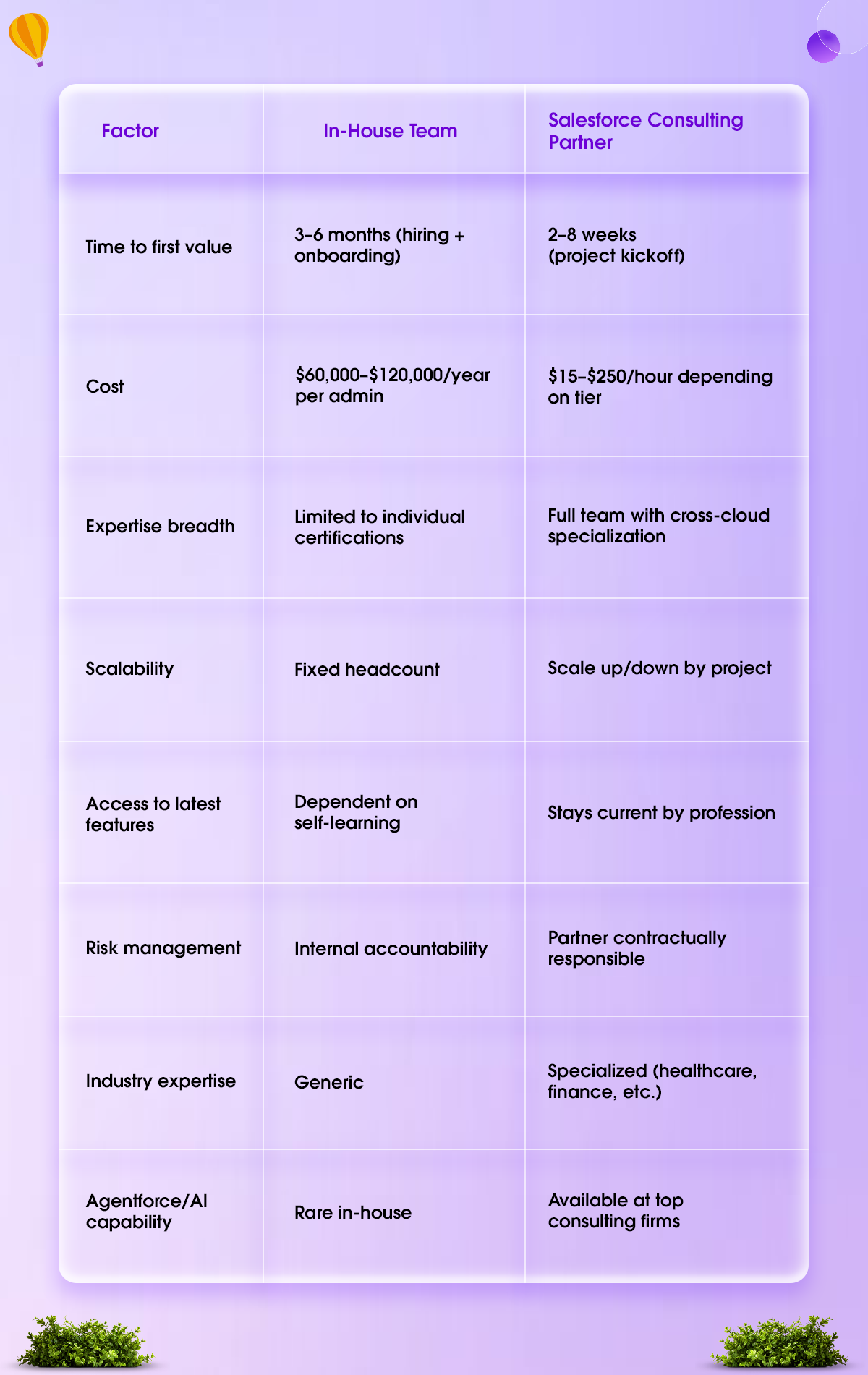
A simple way to decide: If Salesforce requires continuous day-to-day administration and you have enough ongoing work to support dedicated roles, building internal expertise may make sense. If you need specialized skills for a defined project—or access to architects, developers, consultants, and other specialists without building an entire team—a consulting partner may be more practical.
How to Choose the Right Salesforce Consulting Partner in 2026
Choosing the right Salesforce consulting partner requires more than comparing certifications or hourly rates. Look for a partner with relevant Salesforce expertise, experience solving problems similar to yours, a clear delivery methodology, strong communication, and a plan for supporting user adoption after go-live.
Before deciding, evaluate how well the partner understands your business requirements, who will actually work on your project, how success will be measured, and what support will be available after implementation.
Here's a practical checklist:
✅ Verify Partner Tier
Salesforce partner status can provide useful context when evaluating a consulting firm, but it shouldn't be the only deciding factor. Review the partner's Salesforce credentials alongside its project experience, customer outcomes, industry knowledge, and ability to support your specific requirements.
✅ Ask About Team Certifications
Ask which certifications are relevant to your project and which certified professionals will actually be assigned to the engagement. A large certification count can demonstrate platform knowledge, but relevant hands-on experience with the Salesforce products and challenges involved in your project matters just as much.
✅ Demand Industry References
Ask for relevant case studies, customer references, or examples of similar projects. Look for evidence that the partner understands the workflows, compliance requirements, integrations, and business challenges common to your industry.
✅ Evaluate Their Implementation Methodology
Ask the partner to explain how discovery, solution design, configuration, testing, user acceptance, training, and go-live will be managed. The methodology should provide clear milestones, responsibilities, feedback loops, and a process for handling scope changes.
✅ Understand Their Support Model
Clarify what happens after go-live. Ask who will handle support, how issues are prioritized, what response expectations apply, and whether ongoing optimization, training, and release readiness are included or available separately.
✅ Fit Your Budget — Without Sacrificing Quality
Compare proposals based on scope, team composition, deliverables, support, assumptions, and expected business outcomes—not price alone. The lowest quote may exclude important work, while the highest price doesn't automatically guarantee the best fit. Look for a partner that clearly explains what you're paying for and how the engagement will create value.
Red Flags: Signs You're Working With the Wrong Consultant
Choosing a Salesforce consultant is not only about evaluating certifications and technical skills. The way a consultant handles discovery, communication, project planning, testing, training, and post-launch support can be just as important. Recognizing potential warning signs early can help you reduce project risk and avoid costly rework.
Watch out for these warning signs:
-
Building before understanding the business. They start building before understanding your business. A consultant should first understand your goals, users, workflows, pain points, data, and existing systems. Moving directly into configuration without sufficient discovery can lead to a solution that technically works but doesn't fit the way your business operates.
-
No clear project plan. There's no clear project plan or ownership. You should understand the project's scope, milestones, deliverables, responsibilities, dependencies, and decision-making process. If these remain unclear after discovery, timelines and budgets can become difficult to manage.
-
The proposed team doesn't match the project's complexity. Ask who will actually work on your project and what roles they will perform. Complex architecture, integrations, security, or data migration may require experienced specialists and appropriate senior oversight.
-
Their claimed expertise is difficult to verify. Certifications can indicate platform knowledge, but also ask for relevant project examples, case studies, references, and clarity on which specialists will be assigned to your engagement.
-
There's no clear post-go-live plan. Salesforce continues to evolve after implementation, and users may need additional support, training, fixes, and optimization. Clarify how the partner will handle stabilization after launch and whether ongoing support is available.
-
The proposal makes unrealistic promises. Be cautious of unusually short timelines, vague fixed-price promises, or guarantees made before the partner has properly assessed your requirements. Reliable estimates should be based on scope, complexity, integrations, data, and stakeholder availability.
-
User adoption is treated as an afterthought. A technically sound Salesforce implementation can still underperform if users don't understand or adopt the new processes. Look for a plan that addresses training, communication, user feedback, and change management before and after go-live.
How Much Does Salesforce Consulting Cost in 2026?
Salesforce consulting costs vary based on project scope, complexity, required expertise, Salesforce products involved, integrations, data migration, customization, and the level of ongoing support required. Pricing can also differ depending on whether you engage a consultant for a defined project, hourly support, or a longer-term managed services engagement.
Rather than comparing providers on hourly rates alone, evaluate what is included in the engagement—such as discovery, solution design, configuration, development, testing, training, deployment, and post-launch support. Two proposals with very different prices may also have very different scopes and deliverables.
Here's a breakdown to calibrate your expectations:
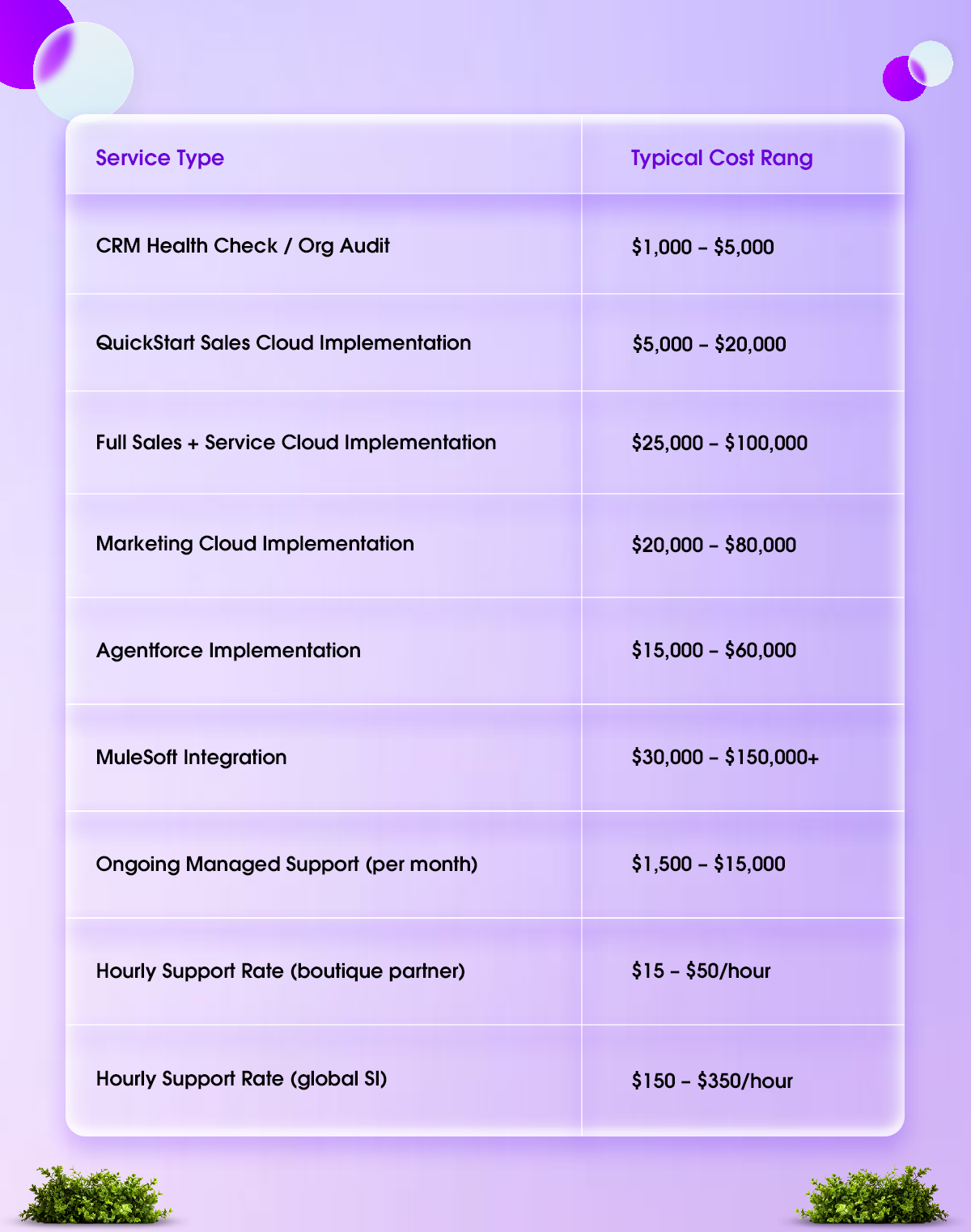
If you're planning a Salesforce project, build your budget around the scope and business outcomes you need rather than choosing a provider on price alone. For a deeper look at pricing models, cost factors, and budgeting considerations, read our guide to the cost of hiring a Salesforce consultant.
What Does a Salesforce Implementation Timeline Look Like?
Salesforce implementation timelines vary depending on project scope, number of Salesforce products involved, data volume and quality, integrations, customization requirements, testing, and stakeholder availability. A focused implementation with limited customization may take several weeks, while a complex multi-cloud project involving integrations, data migration, and custom development can take several months.
The most reliable timeline is created after discovery, when the project team has defined the requirements, dependencies, technical complexity, and responsibilities involved.
Here's a typical phased timeline:
-
Phase 1: Discovery & Requirements. Stakeholder interviews, current-state process mapping, business and technical requirements, data assessment, success criteria, and project planning.
-
Phase 2: Design & Configuration. Salesforce environment setup, data model design, workflow and automation configuration, security and permissions, integration architecture, and iterative solution reviews.
-
Phase 3: Data Migration & Integration. Data cleansing and mapping, test migrations, integration development, system testing, and user acceptance testing (UAT).
-
Phase 4: Training & Change Management. Role-based user training, documentation, stakeholder communication, user feedback, adoption planning, and final readiness activities.
-
Phase 5: Go-Live & Hypercare. Production deployment, launch support, issue resolution, performance monitoring, user assistance, and transition into ongoing support or optimization
Clear scope, timely stakeholder decisions, realistic requirements, clean data, structured testing, and strong project management can all help keep a Salesforce implementation on track. Building time for user feedback and unexpected technical issues also helps reduce avoidable delays.
Why Businesses Choose Codleo as a Salesforce Consulting Partner
Codleo Consulting is a Salesforce consulting partner helping businesses plan, implement, integrate, customize, and optimize Salesforce solutions. With experience supporting organizations across multiple industries and markets, our team combines Salesforce expertise with a consulting approach focused on business requirements, user adoption, scalability, and long-term CRM value.
Here's what makes working with Codleo different:
-
Salesforce Expertise: Codleo's team works across Salesforce implementation, integration, customization, optimization, support, and emerging AI capabilities. This allows businesses to access different Salesforce skill sets as their requirements evolve.
-
Salesforce Partner Credentials: Codleo is part of the Salesforce partner ecosystem, with a team holding certifications across multiple Salesforce products and specializations. When evaluating us, businesses can review the credentials relevant to their specific project requirements.
-
Cross-Industry Experience: Codleo has worked on Salesforce projects across industries including healthcare, financial services, education, manufacturing, retail, nonprofit, and technology, helping teams adapt Salesforce to different workflows and business requirements.
-
Agentforce & AI Capabilities: For businesses exploring Salesforce AI, Codleo supports Agentforce-related strategy, data readiness, use-case planning, implementation, testing, and ongoing optimization.
-
Flexible Engagement Models: Different Salesforce projects require different levels of support. Codleo works across project-based consulting, implementation, optimization, and ongoing support engagements depending on the scope and expertise required.
-
Customer Proof: Before selecting any Salesforce partner, review real customer experiences. Codleo's case studies, Salesforce ecosystem presence, and independent client reviews can help prospective customers evaluate our project experience and approach.
Need Help With Your Salesforce Strategy?
Whether you're planning a new Salesforce implementation, improving an existing org, connecting business systems, or exploring Agentforce, the right approach starts with understanding your business requirements and desired outcomes.
Explore Codleo's Salesforce consulting services to learn how our team supports Salesforce strategy, implementation, integration, optimization, and ongoing support.
📞 +91 93118 16065 | 📧 consult@codleo.com
 0
0
About the Author

 603 D-Mall Netaji Subhash Place, Delhi 110034 IND


