


Publish date:
You just bought Salesforce licenses for your sales team. The platform arrived, your team got their login credentials, and now... nobody's really using it the way you expected. Or maybe you've been using Salesforce for years, but something feels off. You're not sure if you're using it right. You're definitely not getting the return on investment you heard about.
Sound familiar? You're not alone. This is one of the most common situations businesses find themselves in after implementing Salesforce.
The question then becomes: The question then becomes: Do you actually need a Salesforce consultant, or can your internal team manage Salesforce successfully on its own?
This guide cuts through the sales talk and gives you a straight answer. We'll look at what consultants actually do, when you genuinely need one, and what you should expect if you decide to hire one. By the end, you'll know whether bringing in expert help is the right move for your business.
Quick Navigation
-
What Does a Salesforce Consultant Actually Do?
-
6 Signs You Need a Salesforce Consultant
-
Real-World Example: When Salesforce Consulting Makes a Difference
-
Why Most DIY Salesforce Projects Struggle
-
What to Expect From a Real Consulting Engagement
-
How to Choose the Right Consultant for Your Situation
-
The Real Cost of Hiring a Consultant (And ROI)
-
Key Takeaways
What Does a Salesforce Consultant Actually Do?
Let's start by breaking down what a Salesforce consultant actually does. This matters because many businesses have the wrong mental picture of what they're paying for.
Businesses that need broader CRM strategy, implementation, integration, and ongoing optimization can explore professional Salesforce consulting services for end-to-end support.
More Than Just Technical Setup
If you're looking for end-to-end CRM strategy, implementation, and ongoing optimization, it's equally important to choose the right Salesforce consulting partner rather than focusing only on an individual consultant.
-
Understands your business before touching Salesforce. This means spending time learning how your sales team actually works, where leads come from, what your decision process looks like, and where the current system breaks down.
-
Designs a solution that matches your reality. Not what Salesforce salespeople think you need, but what actually solves your problems. This includes custom fields, automations, dashboards, and integrations.
-
Handles data migration properly. Moves your existing data into Salesforce without losing information or creating duplicate records that will frustrate your team for years.
-
Trains your team so they actually use it—more than just clicking through screens. Real training means your team understands why they use Salesforce and how it helps them do their jobs better.
-
Sticks around after launch. The first few weeks after go-live are when most questions pop up. A good consultant is available to help when issues come up.
-
Think of it this way: A consultant is part business strategist, part technical expert, and part teacher. They're not just setting up software—they're helping you transform how your team works.
6 Signs You Need a Salesforce Consultant
Not every business needs to hire a consultant, nor does every situation call for one. But there are clear warning signs that your business would benefit from expert help.
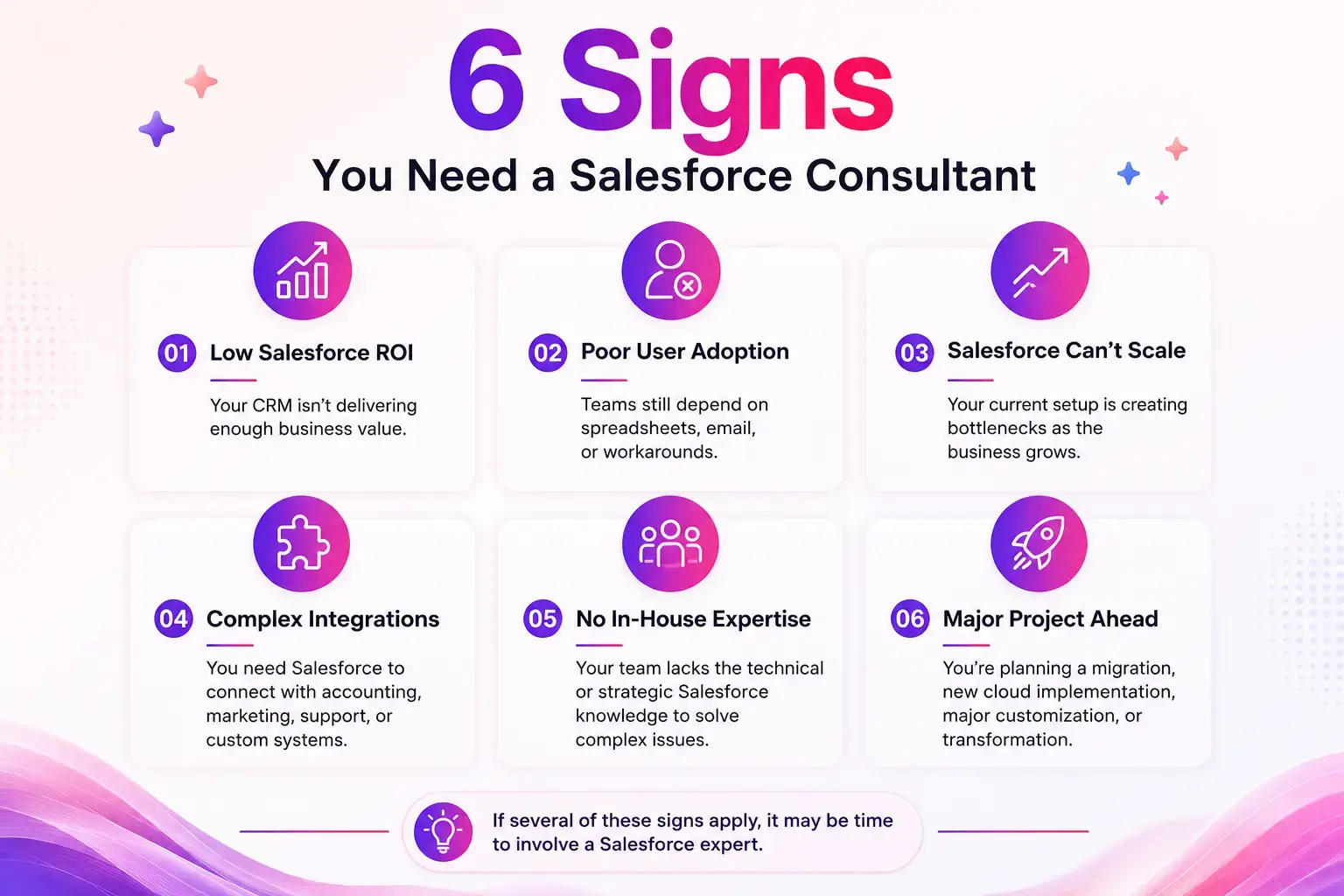
1. You're Not Getting ROI From Your Salesforce Investment
You're paying for Salesforce licenses each month, but you're not seeing a clear return on investment. Your sales team isn't closing deals faster. You don't have better visibility into your pipeline. Customer service isn't faster. Something's just not clicking.
This is usually a sign that Salesforce isn't actually configured to match how your team works. An experienced Salesforce consultant can audit your current setup, identify what's limiting ROI, and recommend practical improvements based on your business needs.
2. Your Team Isn't Using It (Or Actively Avoiding It)
You notice your sales reps still using spreadsheets or email instead of Salesforce. Or they log in to update numbers to keep their managers happy, but they're not actually running their business through the system.
Low adoption usually means one of two things: either Salesforce isn't set up to make the rep's job easier, or the rep doesn't understand how to use it. A consultant can fix both problems.
3. You're Scaling, and Your Current Setup Can't Handle It
Your business is growing. You hired new salespeople, or you're entering new markets. Your Salesforce setup worked fine for a smaller team, but now it's creating bottlenecks.
This is often the right time to bring in an experienced Salesforce consultant who can assess your current setup and prepare it for future growth. They can redesign your system to support growth without starting from scratch. They can add automation that saves time, improve security settings for a larger team, and integrate new tools you're adding.
4. You Need to Integrate Other Tools Into Salesforce
You use QuickBooks for accounting, Slack for communication, HubSpot for marketing, or a custom customer service system. You want all these tools to talk to Salesforce, but you're not sure how.
Integration is where experienced Salesforce specialists add significant value, especially for businesses managing multiple systems. Instead of your team manually copying data between systems, a consultant builds connections that sync information automatically. This saves time and eliminates errors.
5. You Don't Have In-House Salesforce Expertise
You have someone (maybe an admin, maybe a manager) trying to manage Salesforce on top of their regular job. They don't have formal training. They're learning as they go, which means configuration decisions might not be optimal, and problems take longer to solve.
A consultant can come in, fix existing problems, properly train this person, and document everything so they can manage it going forward. This is actually really cost-effective if you're not looking for ongoing support.
6. You're Planning Something Big (New Cloud Product, Major Customization, etc.)
Maybe you want to implement Salesforce Service Cloud (for support) in addition to Sales Cloud. Or you need a custom portal for your partners. Or you're moving from one Salesforce version to another. These are complex projects where mistakes are expensive.
A consultant has done these projects before. They know what works, what doesn't, and how to avoid common mistakes. They can often complete the project faster and with fewer problems than an internal team attempting it for the first time.
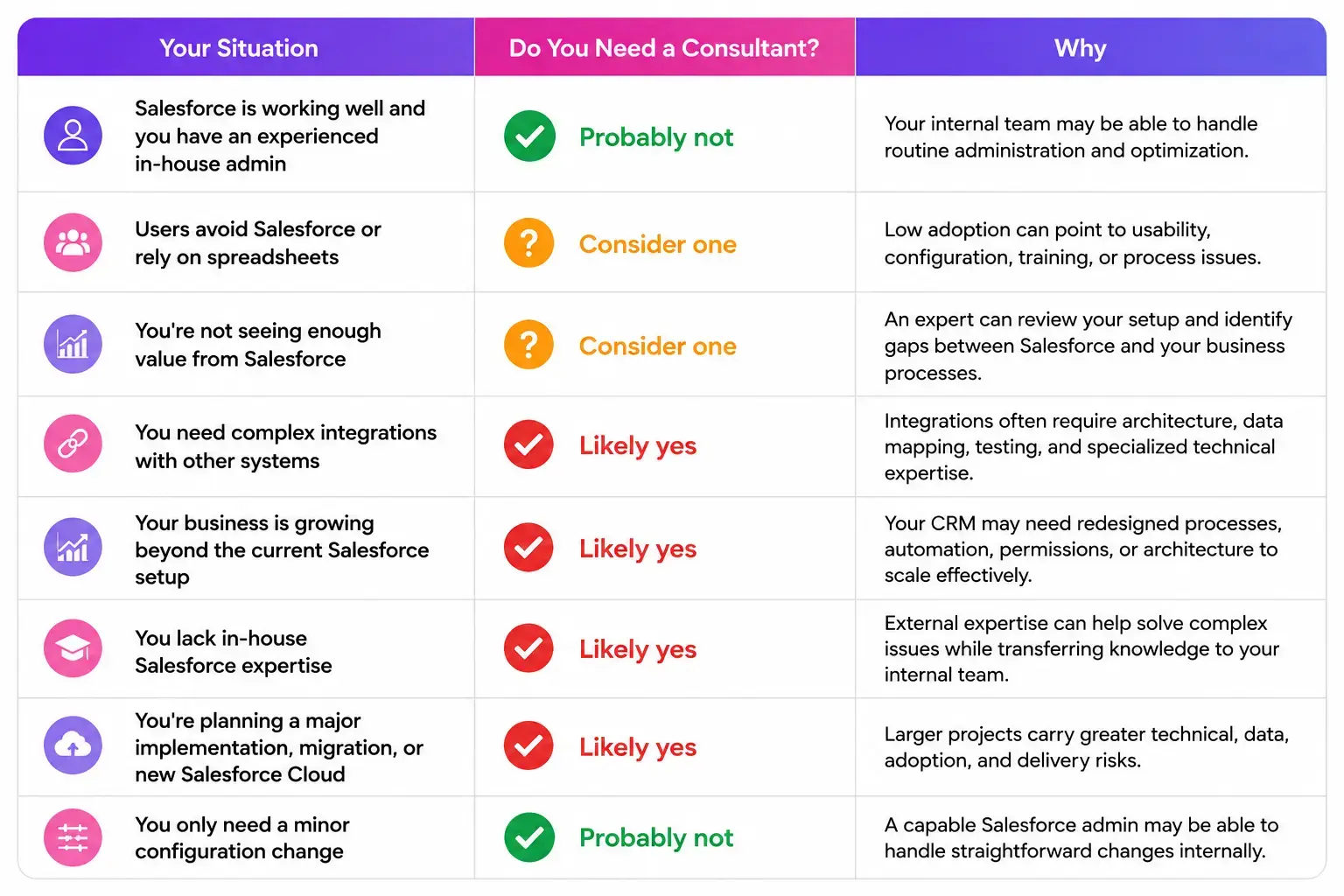
Simple rule: If Salesforce problems are affecting multiple teams, systems, or business processes—or your internal team doesn't have the expertise to resolve them—it may be time to involve a Salesforce consultant.
Real-World Example: When Salesforce Consulting Makes a Difference
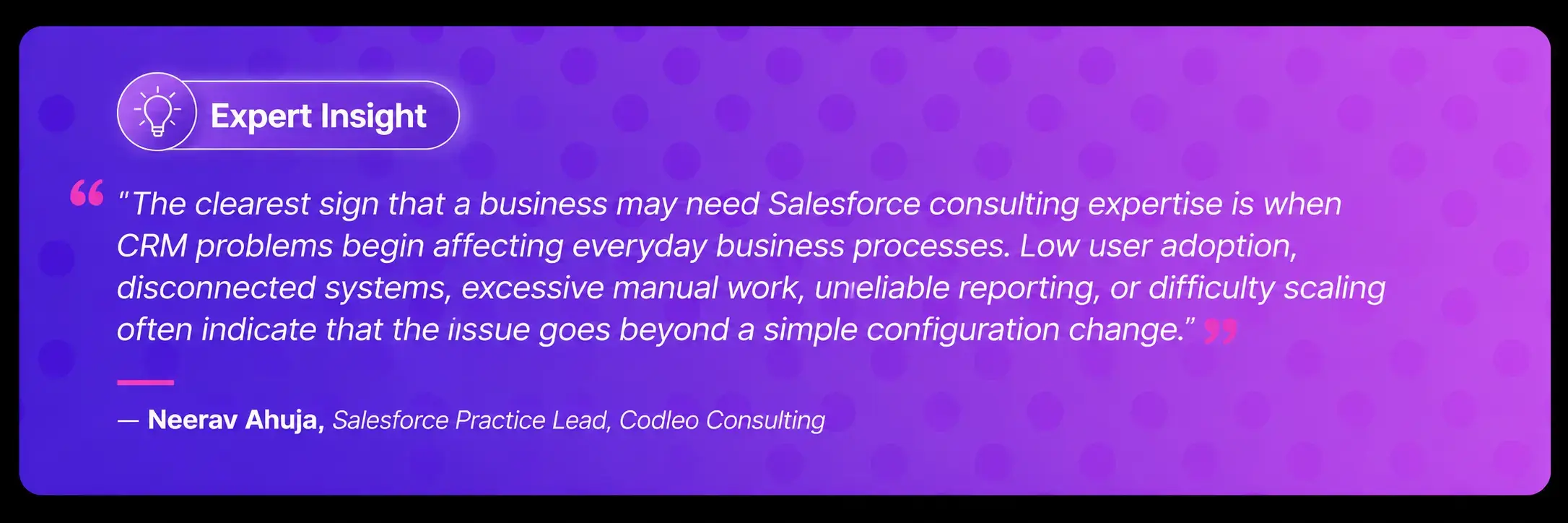
The need for a Salesforce consultant becomes much clearer when CRM challenges start affecting everyday operations.
In one Codleo project, a manufacturing enterprise was struggling with an inefficient sales-to-order process, limited visibility into order status, disconnected supplier data, manual document management, and systems that weren't working together effectively.
Rather than treating these as isolated Salesforce issues, Codleo approached them as connected business-process challenges.
The solution included implementing Salesforce Sales Cloud to streamline the sales-to-order lifecycle, creating a unified supplier view with Supplier360, automating quotation and document management, integrating key systems, and configuring approval workflows to reduce manual effort.
The result was a more connected sales operation with faster and more accurate order processing, improved supplier visibility, streamlined document approvals, better cross-department collaboration, and fewer manual tasks.
Why this matters: If your Salesforce challenges involve disconnected systems, manual processes, poor visibility, or workflows that no longer support how your business operates, the problem may require more than a few configuration changes. That's often when experienced Salesforce consulting becomes valuable.
Read the complete Salesforce transformation case study →
Why Most DIY Salesforce Projects Struggle
You might be thinking, "Can't we just figure this out ourselves? Salesforce is powerful, but how hard can it be?"
The honest answer? Salesforce is a lot more complex than it looks. Here are the main problems DIY teams run into:
Time Is a Silent Cost You'll Underestimate
Your internal team is trying to set up Salesforce while also doing their regular job. Configuration takes longer. Training takes longer. Problem-solving takes way longer. What should be a three-month implementation becomes a six-month project, with people frustrated and burned out.
A consultant can do it full-time, in their sleep. They've built the same configuration 50 times. What takes your team weeks takes them days.
You'll Make Mistakes That Cost You Later
Maybe you set up your data model wrong. Maybe you used the wrong automation tool, creating technical debt that becomes harder to fix later. Maybe you didn't plan for growth, and now your system doesn't scale. These mistakes aren't obvious until you're already committed to them.
A consultant helps you avoid these by thinking through scenarios you haven't considered. They've learned from others' mistakes, so you don't have to repeat them.
Your Team Gets Frustrated and Adoption Tanks
If Salesforce isn't working well or your team doesn't understand how to use it, adoption fails. And once people stop using it, getting them back is really hard. They've built workarounds. They're skeptical. Fixing this after the fact takes much longer than getting it right the first time.
What to Expect From a Real Consulting Engagement
If you do decide to bring in a consultant, here's what a solid engagement looks like:
Phase 1: Discovery (2-3 Weeks)
The consultant sits with your team and learns how you actually work. They're not trying to solve anything yet. They're asking questions: How do leads come in? How do you qualify them? What happens when a deal moves to the next stage? What reports do your managers look at? Where does the current process break?
By the end of this phase, you and the consultant should agree on what "success" looks like and what problems you're actually trying to solve.
Phase 2: Design & Planning (1-2 Weeks)
The consultant builds a blueprint for how Salesforce will work at your company. This includes the objects you need, the custom fields required, the automation, security settings, the reporting structure, and any integrations with other tools.
This phase is crucial because it's much easier to change plans now than after configuration is done.
Phase 3: Configuration (2-4 Weeks, Depending on Complexity)
The consultant actually builds the system based on the approved design. They configure fields, build automations, create dashboards and reports, set up security, and handle any custom coding if needed.
Phase 4: Data Migration & Testing (1-2 Weeks)
Your existing data gets moved into Salesforce. The consultant performs a "test migration" first to ensure nothing breaks. They check for duplicate records, broken relationships, and missing data. Then they do the real migration.
You and your team test the system with real scenarios. The consultant fixes anything that doesn't work.
Phase 5: Training & Go-Live (1 Week)
The consultant runs training sessions for your team, usually split by role (salespeople get different training than managers). They show people how to do their job in Salesforce. Then you go live.
The consultant sticks around for the first week or two after launch to fix issues that pop up in real use.
How to Choose the Right Consultant for Your Situation
When evaluating a Salesforce consultant, look beyond certifications and consider their relevant experience, technical expertise, communication skills, and understanding of your business needs.
Look for Relevant Certifications
Salesforce offers certifications for different roles. A real consultant should be certified as a Salesforce Administrator or Salesforce Consultant. If they're doing custom development, they should have a Developer certification. These aren't everything, but they show the person has invested in learning the platform properly.
Ask About Specific Experience With Your Use Case
If you're in the real estate business, ask for examples of other real estate companies they've worked with. If you need to integrate Salesforce with QuickBooks, ask if they've done that before. If you're implementing Service Cloud, ask about their experience there.
Someone who's done this before can avoid common pitfalls specific to your industry.
Get Real References (And Actually Call Them)
Ask the consultant for references from past clients. Then actually call them. Ask about the timeline, the quality of work, whether the consultant was easy to communicate with, and whether the client would hire them again.
This matters more than almost anything else. Results speak louder than promises.
Check Partner Status With Salesforce
Salesforce has a partner directory. They rate partners based on customer satisfaction, delivery performance, and certified headcount. If you're evaluating a consulting firm, check whether they're a recognized Salesforce consulting partner with relevant implementation experience.
This doesn't guarantee good work, but it shows Salesforce has vetted them.
Evaluate Communication Skills
You'll be working closely with this person (or team) for months. Can they explain technical concepts in a way you understand? Do they listen to your concerns, or do they try to force their solution on you? Do they follow up on emails? Good communication is more important than you might think.
The Real Cost of Hiring a Consultant (And ROI)
Let's talk money. Salesforce consulting isn't cheap. A full implementation can run from $25,000 to $150,000+, depending on complexity. But here's the thing: It's usually an investment, not an expense.
What You'll Actually Spend
Salesforce consulting costs can vary significantly depending on the scope of work, number of users, level of customization, data migration requirements, integrations, and the consultant’s expertise. Some consultants charge hourly rates, while others offer fixed-price projects or ongoing engagement models. Complex implementations typically require a larger investment than basic configuration or advisory support.
For a more detailed breakdown of pricing models and the factors that affect fees, see our guide to the cost of hiring a Salesforce consultant.
Some consultants also offer ongoing support after launch for maintenance, user training, troubleshooting, and future enhancements. The cost can vary depending on the level of support, response times, and scope of work.
What You'll Get Back
A well-implemented Salesforce system can create measurable business value by improving sales processes, reducing manual work, providing better customer insights, and helping teams work more efficiently.
-
Faster sales cycles. Better visibility into the pipeline means your sales team closes deals faster.
-
Reduced administrative work. Automations mean fewer manual data entry tasks, freeing your team for higher-value work.
-
Better customer insights. Reports and dashboards help you make smarter decisions.
-
Improved team efficiency. When Salesforce is set up right, people use it. That means better data quality, which in turn leads to better decisions.
Key Takeaways
Do you need a Salesforce consultant? Here's how to decide:
-
You may need a Salesforce consultant if: You're not getting ROI, your team isn't using Salesforce, you're scaling and need redesign, you need integrations, you're planning something big, or you don't have internal expertise.
-
You might not need one if: You have an experienced admin on staff, your Salesforce setup is working well, you need occasional training, or you have a clear support plan in place.
-
When you do hire one, choose carefully: Look for certifications, relevant experience, real references, Salesforce partner status, and good communication skills.
-
Think about ROI: The upfront cost of a consultant usually pays for itself within 6–12 months through increased productivity, faster sales cycles, and better decision-making.
If your needs go beyond solving a single Salesforce issue and include CRM strategy, implementation, integrations, or long-term optimization, working with an experienced consulting team may be more practical than relying on occasional technical support.
Do you need a consultant? Start by asking yourself: Is my current Salesforce setup delivering real value? If the answer is anything less than a confident "yes," it's worth speaking with an expert.
 103 claps
About the Author




 603 D-Mall Netaji Subhash Place, Delhi 110034 IND


