


Publish date:
Investing in Salesforce does not automatically translate into business growth. The real value comes from how effectively the platform improves sales processes, connects customer data, automates repetitive work, supports employees, and helps teams make better decisions.
Salesforce consulting can help businesses close the gap between platform capabilities and measurable business outcomes. By aligning Salesforce with business processes, data, integrations, automation, and user needs, consultants can help organizations improve productivity, strengthen customer experiences, and get more value from their CRM investment.
In this article, we’ll explore where Salesforce consulting can create the greatest business impact, which outcomes are worth measuring, common barriers to ROI, and how organizations of different sizes can use Salesforce more effectively as they grow.
TABLE OF CONTENTS
-
How Salesforce Consulting Supports Business Growth
-
Where Salesforce Consulting Creates the Most Business Value
-
How Salesforce Consulting Improves Sales Performance
-
Using Salesforce to Automate Business Processes
-
Improving Customer Experience with Salesforce
-
Connecting Data and Systems for Better Decision-Making
-
How Salesforce Consulting Supports Scalable Growth
-
Common Barriers That Reduce Salesforce ROI
-
How to Measure ROI from Salesforce Consulting
-
Salesforce Consulting for Small, Mid-Market, and Enterprise Businesses
-
When External Salesforce Expertise Can Accelerate Growth
-
Getting More Value from Your Salesforce Investment
How Salesforce Consulting Supports Business Growth
Salesforce consulting supports business growth by connecting CRM technology with the processes and outcomes that matter most to an organization. Instead of treating Salesforce as a standalone software implementation, consultants help businesses use the platform to improve how teams sell, serve customers, manage data, automate work, and make decisions.
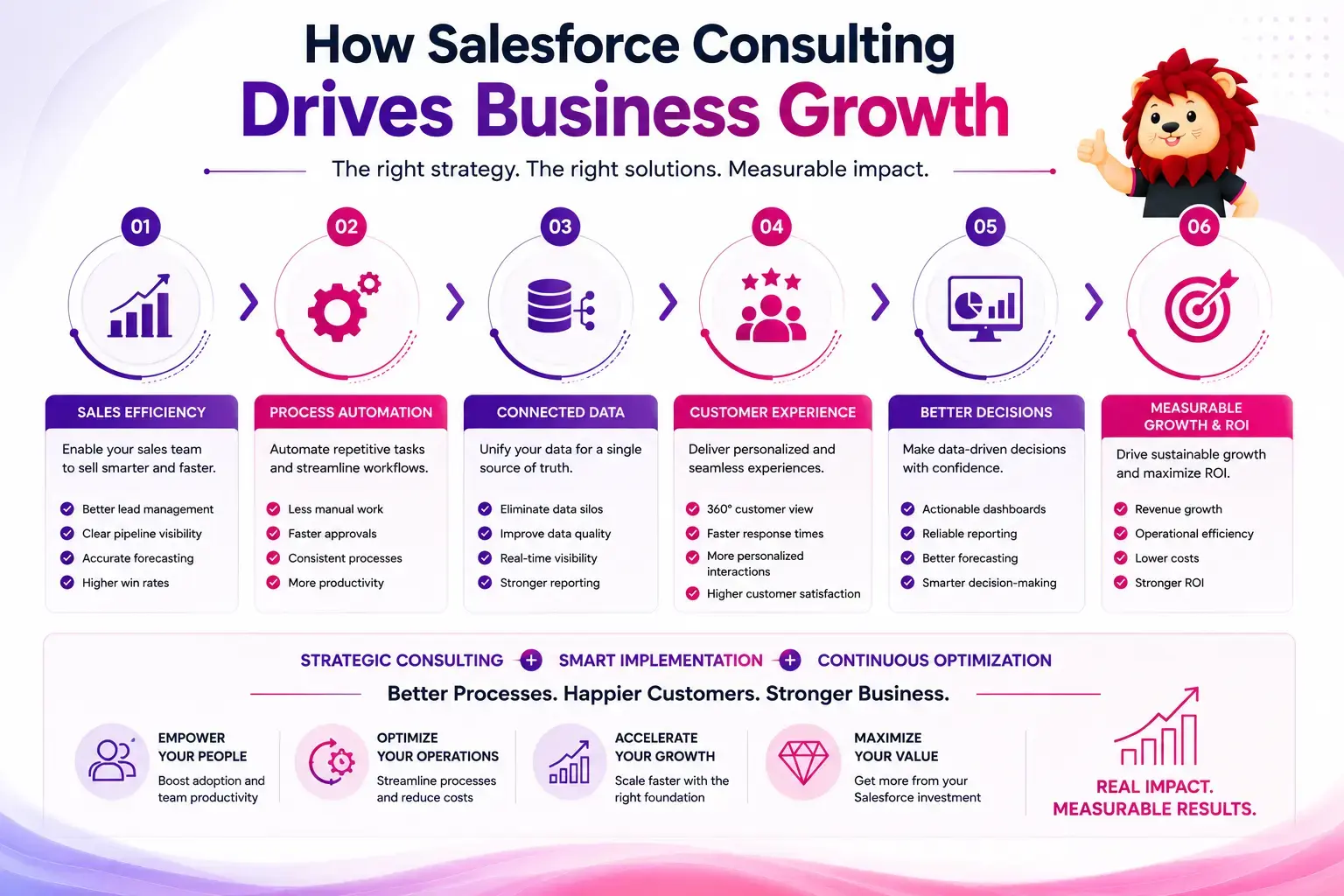
The impact can appear across several areas of the business:
-
Sales efficiency: Salesforce consultants can help simplify lead management, opportunity tracking, approvals, forecasting, and other sales workflows so representatives spend less time on repetitive administration and more time working with customers.
-
Process automation: Manual handoffs, repetitive data entry, approvals, notifications, and other routine activities can often be automated, helping teams operate more consistently as transaction volumes grow.
-
Connected customer data: Integrating Salesforce with ERP, marketing, finance, service, and other business systems can give teams a more complete view of customer activity and reduce information silos.
-
Customer experience: Better access to customer history, service information, preferences, and interactions can help sales and service teams deliver more informed and consistent experiences.
-
User productivity and adoption: Consultants can simplify workflows, improve system usability, provide role-based training, and help ensure Salesforce supports the way employees actually work.
-
Scalability: As a business adds customers, employees, products, markets, or Salesforce capabilities, a well-designed CRM architecture can make it easier to expand without constantly rebuilding existing processes.
The goal of Salesforce consulting should therefore be more than delivering technical features. Each recommendation should connect back to a business outcome that can be measured after implementation.
Where Salesforce Consulting Creates the Most Business Value
The value of Salesforce consulting depends on whether the platform is solving meaningful business problems. Adding more features or customizations does not automatically create ROI. The strongest results usually come from improving processes that directly affect revenue, productivity, customer experience, or operating efficiency.
Businesses can look for Salesforce consulting value in areas such as:
-
Revenue processes: Improving lead routing, opportunity management, forecasting, account visibility, and sales automation can help sales teams operate more efficiently and give leadership better visibility into the pipeline.
-
Operational efficiency: Automating repetitive activities, approvals, handoffs, notifications, and data entry can reduce manual effort and help processes scale without adding the same level of administrative overhead.
-
Customer retention and service: Connecting customer information and service workflows can help teams respond faster, understand customer history, and manage issues more consistently.
-
Data visibility: Bringing relevant customer and operational information into Salesforce can reduce fragmented reporting and give teams a more consistent view of business performance.
-
Employee productivity: Better-designed workflows, automation, dashboards, and integrations can reduce unnecessary steps and make Salesforce easier for employees to use.
-
Scalable operations: A Salesforce environment designed around long-term business requirements can make it easier to introduce new products, teams, markets, automations, and customer journeys as the organization grows.
The specific impact will vary by organization, which is why Salesforce ROI should be measured against clearly defined business KPIs rather than generic industry benchmarks.
How Salesforce Consulting Improves Sales Performance
For many businesses, one of the clearest opportunities to create value from Salesforce is improving how sales teams manage leads, opportunities, accounts, forecasts, and customer relationships. Salesforce consulting can help identify friction in these processes and redesign the CRM around a more efficient sales workflow.
-
Faster lead management: Consultants can help improve lead capture, assignment, qualification, and routing so high-priority opportunities reach the right sales representatives without unnecessary manual steps.
-
More consistent sales processes: Standardized opportunity stages, qualification criteria, approval workflows, and required data can help teams follow a more consistent sales process and give managers better visibility into deal progression.
-
Better pipeline visibility: Well-designed dashboards and reporting can help sales leaders understand pipeline health, deal movement, conversion patterns, and potential risks without relying on disconnected spreadsheets.
-
Improved forecasting: Cleaner CRM data, consistent opportunity management, and structured reporting can give leadership a stronger foundation for sales forecasting and planning.
-
Less administrative work: Automation can reduce repetitive activities such as data entry, task creation, follow-up reminders, notifications, and approvals, allowing sales representatives to spend more time on customer-facing activities.
-
Stronger account visibility: Connecting customer interactions, opportunities, service information, and other relevant data in Salesforce can give sales teams more context when managing existing accounts and identifying growth opportunities.
The goal is not simply to add more Salesforce features. It is to remove friction from the sales process and make it easier for teams to focus on activities that contribute to revenue.
Real-World Example: How Salesforce Helped Improve Team Productivity by 30%
Growth becomes difficult when manual processes and disconnected data hold sales teams back. A payment solutions provider faced this exact challenge: merchant onboarding was time-consuming, sales teams lacked clear visibility into deal progress, and disconnected systems created data errors and operational inefficiencies. Enterprise change management was essential to help teams adapt to new processes, improve adoption, and support a smoother transformation.
Codleo helped the company address these challenges by building a more connected Salesforce environment. Codleo automated merchant onboarding workflows to reduce manual effort and give teams a 360-degree view of merchant information. Salesforce pipeline management provided real-time visibility into deals, while competitor tagging gave sales teams additional market insights. Codleo also integrated SAP with Salesforce, helping synchronize order data, reduce manual errors, and improve invoicing and payment processes.
-
The result? A 30% increase in team productivity. The company also achieved faster merchant onboarding, better data accuracy, fewer information silos, and improved cash-flow management.
-
Why this matters: The business value did not come from simply adding more Salesforce features. It came from identifying where growth was being slowed down—manual onboarding, poor pipeline visibility, and disconnected systems—and using Salesforce consulting to solve those specific problems.
Using Salesforce to Automate Business Processes
Business growth often creates operational complexity. As customer volumes increase, manual approvals, repetitive data entry, disconnected handoffs, follow-up tasks, and spreadsheet-based processes can become difficult to manage at scale.
Salesforce consulting can help identify which processes are suitable for automation and redesign them around clear business rules, data, and ownership.
Where Salesforce Automation Can Help
-
Lead and opportunity workflows: Automate lead assignment, follow-up reminders, opportunity updates, approval requests, and notifications based on defined criteria.
-
Sales approvals: Route discounts, pricing exceptions, contracts, or other approvals to the appropriate stakeholders while maintaining visibility into their status.
-
Customer service workflows: Automatically route cases, trigger escalations, create follow-up tasks, and help service teams prioritize requests based on urgency or customer context.
-
Internal handoffs: Create structured transitions between marketing, sales, service, finance, and operations when a customer reaches a specific stage or action is required.
-
Customer communications: Trigger relevant emails, reminders, service notifications, or other communications based on customer activity and business rules.
-
Reporting and alerts: Automatically surface important changes, exceptions, or performance indicators so teams do not need to manually monitor every record.
Automation should not be used simply because a process can be automated. Before automating a workflow, businesses should confirm that the underlying process is necessary, clearly defined, and supported by reliable data. Automating a poorly designed process can make inefficiency happen faster rather than solving it.
Look for Certification and Credentials
Salesforce maintains a formal partner program. Consulting partners are tiered based on certifications, customer satisfaction, project delivery volume, and other factors. The tiers are:
-
Base
-
Ridge
-
Crest
-
Summit (fewer than 10% of all partners globally)
Not every Salesforce partner brings the same level of consulting experience. A Summit-tier partner has passed rigorous quarterly reviews. They've delivered at scale. They've maintained customer satisfaction metrics. A Base-level partner may still be competent, but they carry more risk.
Similarly, individual consultants should hold relevant Salesforce certifications:
-
Sales Cloud Consultant
-
Service Cloud Consultant
-
Platform Developer
-
Solution Architect
-
Marketing Cloud Consultant
-
Data Cloud Consultant
A consulting firm that lacks certified staff should be a red flag.
Evaluate Industry Experience
The best Salesforce consulting firms bring domain expertise to your engagement. They've worked with companies like yours. They understand your industry workflows, compliance needs, and competitive landscape.
When evaluating potential Salesforce partners, ask:
-
How many implementations have you completed in my industry?
-
What's your typical timeline for a business like mine?
-
What unexpected challenges did you encounter—and how did you solve them?
-
Can you share case studies or references from similar organizations?
Review Implementation Methodology
Experienced Salesforce teams typically follow proven implementation methodologies.—frameworks that reduce risk and improve outcomes. They should be able to explain their approach clearly.
Look for:
-
Structured discovery and requirements gathering
-
User involvement and change management
-
Iterative development (not big-bang deployments)
-
Comprehensive testing protocols
-
Knowledge transfer and training plans
-
Post-go-live support
"We'll build it fast" might sound efficient, but it often leads to missed requirements and poor adoption. The right implementation partner balances speed with long-term success.
Ask About Post-Implementation Support
Implementation is a beginning, not an ending. The best Salesforce consulting partners include post-go-live support and guide optimization.
Ask:
-
What happens after go-live?
-
How long is post-implementation support included?
-
Do you provide managed services or ongoing optimization?
-
How do you help teams continue learning after the consultant leaves?
Get References and Check Reviews
Before committing, talk to references. Ask past clients:
-
Did the consultant deliver on scope and timeline?
-
How did they handle challenges?
-
Is the solution still working well 12+ months later?
-
Would you hire them again?
Also check third-party reviews on platforms like Clutch, G2, and Salesforce AppExchange. Patterns in reviews reveal a lot about how a consulting firm actually operates.
Choosing the right consulting partner is about more than comparing project costs. Look for a team with certified Salesforce expertise, relevant industry experience, a proven delivery methodology, integration capabilities, and long-term support. If you're evaluating providers for your next Salesforce project, explore Codleo's Salesforce consulting services in the USA to understand how our team supports businesses across strategy, implementation, integration, optimization, and ongoing Salesforce requirements.
Improving Customer Experience with Salesforce
Business growth depends not only on acquiring new customers but also on creating experiences that encourage customers to stay, buy again, and build stronger relationships with the business. Salesforce consulting can help connect customer data, processes, and teams so employees have better context at each stage of the customer journey.
-
Create a more complete customer view: Bringing relevant sales, service, marketing, and interaction data together can help teams understand customer history without searching across disconnected systems.
-
Improve service responsiveness: Consultants can help design case routing, prioritization, escalation, knowledge, and automation workflows that make it easier for service teams to manage customer requests efficiently.
-
Make interactions more relevant: Connected customer data can help sales, service, and marketing teams use previous interactions, preferences, account information, and engagement history when communicating with customers.
-
Improve handoffs between teams: Salesforce can help create clearer transitions between marketing, sales, onboarding, service, and account management so important customer context is less likely to be lost.
-
Identify customer risks and opportunities: Dashboards, reports, and structured customer data can help teams identify unresolved service issues, declining engagement, renewal opportunities, and other signals that may require attention.
The objective is not simply to collect more customer data. Salesforce creates greater value when that data helps employees take better actions and deliver more consistent customer experiences.
Connecting Data and Systems for Better Decision-Making
As businesses grow, customer and operational data often becomes fragmented across CRM, ERP, finance, marketing, service, ecommerce, and other applications. When these systems operate in isolation, employees spend more time searching for information, reconciling reports, and manually transferring data between teams.
Salesforce consulting can help determine which systems and data sources should connect with Salesforce, how information should move between them, and which platform should remain the source of truth for different types of data.
A connected Salesforce environment can help businesses:
Create more complete customer visibility:
Sales and service teams can access relevant customer, transaction, interaction, and account information without switching constantly between disconnected systems.
Improve reporting and forecasting:
Consistent data definitions and connected systems can reduce conflicting reports and give leadership a stronger foundation for pipeline, customer, and operational analysis.
Reduce duplicate work:
Integrations can reduce the need to manually re-enter the same information across multiple platforms.
Improve cross-functional coordination:
Marketing, sales, service, finance, and operations can work with more consistent information as customers move through different stages of their relationship with the business.
Support automation and AI:
Automation and AI depend on reliable data and clearly defined processes. Connecting relevant systems can provide Salesforce workflows and AI initiatives with better business context.
The goal is not to move every piece of company data into Salesforce. A stronger integration strategy identifies which information employees and workflows actually need, where that data should be maintained, and how systems should exchange it securely and reliably.
Common Barriers That Reduce Salesforce ROI
Salesforce ROI can fall short even when the platform itself is technically working. In many cases, the problem is not a lack of Salesforce capabilities but the way the system was planned, configured, adopted, integrated, or maintained. Identifying these barriers early can help businesses protect the value of their CRM investment.
1. Unclear Business Objectives
Salesforce projects can become feature-driven when teams have not clearly defined the problems they are trying to solve. Without measurable objectives, it becomes difficult to prioritize requirements or determine whether the investment is delivering value.
How to address it: Define business outcomes and KPIs before major configuration or development begins.
2. Over-Customization
Excessive customization can make Salesforce harder to maintain, increase technical complexity, and create additional work when business requirements or platform capabilities change.
How to address it: Use standard Salesforce capabilities where they meet the requirement, and introduce custom development when it creates clear business value.
3. Low User Adoption
A CRM cannot generate meaningful returns if employees avoid using it, enter incomplete information, or continue managing important processes outside the system.
How to address it: Involve users early, simplify workflows, provide role-based training, collect feedback, and measure adoption after launch.
4. Poor Data Quality
Tumhare existing section mein ye dedicated point missing hai, aur ROI article ke liye important hai.
Duplicate, incomplete, outdated, or inconsistent data can weaken reporting, automation, forecasting, customer visibility, and AI initiatives.
How to address it: Establish data standards, ownership, cleansing processes, validation rules, and ongoing data-quality monitoring.
5. Disconnected Systems
If Salesforce does not exchange the right information with ERP, marketing, finance, service, or other important systems, employees may still depend on manual transfers and fragmented reporting.
How to address it: Prioritize integrations based on business value and define clear rules for data ownership, synchronization, error handling, and monitoring.
6. Treating Go-Live as the Finish Line
Business processes, users, Salesforce capabilities, and customer expectations continue to change after implementation. A Salesforce environment that is never reviewed can gradually become less aligned with the business.
How to address it: Establish ongoing ownership for support, adoption, data quality, platform health, and optimization.
Removing these barriers can be just as important as introducing new Salesforce functionality. Before investing in additional features, businesses should understand whether existing process, adoption, data, or integration issues are limiting the value of what they already have.
How to Measure ROI from Salesforce Consulting?
Salesforce consulting ROI should be measured against the business outcomes the project was designed to improve. Instead of looking only at whether Salesforce was delivered on time or within budget, businesses should compare performance before and after implementation across revenue, productivity, operational efficiency, customer experience, and user adoption.
Define the most useful KPIs before major changes are implemented so the organization has a clear baseline for measuring improvement.
How do you know if your Salesforce consulting investment actually paid off?
Define metrics before implementation begins. Work with your Salesforce consulting partners to identify realistic, measurable metrics.
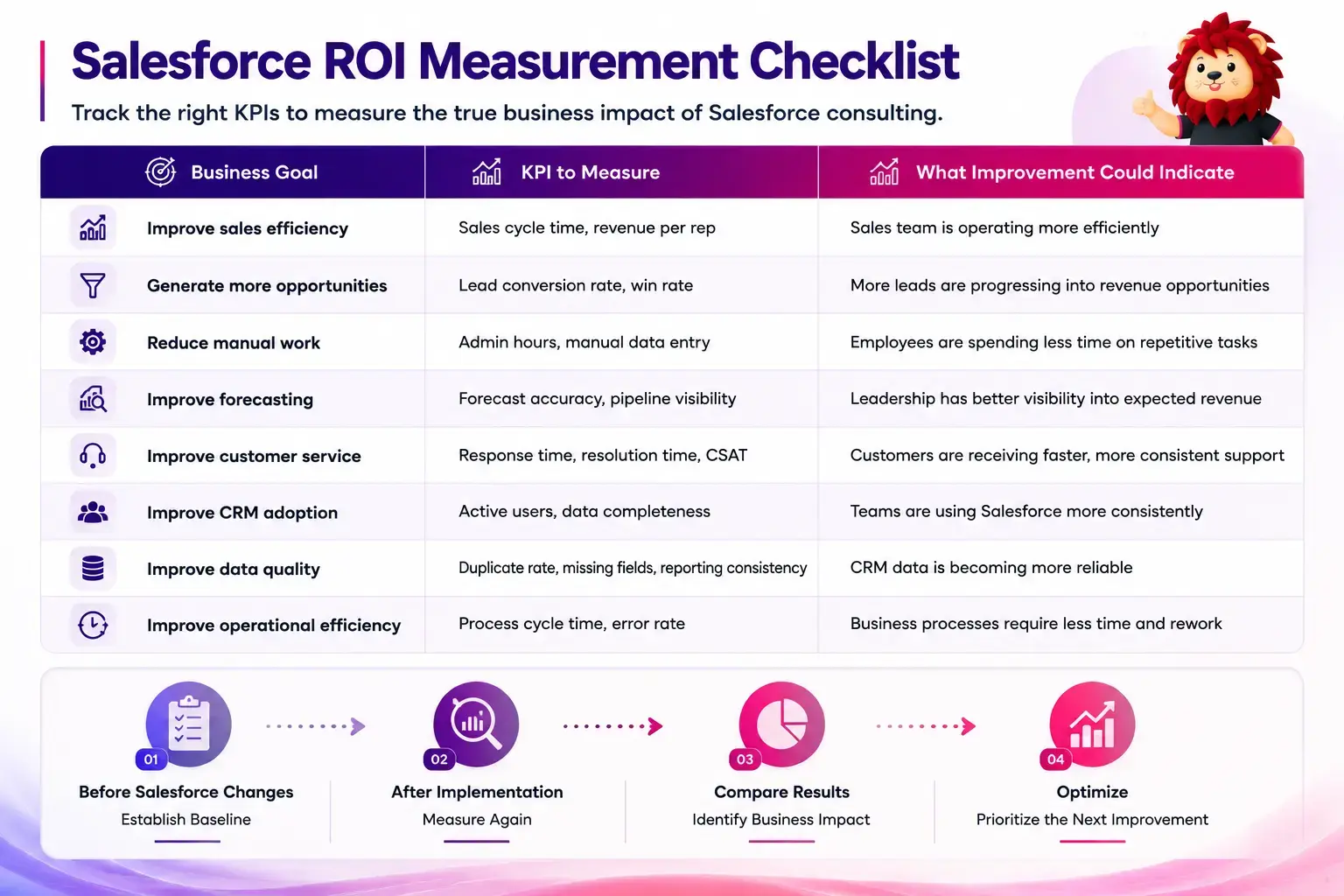
Common ROI Metrics:
Sales Productivity
-
Average deal cycle time
-
Sales rep productivity (revenue per rep)
-
Lead response time
-
Forecast accuracy
-
Win rates
Example calculation: If a business reduces average deal cycle time after a Salesforce improvement, it can compare the change against its pre-implementation baseline and evaluate the effect on pipeline velocity and cash flow.
Operational Efficiency
-
Hours spent on administrative work
-
Process cycle times
-
Error rates
-
Reporting turnaround time
-
Manual data entry reduction
Example calculation: If automation reduces the average time employees spend on repetitive administrative tasks, multiply the time saved by the number of affected employees and periods worked to estimate recovered capacity.
Customer Experience
-
Customer satisfaction scores (CSAT)
-
Net Promoter Score (NPS)
-
Response times
-
First-contact resolution rates
-
Customer retention
Financial Impact
-
Increased revenue (from faster sales cycles, higher win rates)
-
Reduced costs (from automation, efficiency)
-
Improved cash flow (from faster billing, collections)
-
Avoided costs (from prevented errors, better compliance)
ROI timelines and results vary significantly based on the starting condition of the Salesforce environment, project scope, user adoption, data quality, integrations, and the business processes being improved. Rather than relying on generic benchmarks, establish a baseline before the project and measure changes against the KPIs that matter to your organization.
How Salesforce Consulting Supports Scalable Growth
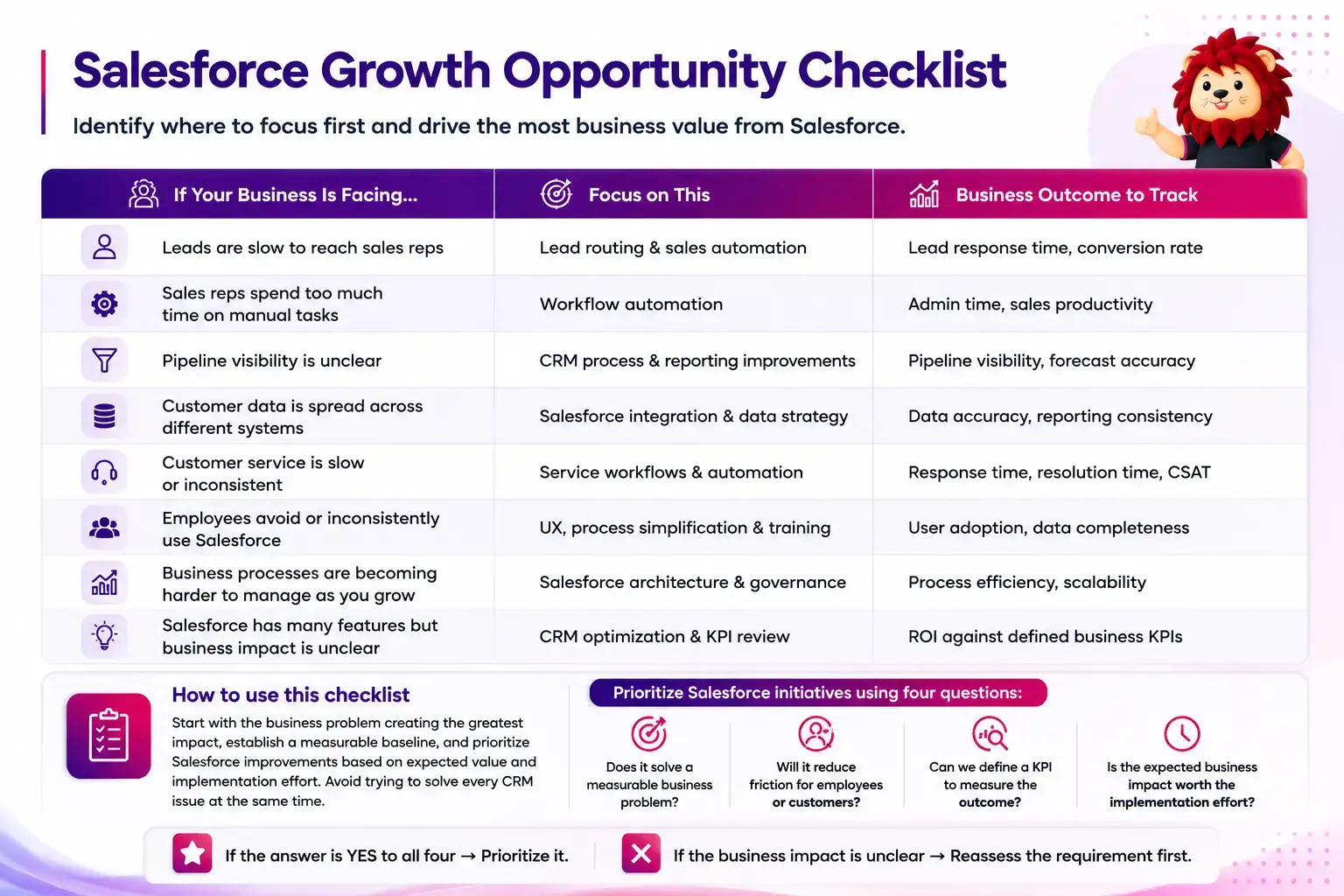
A Salesforce environment that works for a business today may not automatically support the same organization as customer volumes, teams, products, and processes expand. Scalable CRM design focuses on creating a foundation that can adapt without requiring major rework every time the business changes.
Salesforce consultants can help businesses prepare for growth by evaluating both immediate requirements and the likely impact of future expansion.
Standardize Core Processes
Growth becomes harder to manage when different teams follow different processes for leads, opportunities, customer service, approvals, or data entry. Standardizing core workflows in Salesforce can create greater consistency as new employees, teams, and locations are added.
Design for Changing Requirements
Salesforce architecture should support foreseeable changes without unnecessary customization. Flexible data models, appropriate automation, clear security structures, and thoughtful solution design can make future enhancements easier to manage.
Build Integration Foundations
As businesses grow, they often add finance, ERP, ecommerce, marketing, service, analytics, and other systems. Establishing clear integration patterns and data ownership early can reduce fragmentation as the technology stack expands.
Establish Governance
More Salesforce users and teams can mean more requests for fields, automations, reports, integrations, and customizations. Governance helps organizations evaluate these changes consistently and reduce unnecessary complexity.
Maintain Data Quality
Growth increases the volume of customer and operational data entering Salesforce. Clear ownership, validation, deduplication, and data-quality processes become increasingly important for reporting, automation, forecasting, and AI.
Review and Optimize Regularly
Salesforce should evolve alongside the business. Regular reviews can identify outdated processes, unused functionality, adoption issues, technical debt, and new opportunities for automation or optimization.
Scalability does not mean building every possible future requirement in advance. It means creating a Salesforce foundation that can accommodate change without making the platform unnecessarily complex today.
Salesforce Consulting for Small, Mid-Market, and Enterprise Businesses
Consulting needs vary significantly based on company size.
Mid-Market (100-500 employees)
As organizations grow, Salesforce requirements often become more complex. Mid-market businesses may need integrations with finance, marketing, service, or operational systems; more sophisticated automation; stronger reporting; custom workflows; and clearer governance.
Consulting can help these organizations standardize processes and reduce operational friction before growth makes existing inefficiencies more difficult to manage.
Enterprise (500+ employees)
Enterprise Salesforce environments may involve multiple business units, large user populations, complex integrations, security and compliance requirements, multiple Salesforce products, and significant change-management needs.
Consulting at this level often requires stronger architecture, governance, integration planning, data strategy, testing, release management, and coordination across different teams and stakeholders.
Small Business (under 100 employees)
Small businesses often need Salesforce to create structure around growing sales and customer processes without introducing unnecessary complexity. Consulting engagements may focus on core CRM configuration, lead and opportunity management, basic automation, reporting, data migration, and user training.
The priority should be building a practical foundation that solves current business needs while leaving room for future expansion.
Business size alone should not determine the scope of a Salesforce engagement. A smaller organization with complex integrations may require more specialized expertise than a larger business with relatively straightforward CRM requirements. Project scope should be based on business processes, technical complexity, data, users, and desired outcomes.
When External Salesforce Expertise Can Accelerate Growth
Not every Salesforce challenge requires an external consultant. Businesses with experienced internal Salesforce teams may be able to manage routine administration, reporting, configuration changes, and ongoing platform maintenance themselves.
External Salesforce expertise becomes more valuable when the organization faces a project, capability gap, or level of complexity that the internal team cannot efficiently address alone.
External expertise may help when:
Your Salesforce environment is becoming difficult to scale
Growing teams, products, markets, and customer volumes can expose limitations in processes, automation, data models, and system architecture. External specialists can help identify where the current environment needs to evolve.
You are planning a major Salesforce initiative
Implementations, migrations, multi-cloud expansion, complex integrations, data consolidation, or AI initiatives may require expertise that is not needed on a full-time basis internally.
Important business processes still depend on manual work
If employees rely heavily on spreadsheets, repetitive data entry, manual approvals, or disconnected handoffs, consultants can help identify opportunities to simplify and automate those processes.
Salesforce data is not supporting reliable decisions
Inconsistent data, fragmented reporting, duplicate records, or disconnected systems can make it difficult for leadership and operational teams to trust CRM insights.
User adoption has stalled
Low adoption may indicate that Salesforce workflows do not match user needs, the system has become too complex, or employees need better training and change support.
Specialized expertise is required
Architecture, integration, development, data migration, security, Agentforce, and other specialized Salesforce initiatives may require skills beyond those available within the existing team.
The decision should be based on the business problem and expertise required—not simply on whether Salesforce is already in use. In many organizations, the most practical model combines internal Salesforce ownership with external specialists for projects or capabilities that require additional expertise.
Getting More Value from Your Salesforce Investment: Next Steps
If you're ready to explore Salesforce consulting for your organization, here's how to move forward:
Step 1: Identify the Business Problem
Start with the outcome rather than the Salesforce feature. Identify where the business is losing time, visibility, revenue opportunities, or customer experience quality.
Ask:
-
Which processes create the most friction?
-
Where are employees doing repetitive manual work?
-
Which customer or operational data is difficult to access?
-
Where are teams still relying on spreadsheets or workarounds?
Step 2: Establish a Baseline
Document current performance before making major Salesforce changes. Depending on the project, this might include sales cycle time, lead response time, manual processing hours, case resolution time, user adoption, data quality, or other relevant KPIs.
Without a baseline, demonstrating ROI later becomes much harder.
Step 3: Prioritize High-Impact Opportunities
Not every Salesforce improvement needs to happen at once. Prioritize initiatives based on expected business impact, urgency, complexity, dependencies, and the effort required to implement them.
A simple prioritization approach:
-
High impact + lower effort → Start first
-
High impact + higher effort → Plan strategically
-
Low impact + lower effort → Consider later
-
Low impact + higher effort → Reassess whether it's necessary
Step 4: Decide What Expertise You Need
Determine whether the work can be handled internally or requires additional Salesforce expertise. Consider the complexity of the architecture, integrations, data, automation, development, AI requirements, and change management involved.
Step 5: Measure, Learn, and Optimize
After implementation, compare results against the baseline established earlier. Review what improved, where users are still experiencing friction, and which opportunities should be prioritized next.
Salesforce optimization should be an ongoing cycle:
Measure → Identify → Prioritize → Improve → Measure Again
This approach keeps Salesforce investment connected to measurable business outcomes rather than turning CRM improvement into a continuous list of disconnected feature requests.
Conclusion
Salesforce creates greater business value when it is aligned with the processes, data, people, and outcomes that matter most to an organization. Simply adding more features or customizations does not guarantee better results.
The strongest opportunities often come from improving sales workflows, automating repetitive processes, connecting customer and operational data, strengthening customer experiences, and making Salesforce easier for employees to use.
Businesses should define measurable goals before making major Salesforce changes and track relevant KPIs after implementation. This makes it easier to understand what is working, identify where value is being lost, and prioritize the next improvement based on business impact.
As the organization grows, Salesforce should evolve with it. Regular optimization, strong data practices, scalable architecture, and the right mix of internal and external expertise can help turn Salesforce from a CRM system into a platform that supports long-term business growth.
Ready to Get More Value from Salesforce?
If Salesforce isn't delivering the productivity, visibility, automation, or customer experience your business expected, the next step is to understand where the biggest opportunities for improvement exist.
Codleo helps businesses evaluate their Salesforce environment, identify high-impact opportunities, and improve the platform across strategy, implementation, integration, automation, optimization, and ongoing support.
Explore our Salesforce consulting services to see how Codleo can help align Salesforce with your business goals and long-term growth plans.
 0
0
About the Author

FAQ
Salesforce consulting can support business growth by improving sales processes, automating repetitive work, connecting customer and operational data, and giving teams better visibility into performance. The greatest impact comes when Salesforce improvements are tied to specific goals such as increasing sales productivity, reducing manual work, improving customer experiences, or supporting scalable operations.
Salesforce consultants help businesses design CRM processes, automation, integrations, data structures, and governance that can evolve as the organization grows. This can make it easier to support additional customers, employees, products, locations, and business processes without constantly rebuilding the Salesforce environment.
Businesses may use Salesforce consulting when they need specialized expertise to align the platform with their processes and goals. Consultants can help with strategy, implementation, integration, automation, data migration, optimization, user adoption, and other complex initiatives that an internal team may not have the capacity or expertise to manage alone.
Salesforce consulting can improve ROI by focusing Salesforce investments on measurable business problems rather than simply adding functionality. This may include reducing manual work, improving sales efficiency, increasing CRM adoption, connecting fragmented systems, improving data quality, or optimizing customer-facing processes.
Consultants can help simplify lead routing, opportunity management, approvals, forecasting, reporting, account visibility, and other sales workflows. Automation can also reduce repetitive administrative work, allowing sales teams to spend more time on prospects and customers while giving managers better visibility into pipeline performance.
Yes. Salesforce consultants can identify repetitive workflows that may benefit from automation, including lead assignment, approvals, follow-up tasks, notifications, case routing, data updates, and cross-team handoffs. Review the underlying process before automating to avoid automating inefficient workflows.
Salesforce integration can connect CRM data with ERP, marketing, finance, ecommerce, service, and other business systems. This can reduce duplicate data entry, improve customer visibility, support more consistent reporting, and give teams access to the information they need for faster and better-informed decisions.
Start by defining measurable KPIs before major Salesforce changes. Depending on the project, these may include sales cycle time, lead response time, win rate, administrative hours, process completion time, forecast accuracy, customer-service metrics, user adoption, or data quality. After implementation, compare results against the original baseline.
Common barriers include unclear business objectives, low user adoption, poor data quality, excessive customization, disconnected systems, inefficient workflows, and limited post-launch optimization. Before investing in additional functionality, businesses should identify whether these underlying issues are preventing the existing Salesforce environment from delivering value.
A business may consider external Salesforce expertise when its CRM becomes difficult to scale, manual processes increase, data becomes fragmented, user adoption declines, or the organization plans a complex implementation, integration, migration, automation, or AI initiative. External specialists can complement an internal Salesforce team when additional expertise or capacity is required.



 603 D-Mall Netaji Subhash Place, Delhi 110034 IND


