


Publish date:
You know your Salesforce partner isn’t working out.
Tickets that should take days are stretching into weeks. Every new requirement seems to need more hours. You are following up for updates more often than you are getting answers. And somewhere along the way, your internal team has started asking a difficult question:
“Should we find another Salesforce partner?”
Then comes the second question:
“But who is going to understand everything the current team has already built?”
That is usually what stops businesses from making the change.
Switching a Salesforce partner can sound like handing a half-built house to a new contractor. There is existing code, automation, integrations, data, documentation, unfinished work—and probably a few decisions nobody remembers making.
But changing partners does not mean replacing everything.
A good transition starts by figuring out three things:
What should stay. What needs fixing. What should never have been built that way in the first place.
For a business looking for a new Salesforce consulting partner in India, that distinction matters far more than finding another company that can simply provide Salesforce developers.
The incoming team needs to understand the existing org before trying to improve it.
And whether your business operates from Mumbai, Bengaluru, Hyderabad, or another Indian city, the first conversation with a potential replacement partner should not be:
“How much do you charge per hour?”
It should be:
“Here is where we are stuck. How would you take this over?”
That is exactly what this guide will help you evaluate.
Before You Switch: One Important Question
Do you actually need a new Salesforce partner?
Not every difficult project needs a new vendor.
A missed deadline can be fixed. A misunderstanding can be resolved. Even a bad release can happen in an otherwise healthy engagement.
The bigger concern is a pattern.
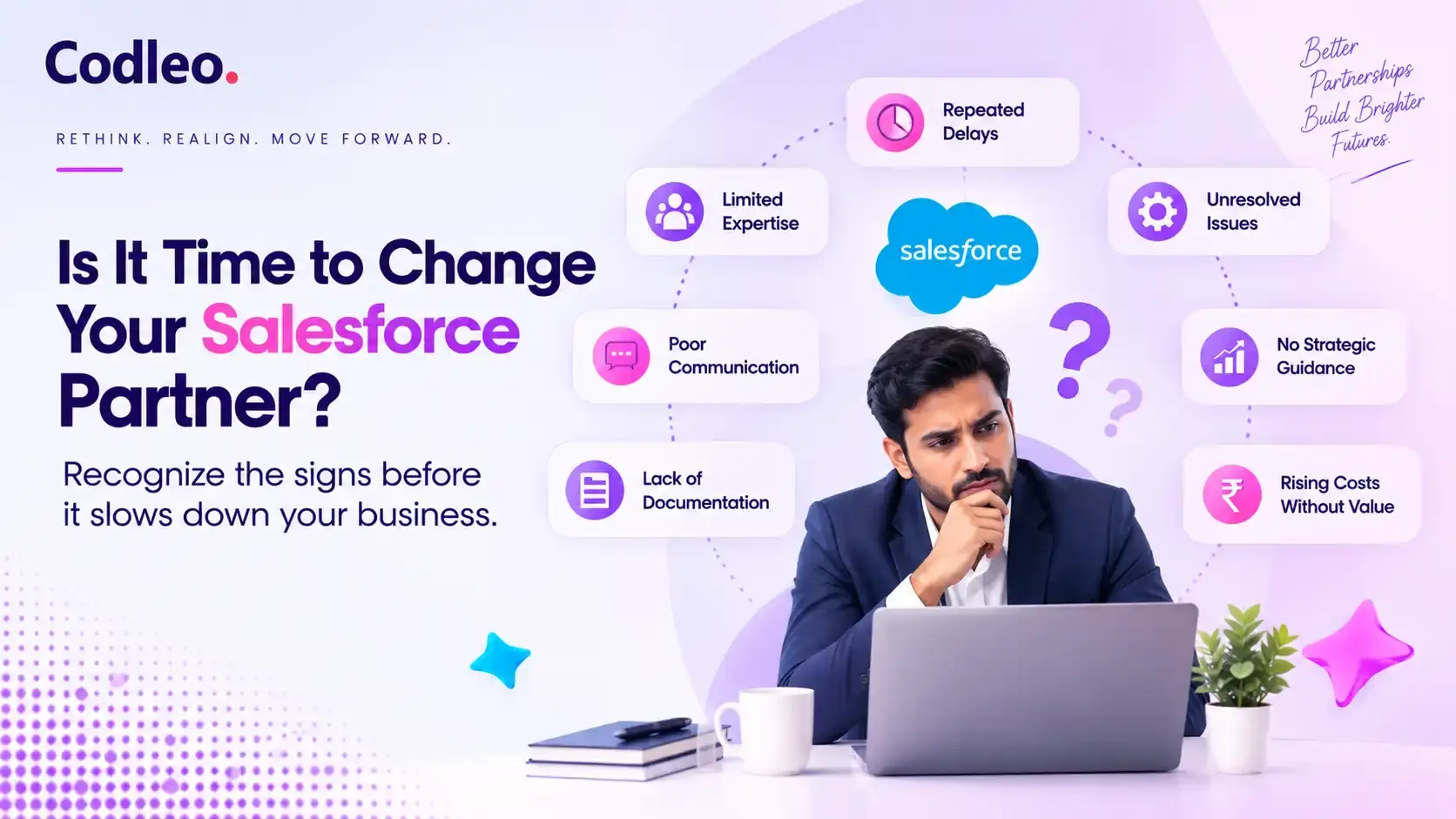
When delays, rework, unclear ownership, unresolved issues, poor documentation, or weak technical guidance become normal rather than exceptional, you are no longer dealing with one bad sprint.
You may be dealing with the wrong partnership.
And that is where changing your Salesforce partner becomes a business decision—not just a vendor decision.
When “We’ll Fix It Next Sprint” Stops Being Good Enough
One delayed release is not a reason to change your Salesforce partner.
Neither is one difficult integration or a requirement that takes longer than expected. Salesforce projects can get complicated, and sometimes the original estimate genuinely changes.
The problem begins when temporary issues become the norm.
You raise a production issue on Monday. By Thursday, you are still asking for an update.
A new feature is delivered, but fixing it creates another problem somewhere else.
Your sales team has stopped reporting smaller Salesforce issues because they assume nothing will happen quickly.
And every project meeting ends with another version of:
“We’ll take this up in the next sprint.”
At that point, the question is no longer whether your partner can close individual tickets. The question is whether the partnership is helping your Salesforce environment move forward.
Your Backlog Keeps Growing, but Nothing Really Gets Better
Look at your Salesforce backlog from six months ago.
How many of those issues are still there?
A healthy backlog will always have new requirements. Your business changes, users ask for improvements, and Salesforce itself evolves.
But an active backlog differs from a stuck backlog.
If old problems remain unresolved while new ones keep getting added, your team may be spending most of its time reacting instead of improving the platform.
This becomes particularly expensive when business-critical requests—lead routing, opportunity management, approvals, integrations, dashboards, case management—remain buried among dozens of smaller tickets.
A new partner should be able to look at that backlog and tell you:
What needs attention now? What can wait? What should be dropped entirely?
Sometimes reducing the backlog is more valuable than adding another developer.
Every Small Change Has Started Feeling Expensive
“Can we add one field to this process?”
Sounds simple.
Then the estimate arrives.
Discovery. Development. Testing. Deployment. Additional fixes.
A request that appeared straightforward suddenly becomes surprisingly expensive.
Sometimes there is a legitimate reason. Your Salesforce org may have dependencies that are invisible to business users.
But if every small change has become complicated, a deeper problem may be at play.
Years of overlapping automation, unnecessary customization, poorly documented code, and short-term fixes can turn a Salesforce org into an environment where nobody wants to touch anything.
That is technical debt—and adding more development on top of it rarely solves the underlying problem.
An experienced Salesforce implementation partner in India taking over such an environment should first understand why simple changes have become difficult before recommending more customization.
You Know What Salesforce Costs You. You Don’t know what it's giving you.
This is a more uncomfortable question:
What has improved because of the Salesforce work you paid for during the last 12 months?
Not how many tickets were completed.
Not how many development hours were consumed.
What actually improved?
Maybe sales representatives spend less time entering data.
Maybe lead response is faster.
Maybe managers finally trust their pipeline reports.
Maybe service teams resolve cases with fewer manual steps.
Maybe an integration removed hours of repetitive work.
Those are outcomes.
If you can see invoices, hours, and completed tickets—but struggle to identify meaningful business improvements—the engagement may have become too focused on activity rather than value.
Your next Salesforce consulting partner in India should be comfortable discussing both.
You Have Become Too Dependent on One Person
One developer understands everything.
Everyone knows it.
Your team waits for that person before making an important change. The partner waits for that person to investigate difficult bugs. And when that person is unavailable, progress slows down.
That is not expertise.
That is dependency.
Your Salesforce knowledge should exist in documentation, architecture decisions, release records, and shared processes—not only in someone's memory.
This becomes especially important when switching partners.
Whether you are evaluating a Salesforce partner in Mumbai, Bengaluru, or Hyderabad, ask a simple question during the selection process:
“If the person assigned to us leaves tomorrow, what happens to our account?”
The answer tells you a lot about how mature the delivery model actually is.
And Then There’s the Biggest Red Flag: You’ve Lost Confidence
This doesn't appear on a project dashboard.
But you notice it.
Your team double-checks estimates because they no longer trust them.
Business users hesitate before requesting changes.
Management wants another opinion before approving Salesforce work.
You start asking other companies how their Salesforce projects are managed.
Eventually, you start searching for another partner.
At that stage, the relationship may still be repairable—but it deserves a serious review.
Because a Salesforce partner does not need to be perfect.
You do need to trust them with a platform your business depends on.
Will Changing Salesforce Partners Break What You Already Have?
This is usually the real reason companies delay switching.
Not the contract. Not the search for another vendor.
It is the fear of what happens after the new team gets access.
-
Will they understand the customizations?
-
What happens to our integrations?
-
Will we have to rebuild everything?
-
Could something stop working in production?
These are reasonable concerns, particularly if Salesforce has been customised over several years.
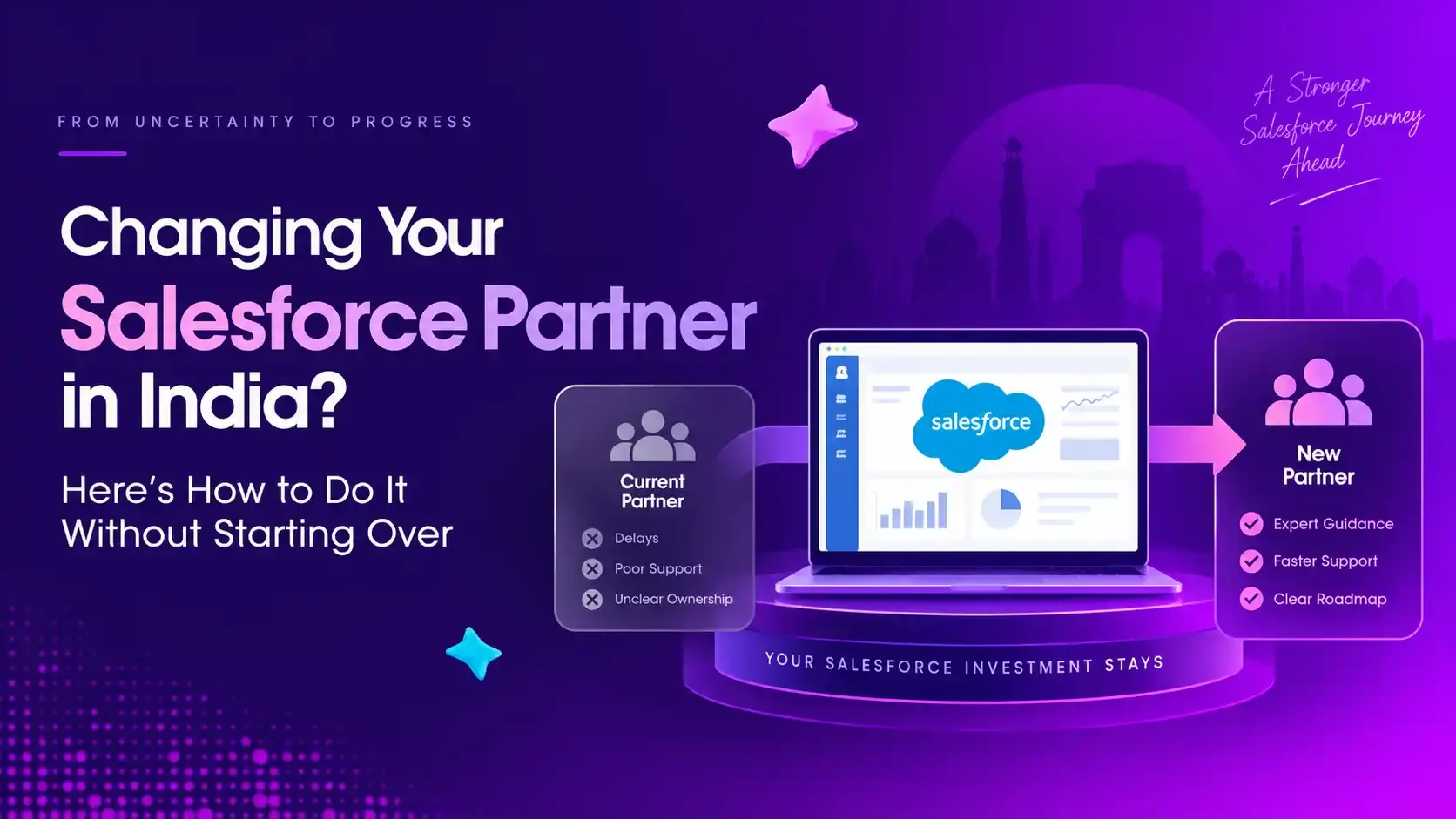
But changing your Salesforce partner should not automatically mean changing your Salesforce org.
A responsible incoming partner should resist the temptation to start “improving” things on day one.
First, they need to understand what they have inherited.
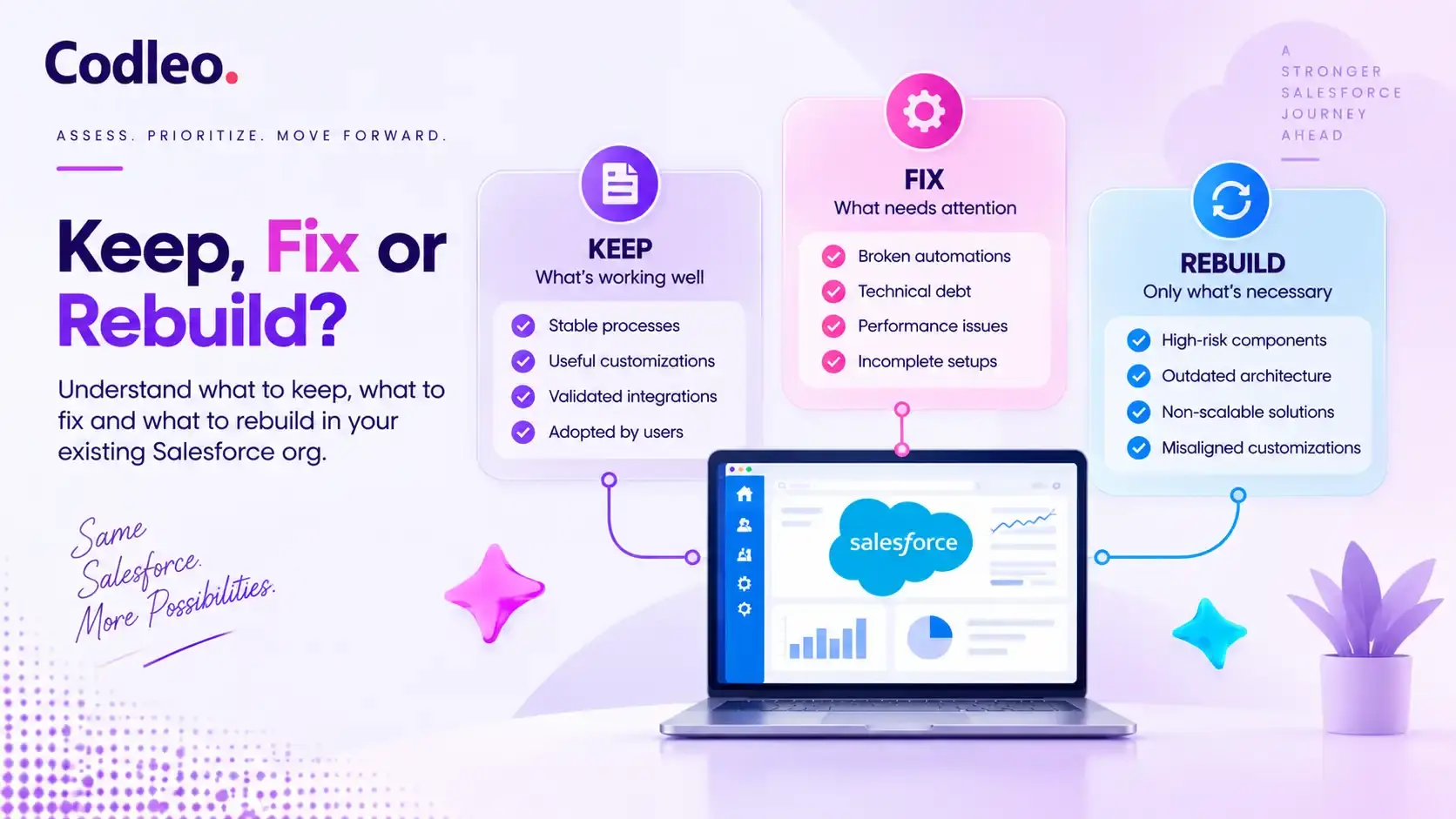
Think of Your Salesforce Org in Three Buckets: Keep, Fix, Rebuild
Instead of approaching the transition as a fresh implementation, ask the new team to classify the existing environment into three buckets.
| Decision | What It Means | Example |
|---|---|---|
| Keep | It works, users rely on it, and there is no strong reason to change it. | A stable opportunity approval process |
| Fix | The underlying solution is useful, but its design, performance, or usability needs improvement. | Lead routing that works but requires too much manual intervention |
| Rebuild | The existing approach creates enough business or technical risk that repairing it no longer makes sense. | An unstable custom solution repeatedly causing production failures |
This sounds simple, but it changes the conversation.
Instead of asking:
“What can the new partner build for us?”
You start asking:
“What actually needs to change?”
That can prevent a partner transition from turning into an unnecessary second implementation.
A New Partner Should Earn the Right to Change Your Org
Before major development begins, the incoming team should be able to explain your current Salesforce environment back to you.
They should understand where your customer data comes from, which automations affect key processes, what systems integrate with Salesforce, which customizations are business-critical, and where the biggest risks currently sit.
If they cannot explain the existing environment, they are not ready to redesign it.
For companies evaluating a Salesforce consulting partner in India, this is a useful test during the selection process.
Ask the potential partner:
“If we give you access to our existing Salesforce org, what will you do before writing your first line of code?”
Listen carefully to the answer.
You want to hear about discovery, documentation, architecture, data, integrations, security, business processes, and existing technical debt.
Not:
“We can start development immediately.”
Speed is useful only when the team is moving in the right direction.
What About an Implementation That Is Already Halfway Done?
You can change partners during an active Salesforce implementation too.
But the handover needs a little more discipline.
Suppose the previous Salesforce implementation partner in India completed 60% of the project.
That does not automatically mean the new partner has only 40% left to build.
Some completed work may be ready for production. Some may need testing. Some requirements may have changed. And some features marked as “done” may still have unresolved dependencies.
So the incoming team should establish a new baseline:
What was promised → What was built → What actually works → What is incomplete → What still matters to the business
Only then should you create a revised delivery plan.
This gives management something much more useful than another percentage-complete number:
a realistic picture of where the project actually stands.
The Goal Is Not a Clean Slate. It Is a Clean Handover.
If you are looking for a new Salesforce partner in Bengaluru or Hyderabad, be cautious of anyone who recommends a major rebuild before properly examining your existing setup.
Sometimes a rebuild will be the right answer.
But it should be the result of the assessment—not the starting assumption.
A well-managed partner transition should protect the investment you have already made while giving you a clear path to fix the parts holding Salesforce back.
Keep what works. Fix what can be improved. Rebuild only when there is a strong reason.
That is a much safer way to change Salesforce partners.
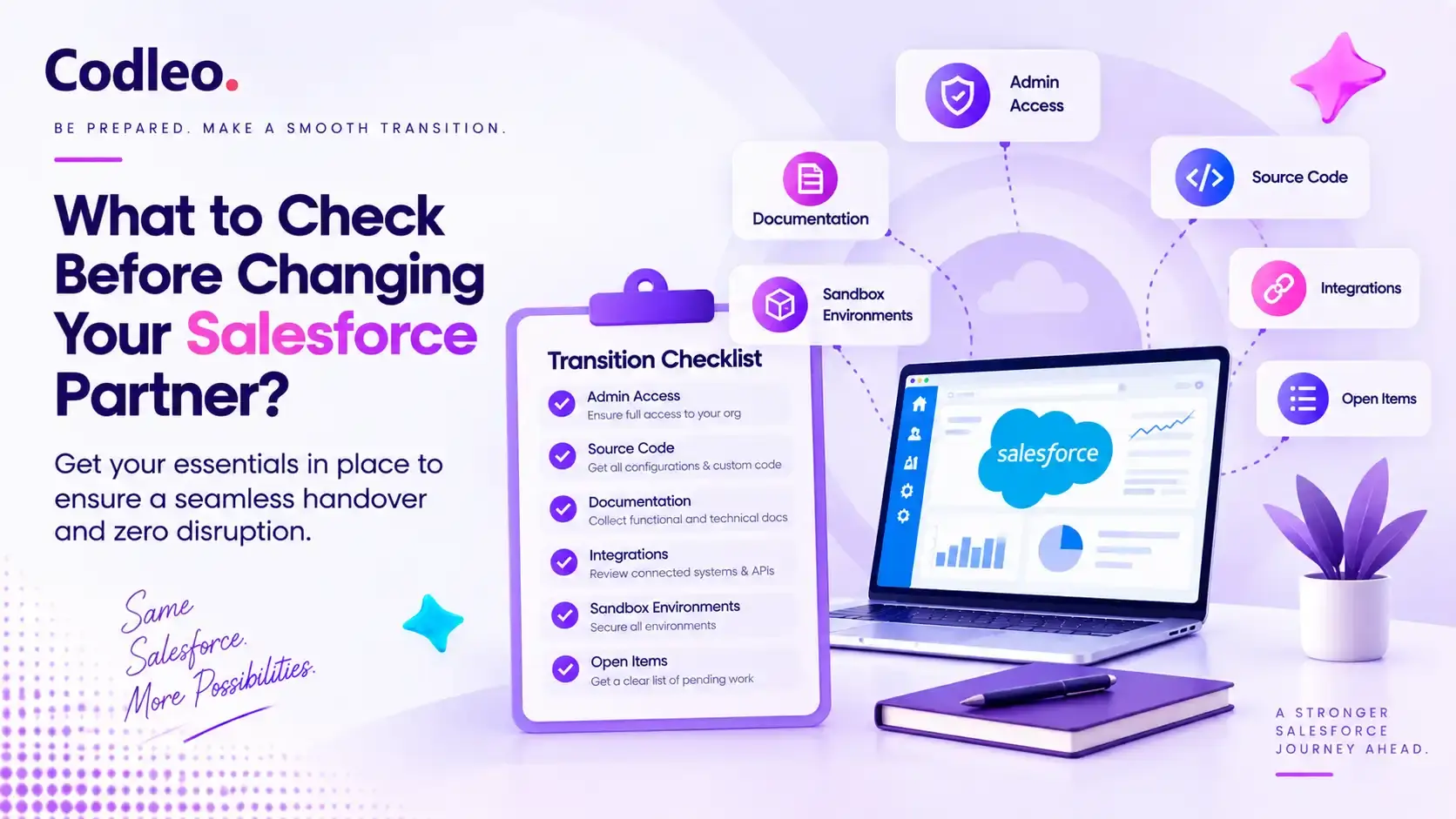
Before You Tell Your Current Salesforce Partner You’re Leaving, Secure These Things
There is a moment in almost every partner transition when someone asks:
“Wait… who has access to that?”
It might be the source-code repository.
An integration account.
A sandbox.
A deployment tool.
Or a document containing information that only the current development team understands.
You do not want to discover these gaps after the handover has started.
Before switching to a new Salesforce consulting partner in India, make sure your company has appropriate ownership and access to the systems, information, and documentation needed to operate its Salesforce environment.
Start With Access, Not Development
Your incoming partner will eventually need access to understand the environment, but first your internal team should know what exists.
Create a simple ownership list covering:
| Check | What You Need to Confirm |
|---|---|
| Salesforce Production | Your organisation retains appropriate administrative access |
| Sandboxes | Active development and testing environments are identified |
| Source Code | Current code and metadata are available through the appropriate repository |
| Integrations | Connected systems and responsible owners are known |
| Deployment Process | You know how changes currently move into production |
| Documentation | Architecture, requirements, and technical documents are accessible |
| Open Work | Bugs, enhancements, and incomplete user stories are recorded |
| Third-Party Apps | Installed applications and important dependencies are identified |
You may find gaps.
That is normal.
The point of this exercise is to find them before they become transition problems.
Ask for the Story Behind the Salesforce Org
Documentation is useful.
Context is even better.
Imagine the new team discovers three different automations affecting the same opportunity stage.
Technically, they can inspect all three.
What they may not know is why they exist.
Perhaps one was created for the sales team.
Another may have been added six months later for finance.
The third may have been introduced as a temporary workaround that somehow became permanent.
That history matters.
Where possible, capture knowledge from the existing team around:
-
Major architectural decisions
-
Important customisations
-
Business-critical automations
-
Known technical limitations
-
Integration dependencies
-
Recurring production issues
-
Workarounds currently used by employees
-
Features that were started but never completed
A good handover does more than transfer files.
It transfers context.
Don’t Forget the Backlog
Your Jira board, spreadsheet, ticketing system or email trail may contain months—or years—of Salesforce requests.
Do not simply hand the entire list to your new partner and say:
“Please continue from here.”
Some tickets may no longer matter.
Some may describe symptoms rather than the actual problem.
Others may have been waiting so long that the underlying business requirement has changed.
Use the partner change as an opportunity to reset the backlog.
A practical approach is:
Do now → Review → Later → Close
Your incoming Salesforce implementation partner in India should help challenge the backlog rather than automatically billing hours against every old ticket.
Create a “Do Not Touch Yet” List
This is one of the simplest ways to reduce transition risk.
Identify the Salesforce processes that are too important to change until the new team fully understands them.
For example:
-
Lead assignment
-
Opportunity approvals
-
Quote generation
-
Customer onboarding
-
Case routing
-
Billing integrations
-
ERP synchronisation
-
Management reporting
If one of these processes is stable, there's no reason to modify it during the first few weeks.
Mark it clearly:
Business-critical. Understand first. Change only with approval.
This gives the incoming team room to learn without experimenting on processes your employees depend on every day.
What If Your Existing Documentation Is Poor?
Don’t let that stop the transition.
Many companies looking for a replacement Salesforce partner discover that documentation is incomplete, outdated, or scattered across different systems.
Tell prospective partners that upfront.
Then ask:
“If we cannot give you perfect documentation, how will you understand our Salesforce org?”
A capable Salesforce partner in Hyderabad, Mumbai & Bengaluru should have a discovery process for exactly this situation.
They may need to combine technical analysis with stakeholder interviews, existing tickets, configuration reviews, and user walkthroughs to reconstruct how the environment actually works.
Poor documentation makes the takeover harder.
It does not make it impossible.
Your Pre-Switch Test
Before the handover begins, your internal team should be able to answer five questions:
-
Who controls our Salesforce environment?
-
Where is our current technical work stored?
-
Which systems depend on Salesforce?
-
Which processes cannot afford disruption?
-
What unfinished work are we actually carrying forward?
If you cannot answer all five yet, that is where the transition should start.
Because the safest Salesforce partner change does not begin when the new company starts coding.
It begins when your business takes clear ownership of what it already has.
Your First Meeting With a New Salesforce Partner Shouldn’t Feel Like a Sales Pitch
You explain that your current Salesforce setup has problems.
And five minutes later, the conversation turns into:
“We have X certified consultants.”
“We have delivered hundreds of projects.”
“Here is our company presentation.”
Those things can help establish credibility, but they do not answer the question you actually came with:
Can this team take over our existing Salesforce environment and improve it?
When you are replacing a partner, you are not buying a fresh implementation.
You are asking someone to inherit previous decisions, unfinished work, technical debt, integrations, user frustrations, and possibly a project that is already under pressure.
Your first meeting should reflect that.
Pay Attention to What They Ask You
A good discovery conversation should involve more listening than pitching.
The potential partner should want to know:
-
Why are you considering a change now?
-
What is frustrating your users?
-
Which Salesforce products are currently in use?
-
What work is incomplete?
-
Which issues affect the business most?
-
What other systems are connected to Salesforce?
-
How much custom development exists?
-
What does your internal Salesforce team look like?
-
What would a successful transition look like six months from now?
These questions tell you something important.
The company is trying to understand the problem before proposing the solution.
Ask One Question That Is Difficult to Fake
When evaluating a Salesforce consulting partner in India, give them a real problem from your current environment.
Not a hypothetical one.
For example:
“Our opportunity process has been customised by two previous teams, reporting is unreliable, and sales users complain that there are too many manual steps. Where would you start?”
Then listen.
A thoughtful answer may begin with understanding the process, reviewing the data model and automation, speaking with users, identifying dependencies, and establishing the root cause.
A weak answer often jumps straight to a solution.
“We can automate that.”
Maybe they can.
But they do not know enough yet to know whether they should.
Ask Who Will Actually Work With You
This matters more during a takeover than many companies realize.
The strongest architect in the sales meeting is not useful if you never see that person again after signing the contract.
Ask to understand the proposed delivery team.
-
Who will own the engagement?
-
Who will understand your business requirements?
-
Who will review the architecture?
-
Who handles development?
-
Who makes decisions when there is a production issue?
And who do you call when something is not going well?
If you are comparing Salesforce consulting partners in Mumbai, Bengaluru, or Hyderabad, don't decide purely on office location.
Instead, understand whether the people assigned to your account can work effectively with your stakeholders during Indian business hours and whether senior expertise will remain accessible after onboarding.
Use the “Show Me” Test
There is a useful difference between:
“Yes, we can handle that.”
and:
“Here is how we have handled something similar.”
If a provider says they can take over a complex Salesforce org, ask them to walk you through a comparable situation.
You do not need confidential client information.
You need to understand their thinking.
-
What did they inherit?
-
What was wrong?
-
What did they check first?
-
What did they leave untouched?
-
What did they change?
-
What happened after the transition?
Relevant experience becomes much easier to judge when the conversation moves from claims to examples.
A Few Answers Should Make You Cautious
| If You Hear This | Ask a Follow-Up |
|---|---|
| “We can start immediately.” | “What would you review before development starts?” |
| “We’ll rebuild that.” | “What evidence would make a rebuild necessary?” |
| “We can provide more developers.” | “Who will own architecture and business requirements?” |
| “Migration will be easy.” | “What dependencies would you assess first?” |
| “We’ve done this many times.” | “Can you walk us through a comparable takeover?” |
| “We can give you a fixed estimate now.” | “What assumptions are you making about our existing org?” |
None of these statements is automatically wrong.
The follow-up tells you whether it has substance.
Don’t End the Meeting With “Send Us Your Rate Card”
Price matters.
But by the end of the first conversation, you should understand something more important:
How does this company think?
The best replacement partner for your business is not necessarily the company with the lowest hourly rate, the largest team, or the closest office.
It is the team that can look at an environment they did not build, understand why it works the way it does, challenge what needs challenging, and take responsibility for moving it forward.
That is a much higher bar than simply knowing Salesforce.
And when you are changing partners, it should be.
Mumbai, Bengaluru or Hyderabad: Does Your Salesforce Partner Actually Need to Be Local?
Suppose your head office is in Mumbai.
Would you automatically choose a Salesforce company in Mumbai?
Probably not.
You would choose the team that understands your Salesforce environment, works with your people, responds when something goes wrong, and delivers what was promised.
Location can help. But location alone does not make a good Salesforce partnership.
This distinction matters when businesses search for a Salesforce consulting partner in Mumbai, Bengaluru, or Hyderabad. What they often need is not simply a company with a nearby address—they need a team that can work effectively with local stakeholders.
If Your Team Is in Mumbai…
You may have sales leadership in Mumbai, an IT team elsewhere, and users spread across India.
In that situation, ask a potential Salesforce consulting partner in Mumbai how they would run discovery workshops, involve business stakeholders, and manage communication across locations.
For an existing Salesforce org, also ask whether they can conduct an initial assessment before proposing major changes.
A nearby office is convenient.
A team that understands your business matters more.
If Your Team Is in Bengaluru…
The conversation may be different.
Many Bengaluru-based organizations have internal engineering, product, data, or DevOps teams that need to work directly with external Salesforce specialists.
If that describes your company, your Salesforce consulting partner in Bengaluru should fit into your existing technology environment, not operate as an isolated Salesforce team.
Ask how they handle:
-
Source control and deployments
-
API and integration dependencies
-
Architecture reviews
-
Collaboration with internal developers
-
Release management
-
Technical documentation
You may not need another outsourced development team.
You may need Salesforce specialists who can work with the technology team you already have.
If Your Team Is in Hyderabad…
Salesforce may connect to several business systems, and your biggest concern may be continuity.
In that case, when evaluating a Salesforce consulting partner in Hyderabad, spend less time asking how quickly they can develop new features and more time understanding how they take ownership of an existing environment.
-
Can they troubleshoot integrations they did not build?
-
Can they understand custom code written by another vendor?
-
Can they manage an existing enhancement backlog?
-
Can they support production while gradually improving the architecture?
These questions matter most when Salesforce is already embedded in daily operations.
So, Should You Choose a Local Salesforce Partner?
Choose based on the way your organization actually works.
-
If frequent in-person workshops are important, local availability should carry more weight.
-
If your stakeholders are distributed across India, a strong remote or hybrid delivery model may matter more.
-
If you have a large internal technology team, technical collaboration may be the deciding factor.
And if you are recovering a troubled implementation, takeover experience may matter more than all three.
The better question is not:
“Is this Salesforce partner based in our city?”
It is:
“Can this team work the way our business needs them to work?”
When comparing a Salesforce implementation partner in India, look at location alongside relevant Salesforce expertise, industry experience, communication, governance, availability, and the people who will actually be assigned to your account.
Your next partner shouldn't just be closer.
They should be a better fit.
How Much Does It Cost to Change a Salesforce Partner in India?
There is usually no line item called “Salesforce partner switching fee.”
The cost comes from the work required to understand and take ownership of what already exists.
A relatively clean Salesforce org with good documentation may require a short discovery and handover.
A heavily customized environment with undocumented code, multiple integrations, unresolved production issues, and years of technical debt may need a much deeper assessment.
So if a potential partner gives you a precise takeover cost before seeing your Salesforce environment, ask what that number is based on.
What Are You Actually Paying for During a Partner Change?
The transition effort usually depends on a few things:
| Cost Driver | Why It Matters |
|---|---|
| Org complexity | More customization and automation means more to understand |
| Integrations | ERP, websites, marketing platforms, and other systems add dependencies |
| Technical debt | Poorly maintained code or automation may require additional investigation |
| Documentation | Good documentation can reduce discovery effort |
| Incomplete project work | The new team needs to validate what is genuinely finished |
| Data issues | Duplicates, poor data quality or migration problems can expand the scope |
| Urgent production problems | Stabilization may need to happen before normal development resumes |
This is why two companies using the same Salesforce product can have completely different transition requirements.
Don’t Compare Partners on Hourly Rate Alone
Imagine you receive two proposals.
-
Partner A: Lower hourly rate, but expects your team to define every ticket and closely manage delivery.
-
Partner B: Higher rate, but provides functional consulting, architecture oversight, documentation, delivery management, and proactive recommendations.
Which one costs less?
You cannot answer that from the hourly rate.
You need to understand how much work your own team will need to absorb, how much rework is likely, and whether the proposed delivery model solves the problems that made you consider switching in the first place.
When comparing Salesforce implementation partners in India, ask for the commercial model and what it includes.
The More Useful Calculation Is the Cost of Staying
Suppose you postpone changing partners for another six months.
What happens?
Perhaps nothing serious.
Or perhaps:
A critical integration continues requiring manual intervention.
Salespeople continue working around Salesforce instead of using it properly.
Your internal IT team keeps spending time chasing external developers.
New features keep getting added on top of existing technical debt.
A delayed project pushes another business initiative back by a quarter.
Those costs rarely appear on a Salesforce invoice.
But your business still pays them.
That is why the decision should not be:
“Is switching partners expensive?”
It should be:
“What will it cost us to fix this now—and what will it cost us if we don’t?”
Should You Ask the New Partner for a Fixed Price?
For clearly defined work, a fixed-price model can make sense.
A partner takeover is different.
There are often unknowns hidden inside an existing Salesforce org.
A more practical approach can be to separate the engagement into two decisions:
First: Understand the environment.
Then: Price the work that needs to be done.
For example:
Assessment → Findings → Priorities → Scope → Commercial Proposal
This gives both sides more information before committing to a larger engagement.
It also gives you an opportunity to see how the new team works before handing them a major Salesforce roadmap.
You Don’t Have to Move Everything on Day One
Changing your Salesforce partner does not necessarily require signing a large annual engagement immediately.
You can start smaller.
Give the prospective Salesforce consulting partner in India a defined problem or assessment.
See how they communicate.
See how deeply they investigate.
See whether their recommendations make sense.
See whether they document what they find.
And most importantly, see whether your internal team trusts working with them.
Because after a difficult partner relationship, you don't need another impressive proposal.
You need evidence that the next relationship will work differently.
How Long Does It Take to Switch Salesforce Partners?
You can sign with a new partner quickly.
Trusting them with your production Salesforce org should take a little more thought.
No universal transition timeline exists because taking over a relatively standard Salesforce setup is very different from inheriting an org with years of custom development, multiple integrations, and unfinished projects.
Instead of asking a potential Salesforce consulting partner in India, “How quickly can you take over?”, ask:
“What will you need to understand before you take responsibility for our Salesforce environment?”
The answer is far more useful.
What Should the First 30 Days Look Like?
A structured transition might look something like this:
| Stage | What Should Happen |
|---|---|
| Days 1–5: Listen | Meet stakeholders, understand why the existing relationship is changing, collect access, and identify urgent issues |
| Days 6–10: Investigate | Review configuration, automation, custom code, integrations, data, security, and existing documentation |
| Days 11–20: Prioritize | Separate critical problems from technical debt, old backlog items, and future enhancements |
| Days 21–30: Plan | Agree on what to keep, what to fix, what may need redesign, and what should happen first |
The exact timing will vary.
What matters is the sequence.
Understand before changing. Stabilize before expanding.
What Happens After the First Month?
By this point, the relationship should start moving from takeover to improvement.
The new team should have a clearer picture of the Salesforce environment and be able to answer questions such as:
-
What are the biggest risks?
-
Which existing problems are affecting users or business operations?
-
Which technical debt actually needs attention?
-
What should we deliberately leave alone?
-
Which unfinished projects are still worth completing?
-
What should the next release contain?
This is where you should start seeing the difference between a team that merely inherited your ticket queue and a team that has taken ownership of the platform.
And by 60–90 Days?
The objective should not be to claim that every historical Salesforce problem has disappeared.
That's rarely realistic in a complex environment.
A better sign of progress is reduced chaos.
Your team knows what is being worked on and why.
Priorities are clearer.
Critical issues have owners.
The backlog is more meaningful.
Technical decisions are being documented.
Stakeholders know where to escalate problems.
And there is an agreed roadmap for what happens next.
That is what a successful Salesforce partner transition should start to create:
predictability.
Complex Salesforce Orgs Will Naturally Take Longer
If you operate a heavily customized Salesforce environment, use several clouds, have complex integrations, or are midway through a large implementation, discovery may need to go deeper.
That is not necessarily a negative sign.
In fact, be cautious if a prospective Salesforce implementation partner in India looks at a complex environment and promises an immediate takeover without asking many questions.
A partner that says:
“Give us a little time to understand this properly.”
may sometimes be giving you the more responsible answer.
Don’t Measure the Transition by How Quickly the Old Partner Disappears
Measure it by how confidently the new partner takes ownership.
Whether your stakeholders are in Mumbai, Bengaluru, Hyderabad, or across multiple Indian locations, the transition is complete when your new team understands the environment well enough to support it responsibly—not simply when the old contract ends.
The goal is not the fastest handover.
It is the last handover you should need for a long time.
Don’t Hire the Same Salesforce Partner Twice
Different company. Different proposal. Different people.
Same problems six months later.
This happens when businesses change vendors without changing how they evaluate them.
If poor communication is one reason you are leaving your current partner, your next selection process should test communication.
If technical debt is the problem, test architecture capability.
If support has been slow, understand the escalation model before signing.
In other words:
Use the problems with your current partner to build the scorecard for your next one.
Turn Every Current Problem Into a Selection Question
| What Isn’t Working Today? | What Your Next Partner Should Demonstrate |
|---|---|
| Requirements are regularly misunderstood | A strong functional discovery process and access to experienced consultants |
| Projects keep slipping | Clear milestones, dependencies, ownership, and project governance |
| Small changes create new bugs | Architecture review, testing and release-management discipline |
| Nobody understands old customizations | Existing-org assessment and documentation capability |
| Support tickets move too slowly | Defined severity levels, ownership and escalation process |
| You depend on one developer | Team-based knowledge sharing and documentation |
| Integrations keep failing | Relevant integration and troubleshooting experience |
| Costs keep increasing | Transparent estimates, assumptions and scope management |
| Your team gets little strategic guidance | Consultants who can connect Salesforce decisions with business priorities |
| Senior experts disappeared after the sales process | Named delivery roles and clarity on senior involvement |
This table can become one of your most useful tools during vendor discussions.
You are no longer asking every Salesforce consulting partner in India the same generic questions.
You are testing whether they can solve the specific reasons you are changing partners.
Ask for Proof, Not Adjectives
Almost every proposal will contain words such as:
Experienced.
Agile.
Customer-centric.
Scalable.
Expert.
They sound good.
They are also difficult to evaluate.
Turn each claim into something you can inspect.
If a company says it has strong Salesforce expertise, ask which consultants would work on your account and what relevant projects they have delivered.
If it says it provides proactive support, ask for an example of how it identifies problems before a client raises a ticket.
If it says it has experience taking over existing implementations, ask what its takeover process looks like.
If it says documentation is part of delivery, ask what gets documented and when.
The more commercial the claim, the more specific your follow-up should be.
Certifications Matter. They Just Don’t Tell the Whole Story.
Salesforce credentials can help you understand whether a prospective team has relevant platform knowledge.
But certifications alone cannot tell you whether that team will:
understand your business,
communicate clearly,
challenge a poor requirement,
document its decisions,
respond well under pressure,
or take ownership when something goes wrong.
That is why companies evaluating a Salesforce implementation partner in India should look at credentials alongside relevant project experience, delivery methodology, customer evidence, team structure, and governance.
You are hiring a working relationship, not a certification count.
Give the Shortlisted Partner a Real Scenario
Before making the final decision, take one genuine challenge from your Salesforce environment.
For example:
“Our lead assignment has been modified several times. Some leads are going to the wrong owners, but we are worried that changing the automation could affect other processes. How would you approach this?”
Do not expect an immediate technical solution—they have not inspected your org yet.
Instead, evaluate their thought process.
Do they ask about assignment rules?
Existing Flows?
Custom Apex?
Territories?
Integrations?
Business exceptions?
Recent changes?
How was the issue diagnosed previously?
A consultant who asks intelligent questions can tell you more than one who offers an instant answer.
Your Final Shortlist Should Answer One Question
Whether you are comparing a Salesforce partner in Mumbai, Bengaluru, or Hyderabad, you will probably find several companies capable of configuring Salesforce.
That should not be the deciding factor.
Ask yourself:
“Which team has given us the most confidence that they can inherit what we already have?”
Not who made the best presentation.
Not who sent the lowest quote.
Not who promised the fastest start date.
The team that understands why you are leaving your current partner—and can show how its way of working addresses those problems—deserves a much closer look.
Because changing your Salesforce partner once can be a business decision.
Changing again because you selected the same problems in a different package is expensive.
What Should a Salesforce Partner Takeover Actually Look Like?
You have shortlisted a new partner.
The contract is signed.
Access is ready.
Now what?
This is where the quality of the new partnership starts becoming visible.
A Salesforce takeover should not begin with a developer opening your backlog and picking up Ticket #147.
It should begin with context.
The new team needs to understand what your business expected from Salesforce, what has already been built, what users are struggling with, and why you decided to change partners in the first place.
A practical takeover can follow five stages:
Listen → Inspect → Stabilise → Prioritise → Improve
1. Listen: Start With the Business, Not the Org
Before analyzing code or configuration, the incoming team should speak with the people who actually depend on Salesforce.
Sales may say lead assignment is the biggest problem.
Management may say pipeline reporting cannot be trusted.
IT may be worried about an unstable integration.
Your Salesforce administrator may be concerned about years of overlapping automation.
All four can be right.
The new partner's first job is to understand these perspectives and identify where the business impact is greatest.
2. Inspect: Find Out What You’ve Actually Inherited
Now comes the technical work.
The new team reviews the existing Salesforce environment, including relevant configuration, automation, custom development, integrations, data, security, documentation, and unfinished work.
The purpose is not to create a long list of everything that could theoretically be improved.
It is to answer more useful questions:
-
What is healthy?
-
What is fragile?
-
What is creating business problems today?
-
What could become a problem later?
And importantly:
What should we leave alone?
A good assessment should give you clarity—not simply a larger backlog.
3. Stabilize: Fix the Things That Are Hurting Today
If salespeople cannot receive leads correctly, an integration fails every week, or users cannot trust important reports, those problems should not sit behind a six-month transformation roadmap.
Stabilize business-critical Salesforce processes first.
This is also where the new partner begins earning trust.
Not through a presentation.
Through small, visible improvements that make Salesforce more reliable for the people using it.
4. Prioritize: Not Everything Deserves to Be Fixed
This can be surprisingly valuable.
An old backlog may contain 100 requests.
You may not need 100 solutions.
Some requirements are outdated.
Some problems can be solved differently today.
Some customizations may no longer support the way your business operates.
And some items simply do not create enough value to justify the effort.
Your new Salesforce consulting partner in India should be willing to say:
“We don’t think you need to spend money on this.”
That is consulting.
Not just development.
5. Improve: Build the Next Roadmap From What You Now Know
Once you understand the environment and control urgent issues, you can make better decisions about what comes next.
That could include improving existing automation, completing an unfinished implementation, simplifying architecture, addressing data quality, improving integrations, increasing user adoption, or introducing additional Salesforce capabilities.
At this point, the roadmap is based on evidence from your environment, not assumptions made during a sales call.
Where Codleo Consulting Can Enter the Conversation
If you are already using Salesforce and considering replacing your existing provider, you do not necessarily need to approach Codleo with a perfectly written RFP.
You can start with the problem.
“Our implementation is stuck.”
“Our current Salesforce partner is too slow.”
“We have inherited an org nobody fully understands.”
“Our integration keeps failing.”
“We are spending more on Salesforce, but the experience is not improving.”
That is enough to begin a useful conversation.
As a Salesforce consulting partner in India, Codleo Consulting can review the current situation before recommending what the next engagement should look like.
The goal of that initial discussion isn't to assume everything needs replacing.
It is to understand:
-
Where are you today?
-
What is creating the most friction?
-
What have you already invested in?
-
What needs immediate attention?
-
And what would a successful Salesforce relationship look like from here?
For organizations evaluating a new Salesforce partner across Mumbai, Bengaluru, Hyderabad, and other Indian locations, this provides a lower-friction way to start the transition conversation.
You do not have to decide the entire Salesforce roadmap before speaking to the next partner.
Start With One Problem
If you are unsure whether changing partners is the right decision, bring us the Salesforce problem your current team has struggled to resolve.
Let’s start there.
Discuss Your Existing Salesforce Org With a Consultant
No fresh implementation pitch. No assumption that everything needs rebuilding.
First, let’s understand what you already have.
Should You Change Your Salesforce Partner Now—or Give Them One More Chance?
By this point, you may recognize several problems in your current Salesforce relationship.
But recognizing a problem and replacing a partner are two different decisions.
Before starting another vendor search, ask yourself:
Is the relationship struggling—or has it stopped working?
There is an important difference.
Stay, Reset or Switch?
Use your current situation to decide your next move.
| What’s Happening? | What It May Mean | Practical Next Step |
|---|---|---|
| One important milestone was missed, but delivery is normally reliable | A project issue rather than a partnership issue | Stay and agree on a recovery plan |
| Communication has become inconsistent, but the technical work is good | The engagement may need better governance | Reset roles, meetings, and escalation |
| Requirements are repeatedly misunderstood | Functional discovery may be weak | Reset the process and set a deadline for improvement |
| The same production problems keep returning | There may be a deeper technical or quality issue | Start evaluating alternatives |
| Your team no longer trusts estimates or timelines | Confidence in delivery has deteriorated | Start evaluating alternatives |
| Nobody can clearly explain the existing architecture | Knowledge and documentation risk is increasing | Request an independent org assessment |
| Senior expertise is unavailable when difficult issues arise | The delivery model may no longer fit your needs | Compare other partners |
| Salesforce is affecting business operations, and there is still no recovery plan | The cost of waiting may be increasing | Prepare for a structured transition |
One issue rarely tells the whole story.
Patterns do.
Try the 90-Day Question
Here is another way to look at the decision.
Imagine nothing changes for the next 90 days.
Same partner.
Same team.
Same delivery process.
Same backlog.
Same communication.
Would you be comfortable with where your Salesforce environment would be three months from now?
If the answer is yes, the relationship may deserve another chance.
If the answer is no, postponing the decision is still a decision—you are choosing to continue with the current situation.
You Can Evaluate Another Partner Before You Replace Anyone
Looking for another Salesforce consulting partner in India doesn't mean you need to terminate your current engagement tomorrow.
You can first get an independent perspective.
Show a shortlisted partner the challenges you are facing.
Explain what has been built.
Discuss the unresolved issues.
Ask how they would approach the takeover.
This is particularly useful if your organization is comparing Salesforce partners serving Mumbai, Bengaluru, or Hyderabad and wants to understand available delivery options before making a contractual decision.
A second opinion may confirm that your existing partner can still fix the situation.
Or it may show you that another approach is possible.
Either way, you make the decision with more information.
Don’t Wait for a Crisis to Create an Exit Plan
The worst time to discover that you cannot easily change Salesforce partners is during a critical production problem.
Even if you decide to stay with your existing provider, your organization should know:
-
Who owns important Salesforce access
-
Where documentation is stored
-
Where source code is maintained
-
Which integrations are business-critical
-
What work is currently unfinished
-
Who internally understands key Salesforce processes
That is not planning for the relationship to fail.
It is good platform governance.
One Final Test
Ask your internal Salesforce stakeholders one question:
“If we were choosing our Salesforce partner today, knowing everything we know now, would we choose the same company again?”
Do not make the decision from that answer alone.
But pay attention to the reasons people give.
Those reasons will tell you what needs to change—whether that means repairing the current relationship or finding a new Salesforce implementation partner in India.
The goal is not to change partners for the sake of change.
The goal is to get Salesforce moving forward again.
You Don’t Need to Start Over. You Need a Better Way Forward.
Changing your Salesforce partner can feel risky when years of configuration, customization, integrations, data, and business processes are already sitting inside your org.
But switching partners does not have to mean throwing that investment away.
The right transition starts by understanding what you already have—then deciding what should stay, what needs attention and what should change.
If your current Salesforce relationship is no longer delivering, do not begin by asking:
“Who can rebuild this for us?”
Start with:
“Who can understand this properly and help us move forward?”
That distinction matters.
Considering a New Salesforce Partner in India?
If you are dealing with delayed projects, unresolved Salesforce issues, technical debt, an incomplete implementation, or simply a partner relationship that is no longer working, Codleo Consulting can start by reviewing the situation with you.
You do not need to arrive with a complete scope.
Bring us the problem.
Tell us what is not working.
Show us what has already been built.
We’ll start by understanding your existing Salesforce environment before discussing what should happen next.
Talk to Codleo About Your Existing Salesforce Org
Whether your team is in Mumbai, Bengaluru, Hyderabad, or elsewhere in India, you can speak with our Salesforce consultants about your current setup and the challenges you are facing.
Get a Salesforce Second Opinion
Already invested in Salesforce? Let’s discuss what’s working, what isn’t, and whether you can improve your current org without starting over.
Talk to a Salesforce Consultant
 0
0
About the Author




 603 D-Mall Netaji Subhash Place, Delhi 110034 IND


