


Publish date:
You’ve invested in Salesforce, but your team is still relying on spreadsheets, missing follow-ups, or working around a CRM that doesn’t fully support the way your business operates. At that point, bringing in the right Salesforce expert becomes critical—but deciding who you actually need isn’t always straightforward.
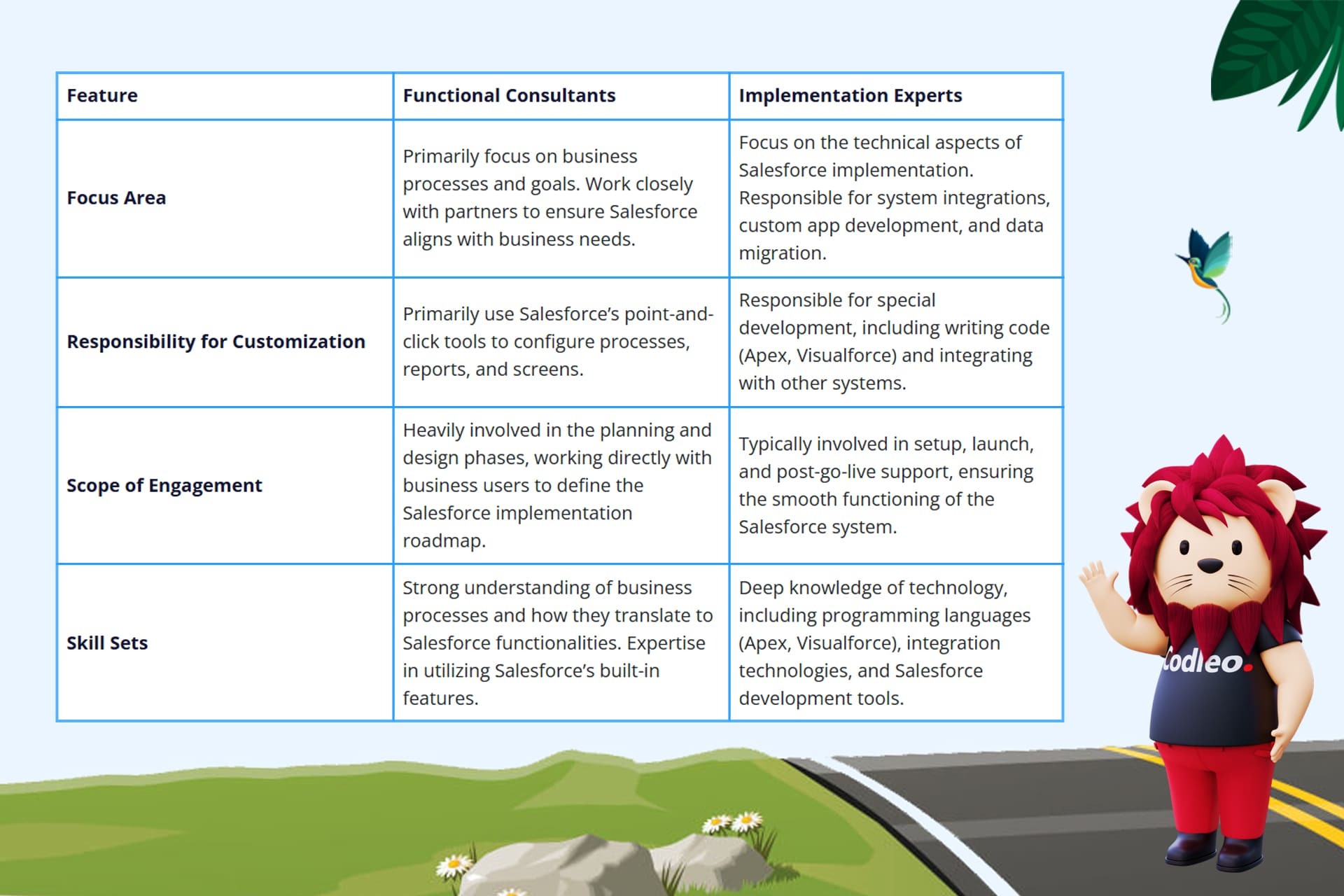
A Salesforce Functional Consultant focuses on understanding your business processes, user requirements, and CRM goals, while a Salesforce Implementation Consultant turns those requirements into a working Salesforce solution through configuration, integrations, data migration, automation, and technical delivery. For more complex projects, a Salesforce Implementation Specialist may also be brought in to provide deeper expertise in a specific Salesforce cloud, integration, or technical area.
Although these roles often overlap, they solve different problems. Choosing the wrong expertise at the wrong stage can lead to unnecessary customization, implementation delays, poor user adoption, and costly rework.
In this guide, we’ll break down the difference between Salesforce Functional Consultants and Implementation Consultants, explain where Salesforce Implementation Specialists fit in, compare their responsibilities and skills, and help you determine which expertise your Salesforce project actually needs.
Table of Contents
-
The Short Answer
-
What Is a Salesforce Functional Consultant?
-
What Is a Salesforce Implementation Consultant?
-
Side-by-Side Comparison
-
What Does Each Role Cost in the U.S. in 2026?
-
Where a Salesforce Implementation Partner Comes In
-
Salesforce Implementation Specialist vs. Consultant — Is There a Difference?
-
The 5 Scenarios Where Businesses Get This Wrong
-
When Do You Need a Functional Consultant?
-
When Do You Need an Implementation Consultant?
-
What to Ask Before Hiring Either One
-
Frequently Asked Questions
The Short Answer (Before We Go Deep)
-
A Salesforce Functional Consultant focuses on your business — your processes, your goals, your people. They figure out what Salesforce should do for you.
-
A Salesforce Implementation Consultant focuses on your technology — the configuration, code, integrations, and data migration. They figure out how to build what Salesforce needs.
Most mid-sized U.S. businesses need both at different stages of a Salesforce CRM implementation. The mistake is hiring them in the wrong order — or treating them as interchangeable.
What Is a Salesforce Functional Consultant?
Think of a Salesforce Functional Consultant as your CRM strategist. Before a single field gets created or a workflow gets built, this person sits down with your sales team, your service team, your leadership — and asks the hard questions.
-
What does your sales cycle actually look like?
-
Where do leads fall through the cracks?
-
What does your team do inside Salesforce versus outside of it, and why?
-
What would a "perfect day" look like for your top-performing sales rep?
Their job is to translate the answers into a Salesforce blueprint—a detailed design that maps your real business processes to the platform's capabilities. This design phase is what separates a successful Salesforce CRM implementation from a very expensive mistake.
Core Responsibilities of a Salesforce Functional Consultant
Requirements Gathering and Discovery
This is where Functional Consultants spend the most time, and it's the most underappreciated part of any Salesforce project. They run stakeholder workshops, process interviews, and current-state analyses. The goal isn't to document what Salesforce can do in theory — it's to understand what your company actually needs to accomplish.
Solution Design
After discovery, they create a functional specification document — a detailed plan that outlines exactly how Salesforce should behave for your business. This becomes the instruction manual for whoever builds and configures the system. Without it, your Salesforce CRM implementation is essentially being built from guesswork.
Configuration and Point-and-Click Customization
Salesforce Functional Consultants work with the platform's built-in declarative tools — flows, validation rules, page layouts, record types, assignment rules, and approval processes—no custom code required. For many small and mid-sized businesses, this no-code and low-code approach covers 70–80% of everything they need from a Salesforce CRM implementation.
User Training and Change Management
Getting Salesforce deployed is one thing. Getting your team to actually use it consistently is another challenge entirely. A skilled Functional Consultant designs training programs, creates adoption frameworks, and helps people understand why the new system makes their daily work better — not just different. Poor user adoption is one of the most cited reasons Salesforce implementations fail in the U.S., and Functional Consultants are the ones who prevent it.
Business Process Optimization
A good Salesforce Functional Consultant doesn't just replicate your current process inside the CRM. They challenge it. If your lead-to-close workflow has three unnecessary approval steps or your service escalation process creates duplicate work, they'll flag it — and design something cleaner before a single line of configuration is written.
Skills a Strong Salesforce Functional Consultant Should Have
-
Deep understanding of CRM concepts, B2B and B2C sales cycles, and service workflows
-
Salesforce certifications: Sales Cloud Consultant, Service Cloud Consultant, and/or Business Analyst
-
Strong facilitation and communication skills — they'll run workshops with your VP of Sales and front-line reps at the same time.
-
Familiarity with Agentforce and AI-driven automation, which is increasingly relevant to functional design decisions in 2026
-
Industry experience is a genuine advantage, not just a nice-to-have
What a Functional Consultant Typically Does NOT Do
They don't write Apex code. They don't build custom Lightning Web Components. They don't handle complex API integrations between Salesforce and your ERP or data warehouse. The moment a requirement needs custom development or deep system integration, you've crossed into Implementation Consultant territory.
What Is a Salesforce Implementation Consultant?
If the Functional Consultant is the architect, the Salesforce Implementation Consultant is the general contractor. They take the blueprint and build the structure — making sure every component comes together correctly, on schedule, within budget, and without breaking your existing systems.
A Salesforce Implementation Consultant is the person responsible for the technical execution of your Salesforce CRM implementation from start to finish.
Core Responsibilities of a Salesforce Implementation Consultant
Project Management
Most Salesforce Implementation Consultants own the project timeline. They build work-breakdown structures, manage sprint cycles, run standups, track blockers, and escalate risks before they become problems. In larger Salesforce CRM implementations, they often work alongside a dedicated project manager or Salesforce program manager—but on mid-market projects, implementation consultants frequently wear both hats.
Salesforce CRM Implementation and System Configuration
Even when a Salesforce Implementation Consultant is not writing custom code, they're responsible for the full technical configuration of the org — object models, security architecture, sharing rules, role hierarchies, profile and permission set design, process automation, and all the technical scaffolding that makes the functional design actually work at scale.
System Integration
This is where Salesforce CRM implementations get technically complex. Most U.S. businesses don't use Salesforce in isolation. They need it to talk to their ERP (SAP, NetSuite, Oracle), their marketing automation platform (Marketo, HubSpot, Pardot/Marketing Cloud Account Engagement), their customer support system (Zendesk, ServiceNow), their billing tools, and sometimes their custom internal applications. Salesforce Implementation Consultants design and build those integrations — often using MuleSoft, REST/SOAP APIs, or middleware platforms. A Salesforce system integrator with deep MuleSoft experience is particularly valuable on enterprise projects where dozens of systems need to communicate in real time.
Custom Development
When Salesforce's out-of-the-box features genuinely can't do what the business needs, Salesforce Implementation Consultants write custom code: Apex classes, triggers, Visualforce pages, and Lightning Web Components. This is specialized development work that requires real programming skills and deep platform knowledge — it's a core differentiator that sets a Salesforce implementation specialist apart from a basic administrator.
Data Migration
Moving data from a legacy CRM — or worse, a scattered collection of spreadsheets — into Salesforce is harder than it looks. Data needs to be mapped, cleaned, deduplicated, and transformed to fit Salesforce's schema. Poor data migration is consistently cited as one of the top reasons Salesforce CRM implementations fail in the U.S. An experienced Salesforce Implementation Consultant will have led dozens of data migrations and won't underestimate the effort or the risks.
Quality Assurance and Testing
Before go-live, every element of the implementation needs to be tested — unit tests, integration tests, regression tests, and user acceptance testing (UAT). Implementation Consultants build test scripts, track defects, and confirm that what was built matches what was designed. They also ensure your org passes Salesforce's own code coverage requirements before anything is pushed to production.
Post-Go-Live Support and Salesforce Managed Services
The first 30–90 days after launch are often the most technically demanding. Things break in ways nobody anticipated. Edge cases appear. Users find workarounds that create new problems. Salesforce Implementation Consultants typically provide stabilization support during this period. For many U.S. businesses, this evolves into an ongoing Salesforce managed services engagement — where a dedicated team handles releases, enhancements, and platform health on a retainer basis rather than project by project.
Skills a Strong Salesforce Implementation Consultant Should Have
-
Salesforce certifications: Platform App Builder, Advanced Administrator, Platform Developer I/II
-
Hands-on experience with Apex, SOQL, REST APIs, and Lightning Web Components
-
Data migration tool experience — Data Loader, Informatica, MuleSoft, or Talend
-
Project and program management background — Agile/Scrum, Waterfall, or hybrid delivery
-
DevOps experience with Salesforce deployment tools like Copado or Gearset
-
For enterprise projects: Salesforce System Architect or Application Architect credentials
What Does Each Role Cost in the U.S. in 2026?
Before reaching out to consultants or evaluating Salesforce implementation partners, it helps to understand the current U.S. market.
Salesforce Functional Consultant — U.S. 2026
According to ZipRecruiter data from January 2026, the average annual compensation for a Salesforce Functional Consultant in the United States is approximately $127,000, with most full-time roles falling between $103,000 and $150,000. Senior consultants with 8+ years of cross-cloud experience and certifications can command $150,000–$190,000+. On a contract basis, independent Salesforce Functional Consultants typically charge between $85 and $175 per hour, depending on specialization, location, and project complexity.
Salesforce Implementation Consultant — U.S. 2026
Implementation Consultants sit in a comparable range — generally $127,000 to $135,000 annually for full-time roles, with senior Salesforce implementation specialists who bring deep integration experience (MuleSoft, CPQ, complex Apex) pushing into $160,000–$190,000+. Contract rates for experienced implementation talent tend to run $100–$200 per hour. According to Glassdoor data from April 2026, the average total compensation for a Salesforce Consultant in the U.S. is approximately $119,000, with top earners reporting over $187,000.
Hiring Through a Certified Salesforce Implementation Partner
Many U.S. businesses engage a certified Salesforce implementation partner rather than independent contractors — and for good reason. A Salesforce implementation company brings a structured delivery methodology, certified bench strength across multiple roles (functional analysts, implementation specialists, developers, QA engineers, project managers), and accountability that a single freelancer can't provide.
For a mid-market Salesforce CRM implementation, total project costs through a certified consulting partner typically range from $40,000 to $250,000+, depending on scope, number of clouds deployed, integration complexity, and the partner's tier level (Base, Ridge, Crest, or Summit in Salesforce's partner program). Summit-tier Salesforce implementation partners — the top 10% of the ecosystem — are generally reserved for enterprise-scale, multi-cloud transformations.
Where a Salesforce Implementation Partner Comes In
When people search for Salesforce help in the U.S., they often use "Salesforce implementation partner" and "Salesforce consultant" interchangeably — but they're not the same thing.
A certified Salesforce implementation partner is an organization — not an individual — that Salesforce has officially authorized to sell, deploy, and optimize the platform. They carry a Trailblazer Score based on certifications, customer satisfaction scores, and proven delivery history. Salesforce ranks partners as Base, Ridge, Crest, and Summit.
A Salesforce implementation partner typically employs both Salesforce Functional Consultants and Salesforce Implementation Consultants on the same team, which is one of the key reasons businesses prefer working with a firm over hiring individual contractors for large implementations.
When evaluating any Salesforce implementation partner for your project, the questions that matter most are:
-
What is their Trailblazer tier, and how many certified consultants do they have on staff?
-
Do they have dedicated Salesforce Functional Consultants and Implementation Consultants, or does the same person do everything?
-
Do they have a Salesforce implementation specialist for your specific cloud — Sales Cloud, Service Cloud, Marketing Cloud, Experience Cloud, or CPQ?
-
Can they handle both the functional design and the technical build, or do they subcontract one side?
-
What does their post-go-live managed services offering look like?
The answers to these questions will tell you more about a partner's real capability than their logo on the Salesforce AppExchange.
Salesforce Implementation Specialist vs. Consultant — Is There a Difference?
You'll see both terms used in U.S. job postings and vendor descriptions, and the line between them is blurry by design. Here's a practical way to think about it:
A Salesforce implementation consultant is typically a generalist who manages the full scope of a Salesforce deployment — from project planning through go-live. They are the primary point of contact between the client and the technical build team.
A Salesforce implementation specialist more often refers to someone with deep expertise in a specific cloud or technical domain — for example, a Sales Cloud implementation specialist, a Salesforce CPQ specialist, a Marketing Cloud implementation specialist, or a Data Cloud specialist. These specialists are brought in for implementations that go beyond general Sales and Service Cloud deployments.
As Salesforce grows more complex in 2026 — with Agentforce AI agents, Data Cloud, Revenue Cloud, and MuleSoft all requiring their own depth of expertise — the role of the implementation specialist has become increasingly important on larger projects. A generalist implementation consultant might manage the overall CRM implementation, while a Marketing Cloud implementation specialist handles the email automation architecture, and a separate MuleSoft specialist owns the integration layer.
For most small to mid-sized businesses, a strong Salesforce Implementation Consultant with broad experience is sufficient. For enterprise-scale projects or specialty clouds, budgeting for dedicated implementation specialists in the relevant areas is money well spent.
The 5 Scenarios Where Businesses Get This Wrong
Understanding the difference on paper is useful. Seeing how it plays out in real situations is where U.S. businesses actually make — or avoid — costly mistakes.
Scenario 1: Hiring an Implementation Consultant Before Doing Discovery
The result is a Salesforce org that is technically functional and completely wrong for your business. The consultant built exactly what they were asked for — but nobody stopped to ask whether what was asked for actually reflected how the business should work. Rework after a failed CRM implementation costs 2 to 5 times the original build cost. A Functional Consultant should always come first.
Scenario 2: Hiring Only a Functional Consultant and Assuming They'll Handle the Build
This gives you a beautifully designed solution that never gets properly built. The Functional Consultant may handle basic declarative configuration, but when you hit your first complex integration requirement or data migration challenge, the project stalls. You end up with documentation and no production org.
Scenario 3: Hiring a Developer When You Actually Need a Functional Consultant
A surprisingly common pattern, especially at smaller companies. Developers will build exactly what you spec — but they won't push back when the spec is wrong, won't redesign an inefficient process, and typically won't ask whether the business logic makes sense before writing the code. Functional expertise and development skill are genuinely different disciplines.
Scenario 4: Skipping the Functional Consultant to Save Money
Discovery and requirements gathering produce documents, not code. They feel like "soft" work and are the first thing cut when budgets get tight. This is consistently one of the most expensive decisions in a Salesforce CRM implementation. The cost of undoing six months of builds based on poorly gathered requirements dwarfs the cost of a thorough discovery phase.
Scenario 5: Treating Your Salesforce Admin as Both Functional Consultant and Implementation Specialist
Salesforce Admins are essential and valuable — but their primary job is maintaining and extending an existing org. Most admins are not equipped to run enterprise discovery workshops, design multi-cloud architectures, lead data migrations from legacy systems, or manage a full Salesforce CRM implementation project. Expecting one person to fill all of these roles is a reliable path to burnout, scope creep, and a project that goes sideways.
When Do You Need a Salesforce Functional Consultant?
Hire a Salesforce Functional Consultant when:
-
You're beginning a new Salesforce CRM implementation and need to define what the system should actually do for your business.
-
Your current Salesforce org exists, but your team avoids it — and you don't know why
-
You're expanding into a new business unit, geographic market, or product line and need to extend your CRM
-
You're preparing for an Agentforce AI implementation and need someone to define the use cases before the technical build begins.
-
You're about to redesign your sales or service process and want Salesforce to reflect the new model.
-
You've been through a Salesforce CRM implementation before, and it didn't deliver — you want to understand the root cause before spending more.
When Do You Need a Salesforce Implementation Consultant?
Hire a Salesforce Implementation Consultant when:
-
Discovery is complete, and you have a clear set of functional requirements ready for development.
-
Your project involves integrations between Salesforce and other enterprise systems, such as ERP, marketing automation, billing, HR, or support platforms.
-
You need custom Apex code, Lightning Web Components, or Visualforce pages that go beyond declarative tools.
-
You're migrating large volumes of data from a legacy CRM or multiple source systems.
-
You're running a multi-phase or multi-cloud implementation that requires structured project management and technical governance.
-
You need DevOps, version control, and deployment pipeline management across sandbox environments.
-
You're engaging a Salesforce implementation partner and need to understand who on their team will own the technical build.
Can One Person Do Both?
Sometimes, but rarely at a high level on complex projects.
Some consultants genuinely operate well across both functional and technical domains. They are typically called Salesforce Solution Architects and command premium rates because they can hold business conversations and make technical architecture decisions simultaneously. A Salesforce Solution Architect is particularly valuable on projects where functional and technical decisions are tightly interdependent — such as complex CPQ implementations, multi-cloud Data Cloud deployments, or Agentforce AI agent rollouts.
For most projects, though, functional and implementation work call for genuinely different skill sets and personality types. Functional work requires empathy, facilitation, and business process intuition. Implementation work requires precision, technical depth, and the capacity to hold an entire system architecture in your head while tracking a project plan.
If your Salesforce CRM implementation is relatively small — say, a Sales Cloud deployment for a 25-person team with no external integrations — a strong generalist consultant may be able to cover both adequately. For anything with real integration complexity, multi-cloud scope, or large data volumes, budget for dedicated expertise in both areas, or engage a Salesforce implementation partner with both capabilities staffed internally.
What to Ask Before Hiring Either One
Whether you're evaluating individual contractors or certified Salesforce implementation partners, these questions will tell you more than a credentials list ever will.
For a Salesforce Functional Consultant:
-
Walk me through your discovery process. How do you structure a requirements workshop with mixed stakeholders?
-
Can you give me an example of a time when you pushed back on a client's existing process and redesigned it? What changed, and what was the outcome?
-
How do you handle disagreements between departments about how Salesforce should work — for example, when sales and marketing want the CRM to behave differently?
-
Which Salesforce certifications do you hold, and which clouds have you worked in most deeply?
-
How do you approach user adoption—what's your strategy when you sense people aren't going to use the system after launch?
For a Salesforce Implementation Consultant or Salesforce Implementation Partner:
-
What's the most technically complex Salesforce integration you've delivered — what systems were involved, and what were the main obstacles?
-
How do you handle data migration from a legacy system with known data quality issues? What's your process for cleansing and validating before import?
-
Walk me through your QA and testing process before go-live. What does UAT look like on your projects?
-
How do you communicate project risks and timeline changes to business stakeholders who don't have a technical background?
-
What does your post-implementation support model look like — do you offer Salesforce managed services after launch, and what does that include?
How Codleo Approaches This
At Codleo, we've delivered enough Salesforce CRM implementations across U.S. industries to know with certainty that the functional and technical sides of a project succeed or fail together. When discovery is weak, the build goes sideways. When the build skips proper testing, the launch creates more work than it saves.
Our process starts with discovery — every time, without exception. Before any configuration, integration, or custom development begins, our Salesforce Functional Consultants spend time genuinely understanding your business: your sales process, service workflows, data, and team. That foundation is what makes the technical build go cleanly.
When it's time to build, our certified Salesforce implementation specialists handle everything — full CRM configuration, custom development, integrations with your ERP and marketing stack, data migration from legacy systems, and end-to-end testing. We don't disappear at go-live. Our Salesforce managed services team is there through stabilization and beyond.
Whether you're starting a new Salesforce CRM implementation, inheriting an org that isn't working the way it should, or evaluating which type of Salesforce consultant your project actually needs — we're happy to have that conversation. No pressure, no jargon. Just an honest look at what your Salesforce needs to do and the best way to get there.
Talk to a Codleo Salesforce Consultant →
Codleo is a certified Salesforce consulting partner with offices in the U.S. and India, serving clients across financial services, healthcare, manufacturing, retail, and professional services. Our team includes certified Salesforce Functional Consultants, Implementation Consultants, Implementation Specialists, and Managed Services Practitioners.
 0
0
About the Author

FAQ
A Salesforce Functional Consultant focuses on understanding your business processes and designing the right CRM solution. A Salesforce Implementation Consultant focuses on technical implementation, configuration, integration, and deployment of the solution. Both roles are essential for a complete Salesforce CRM implementation, but they operate at different phases and require different skills.
A Salesforce implementation specialist typically refers to someone with deep expertise in a specific Salesforce cloud or technical domain — for example, a Sales Cloud implementation specialist, CPQ specialist, or Marketing Cloud implementation specialist. As Salesforce has grown more complex, specialists are increasingly brought in to handle specific technical areas within a larger implementation project.
A certified Salesforce implementation partner is a company that Salesforce has officially authorized to deploy and optimize the platform. Partners are ranked in tiers — Base, Ridge, Crest, and Summit — based on certifications held, customer satisfaction scores, and delivery track record. Working with a certified Salesforce implementation partner typically provides greater accountability and a more structured approach than hiring individual contractors.
A Salesforce system integrator specializes in connecting Salesforce with other enterprise platforms — ERP systems, marketing automation tools, support platforms, data warehouses, and so on. Many certified Salesforce implementation partners also function as system integrators, but not all system integrators provide the full consulting and configuration scope that a Salesforce implementation partner delivers.
Always engage a Salesforce Functional Consultant before your Implementation Consultant starts work. Discovery and requirements definition must happen before the technical build begins. Starting a Salesforce CRM implementation without this foundation is one of the most reliable ways to go over budget.
As of early 2026, the average annual compensation for a Salesforce Implementation Consultant in the United States is approximately $127,000–$135,000, according to ZipRecruiter and Glassdoor data. Contract rates typically range from $100 to $200 per hour. Total Salesforce CRM implementation project costs through a certified consulting partner range from roughly $40,000 for smaller deployments to $250,000+ for enterprise-scale implementations with multiple integrations.
For simple Sales Cloud implementations with no integrations and a small team, a strong freelance Salesforce implementation consultant may be sufficient. For projects with real integration complexity, custom development, data migration from legacy systems, or multi-cloud scope, a certified Salesforce implementation partner provides the bench strength, methodology, and accountability that individual contractors cannot match.
Salesforce managed services is an ongoing retainer arrangement in which a certified partner or team manages your Salesforce org's health, releases, enhancements, and optimization after the initial implementation is complete. For most U.S. businesses without large internal Salesforce teams, managed services is the most cost-effective way to keep the platform performing well and adapting to Salesforce's three annual releases.
Key certifications for a Salesforce Implementation Consultant or implementation specialist include Platform App Builder, Platform Developer I, Platform Developer II, Salesforce Administrator (Advanced), and, for senior roles, System Architect or Application Architect. Cloud-specific certifications — Service Cloud Consultant, Marketing Cloud Email Specialist, CPQ Specialist — are important when your implementation involves those specific products.
Independent Salesforce Functional Consultants in the U.S. typically charge between $85 and $175 per hour in 2026, depending on specialization, certification level, and project complexity. Senior functional consultants with cross-cloud expertise and a strong delivery track record sit toward the higher end of this range.



 16192 Coastal Highway Lewes, Delaware 19958 USA


