


Publish date:
For most mid-sized businesses in the USA, a boutique or mid-tier Salesforce consulting partner offers the best balance of certified expertise, project flexibility, cost, and ongoing support. A typical mid-market Salesforce implementation can cost $25,000–$65,000, while ongoing support commonly ranges from $2,000–$8,000 per month, depending on scope, integrations, customization, and support requirements.
Salesforce Consulting Partner Cost in the USA: Quick Answer
| What You're Comparing | Typical USA Range | Best Fit |
|---|---|---|
| Starter Salesforce project | $8,000–$20,000 | Basic setup and smaller teams |
| Mid-market implementation | $25,000–$65,000 | Growing businesses with customization or integrations |
| Complex implementation | $65,000–$150,000+ | Multi-cloud and integration-heavy projects |
| Salesforce consultant | $100–$250/hour | Advisory, configuration, and ongoing improvements |
| Senior Salesforce architect/specialist | $200–$400/hour | Complex architecture and specialized requirements |
| Ongoing Salesforce support | $2,000–$8,000/month | Businesses without a full-time internal Salesforce team |
These are indicative USA market ranges. Actual Salesforce consulting costs vary based on project scope, cloud products, integrations, data migration, customization, delivery model, and consultant experience.
Also Read: Top Salesforce Consulting Partners in the USA for 2026
The harder question isn't simply “How much does Salesforce consulting cost?” It's whether you're paying for the right level of expertise for your business.
Mid-sized companies often sit between two extremes: independent Salesforce consultants who may be cost-effective for narrow requirements, and large systems integrators designed for complex enterprise programs. The right fit is usually somewhere in between.
This guide breaks down Salesforce consulting services, partner pricing models, hourly consulting rates, implementation packages, additional costs, and partner-selection criteria for mid-sized businesses in the USA. You'll also see what should be included in a proposal, what can be negotiated, and what to ask before choosing a Salesforce partner.
The goal is simple: help you compare Salesforce consulting partners by scope, expertise, delivery model, and total cost—not hourly rates alone.
Key Takeaways: Choosing a Salesforce Consulting Partner in the USA
| Buyer Question | Quick Answer |
|---|---|
| What type of Salesforce partner is best for a mid-sized business? | A boutique or mid-tier Salesforce consulting partner is often the best fit when you need certified expertise, multiple skill sets, and ongoing support without large-SI overhead. |
| How much should a mid-sized Salesforce project cost? | Expect roughly $25,000–$65,000 for a typical mid-market implementation. Simpler projects may start around $8,000, while complex multi-cloud projects can exceed $150,000. |
| What should I compare between Salesforce partners? | Compare project scope, relevant certifications, industry experience, assigned team, integrations, post-launch support, and total cost—not just hourly rates. |
| Partner or independent Salesforce consultant? | An independent Salesforce consultant can work well for a narrow project. A consulting partner is generally better when the project requires administrators, developers, architects, integrations, or long-term support. |
| What should Salesforce consulting services include? | Look for discovery, solution design, configuration, data migration, integrations, testing, training, deployment, documentation, and clearly defined post-launch support based on your scope. |
| What is the biggest pricing mistake? | Choosing the lowest quote without checking what is excluded. Data migration, integrations, custom development, additional training, and post-launch support can materially increase the final cost. |
Why Mid-Sized Businesses Need a Different Salesforce Consulting Approach
Mid-sized businesses usually need more than a basic Salesforce setup but less complexity than a large enterprise transformation.
A growing company may need Sales Cloud and Service Cloud, data migration, workflow automation, reporting, user training, and several integrations—all within a controlled budget and a relatively lean internal team. This makes the choice of Salesforce consulting partner especially important.
The right partner should provide enough technical depth to handle growing requirements without adding unnecessary enterprise-level complexity.
| Consulting Option | Best Suited For | Where It May Fall Short for Mid-Sized Businesses |
|---|---|---|
| Independent Salesforce Consultant | Audits, configuration changes, troubleshooting, or a clearly defined project | One person may not cover architecture, development, integrations, migration, training, and support |
| Boutique/Mid-Tier Salesforce Consulting Partner | Growing businesses requiring implementation, integration, optimization, and ongoing support | Capabilities vary, so certifications, relevant experience, and the proposed delivery team should be verified |
| Large Systems Integrator (SI) | Enterprise transformations, global rollouts, complex governance, and large multi-cloud programs | Delivery structure and project costs may be more than a mid-market project requires |
What Should a Mid-Sized Business Look for?
For many mid-sized organizations, a boutique or mid-tier partner provides a practical balance between specialist expertise, access to multiple Salesforce consultants, project flexibility, and ongoing support.
Before selecting a partner, evaluate whether they can provide:
-
Certified expertise in the Salesforce products you actually use
-
Experience with businesses of similar size and complexity
-
Data migration and third-party integration capabilities
-
A clearly defined implementation scope and pricing model
-
User training and adoption support
-
Post-launch optimization and Salesforce support
-
Access to administrators, developers, consultants, and architects when required
The goal isn't to hire the biggest Salesforce firm or simply choose the lowest quote. It's to find a Salesforce consulting partner whose capabilities, delivery model, and pricing match the complexity of your project.
How to Choose the Best Salesforce Consulting Partner for a Mid-Sized Business
The best Salesforce consulting partner isn't necessarily the largest firm or the one with the lowest quote. For a mid-sized business, the right choice depends on your Salesforce products, project complexity, industry requirements, budget, and the level of support you need after go-live.
A practical way to compare partners is to use the same criteria for every firm you shortlist.
| What to Evaluate | What to Ask the Partner | What a Strong Answer Looks Like |
|---|---|---|
| Relevant Salesforce expertise | Which Salesforce products does your proposed team specialize in? | Certifications and hands-on experience aligned with the products and requirements in your project |
| Assigned project team | Who will actually work on our project? | Named roles for consulting, architecture, development, project management, and other required expertise |
| Similar project experience | Have you delivered projects with a similar scope, industry, or company size? | Relevant case studies, project examples, or references with comparable requirements |
| Pricing & scope clarity | What is included in the quote, and what could increase the final cost? | Clear assumptions, deliverables, exclusions, change-request terms, and payment milestones |
| Implementation approach | How do you move from discovery to go-live? | A defined process covering discovery, solution design, build, testing, training, deployment, and hypercare |
| Integration & data capabilities | How will you handle our existing systems and data? | A clear approach to data migration, APIs, third-party integrations, validation, and data quality |
| Post-launch support | What happens after Salesforce goes live? | Defined support options, response expectations, optimization, release management, and admin assistance |
| Communication & governance | How will progress, risks, and scope changes be communicated? | Regular status updates, clear ownership, escalation paths, and transparent change management |
A Simple Rule for Shortlisting Salesforce Partners
Before signing a contract, ask each shortlisted partner to show evidence, not just capabilities.
For example, instead of accepting “we have experienced Salesforce consultants,” ask:
-
Who are the consultants assigned to our project?
-
Which certifications and relevant project experience do they have?
-
Can you show a comparable implementation or case study?
-
What exactly is included in the proposed Salesforce consulting services?
-
Which requirements would be considered out of scope?
-
Who owns the project after go-live?
-
How are additional hours or change requests priced?
A strong proposal should make it easy to understand who will deliver the work, what they will deliver, how much it will cost, how success will be measured, and what happens after launch.
For mid-sized businesses, that level of transparency is often more useful than choosing a Salesforce partner based on company size or headline hourly rate alone.

Salesforce Consulting Partner Pricing Models and Service Packages
Salesforce consulting pricing in the USA depends on the engagement model, project scope, Salesforce products involved, integrations, data migration, customization, and the experience level of the team.
For mid-sized businesses, a Salesforce project may start around $8,000–$20,000 for a relatively simple implementation, while a more typical multi-cloud or moderately customized implementation may fall in the $25,000–$65,000 range. Complex projects involving multiple systems, advanced integrations, or custom development can reach $65,000–$150,000+.
The first pricing decision, however, is usually how you want to pay your Salesforce consulting partner.
Salesforce Consulting Pricing Models Compared
| Pricing Model | How It Works | Best For | Main Cost Consideration |
|---|---|---|---|
| Fixed Price | A defined scope, timeline, and set of deliverables are agreed upon for a fixed project fee | Businesses with clear requirements and a well-defined implementation scope | Requirements outside the agreed scope may require a paid change request |
| Time & Materials (T&M) | You pay for the actual consulting, development, or architecture hours used | Projects where requirements are expected to evolve | Final cost can increase if scope and hours are not actively managed |
| Monthly Retainer | A recurring fee covers an agreed number of support or enhancement hours | Ongoing Salesforce administration, optimization, troubleshooting, and enhancements | Check included hours, response terms, rollover rules, and out-of-scope rates |
| Hybrid Model | Implementation is fixed-price, followed by a monthly support agreement | Mid-sized businesses that need implementation plus ongoing Salesforce support | Review implementation and post-launch costs separately |
Which pricing model is best?
For a clearly defined implementation, fixed-price can provide greater budget predictability. If requirements are likely to change during delivery, T&M provides more flexibility. Businesses that need continuous optimization after launch may prefer a retainer or hybrid model.
Typical Salesforce Consulting Packages for Mid-Sized Businesses
The cost of Salesforce consulting services also changes significantly with the complexity of the project. Instead of comparing quotes only by price, compare what each package actually includes.
| Package | Best For | Typical Scope | Typical USA Consulting Cost* |
|---|---|---|---|
| Starter / QuickStart | Businesses moving from spreadsheets or a basic CRM | Sales Cloud setup, standard configuration, basic automation, reports, and initial user training | $8,000–$20,000 |
| Growth | Mid-sized businesses requiring greater automation or multiple Salesforce products | Sales Cloud + Service Cloud, custom configuration, data migration, 1–2 integrations, automation, and training | $25,000–$65,000 |
| Scale | Growing organizations with multiple departments and a more complex technology stack | Multi-cloud setup, advanced integrations, custom reporting, automation, data migration, and project management | $65,000–$150,000+ |
| Managed Salesforce Support | Businesses that need help after implementation | Administration, troubleshooting, enhancements, release support, user assistance, and ongoing optimization | $2,000–$8,000/month |
These ranges are indicative rather than fixed Salesforce prices. Actual consulting fees depend on requirements, delivery model, project duration, integrations, data volume, customization, and the Salesforce consultants or specialists required.
What Can Increase Salesforce Consulting Costs?
Two businesses using the same Salesforce product can receive very different quotes. The difference is usually driven by project complexity rather than licenses alone.
Common cost drivers include:
-
Number of Salesforce products and business processes being configured
-
Number and complexity of third-party integrations
-
Volume and quality of data being migrated
-
Custom Apex, API, or Lightning development
-
Complex workflow and automation requirements
-
Number of users, teams, or business units involved
-
Security, compliance, and governance requirements
-
Training and change-management requirements
-
Amount of post-launch Salesforce support required
When comparing proposals from different Salesforce consulting partners, ask for the scope, assumptions, exclusions, deliverables, and change-request pricing alongside the headline project cost. A lower initial quote isn't necessarily less expensive if essential work is excluded.

What Do Salesforce Consultants Charge Per Hour in the USA?
Salesforce consulting rates in the USA vary by role, specialization, experience, project complexity, and delivery model. As a general market benchmark, independent Salesforce consultants may charge around $50–$150 per hour, while certified consulting resources commonly range from $100–$250 per hour. Senior architects and specialists can cost considerably more.
Salesforce Consultant Hourly Rates by Role
| Salesforce Resource | Typical Hourly Rate | Best Used For |
|---|---|---|
| Independent Salesforce Consultant | $50–$150/hr | Configuration, audits, troubleshooting, and smaller well-defined projects |
| Salesforce Administrator / Consultant through a Partner | $100–$250/hr | Configuration, automation, requirements, reporting, and ongoing optimization |
| Senior Salesforce Architect / Specialist | $200–$400/hr | Solution architecture, complex integrations, Revenue Cloud, CPQ, and advanced technical requirements |
| Large Systems Integrator | $250–$500+/hr | Large enterprise transformations, global programs, and complex multi-cloud environments |
| Offshore or Blended Delivery Team | Often lower than fully US-based delivery | Projects where businesses want to balance senior US-facing expertise with more cost-efficient delivery capacity |
These are indicative consulting ranges, not Salesforce-published rates. Actual quotes vary by partner, location, specialization, scope, contract structure, and resource seniority.
What Determines a Salesforce Consultant's Hourly Rate?
Hourly rate alone doesn't tell you whether a proposal offers good value. Two Salesforce consulting partners can quote very different rates because they may be assigning different levels of expertise to the project.
The biggest factors affecting consulting rates include:
-
Role and seniority: Administrators, developers, consultants, and architects command different rates.
-
Specialization: Expertise in complex areas such as Revenue Cloud, CPQ, integrations, or solution architecture may cost more.
-
Project complexity: Advanced automation, custom development, and integration-heavy projects generally require more senior resources.
-
Delivery location: Fully US-based, offshore, nearshore, and blended delivery models have different cost structures.
-
Engagement length: Long-term support agreements may be priced differently from short specialist engagements.
-
Partner model: Independent consultants, boutique firms, mid-tier partners, and large systems integrators have different overhead and delivery structures.
Should You Choose a Salesforce Partner Based on Hourly Rate?
Usually, no.
A lower hourly rate does not automatically mean a lower total project cost. A more experienced Salesforce consultant may complete a complex requirement faster, identify risks earlier, or reduce rework.
When comparing Salesforce consulting services, evaluate the complete commercial picture:
| Don't Compare Only | Compare Instead |
|---|---|
| Hourly rate | Estimated total project cost |
| Number of consultants | Experience of the assigned team |
| Cheapest proposal | Scope and deliverables included |
| Development hours | Business outcomes and acceptance criteria |
| Initial implementation cost | Implementation + post-launch support requirements |
The better question is not “Who has the lowest Salesforce consulting rate?” but “What team, scope, and delivery model will achieve our requirements at the most predictable total cost?”
Onshore vs. Offshore vs. Blended Salesforce Consulting
Many Salesforce consulting companies use a blended delivery model, where client communication, discovery, and solution architecture may be led by senior resources close to the customer while configuration, development, testing, or support is delivered by a broader team.
This model can be cost-efficient, but the delivery structure should be transparent.
Before signing, ask:
-
Who will be our primary point of contact?
-
Where is each part of the delivery team located?
-
Who owns solution architecture and technical decisions?
-
Which resources are included in the quoted rate?
-
How are handoffs, quality assurance, and communication managed?
The location of the team matters less than having clear ownership, relevant expertise, consistent communication, and accountability for delivery.
DIY vs. Freelancer vs. Salesforce Consulting Partner vs. Large SI: Which Should You Choose?
The right Salesforce delivery model depends on more than budget. Project complexity, internal expertise, integrations, timeline, and the level of support required after launch should all influence the decision.
For a simple configuration change, hiring a full Salesforce consulting partner may be unnecessary. For a multi-cloud implementation with integrations and ongoing support, relying on one independent consultant may create capacity or skill-coverage limitations.
Here's how the main options compare:
| Option | Typical Cost | Best Fit | Key Advantage | Main Consideration |
|---|---|---|---|---|
| DIY / Internal Team | No external consulting fee, but significant internal time | Small teams with simple requirements and experienced internal Salesforce resources | Direct internal control | Learning curve, internal capacity, and potential rework |
| Independent Salesforce Consultant | $50–$150/hr | Audits, configuration, troubleshooting, and narrowly defined projects | Flexible access to specialist expertise | Capacity and skill coverage depend heavily on one individual |
| Boutique / Mid-Tier Salesforce Consulting Partner | $8K–$150K+ depending on scope | Mid-sized businesses requiring implementation, integrations, optimization, or ongoing support | Access to consultants, developers, architects, and support resources through one delivery team | Capabilities and delivery quality vary between partners, so due diligence is essential |
| Large Systems Integrator (SI) | $150K–$500K+ for complex programs | Enterprise transformations, global rollouts, complex governance, and large multi-cloud programs | Scale, specialized resources, and enterprise delivery capabilities | Cost and delivery structure may exceed what a mid-market project requires |
Costs are indicative market ranges and can vary significantly by scope, location, Salesforce products, project duration, customization, and delivery model.
Which Salesforce Delivery Model Is Best for Your Business?
Use the complexity of the requirement—not company size alone—to make the decision.
| Your Situation | Option to Consider |
|---|---|
| You have experienced Salesforce resources internally and need only basic configuration | DIY / Internal Team |
| You need an audit, specialist advice, troubleshooting, or a clearly defined piece of work | Independent Salesforce Consultant |
| You need implementation, data migration, integrations, automation, training, and post-launch support | Boutique / Mid-Tier Salesforce Consulting Partner |
| You need a global transformation involving multiple business units, countries, clouds, or complex governance | Large Systems Integrator |
For many mid-sized businesses, a boutique or mid-tier partner can offer a practical middle ground: broader expertise than a single consultant without automatically requiring an enterprise-scale delivery model.
However, the label “Salesforce consulting partner” alone doesn't guarantee the right fit. Before selecting one, evaluate the actual team assigned to your project, relevant certifications, similar project experience, scope clarity, communication model, and post-launch Salesforce consulting services.
When Should You Move From a Freelancer to a Salesforce Consulting Partner?
Consider moving from an independent Salesforce consultant to a consulting partner when your requirements start involving several skill sets at the same time—for example:
-
Salesforce administration plus custom development
-
Multiple third-party integrations
-
Complex data migration
-
Sales Cloud and Service Cloud working together
-
Architecture and security decisions
-
Formal QA and user acceptance testing
-
User training and change management
-
Continuous optimization and Salesforce support after go-live
At that point, the decision becomes less about finding one highly capable consultant and more about having the right combination of Salesforce expertise available throughout the project.
Which Salesforce Consulting Package Fits Your Business?
The right Salesforce consulting services package depends on your current CRM setup, business processes, integration requirements, and how quickly your organization is growing.
Use this framework as a starting point before requesting proposals from Salesforce consulting partners.
| Your Current Situation | Package to Consider | Typical Requirements | Why It Fits |
|---|---|---|---|
| Moving from spreadsheets or a basic CRM | Starter / QuickStart | Sales Cloud setup, pipeline configuration, basic automation, reports, and initial training | Keeps the first implementation focused on core CRM requirements without unnecessary complexity |
| Salesforce is already in place but needs cleanup | Growth | Org audit, process redesign, automation cleanup, data quality improvements, reporting, and user adoption | Existing Salesforce environments often need optimization before new functionality is added |
| Sales, service, and other teams use disconnected systems | Growth / Scale | Sales Cloud, Service Cloud, integrations, data migration, automation, and consolidated reporting | Connects business processes and reduces fragmented customer data across systems |
| Multiple systems need to integrate with Salesforce | Growth / Scale | API integrations, data mapping, automation, architecture, testing, and monitoring | Integration complexity usually requires broader technical expertise than basic CRM configuration |
| Preparing for rapid growth, acquisition, or expansion | Scale | Scalable architecture, security, automation, integrations, governance, and advanced reporting | Designing for expected growth can reduce the need for major restructuring later |
| Salesforce is live but your team lacks internal admin capacity | Managed Support | Administration, troubleshooting, enhancements, release support, user assistance, and optimization | Provides ongoing access to Salesforce consultants without relying entirely on a full-time internal resource |
How Do You Know If Your Salesforce Project Is Becoming More Complex?
A project usually moves beyond a basic implementation when several of these requirements appear together:
-
Multiple Salesforce products or business departments
-
Migration from one or more legacy systems
-
Third-party or API integrations
-
Complex workflow automation
-
Custom development
-
Large or poor-quality datasets
-
Advanced security or access requirements
-
Multiple user groups with different processes
-
Significant reporting or analytics requirements
-
Ongoing administration and optimization after go-live
If several apply to your project, ask your Salesforce consulting partner to explain how those requirements affect the proposed team, timeline, scope, and cost.
Don't Choose a Package by Company Size Alone
Two businesses with 100 employees can require completely different Salesforce implementations.
One may need a straightforward Sales Cloud setup for 20 users. Another may need Sales Cloud, Service Cloud, ERP integration, data migration, advanced automation, and multiple user groups.
That's why a good Salesforce consultant should scope the project around business requirements and technical complexity—not employee count alone.
Before choosing a package, document four things:
Current systems → Required Salesforce capabilities → Required integrations → Expected business growth
That gives potential Salesforce partners a much stronger basis for recommending the right scope and providing a realistic quote.
What’s Included in a Salesforce Consulting Package—and What May Cost Extra?
A Salesforce consulting services proposal should clearly define what is included in the project fee and what will be charged separately. Two partners can quote similar prices but include very different levels of discovery, data migration, integrations, training, and post-launch support.
Before comparing Salesforce consulting proposals, review the scope line by line.
| Service / Deliverable | Commonly Included | May Cost Extra Depending on Scope | What to Confirm |
|---|---|---|---|
| Discovery & requirements workshops | ✓ | Number of workshops, stakeholders involved, and final documentation | |
| Solution design | ✓ | Whether architecture and process recommendations are documented | |
| Standard Salesforce configuration | ✓ | Objects, fields, page layouts, permissions, and reports included | |
| Workflow & Flow automation | ✓ | ✓ | Number and complexity of automations covered |
| Data migration | ✓ | Data sources, record volume, cleansing, mapping, and validation | |
| Third-party integrations | ✓ | Number of systems, APIs, middleware, and integration complexity | |
| Custom Apex / Lightning development | ✓ | Development hours, technical scope, testing, and documentation | |
| Testing & UAT support | ✓ | ✓ | Who owns test cases, defect resolution, and user acceptance testing |
| User training | ✓ | ✓ | Number of sessions, users, departments, recordings, and materials |
| Deployment & go-live support | ✓ | Deployment activities and go-live responsibilities | |
| Post-launch hypercare | ✓ | ✓ | Duration, included hours, and response expectations |
| Ongoing Salesforce support | ✓ | Monthly hours, SLAs, enhancements, administration, and release support | |
| AppExchange / third-party licenses | ✓ | Which software licenses must be purchased separately |
Exact inclusions vary by Salesforce consulting partner, contract, project scope, and engagement model. Confirm every deliverable in the Statement of Work (SOW) before signing.
Which Salesforce Services Commonly Increase the Project Cost?
The biggest differences between an initial quote and the final project cost often come from requirements that were not fully scoped during discovery.
Pay particular attention to:
-
Complex or poor-quality data migration
-
Multiple third-party integrations
-
Custom Apex or Lightning development
-
Additional automation requested after scope approval
-
Changes to requirements during implementation
-
Additional training sessions or departments
-
Specialized architecture or security requirements
-
Extended post-launch support
-
Additional environments, testing, or deployment requirements
For example, “data migration included” is not specific enough. Migrating clean account and contact records from one system is very different from consolidating years of duplicate customer data from several legacy platforms.
The same applies to integrations. A standard connector may require significantly less effort than a custom API integration involving complex business logic.
What Should Be Defined in a Salesforce Statement of Work?
Before selecting a Salesforce consulting partner, make sure the Statement of Work clearly documents:
| SOW Item | What You Should Look For |
|---|---|
| Project scope | Salesforce products, processes, departments, and requirements covered |
| Deliverables | Exactly what the Salesforce consultants will configure, build, migrate, integrate, test, and document |
| Timeline & milestones | Discovery, build, testing, training, deployment, and go-live dates |
| Roles & responsibilities | What the consulting team owns versus what your internal team must provide |
| Assumptions | Data quality, stakeholder availability, system access, and other dependencies |
| Exclusions | Work specifically not covered by the quoted price |
| Change-request process | How additional requirements will be estimated, approved, and billed |
| Acceptance criteria | How completed work will be reviewed and approved |
| Post-launch support | Hypercare period, support hours, response expectations, and ongoing support options |
A transparent proposal should make it possible to understand the total scope of Salesforce consulting services, not just the headline implementation price.
When comparing partners, ask:
“If nothing changes in our requirements, what could still cause the final invoice to exceed this quote?”
The answer can reveal cost assumptions and exclusions that aren't obvious from the initial proposal.
Can You Negotiate Salesforce Consulting Costs?
Yes, some parts of a Salesforce consulting partner proposal may be negotiable—but negotiating the lowest possible headline price isn't always the best way to reduce your total project cost.
Instead, focus on scope, payment structure, included services, resource mix, and post-launch support. These areas can often provide more flexibility without compromising critical implementation work.
| Proposal Item | Negotiability | What to Discuss |
|---|---|---|
| Payment schedule | Often negotiable | Milestone-based payments, payment timing, and how fees align with project deliverables |
| Project scope | Flexible before sign-off | Prioritize must-have requirements and move lower-priority features into a later phase |
| Training | Often flexible | Number of sessions, departments covered, live vs. recorded training, and training materials |
| Post-launch hypercare | Sometimes negotiable | Duration, included hours, response expectations, and transition to ongoing support |
| Documentation & handover | Sometimes negotiable | Admin documentation, technical documentation, recorded walkthroughs, and knowledge transfer |
| Managed support retainer | Often flexible | Monthly hours, contract duration, rollover policy, and enhancement capacity |
| Team composition | Sometimes flexible | Mix of consultants, developers, administrators, and senior architects based on project needs |
| Senior specialist rates | Less flexible | Instead of forcing down specialist rates, confirm where senior expertise is genuinely required |
| Discovery & solution design | Avoid cutting without assessing impact | Reducing discovery can leave requirements, dependencies, and risks unidentified |
| Testing & QA | Avoid cutting simply to reduce cost | Confirm the testing approach, responsibilities, defect management, and acceptance criteria |
How Can You Reduce Salesforce Consulting Costs Without Cutting Quality?
A better cost-control strategy is to reduce unnecessary scope and uncertainty before asking your Salesforce consulting partner for a lower rate.
Consider these approaches:
-
Separate must-have requirements from features that can wait for phase two.
-
Clean and deduplicate data before migration begins.
-
Document your existing sales, service, and approval processes.
-
Identify required integrations before discovery.
-
Assign an internal decision-maker who can resolve questions quickly.
-
Keep stakeholders available for requirements, testing, and approvals.
-
Use standard Salesforce functionality where it meets the business requirement instead of automatically requesting custom development.
-
Agree on the change-request process before implementation starts.
These steps can reduce avoidable consulting hours, delays, and scope changes while preserving the work that directly affects implementation quality.
What Should You Avoid Cutting From a Salesforce Project?
Some activities may look like easy places to save money but can create greater risk later.
Be careful about reducing:
Discovery → Solution architecture → Data validation → Testing → User acceptance testing → Training → Go-live support
These activities help Salesforce consultants identify requirements, validate the solution, prepare users, and catch problems before they affect production.
The goal of negotiation should therefore be cost efficiency, not simply the lowest Salesforce consulting rate.
When comparing proposals, ask each partner:
“If we needed to reduce this project's budget by 10–15%, what would you remove or phase without increasing implementation risk?”
A strong answer should identify lower-priority scope that can be deferred rather than automatically reducing discovery, testing, or other critical delivery activities.
The Real Cost of Choosing the Wrong Salesforce Consulting Partner
The cost of a Salesforce consulting partner isn't limited to the implementation invoice. A poorly scoped or poorly delivered project can also create rework, adoption problems, unreliable data, integration issues, and additional support requirements after go-live.
That's why the cheapest proposal isn't necessarily the lowest-cost option.
| Project Risk | Potential Business Impact | What to Check Before Hiring |
|---|---|---|
| Poor requirements discovery | Important processes may be missed, leading to scope changes or rework | Ask how discovery, requirements, and acceptance criteria are documented |
| Over-customization | Salesforce becomes harder to maintain and update | Ask when the partner recommends standard configuration vs. custom development |
| Weak data migration planning | Duplicate, incomplete, or incorrectly mapped records can reduce trust in CRM data | Review data cleansing, mapping, validation, and migration testing |
| Poor integration design | Teams may still rely on manual data entry or disconnected systems | Ask how integrations, APIs, failures, and data synchronization will be managed |
| Insufficient testing | Issues may reach production and disrupt users or business processes | Confirm QA, UAT, defect resolution, and go-live criteria |
| Limited user training | Employees may struggle to adopt new processes or use Salesforce consistently | Review training by role, documentation, and adoption support |
| Unclear project ownership | Decisions and issues can take longer to resolve | Confirm the project manager, solution owner, escalation path, and responsibilities |
| No post-launch plan | Enhancements, user questions, and system maintenance may accumulate after go-live | Confirm hypercare and ongoing Salesforce support before signing |
What Are the Warning Signs of a Poor Salesforce Consulting Proposal?
Before choosing between Salesforce consulting partners, look beyond certifications and the headline price.
Potential warning signs include:
-
A quote provided without sufficient discovery
-
Deliverables described only in broad terms
-
No clear assumptions or exclusions
-
No named or defined project roles
-
Heavy customization without explaining why standard Salesforce functionality isn't sufficient
-
Data migration described without cleansing and validation steps
-
Integrations mentioned without clear ownership or technical approach
-
No documented testing or UAT process
-
Training treated as an afterthought
-
No clear change-request process
-
No defined support model after go-live
One warning sign doesn't automatically make a partner unsuitable. However, several together should trigger deeper questions before you sign the Statement of Work.
How Should You Compare Salesforce Partners Beyond Price?
A better comparison is:
| Instead of Asking Only... | Also Ask... |
|---|---|
| How much will the implementation cost? | What exactly is included and excluded? |
| What's your hourly rate? | Which Salesforce consultants will actually work on our project? |
| How quickly can you go live? | What discovery, testing, migration, and training are included in that timeline? |
| How many Salesforce certifications do you have? | What similar projects has the assigned team delivered? |
| Can you integrate our systems? | How will the integration be designed, tested, monitored, and supported? |
| Do you provide support? | What happens during hypercare and after the initial support period ends? |
The objective isn't simply to find the lowest-cost Salesforce consulting services provider. It's to reduce the risk of paying twice—first for the initial implementation and again for avoidable remediation, additional consulting, or process redesign.
A well-structured proposal should give you confidence in five areas:
Scope → Team → Delivery Approach → Cost → Post-Launch Ownership
Salesforce Consulting Partner RFP Checklist
Before requesting quotes, prepare the same project information for every Salesforce consulting partner you're considering. This makes proposals easier to compare and reduces pricing differences caused by unclear requirements.
| RFP Information | What to Provide | Why It Matters |
|---|---|---|
| Business goals | 2–3 outcomes you expect Salesforce to improve | Helps partners design around business requirements instead of features alone |
| Salesforce products | Sales Cloud, Service Cloud, Experience Cloud, Marketing Cloud, or other products in scope | Determines the skills and Salesforce consultants required |
| Users & departments | Number of users by sales, service, marketing, operations, or other teams | Helps estimate configuration, security, training, and adoption requirements |
| Current CRM & systems | Existing CRM, ERP, marketing, finance, support, and other relevant platforms | Identifies migration and integration requirements |
| Data migration | Approximate record volume, data sources, known duplicates, and historical data requirements | Helps estimate migration, cleansing, mapping, and validation effort |
| Integrations | Specific systems Salesforce needs to connect with | Helps determine API, middleware, technical architecture, and testing requirements |
| Required processes | Sales stages, case management, approvals, automation, reporting, and other key workflows | Gives partners enough detail to estimate configuration and development |
| Timeline | Preferred go-live date and any fixed business deadlines | Helps determine whether the proposed delivery plan is realistic |
| Budget range | A realistic investment range if available | Helps partners recommend an appropriate scope and delivery model |
| Internal ownership | Project sponsor, decision-maker, subject-matter experts, and approvers | Clarifies responsibilities and reduces project delays |
| Post-launch needs | Admin support, enhancements, release management, training, or optimization | Helps include ongoing Salesforce support in the commercial proposal |
Questions to Ask Every Salesforce Consulting Partner
Use the same questions with each shortlisted partner:
-
Who will actually work on our project, and what are their roles?
-
What similar Salesforce projects has your team delivered?
-
What is included—and specifically excluded—from your quote?
-
Which requirements are driving the largest portion of the cost?
-
How will you handle data migration and integrations?
-
What is your approach to testing, UAT, training, and go-live?
-
How are scope changes estimated and approved?
-
What support is included after launch?
-
What responsibilities will remain with our internal team?
-
What could cause the project timeline or final cost to increase?
How Do You Compare Salesforce Consulting Proposals?
Don't compare proposals on price alone. Create a simple scorecard and evaluate every provider using the same criteria.
| Evaluation Area | Suggested Weight |
|---|---|
| Relevant Salesforce expertise & certifications | 20% |
| Experience with similar projects | 20% |
| Proposed solution & delivery approach | 20% |
| Scope and pricing transparency | 15% |
| Assigned project team | 10% |
| Post-launch Salesforce support | 10% |
| Communication & governance | 5% |
| Total | 100% |
The exact weighting can change based on your priorities. For example, an integration-heavy project may place more weight on technical architecture, while a business replacing a poorly adopted CRM may prioritize training and change management.
The goal is to compare Salesforce consulting services based on the combination of expertise, scope, delivery approach, support, and total cost—not simply which partner submits the lowest quote.
How to Get an Accurate Salesforce Consulting Quote
To get a realistic quote from a Salesforce consulting partner, provide enough information for the team to understand your scope, complexity, and delivery requirements.
For an initial budget estimate, be ready to share these five things:
| Information to Prepare | Example | Why It Affects Pricing |
|---|---|---|
| Salesforce scope | Sales Cloud + Service Cloud for 50 users | Determines the products, configuration, and expertise required |
| Data migration | Accounts, contacts, opportunities, and historical data from a legacy CRM | Affects cleansing, mapping, migration, and validation effort |
| Integrations | ERP, marketing automation, finance, support, or other business systems | Determines integration architecture and development effort |
| Customization & automation | Approval processes, custom workflows, dashboards, or business-specific requirements | Helps estimate configuration versus custom development |
| Timeline & support | Target go-live in 12 weeks + post-launch support | Influences resource planning and ongoing service requirements |
What Should a Salesforce Quote Include?
A useful proposal from a Salesforce consulting partner should make the commercial assumptions clear, including:
-
Estimated project cost or pricing model
-
Scope and deliverables
-
Project timeline and milestones
-
Proposed Salesforce consultants and roles
-
Data migration and integration assumptions
-
Included training and documentation
-
Testing and UAT responsibilities
-
Exclusions and dependencies
-
Change-request pricing
-
Post-launch support
-
Payment terms
For complex projects, an initial conversation may provide only a budgetary estimate or price range. A final quote may require discovery workshops to validate business processes, technical requirements, data quality, integrations, and project dependencies.
Ballpark Estimate vs. Final Salesforce Quote
| Estimate Type | What It Tells You | When to Use It |
|---|---|---|
| Ballpark Estimate | Approximate investment range based on high-level requirements | Early budgeting and partner shortlisting |
| Detailed Estimate | Cost based on documented requirements and assumptions | Comparing shortlisted Salesforce partners |
| Final Proposal / SOW | Agreed scope, deliverables, timeline, responsibilities, and commercial terms | Before approving and starting the project |
If you're comparing Salesforce consulting services, ask each provider to price against the same requirements. That gives you a more meaningful comparison than collecting quotes based on different assumptions.
The objective of the first conversation isn't necessarily to get a final price—it's to determine whether the partner understands your requirements well enough to provide a realistic scope, budget range, and next step.
What Does a 90-Day Salesforce Consulting Engagement Look Like?
For a moderately complex mid-market project, a Salesforce consulting partner may structure implementation across discovery, solution design, configuration, data migration, testing, training, and go-live.
A sample 12-week engagement could look like this:
| Phase | Typical Timeline | Key Activities | Expected Deliverables |
|---|---|---|---|
| Discovery & Planning | Weeks 1–2 | Stakeholder workshops, current-state assessment, process mapping, requirements, integration and data review | Requirements, implementation scope, project plan, and solution approach |
| Configuration & Build | Weeks 3–6 | Salesforce configuration, Flow automation, reports, dashboards, permissions, and initial integrations | Configured Salesforce environment and working business processes |
| Data Migration & Integration Validation | Weeks 7–8 | Data cleansing, mapping, test migration, integration testing, and validation | Validated migrated data and tested system connections |
| Testing & User Training | Weeks 9–10 | QA, user acceptance testing (UAT), defect resolution, and role-based training | Approved solution, resolved critical issues, and trained users |
| Deployment & Go-Live | Weeks 11–12 | Production deployment, final data migration, user activation, and go-live monitoring | Production Salesforce environment ready for business use |
| Hypercare & Ongoing Support | Post-launch | Issue resolution, user assistance, optimization, and enhancement requests | Stable adoption and transition into ongoing Salesforce support |
This is an illustrative timeline rather than a fixed Salesforce implementation schedule. Actual timelines depend on project scope, data quality, integrations, customization, stakeholder availability, testing requirements, and decision-making speed.
What Can Extend a Salesforce Implementation Timeline?
Even an experienced team of Salesforce consultants depends on timely input and decisions from your internal stakeholders.
Common factors that can extend delivery include:
-
Requirements changing after scope approval
-
Poor-quality or incomplete source data
-
Complex third-party integrations
-
Custom development requirements
-
Delayed stakeholder decisions
-
Limited availability for UAT
-
Additional security or compliance requirements
-
New requirements discovered during testing
Can Salesforce Be Implemented Faster Than 90 Days?
Yes. A focused Sales Cloud implementation with limited customization and clean data may require significantly less time than a multi-cloud project involving integrations, migration, and custom development.
Rather than choosing a Salesforce consulting partner based on the shortest promised timeline, ask:
“What assumptions need to remain true for this go-live date to be achievable?”
The partner should be able to explain the dependencies, internal responsibilities, milestones, and risks behind its proposed schedule.
A realistic implementation plan should balance speed, scope, testing, user readiness, and solution quality rather than optimizing for go-live date alone.
Looking for a Salesforce Consulting Partner in the USA?
If you're comparing Salesforce consulting partners for a new implementation, an existing Salesforce org that needs improvement, or ongoing support, the next step is to define the scope before comparing quotes.
Codleo provides Salesforce consulting services for businesses that need help across implementation, optimization, integrations, data migration, automation, and ongoing Salesforce support.
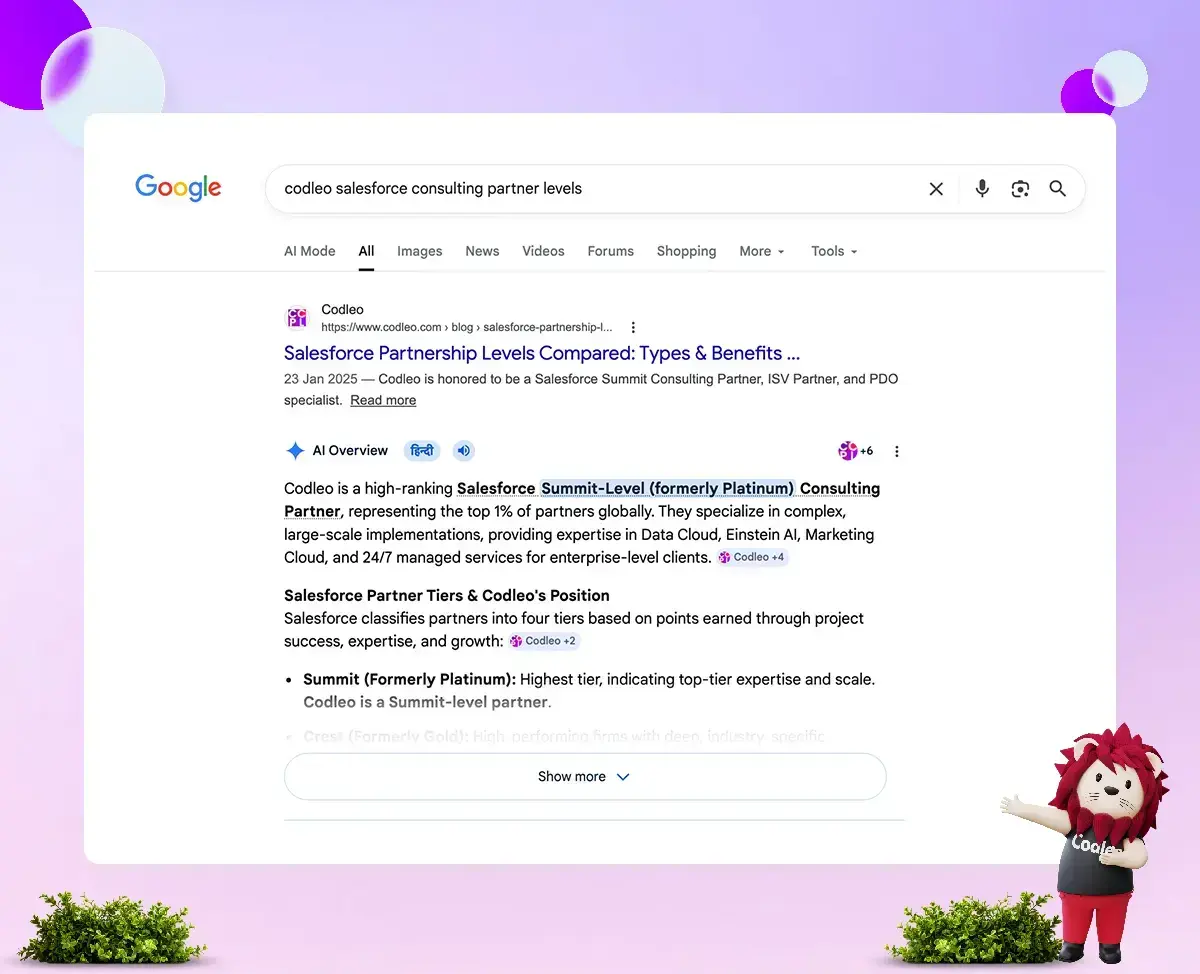
Instead of choosing a partner based only on hourly rates, evaluate whether the proposed team and delivery model match the complexity of your Salesforce environment.
What Can You Discuss With Codleo?
| If You Need Help With | What to Discuss During the Initial Assessment |
|---|---|
| New Salesforce implementation | Business requirements, Salesforce products, users, timeline, integrations, and expected outcomes |
| Existing Salesforce optimization | Current pain points, technical debt, automation, reporting, data quality, and user adoption |
| Data migration | Source systems, record volume, data quality, mapping, validation, and migration requirements |
| Salesforce integrations | Systems that need to connect with Salesforce, data flows, APIs, and integration dependencies |
| Ongoing Salesforce support | Admin capacity, enhancement requests, troubleshooting, release support, and optimization priorities |
Before the Call, Prepare These 5 Things
To make the conversation more useful, bring:
-
Your current CRM or Salesforce setup
-
The business processes you want to improve
-
Systems that need to integrate with Salesforce
-
Approximate number of users
-
Target timeline and budget range, if available
This gives the Salesforce consultants enough context to discuss an appropriate scope, delivery approach, and realistic next steps.
Verify Codleo on Salesforce AppExchange
Codleo Consulting has an active Salesforce AppExchange consulting profile showing its Salesforce competencies, certified professionals, customer rating, and geographic experience, including the United States.
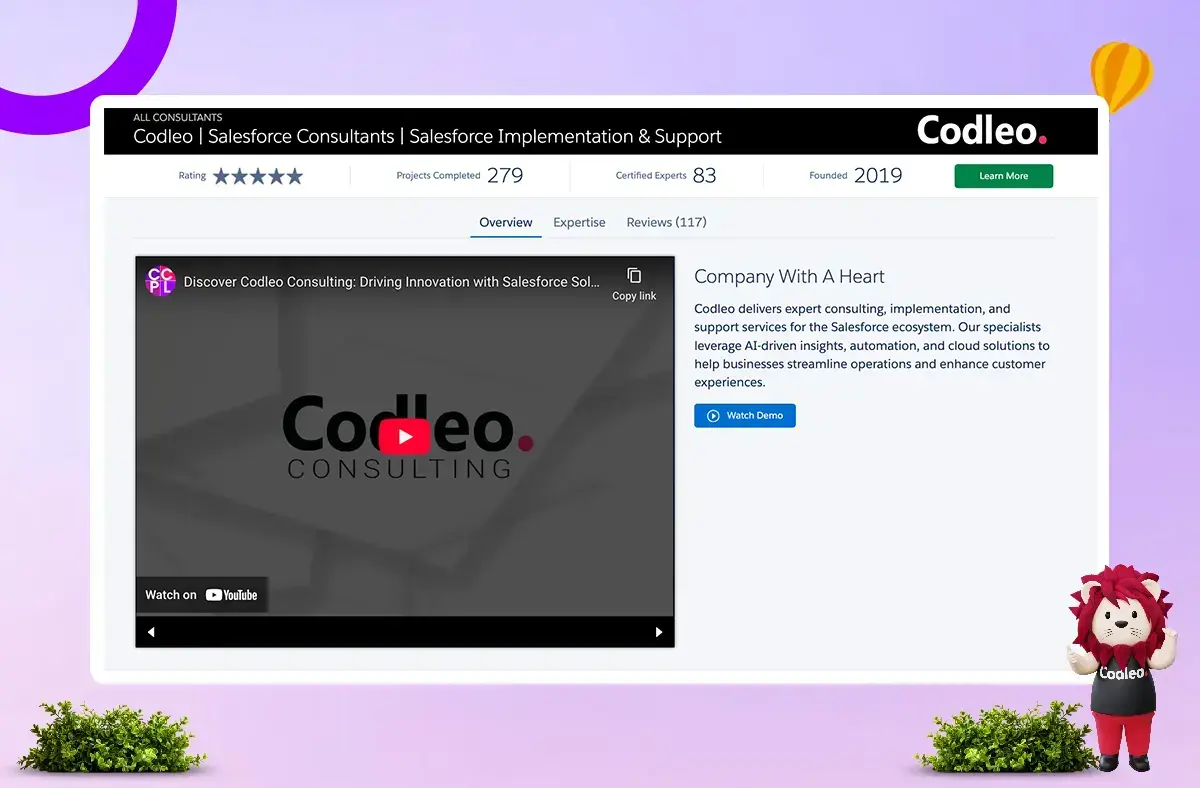
Businesses evaluating Codleo can review the AppExchange profile alongside relevant case studies before deciding whether the team fits their project requirements.
Get a Salesforce Project Fit Assessment
If you're planning a Salesforce project in the USA, Codleo offers an initial Salesforce fit assessment to discuss your requirements, potential project scope, implementation approach, and support needs.
You'll have a clearer understanding of:
-
The likely Salesforce services required
-
Key scope and integration considerations
-
The type of consulting resources your project may need
-
Questions that should be resolved before implementation
-
The appropriate next step for developing a detailed estimate
Book your free Salesforce fit assessment →
 0
0
About the Author



 16192 Coastal Highway Lewes, Delaware 19958 USA


