


Publish date:
Choosing a CRM system is an essential decision for businesses in the UAE. Simply purchasing and installing a CRM with multiple features will not automatically improve customer relationships or increase sales. Companies in Dubai and across the UAE need a clear strategy aligned with local market dynamics, customer expectations, and compliance requirements to ensure successful implementation and avoid wasting time and money.
If you are asking questions like “How do I choose a CRM consultant in the UAE?”, “What does a CRM implementation consultant do for Dubai-based businesses?” or “How can I hire the right CRM consultant in the UAE?” — This guide will help you make an informed decision.
According to Grand View Research, Inc., the global CRM market is expected to reach $163.16 billion by 2030. The UAE is undergoing rapid digital transformation across industries, including real estate, retail, healthcare, finance, and government. With increasing demand for cloud-based solutions and AI-powered CRM systems, more CRM consultancies are entering the Dubai and UAE market. As a result, selecting the right CRM implementation partner has become more challenging.
Choosing the right CRM consultant in the UAE is critical for successfully implementing, customizing, and optimizing your CRM system. A qualified consultant brings regional industry knowledge, technical expertise, and strategic guidance. They help ensure smooth deployment, compliance with local regulations, better customer engagement, and improved return on investment for UAE businesses.
What is a CRM Consultant?
A CRM consultant helps businesses get more value from their customer relationships by setting up and improving the right CRM tools. They take a close look at how your sales, marketing, and support teams work today, then identify gaps and opportunities to streamline operations. Based on these insights, they suggest practical solutions and train your team on how to use the system effectively. The goal is simple: cleaner processes, better customer conversations, and a noticeable boost in overall efficiency.
Why Do UAE Businesses Need a CRM Consultant?
In today's business environment in the UAE, managing customer relationships is critical. A good customer relationship management (CRM) system helps companies in Dubai and throughout the UAE manage client interactions, improve services, and drive growth.
-
Gain a 360-degree view of customers,
-
Enhance customer satisfaction and loyalty,
-
Increase revenue and sales efficiency,
-
Generate insights to improve strategies and decision-making.
Hiring an experienced CRM consultant in the UAE is a wise decision. These experts offer personalized advice based on your business needs and help you with the CRM implementation process.
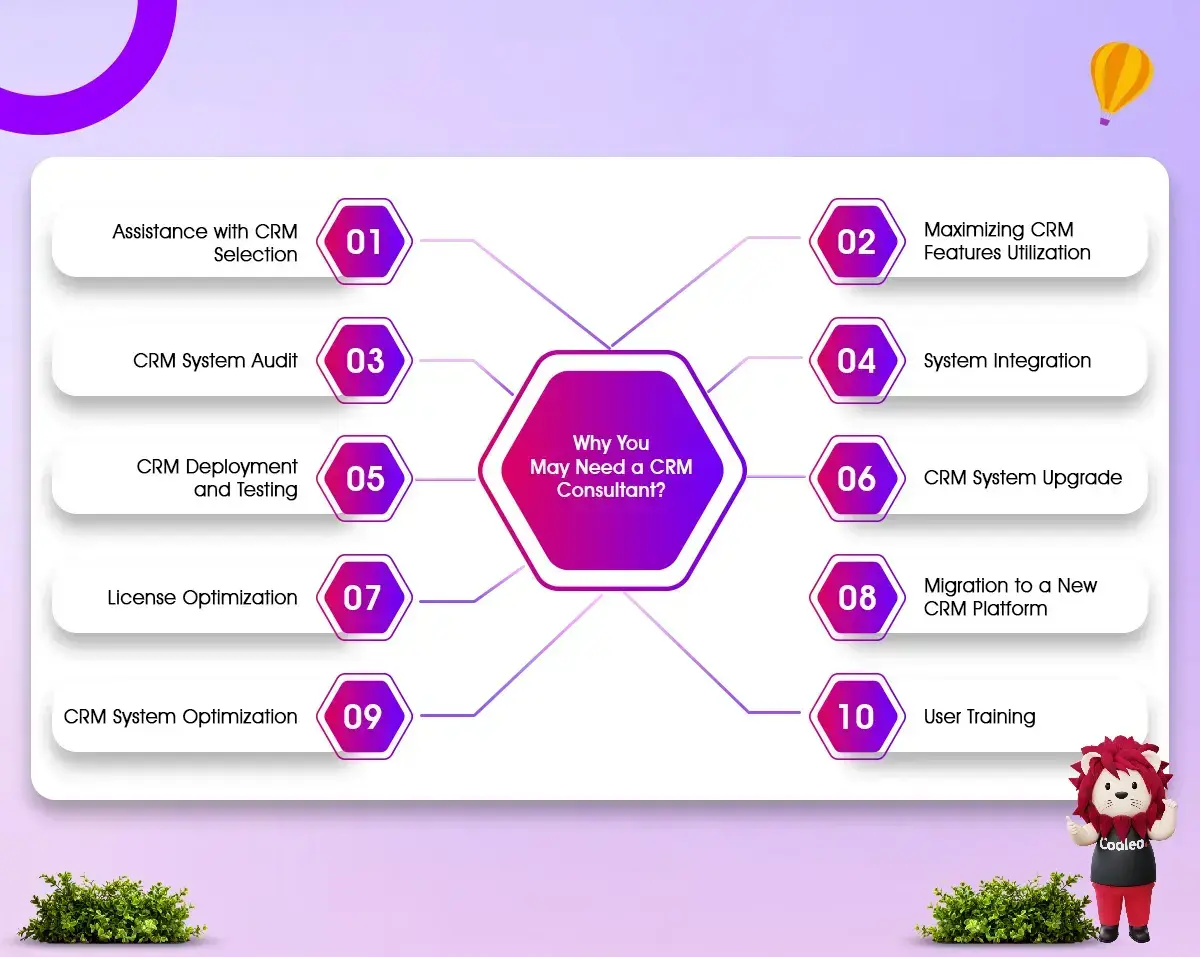
You might need a CRM consultant if you want to:
-
Choose the best CRM platform for your business in the UAE.
-
Keep costs low by avoiding unnecessary features while ensuring your data is secure.
-
Improve your CRM software, handle data well, and follow local rules.
-
Use more CRM features to work more effectively and get things done efficiently.
-
Get help with testing, deployment, and performance optimization.
-
Integrate your CRM with existing systems to streamline operations,
-
Improve your current CRM to meet changing business needs.
-
Switch to a new CRM system that clearly aligns with your business processes.
-
Create clear training programs to help your team get started quickly.
-
Get expert help on best practices, staying compliant, and increasing your return on investment (ROI).
Choosing the wrong CRM consultant in the UAE, however, can be costly and counterproductive:
-
Implementation can be slow, costly, or face delays.
-
Misaligned systems can cause workflow problems and lower productivity.
-
Extra costs can come from fixing mistakes, redoing work, or changing platforms.
-
Poor management of customer relationships can damage customer connections and harm your brand's reputation.
-
Delays in deploying a system can slow the pace at which a product reaches the market. It can hurt competitiveness and slow growth.
-
A skilled CRM consultant helps your business in Dubai or the UAE implement CRM smoothly, build strong customer relationships, and increase your return on investment (ROI).
What Does a CRM Consultant Do?
CRM consultants help businesses choose, set up, and improve their CRM systems. They review current processes, analyze data management, and refine sales and customer interaction strategies to improve the system's performance.
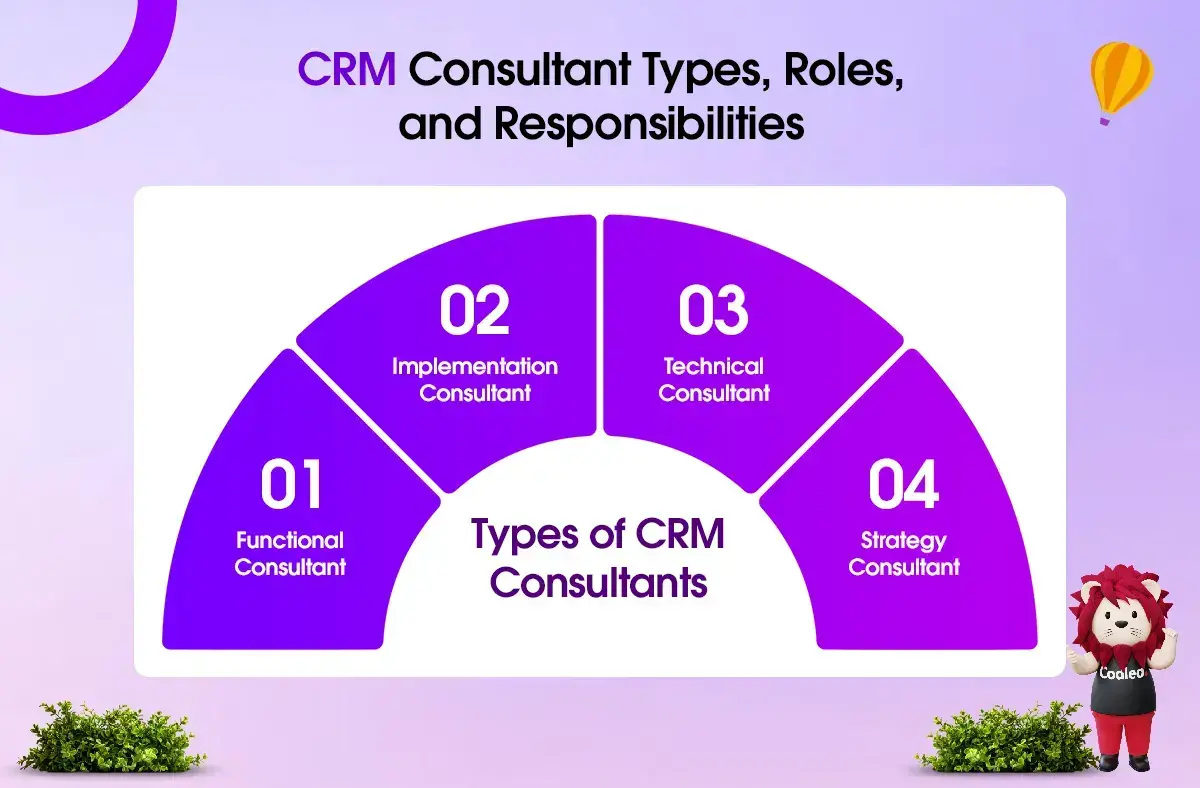
CRM Consultant Types, Roles, and Responsibilities
There are two main types of CRM advisors: functional consultants and technical consultants. Functional consultants focus on business processes and strategy. Technical consultants handle system setup and integration.
There are two types of consultants: strategy consultants and implementation consultants. Strategy consultants help align CRM systems with business goals. Implementation consultants carry out the strategic plans.
What is a Functional CRM Consultant?
A Functional Consultant customizes CRM solutions to meet specific business needs. They collect both functional and non-functional requirements during different stages of CRM implementation. They ensure the system meets these criteria.
A Functional Consultant analyzes systems, configures them, and adjusts settings to achieve the desired functionality.
They create precise functional specifications and work closely with the technical team to ensure accurate implementation. They also manage documentation, support clients during user acceptance testing, and provide training for key users.
Functional CRM consultants can help with CRM strategy and system implementation.
What is a Technical CRM Consultant?
A Technical CRM Consultant works with the technical aspects of CRM solutions. Their main tasks include:
-
Examine what the customer needs from their system.
-
Work with pre-sales and functional teams to discuss technical details.
-
Set up and test customer relationship management systems.
-
Manage connections with other platforms and online services.
In complex projects, they help design technical specifications and data models. They provide technical support to clients and mentor junior team members.
What Do Strategy CRM Consultants Do?
Strategy CRM Consultants help businesses align their CRM system with their goals. They study customer behavior and current processes to create a custom CRM plan. This plan includes key performance indicators (KPIs) and a step-by-step implementation guide.
What Do Implementation CRM Consultants Do?
CRM Implementation Consultants turn strategic plans into action. They perform the following tasks:
-
System configuration,
-
Data migration,
-
Workflow automation.
-
User training
-
CRM system issues troubleshooting.
CRM Consultant Types, Roles & Responsibilities
1. Implementation CRM Consultant
Role:
-
Leads CRM deployment
Responsibilities:
-
Gather business requirements
-
Customize the CRM platform
-
Configure workflows and reports
-
Train users on the system
Qualifications:
-
Bachelor’s degree in Business, IT, or related field
-
CRM certification (e.g., Salesforce Certified Administrator)
2. Strategy CRM Consultant
Role:
-
Provides strategic CRM guidance
Responsibilities:
-
Assess business needs and objectives
-
Develop a CRM strategy aligned with organizational goals
-
Advise on CRM best practices and industry trends
Qualifications:
-
Extensive experience in CRM strategy
-
Strong analytical and problem-solving skills
3. Functional CRM Consultant
Role:
-
Focuses on business processes
Responsibilities:
-
Analyze business processes
-
Map requirements to CRM functionality
-
Optimize workflows for improved efficiency
Qualifications:
-
Strong understanding of CRM concepts and processes
-
Experience in business analysis and gathering requirements
4. Technical CRM Consultant
Role:
-
Manages system connections and custom changes.
Responsibilities:
-
Design and implement system integrations
-
Develop custom CRM features and extensions
-
Ensure system stability and technical performance
Qualifications:
-
Proficiency in programming languages (Apex, JavaScript, etc.)
-
Experience with CRM platforms and development tools
What Types of Businesses Use CRMs?
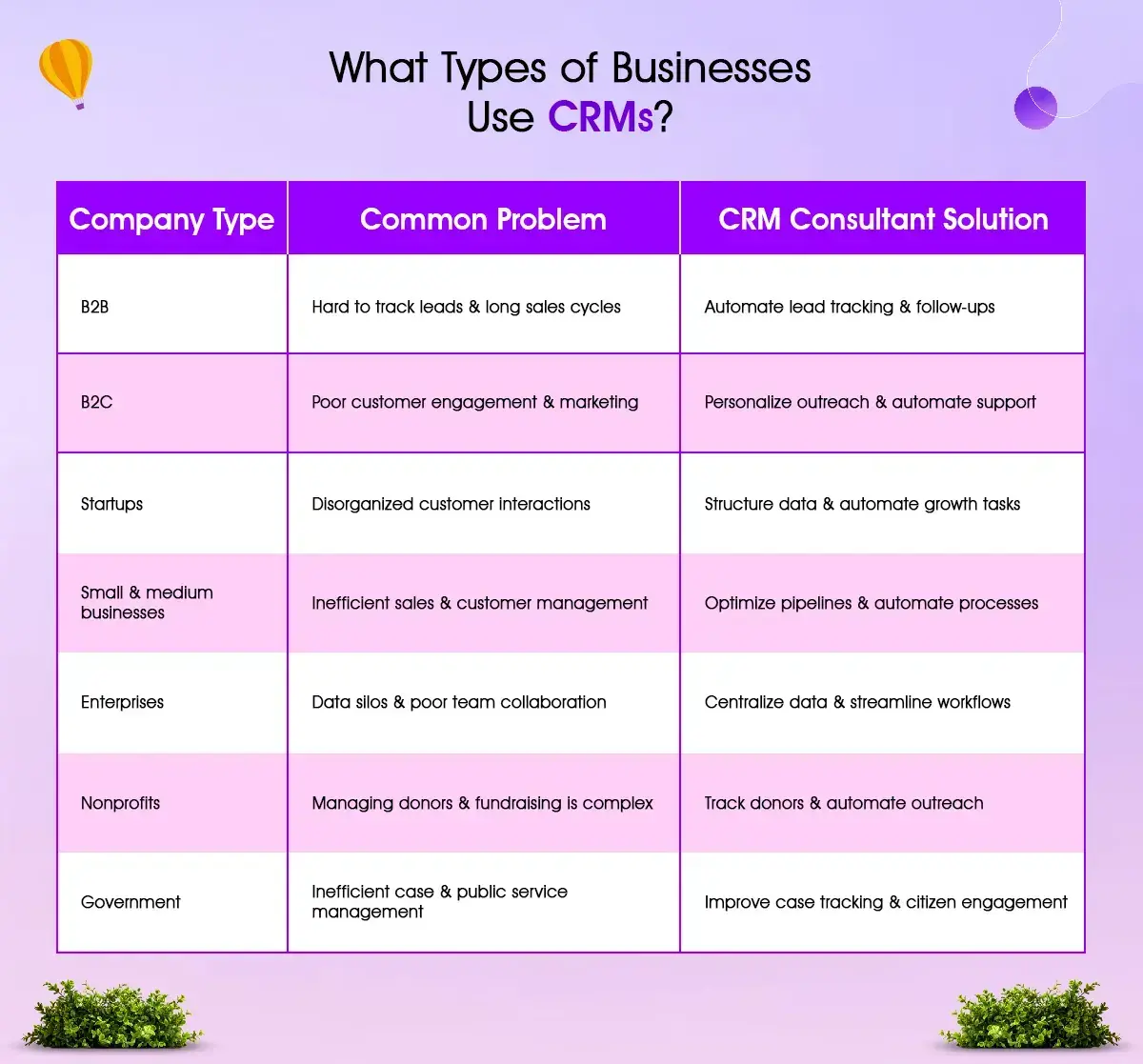
A CRM consultant helps businesses of all sizes use CRM systems. They improve customer relationships, automate tasks, and drive growth.
-
B2B and B2C companies – B2B companies use CRMs to track leads, manage sales, and build strong relationships with clients. B2C businesses use CRMs for personalized marketing, customer support, and customer engagement.
-
Startups, small businesses, medium-sized businesses, and large enterprises. – Startups use CRMs to manage customer interactions and grow effectively. Small and medium businesses rely on CRMs for sales, customer management, and automating tasks. Enterprises use CRMs to gather data in one place, automate workflows, and improve teamwork.
-
Nonprofits and government organizations – Nonprofits use customer relationship management (CRM) systems to handle donors, fundraising, and outreach. For-profit businesses use CRMs to increase sales and keep customers. Government agencies use them to manage cases and engage with the public.
A good CRM strategy helps businesses in any industry become more efficient, build stronger relationships, and succeed in the long run.
Here’s a simple breakdown of the challenges businesses face and how a CRM consultant can help:
Let’s look at some common challenges businesses face when choosing a CRM consultant and how to address them effectively.
Key Challenges of Choosing the Right CRM Consultant in the UAE
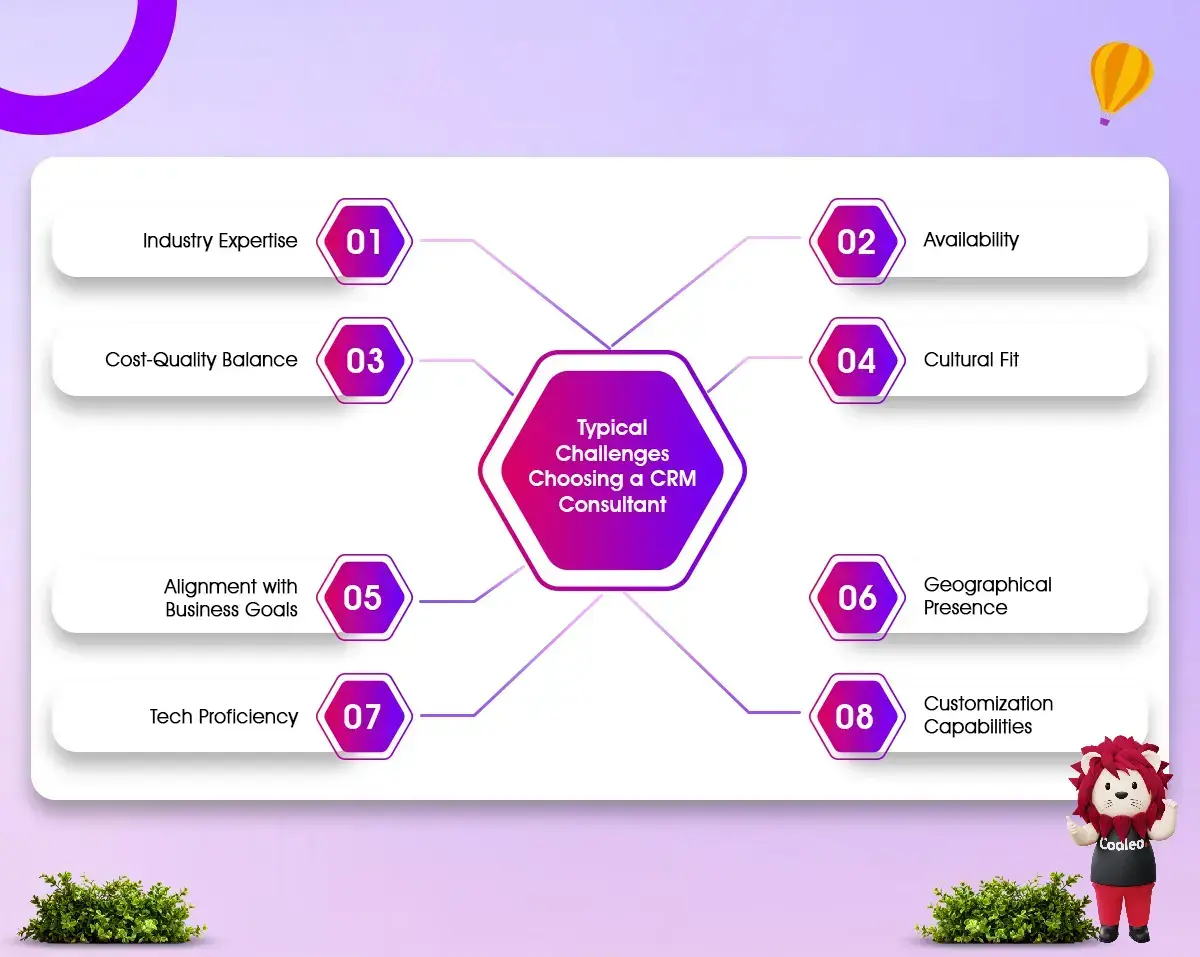
Finding the right CRM consultant can be tough for businesses in Dubai and the UAE. Here are some common challenges that companies in the UAE often face:
-
Unclear CRM Goals: Many businesses struggle to define their CRM goals. It makes it hard to pick the right consultant.
-
Budget Constraints: Hiring a skilled CRM consultant with the right experience can be difficult if money is tight. Companies need to ensure the consultant’s fees match the value they deliver.
-
Platform Expertise: The consultant needs to understand your chosen CRM platform, such as Salesforce or Microsoft Dynamics. If they lack this knowledge, it can cause delays and increase your implementation costs.
-
Industry-Specific Experience: Finding a CRM consultant who understands your industry—such as real estate, retail, healthcare, or finance in the UAE—can be challenging. If a consultant lacks industry knowledge, their strategies may not work as well.
-
Cultural Fit: The consultant should fit in well with your company culture and work closely with your in-house teams. A poor cultural fit can lead to communication problems and lower productivity.
-
High Demand and Availability: Finding skilled CRM consultants in Dubai and the UAE can be difficult. They are often in high demand, which makes it hard to schedule a meeting with them at your preferred time.
-
Short-Term vs. Long-Term Needs: While a consultant can help achieve short-term goals, they might not be the best choice for long-term CRM strategy and improvement. Businesses should consider this before hiring.
Understanding these challenges helps businesses in the UAE prepare effectively, make informed decisions, and select a CRM consultant who can ensure successful implementation and increase their return on investment.
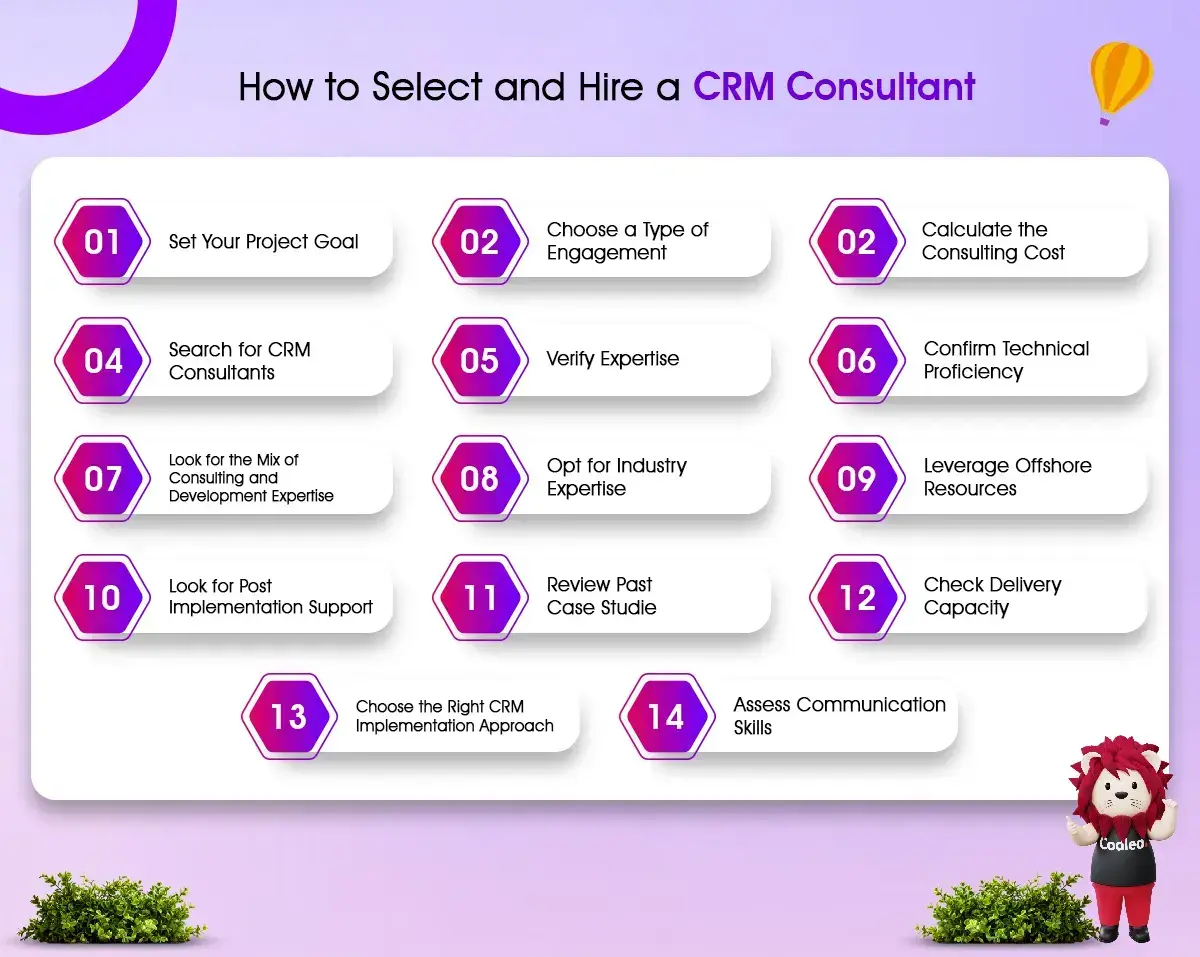
15 Tips to Select and Hire the Right CRM Consultant in the UAE
When hiring a CRM consultant in Dubai or across the UAE, focus on essential selection criteria to ensure successful implementation and maximum ROI:
1. Set Your CRM Project Goal
To choose the right CRM consultant, start by clarifying your goals. When you know exactly what you want your CRM system to achieve, it becomes much easier to find a consultant whose skills and approach match your needs.
If you want to improve how you interact with customers and handle sales, a functional CRM consultant is a good choice. If you want to focus on a broader customer relationship management strategy for your business, then a strategy CRM consultant would be better.
If you have specific technical needs, like integrating systems or developing custom software, you should work with a technical CRM consultant. Understanding your goals helps you narrow your options and communicate more effectively with potential customer relationship management consultants.
First, understand your business needs. Then, list what you need from a consultant in two categories: ‘must-haves’ and ‘nice-to-haves.’ Make sure to define both your immediate and long-term CRM requirements.
You might not use email outreach or lead scoring right now, but consider how these CRM features could become important as your business expands.
Make a detailed list of what you need, including plans for future growth.
2. Pick Your Preferred Engagement Type
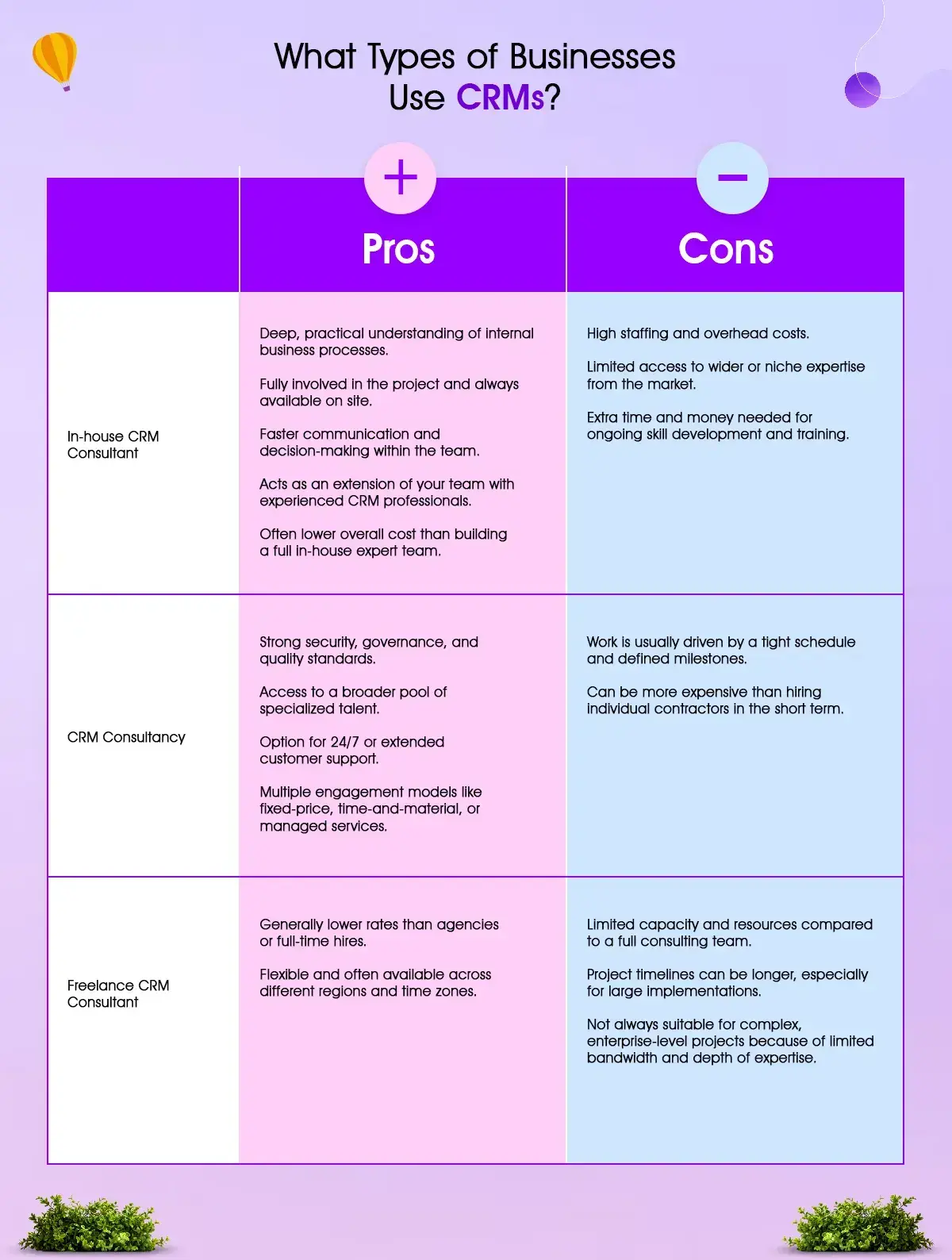
There are three main ways to hire a CRM consultant: you can bring someone in-house, hire a CRM consulting firm, or work with a freelance CRM consultant. The roles of in-house and freelance consultants are usually clear, so let’s look at their advantages and disadvantages.
3. Calculate the cost of CRM consulting.
Understanding the cost structure is essential for budget planning and evaluating the value a CRM consultant adds to your project. Consultants can charge in different ways: by the hour, with a fixed project fee, or on a retainer basis.
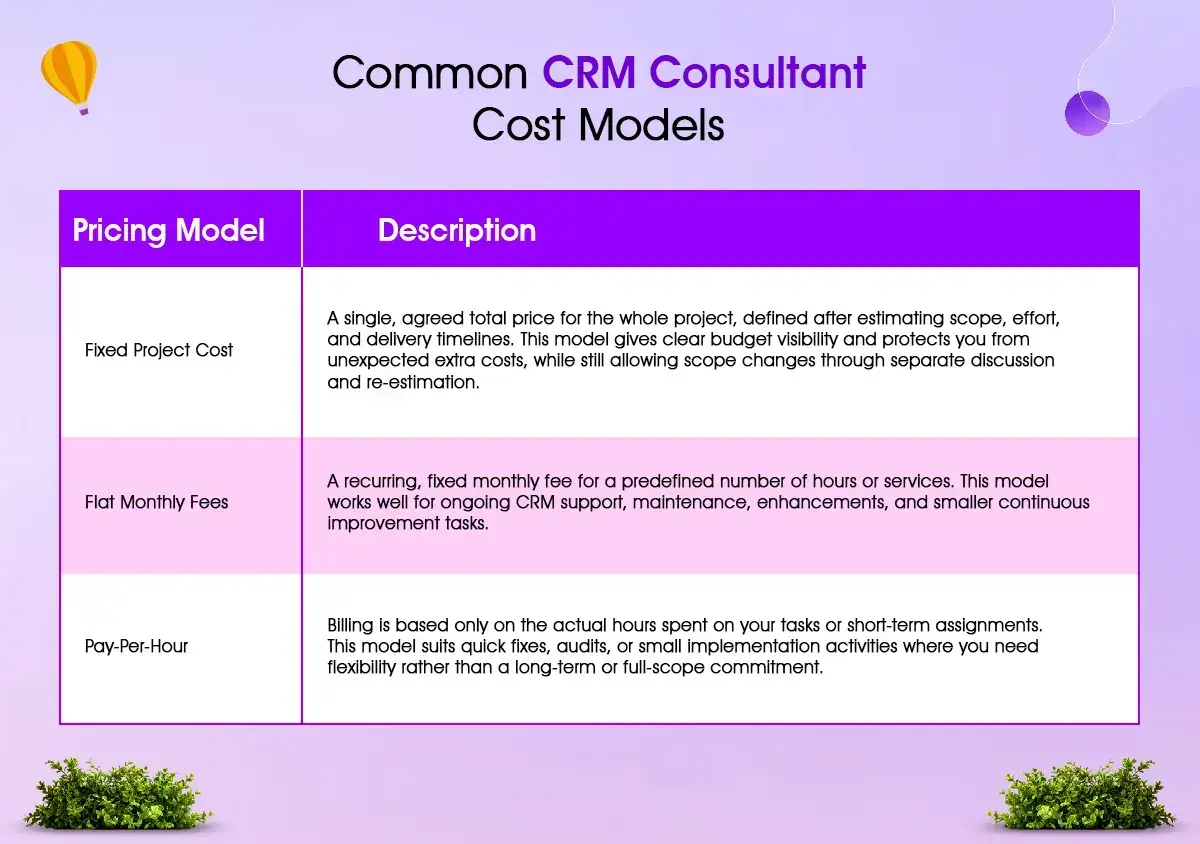
Hourly rates offer flexibility, but costs can rise if the project takes longer than planned.
Fixed project fees give you clear costs but might not work well if the project changes. A retainer model provides ongoing support and ensures the consultant is available when you need help. However, if you don’t use the services frequently, you might not get your money’s worth.
It's essential to align your project’s costs with its scope and duration to ensure good value. Also, consider what the fee includes—such as post-implementation support or training—because these factors can significantly affect the project's overall cost and value.
When considering a CRM consultancy, think about the project duration. Longer projects offer lower rates, but the total cost can add up over time. Don’t choose a consultancy based solely on a low price. Initial savings may be wiped out by additional hours required to complete the project or by serious delivery issues.
Some companies use a “mixed delivery model.” It means they combine local roles, such as project managers and business analysts, with offshore development teams to reduce costs. While this option may not be the cheapest, it can still offer significant savings while maintaining the quality and experience you would expect from a UAE consulting firm.
4. Look for CRM Consultants.
Don't only depend on official websites when looking for CRM consultancies. Check their social media profiles and reviews, too. LinkedIn is a great place to do this, as it has over 660 million users worldwide.
On LinkedIn, you can easily check how big a consultancy is, see the skills of its team members, and find out where it is located. Although not everyone uses LinkedIn, it is a good place to start your research.
Good sources for your research include independent B2B review platforms like Clutch.co.
Codleo has received high praise from Clutch and AppExchange for offering great consulting and development services.
5. Check how long the business has been operating and its level of expertise.
The field of CRM consulting and implementation is highly competitive, with popular platforms such as Salesforce and Microsoft Dynamics 365. Consulting firms with a long history in this area often have valuable expertise, gained from watching CRM technology develop over time.
They have effective methods based on their specialized experience.
Knowing multiple CRM platforms helps a consultant provide advice that fits your needs better and reduces bias. This knowledge also allows them to create customized, innovative solutions for your business.
For 10 years, Codleo has worked in the CRM business and partnered with over 10 CRM systems. We have long-term partnerships with Microsoft and Salesforce, two leading CRM providers. Our experience enables us to address the challenges our clients face in managing their customer processes.
6. Verify Technical Skills
Finding a skilled CRM consultant is essential. Look for someone who understands CRM systems well. They should know how to handle critical tasks such as data migration, system integration, and feature customization.
When moving to a new system, it’s essential to have expertise in data migration. It helps ensure everything transfers smoothly from the old system. You also need experience in system integration to improve workflow. It is especially true when connecting your CRM system to other tools, such as ERP or marketing automation systems.
Customization is essential for adapting your CRM solution to meet your specific business needs. It ensures the system addresses your unique challenges rather than offering a generic solution. It’s helpful to check technical skills and related certifications beforehand. It can save you time, money, and potential issues later.
7. Check for a mix of CRM consulting and development experience.
CRM consulting firms with experience in product development provide key benefits for your custom projects. Those who have created their own CRM products or built solutions on existing platforms have a better understanding of user needs. They offer ready-made solutions for everyday business challenges and can communicate effectively with you.
CRM consulting companies have strong skills in quality control and testing. These are important for launching and supporting products for different users. Many agencies that focus solely on CRM consulting lack this level of expertise.
Our custom development team has created 17 software products.
Marketspace is a website where you can list properties. It offers secure spaces for collaboration and deal-making.
Composer is an app that helps users create brochures and reports. It works for both Salesforce and Dynamics 365 users.
8. Choose CRM consultants who have experience in your industry.
When choosing a CRM consultant, it’s essential to look for someone with experience in your industry. Consultants who know your field can provide valuable insights into market trends, customer behavior, and the everyday challenges businesses like yours face.
This knowledge gives CRM consultants an advantage in creating solutions that work well for your industry. Whether you are in healthcare, finance, manufacturing, or another field, a CRM consultant with experience in your sector will understand your needs and challenges.
It shortens the learning process and helps you achieve faster, more effective results.
Codleo has over 10 years of experience in CRM consulting and development for the commercial real estate sector. We specialize in:
-
Residential Real Estate
-
Capital Markets
-
Investment Banking
-
Land
-
Legal Services
-
Private Equity
-
Venture Capital
-
Oil & Energy
-
Property Management
9. Use Offshore Resources
Advanced collaboration tools have changed the tech community into a global marketplace. Companies can often find offshore resources at lower cost than local talent, helping them spend their budget more wisely.
Consultants with a global perspective can help companies expand into and better understand international markets. They offer a range of skills and expertise that can be hard or costly to find locally.
Codleo is a global CRM consulting firm that has expanded its services to the UAE to provide cost-effective solutions while leveraging local talent. With operations in Dubai and other key regions, Codleo delivers high-quality CRM consulting and implementation services to businesses in the UAE, maintaining excellence across all locations.
10. Seek Support After Implementation
Post-implementation support is an important consideration when choosing a CRM consultant. The work continues even after the CRM system is up and running. This new phase includes training users, fixing problems, and making ongoing improvements.
Check if the CRM consultant provides ongoing support to adjust the system as needed. This support can be invaluable for a smooth transition and for helping your team quickly adapt to the new system.
If you don't have sufficient support after implementing your CRM, you might face operational issues or see fewer users adopt it. It could waste your investment. Ensure the consultant’s support services meet your long-term needs for a successful, lasting CRM solution.
Codleo provides two types of support after implementation: on-demand CRM administration and dedicated virtual administration.
11. Review previous case studies.
When choosing a CRM consultant, reviewing their past work, like case studies or portfolios, is very important. This practice provides clear proof of their skills, knowledge, and the results they have delivered for other clients.
Look for projects similar to yours in terms of size, industry, and goals. It will help you see what they can achieve and show how well they understand the unique challenges and objectives you face.
Case studies can show how well consultants solve problems, meet deadlines, and satisfy customers. By looking at a consultant's past work, you can better predict how they will perform on your project. It helps reduce risks and leads to a more successful implementation—Review Codleo's portfolio of projects.
12. Check the delivery capacity.
It might seem like larger firms are better, but it's more important to pay attention to how quickly they respond and how well they communicate.
Be careful with quality control and the risk of inflated consulting hours. Freelance CRM consultants and smaller CRM firms may be very popular, so take enough time to find the right one. Ask them about their availability to start your project.
Choose your consultant based on the complexity of your project. For simple projects, a consultant with multiple skills can handle roles such as project manager, business analyst, and developer, thereby saving costs. For larger, more complex projects, you may need specialized consultants to achieve the best results.
13. Select the Best Way to Implement a CRM System
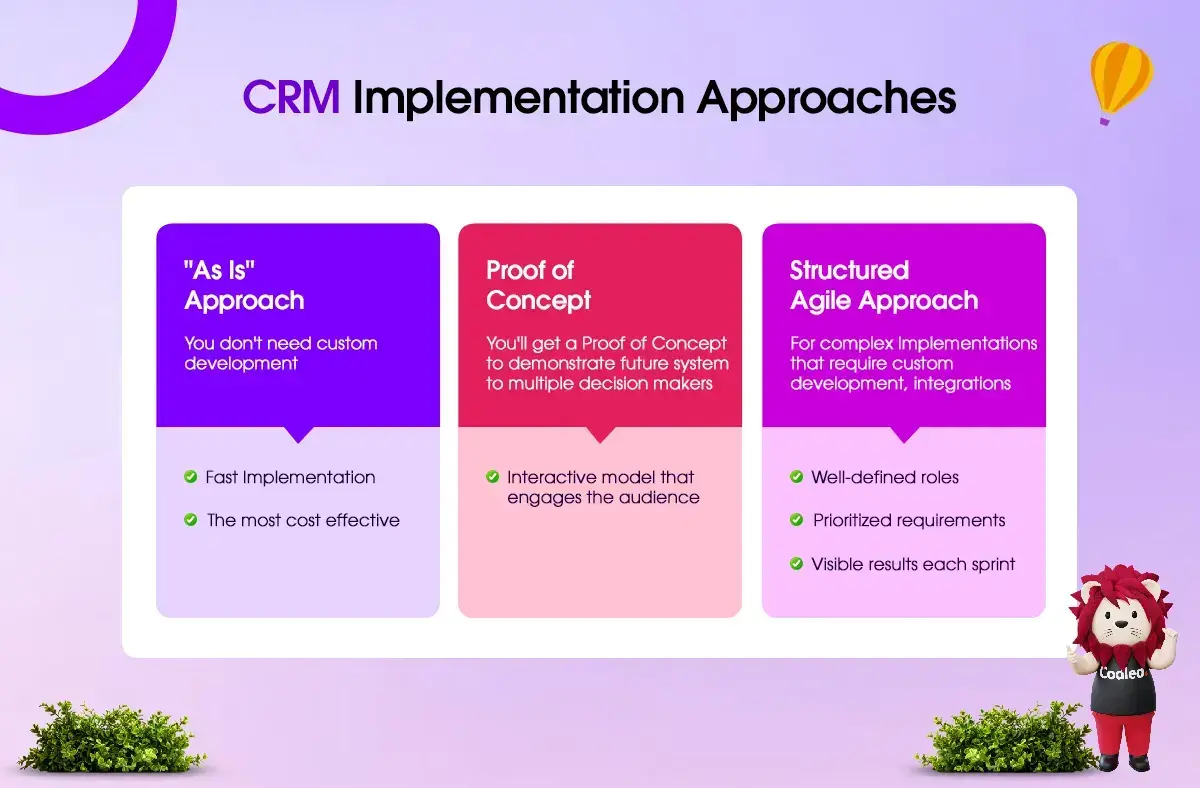
Ensure your CRM implementation specialist’s approach aligns with your goals and needs. Different projects need different strategies.
-
Flexible Approach – Choose a consultant who can adjust to your business needs and culture.
-
“As-Is” Approach – This simple method helps you focus on transforming data and training by using existing features. It cuts costs and speeds up delivery time.
-
Proof of Concept (PoC) Approach– For projects with unclear ideas, a Proof of Concept (PoC) approach helps turn vague requirements into a concrete model. It is done through ongoing interactions and feedback.
-
Structured Agile Approach – For larger, more complex projects that involve multiple business areas and system connections, a structured agile approach is essential. This approach will likely require dedicated project management and business analysis skills to manage timelines, budgets, and project scope effectively.
14. Evaluate Communication Skills
Effective communication is a key part of successfully implementing CRM systems. A good CRM consultant needs to be good with both technology and communication. They should listen carefully to understand your business challenges, needs, and goals.
They need to explain complex technical terms in simple language so that everyone, even those unfamiliar with technology, can understand. If communication is unclear, it can lead to misunderstandings, increase project scope, and cause project failure.
When choosing a consultant, please pay attention to how they communicate. Look for clear, simple explanations and open conversations. These qualities will help make the implementation process smoother and more effective.
After you choose potential consultants, make a list of questions to help you decide if they are a good fit.
Here’s what our clients are saying about our partnership:
15. additional suggestions
Always ask your shortlisted CRM consultants for a detailed proposal. The proposal should clearly explain the project's scope, specific deliverables, estimated timelines, and a cost breakdown. It will help you understand what you're agreeing to and set clear expectations for both parties, reducing misunderstandings and scope creep later.
Before you finalize your agreement with a CRM consultant, carefully review all the contract documents. Pay special attention to sections about confidentiality, data security, and how to end the contract. Understanding these details from the start helps reduce risks and makes sure both parties know their responsibilities and expectations.
Bonus: 14 Questions to Ask Your CRM Consultant in the UAE
To successfully hire a CRM consultant in Dubai or across the UAE, consider asking the following questions:
-
How long have you been providing CRM consulting services in the UAE or international markets?
-
Do you have experience in my industry? Can you share case studies, portfolios, or client references from similar businesses in the UAE?
-
How have you solved challenges similar to ours? (This can give you ideas for your future CRM implementation.)
-
What is your average project size in terms of budget, users deployed, and data migrated?
-
Which CRM platforms have you worked with? Are you affiliated with a specific CRM vendor, such as Salesforce?
-
Do you have experience developing custom CRM applications or integrations?
-
How do you approach projects? What will you need from our team, and what will be our responsibilities?
-
Which CRM tools and technologies are you proficient with, specifically?
-
Who will work on our project? Can you provide CVs or bios of the team members who will handle our implementation?
-
When can you start working on our CRM project?
-
What is your pricing model? What is the typical cost for a project similar to ours in Dubai/UAE?
-
Do you provide training and ongoing support for users? Can we review your Service Level Agreement (SLA) and responsibilities?
-
How do you ensure quality control and adherence to project timelines?
-
What experience do you have in training teams to adopt and effectively use a new CRM platform?
Asking these questions helps UAE businesses make informed decisions, ensuring a smooth CRM implementation and maximizing return on investment.
Why Choose Codleo Consulting as Your CRM Partner in the UAE
Codleo Consulting has over 10 years of experience in customer relationship management (CRM). We help businesses in Dubai and across the UAE choose, implement, and improve their CRM systems. Our expertise includes Salesforce and Dynamics 365 consulting, as well as AppExchange app development, ensuring our solutions fit your specific business needs.
We follow ISO 27001 standards to keep your business and customer data safe throughout the project.
Our CRM services in the UAE include:
-
CRM Selection: We look at your business needs and compare CRM platforms to help you find the right solution.
-
CRM Implementation & Workflow Design: We create CRM systems that fit your processes. We use built-in features and custom functions, integrating detailed customer profiles to boost productivity.
-
Custom CRM Development: We create CRM solutions for businesses that need a comprehensive system with specialized features.
-
CRM Migration: We move your data to a better CRM system without interrupting your daily work.
-
CRM Optimization: We enhance your current CRM by resolving issues and helping you make the most of features you may not be using to their full potential.
-
System Consolidation: We consolidate multiple CRM systems into a single platform. It helps us standardize processes and maintain clean data across all departments.
-
Digital Transformation Support: Our expert team assists businesses in the UAE with workshops, user story development, Salesforce deployments, and user adoption strategies. We focus on making the digital transformation smooth and effective.
Schedule your free consultation today. Let Codleo Consulting help your UAE business with CRM challenges, improve operations, and increase ROI with expert advice.
 0
0
About the Author

FAQ
A CRM consultant guides UAE businesses in selecting, setting up, and optimizing CRM systems such as Salesforce and Dynamics 365. They ensure the setup goes smoothly, keep data secure, and help build stronger customer relationships.
Look for consultants with experience in your industry, a strong understanding of your CRM system, a good track record, skilled team members, fair pricing, and a clear plan to help you achieve your business goals.
Codleo Consulting supports UAE businesses with Salesforce, Dynamics 365, and AppExchange app development. They create custom solutions to fit each business�s unique needs.
The cost depends on your project�s size, the level of customization you need, the platform you choose, and the support you want. Consultants like Codleo are transparent about pricing and aim to deliver solutions that offer strong value for your investment.
How long a project takes depends on how complex it is, how many users are involved, whether you need to move data, and whether you want any custom features. Most projects take anywhere from a few weeks to several months to complete.
CRM Consultants help you safely migrate your data to a new system. They ensure that your daily business operations continue without disruption.
CRM consultants in the UAE support clients across industries such as real estate, healthcare, retail, finance, and education. For example, Codleo offers specialized knowledge for these sectors.
Yes. Experienced CRM consultants provide clear training programs and workshops to help users adopt the system easily and make the most of CRM benefits.
A CRM gathers customer information in one place. It simplifies workflows and improves reporting. It also enhances communication and supports sales and marketing efforts, improving efficiency and return on investment (ROI).
Codleo offers secure, scalable, and customized CRM solutions that meet the needs of businesses in the UAE. We combine technical skills, local market knowledge, and global best practices to achieve this

 603 D-Mall Netaji Subhash Place, Delhi 110034 IND


