


Publish date:
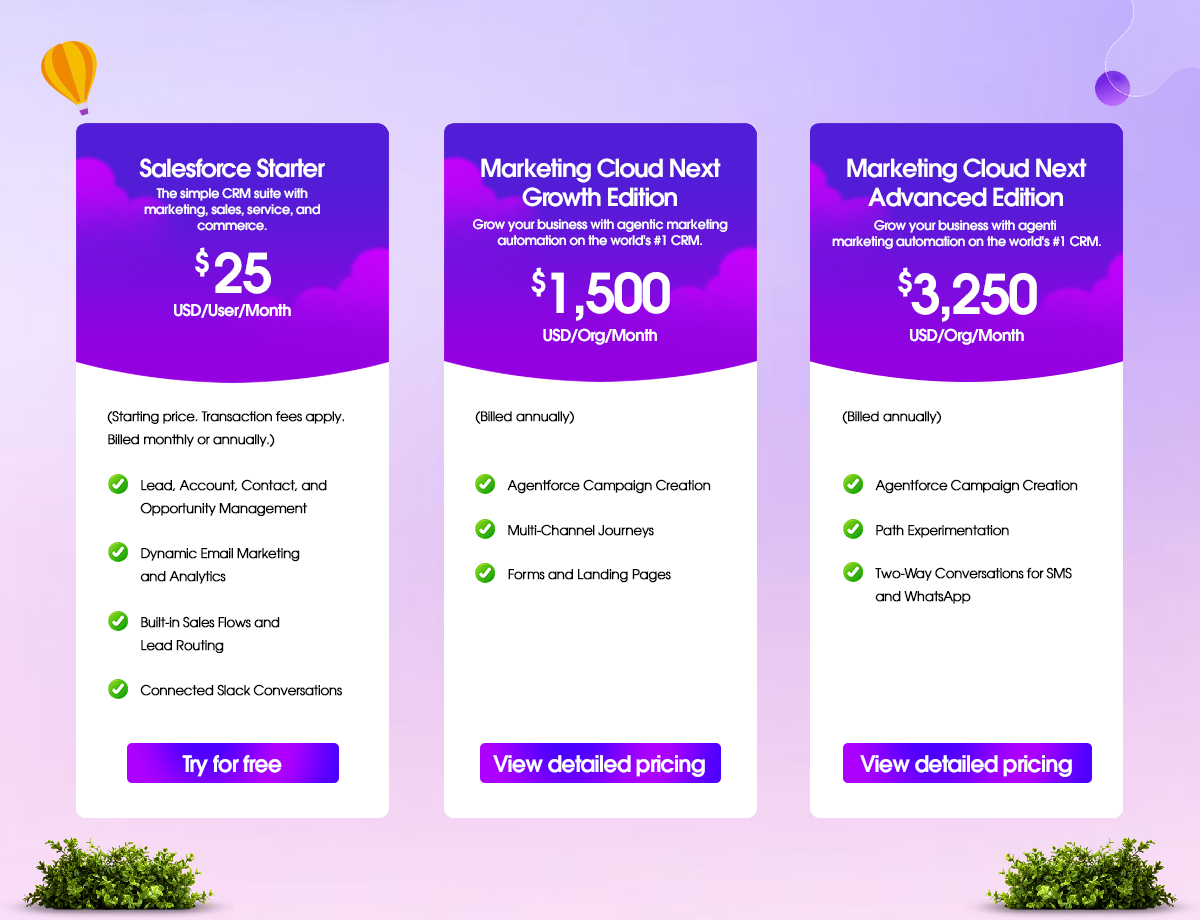
Salesforce Marketing Cloud pricing starts at $25 per user/month for Starter Suite, $1,500 per organization/month for Marketing Cloud Growth, and $3,250 per organization/month for Marketing Cloud Advanced.
But the subscription price is only part of the total investment.
Your actual Salesforce Marketing Cloud cost can vary based on the edition you choose, messaging volume, customer data usage, integrations, implementation requirements, add-ons, and ongoing support.
If you are comparing Salesforce Marketing Cloud plans in 2026, the table below gives you a quick starting point.
Salesforce Marketing Cloud Pricing at a Glance
| Salesforce Marketing Cloud Plan | Starting Price | Best For |
|---|---|---|
| Starter Suite | $25/user/month | Small businesses getting started with CRM, sales, service, and marketing |
| Pro Suite | $100/user/month | Growing businesses needing more automation and customization |
| Marketing Cloud Growth | $1,500/org/month | Businesses scaling cross-channel marketing and AI-powered campaigns |
| Marketing Cloud Advanced | $3,250/org/month | Larger teams needing advanced automation, AI, and journey orchestration |
| Enterprise & Add-ons | Custom / usage-based | Businesses with complex data, messaging, integration, or high-volume requirements |
Quick answer: For most businesses evaluating the dedicated Marketing Cloud platform, the starting budget is typically $1,500–$3,250 per organization/month before implementation, messaging usage, integrations, and optional products.
Pricing can change, and some Salesforce products use usage-based or custom pricing. Always confirm current rates on Salesforce’s official pricing page before making a purchasing decision.

So, how much does Marketing Cloud cost? Let’s find out.
Note: For the most up-to-date pricing, check Salesforce’s official pricing page.
What’s New in Salesforce Marketing Cloud Next for 2026?
Salesforce Marketing Cloud has evolved beyond traditional email marketing into a broader AI-powered marketing platform. In 2026, Marketing Cloud Next brings Agentforce, customer journeys, audience segmentation, content creation, and cross-channel engagement closer to the core Salesforce platform.
The biggest changes buyers should understand are:
-
Agentforce is built into the marketing experience: Teams can use AI to assist with campaign creation, audience segmentation, content development, and campaign execution.
-
Customer journeys are becoming more conversational: Advanced capabilities support two-way interactions across channels such as SMS and WhatsApp rather than relying only on one-way campaigns.
-
Growth and Advanced serve different levels of complexity: Growth suits businesses scaling marketing automation, while Advanced adds capabilities such as AI-powered scoring, path experimentation, and more sophisticated journey orchestration.
-
Usage matters more when estimating cost: Messaging, customer data, personalization, and additional Marketing Cloud products can increase your total investment beyond the base subscription.
What this means for buyers: Don’t compare Marketing Cloud plans on license price alone. Start with the customer journeys, channels, data, AI capabilities, and campaign volume your business actually needs, then choose the edition that supports those requirements.
Salesforce Marketing Cloud Additional Product Pricing
The base Marketing Cloud subscription may not cover every marketing requirement. Salesforce offers additional products for B2B automation, personalization, analytics, loyalty programs, and existing Marketing Cloud customers who want access to newer capabilities.
Here is a quick look at some of the additional costs businesses may need to consider:
| Product | Starting Price | When You May Need It |
|---|---|---|
| Account Engagement+ | $1,250/org/month | B2B lead nurturing, scoring, automation, and sales-marketing alignment |
| Engagement+ | $2,000/org/month | Existing Marketing Cloud Engagement customers who need next-generation Marketing Cloud capabilities |
| Marketing Intelligence | $10,000/org/month | Marketing analytics, campaign measurement, data management, and performance optimization |
| Intelligence+ | $11,000/org/month | Existing Marketing Intelligence customers who need enhanced AI and Marketing Cloud Next capabilities |
| Salesforce Personalization | $8,000/org/month | Real-time personalization across web, mobile apps, email, products, and content |
| Loyalty Management | $20,000/org/month | Enterprise loyalty, rewards, member management, and personalized loyalty programs |
Buyer tip: You may not need all of these products. Start with the business outcomes you need—such as B2B lead nurturing, cross-channel personalization, marketing analytics, or loyalty management—then decide which capabilities to add to your Marketing Cloud setup.
Prices shown are starting prices in USD and are generally billed annually. Salesforce pricing and packaging can change, so confirm current pricing before purchasing.
What Is Included in Salesforce Marketing Cloud?
Salesforce Marketing Cloud combines marketing automation, customer data, AI, personalization, and cross-channel engagement in one platform. However, the features available to you depend on the Marketing Cloud edition and add-ons you choose.
Here are the core capabilities businesses should compare:
| Capability | What It Helps You Do |
|---|---|
| Email Marketing | Create, personalize, send, and measure email campaigns |
| Audience Segmentation | Build targeted audiences using CRM and customer data |
| Agentforce Campaigns | Use AI to support campaign creation and execution |
| Customer Journeys | Automate interactions across different stages of the customer journey |
| Forms & Landing Pages | Capture leads and customer information for marketing campaigns |
| Campaign Analytics | Measure campaign engagement and performance |
| SMS & WhatsApp | Engage customers through messaging channels; additional usage or credits may apply |
| Personalization | Tailor content, recommendations, and customer experiences based on data and behavior |
| AI-Powered Scoring | Prioritize customers and opportunities using predictive insights |
| Journey Experimentation | Test different customer journey paths and optimize engagement |
What’s Not Included in Every Marketing Cloud Plan?
Not every Marketing Cloud capability comes with every edition.
For example, businesses that need advanced personalization, marketing intelligence, loyalty management, higher messaging volumes, or more sophisticated AI capabilities may need a higher edition or additional Salesforce products.
Before choosing a plan, identify the capabilities your marketing team will actually use. This makes it easier to compare editions based on business requirements rather than simply choosing the plan with the longest feature list.
How Does Salesforce Marketing Cloud Pricing Work?
Salesforce Marketing Cloud pricing is not based on the subscription fee alone. Your total cost depends on the edition you choose, how much messaging and data you use, the additional products you need, and the complexity of your implementation.
A simple way to estimate your Marketing Cloud investment is:
Total Marketing Cloud Cost = Base Subscription + Usage + Add-ons + Implementation + Ongoing Support
Here’s what each part means:
1. Base Subscription
Your starting cost depends on the Salesforce product and edition you choose.
For example, Marketing Cloud Next Growth starts at $1,500 per organization/month, while Advanced starts at $3,250 per organization/month, billed annually.
2. Messaging and Data Usage
Email, SMS, WhatsApp, customer data, and other usage-based capabilities can affect your overall cost.
Businesses running high-volume or cross-channel campaigns should estimate expected usage before selecting an edition rather than budgeting around the base license alone.
3. Additional Products and Capabilities
Your requirements may extend beyond the core Marketing Cloud edition.
Products for personalization, marketing intelligence, B2B marketing automation, loyalty management, and other capabilities can increase the overall subscription cost.
4. Implementation and Integration
Buying the license does not mean Marketing Cloud is ready to use.
Your initial investment may also include configuration, customer journey setup, data migration, Salesforce or third-party integrations, testing, and user training.
The more complex your data, integrations, and customer journeys are, the more implementation effort you may need.
5. Ongoing Support and Optimization
After go-live, your business may need ongoing administration, technical support, campaign optimization, integration maintenance, deliverability monitoring, and platform enhancements.
Bottom line: Compare Marketing Cloud plans based on total cost of ownership (TCO), not the advertised subscription price alone. Two businesses using the same edition can have very different overall costs depending on their data, messaging volume, integrations, and implementation requirements.
Salesforce Marketing Cloud Pricing Plans (2026)
Salesforce Marketing Cloud is not a single product with one pricing model. The right option depends on whether you are starting with Marketing Cloud, running large-scale B2C customer journeys, or managing B2B lead generation and nurturing.
Here’s the simplest way to understand the main options:
| Marketing Cloud Product | Starting Price | Best For |
|---|---|---|
| Marketing Cloud Next Growth | $1,500/org/month | Businesses starting with AI-powered marketing automation and cross-channel journeys |
| Marketing Cloud Next Advanced | $3,250/org/month | Businesses needing advanced AI, scoring, experimentation, and conversational journeys |
| Marketing Cloud Engagement+ | From $2,000/org/month | B2C brands managing high-volume email, mobile, and cross-channel customer journeys |
| Marketing Cloud Account Engagement+ | From $1,250/org/month | B2B businesses focused on lead nurturing, scoring, account-based marketing, and sales alignment |
Which Marketing Cloud Product Should You Consider?
Choose Marketing Cloud Next Growth or Advanced if:
You are evaluating Salesforce Marketing Cloud for AI-powered campaign creation, customer journeys, segmentation, and cross-channel marketing automation.
Consider Marketing Cloud Engagement+ if:
Your business runs high-volume B2C email, mobile, and customer journey programs and needs greater messaging capacity and cross-channel orchestration.
Consider Marketing Cloud Account Engagement+ if:
Your primary goal is B2B marketing automation, including lead generation, nurturing, scoring, account-based marketing, and closer alignment between marketing and sales.
The key point is that you shouldn't compare these products on price alone. Their included capabilities, messaging volumes, contact allowances, AI features, and intended use cases are different.
1. Marketing Cloud Engagement+ Pricing
Marketing Cloud Engagement+ is designed for businesses running email, mobile, and cross-channel customer journeys at scale. Pricing starts at $2,000 per organization/month, with higher editions offering significantly more messaging capacity, contacts, and advanced journey capabilities.
| Engagement+ Edition | Starting Price | Included Volume | Best For |
|---|---|---|---|
| Pro+ | $2,000/org/month | 2.5M emails + 15K contacts | Businesses focused primarily on email marketing and customer engagement |
| Corporate+ | $5,500/org/month | 10M emails + 1M mobile app messages + 45K contacts | Growing businesses running sophisticated multi-channel customer journeys |
| Enterprise+ | $30,000/org/month | 150M emails + 10M mobile app messages + 500K contacts | Large enterprises managing high-volume campaigns, multiple brands, and complex customer journeys |
All editions are billed annually.
Which Marketing Cloud Engagement+ Edition Should You Choose?
Choose Pro+ if:
Email is your primary engagement channel and your business does not yet require sophisticated multi-channel journey orchestration. Pro+ also includes access to Marketing Cloud Growth.
Choose Corporate+ if:
Your strategy combines email, mobile messaging, multi-channel journeys, advanced reporting, and AI-powered optimization. Corporate+ includes Marketing Cloud Advanced.
Choose Enterprise+ if:
You operate at enterprise scale with very high messaging volumes, multiple brands or business units, complex customer journeys, and greater governance requirements. Enterprise+ also includes Marketing Cloud Advanced.
Quick recommendation: Don’t choose an Engagement+ edition based only on company size. Compare your expected number of contacts, annual messaging volume, channels, journey complexity, and business-unit requirements. This can prevent you from paying for capacity your marketing team is unlikely to use.
2. Marketing Cloud Account Engagement+ Pricing
Marketing Cloud Account Engagement+ is Salesforce’s B2B marketing automation offering for businesses that need lead generation, nurturing, scoring, marketing analytics, and closer alignment between marketing and sales.
Pricing starts at $1,250 per organization/month, with higher editions adding more advanced automation, analytics, business-unit management, AI capabilities, and support.
| Account Engagement+ Edition | Starting Price | Contacts Included | Best For |
|---|---|---|---|
| Growth+ | $1,250/org/month | 10,000 | B2B teams starting with lead nurturing, scoring, forms, landing pages, and marketing automation |
| Plus+ | $2,750/org/month | 10,000 | Growing B2B teams needing account-based marketing, AI-powered scoring, and deeper marketing analytics |
| Advanced+ | $4,400/org/month | 10,000 | Larger organizations needing business units, advanced automation, greater API capacity, and more control |
| Premium+ | $15,000/org/month | 75,000 | Enterprise B2B teams requiring predictive analytics, higher scale, advanced capabilities, and Premier Success |
All editions are billed annually.
Which Account Engagement+ Edition Should You Choose?
Choose Growth+ if:
Your priority is core B2B marketing automation, including lead generation, nurturing, scoring, forms, landing pages, and campaign creation.
Choose Plus+ if:
You need more sophisticated automation, account-based marketing, AI-powered scoring, and B2B marketing analytics.
Choose Advanced+ if:
Your organization has more complex marketing operations and needs capabilities such as business units, greater API capacity, advanced automation, or a dedicated IP address.
Choose Premium+ if:
You operate at enterprise scale and need a larger contact allowance, predictive capabilities, multiple business units, advanced analytics, and Premier Success.
Quick recommendation: Contact allowance alone should not determine your edition. Compare your automation complexity, reporting requirements, business units, AI needs, integrations, and expected database growth before choosing a plan.
Marketing Cloud Growth vs. Advanced: Which Plan Should You Choose?
Marketing Cloud Growth and Advanced are Salesforce’s core Marketing Cloud Next editions. Growth starts at $1,500 per organization/month, while Advanced starts at $3,250 per organization/month, with both billed annually.
The main difference is not simply price. Advanced is designed for businesses that need more sophisticated AI, experimentation, scoring, personalization, and conversational customer journeys.
| Feature | Marketing Cloud Growth | Marketing Cloud Advanced |
|---|---|---|
| Starting Price | $1,500/org/month | $3,250/org/month |
| Best For | Growing marketing teams scaling automation | Larger teams with complex marketing operations |
| Campaign Creation | Agentforce-powered campaign creation | Agentforce-powered campaign creation with advanced capabilities |
| Customer Journeys | Multi-channel customer journeys | Advanced cross-channel journey orchestration |
| AI & Automation | Core AI-assisted marketing and automation | Advanced AI, scoring, and experimentation |
| Audience Segmentation | AI-assisted audience segmentation | More advanced segmentation and optimization |
| Forms & Landing Pages | Included | Included |
| SMS & WhatsApp | Available with additional credits | Advanced cross-channel capabilities; usage credits may apply |
| Ideal For | Businesses building and scaling marketing automation | Businesses running sophisticated, high-volume customer journeys |
Choose Marketing Cloud Growth If:
Growth is a better starting point if your business needs AI-assisted campaign creation, audience segmentation, forms, landing pages, and multi-channel customer journeys without requiring the more advanced optimization capabilities of the Advanced edition.
At $18,000 per year in base subscription fees, it can also be a more practical entry point for businesses building their Marketing Cloud strategy.
Choose Marketing Cloud Advanced If:
Advanced makes more sense when your marketing team needs sophisticated journey orchestration, AI-powered scoring, path experimentation, and more advanced conversational experiences across channels.
Its base subscription is $39,000 per year, so the additional capabilities should solve a genuine business requirement before you move to the higher edition.
Growth vs. Advanced: Quick Decision
-
Choose Growth if your priority is building and scaling marketing automation.
-
Choose Advanced if your priority is optimizing complex customer journeys with advanced AI, scoring, experimentation, and conversational engagement.
Buyer tip: Don’t upgrade to Advanced simply because it has more features. If your team will not actively use scoring, experimentation, or advanced journey capabilities, Growth may provide better value.
What Additional Salesforce Marketing Cloud Products Can Affect Your Cost?
Salesforce offers additional marketing products, such as apps and add-ons, to enhance business capabilities. You may want these extra apps if your project has specific needs.
Your marketing team might need extra features that Marketing Cloud alone cannot provide. Let's look at a few Salesforce products that can customize your CRM platform for everyday needs.
Marketing Cloud’s Data Model
Salesforce Data Cloud is a platform that collects and manages data from different sources. It is an effective marketing tool for combining data from multiple channels, like mobile apps and social media.
Many teams love using it with Marketing Cloud because it helps them manage data from both online and offline interactions. This tool enables teams to create comprehensive user profiles, helping them understand customer preferences and behaviors.
These are a few ways you can use Marketing Cloud Personalization:
-
You can tailor customer experiences on your websites and apps throughout their journey.
-
You get AI tools that look at intent data and past business interactions. These tools help you understand what your customers are interested in and what they prefer.
-
You can use Interaction Studio to help your marketing team reach customers and leads through web, email, and mobile channels.
There are two Marketing Cloud Personalization packages to choose from:
-
Growth starts at $108,000 per org per year.
-
Premium starts at $300,000 per org per year.
What Is the Real Cost of Salesforce Marketing Cloud?
The advertised subscription price is only the starting point. Your actual Salesforce Marketing Cloud investment includes the license plus the cost of implementing, integrating, operating, and scaling the platform.
Marketing Cloud Growth starts at $1,500 per organization/month ($18,000/year), while Advanced starts at $3,250 per organization/month ($39,000/year). Both are billed annually.
Your total cost of ownership (TCO) may also include:
| Cost Component | What to Budget For |
|---|---|
| Base Subscription | Your selected Marketing Cloud edition |
| Messaging Usage | Additional email, SMS, WhatsApp, or RCS usage |
| Data & Consumption | Customer data and usage-based capabilities required by your use case |
| Add-on Products | Personalization, Marketing Intelligence, Loyalty Management, or other products |
| Implementation | Platform configuration, journeys, automation, testing, and deployment |
| Data Migration | Cleaning, mapping, transforming, and moving customer data |
| Integrations | Connecting Salesforce with ecommerce, ERP, analytics, CRM, or other systems |
| Training | Preparing marketing, admin, and technical teams to use the platform effectively |
| Ongoing Support | Administration, optimization, troubleshooting, deliverability, and enhancements |
Marketing Cloud Growth vs. Advanced: Base Cost vs. Actual Cost
| Cost | Growth | Advanced |
|---|---|---|
| Base Monthly Price | $1,500 | $3,250 |
| Base Annual Price | $18,000 | $39,000 |
| Implementation | Additional | Additional |
| Messaging Usage | May be additional | May be additional |
| Integrations | Depends on requirements | Depends on requirements |
| Data Migration | Depends on complexity | Depends on complexity |
| Add-on Products | Optional | Optional |
| Ongoing Support | Depends on requirements | Depends on requirements |
Example: Why the License Price Is Not Your Final Budget
A business choosing Marketing Cloud Growth may start with a base subscription of $18,000 per year, but its first-year investment can be higher if it needs data migration, ecommerce integration, SMS or WhatsApp campaigns, custom customer journeys, team training, or ongoing technical support.
This is why two companies using the same Marketing Cloud edition can have very different total costs.
Buyer tip: Calculate two numbers before purchasing Salesforce Marketing Cloud:
First-Year Cost = Annual License + Implementation + Migration + Integrations + Usage + Add-ons + Training + Support
Ongoing Annual Cost = Annual License + Usage + Add-ons + Support + Optimization
Separating first-year and recurring costs gives you a much more realistic budget than comparing Marketing Cloud plans on license price alone.
What Are the Hidden Costs of Salesforce Marketing Cloud?
Salesforce Marketing Cloud can cost more than the advertised subscription price. The additional expense usually comes from usage, data, implementation, integrations, add-ons, and the resources required to operate the platform effectively.
Here are the costs buyers should evaluate before finalizing their budget.
1. Messaging and Usage Costs
Marketing Cloud Next Growth and Advanced support additional messaging through usage-based credits.
Current Salesforce starting prices include:
| Additional Usage | Starting Price |
|---|---|
| Additional Email Sends | $2 per 1,000 credits |
| SMS | $2 per 1,000 credits |
| $2 per 1,000 credits | |
| RCS | $2 per 1,000 credits |
For businesses sending millions of messages, even a relatively small per-1,000 usage charge can become a meaningful part of the annual budget.
Estimate your expected email and mobile messaging volume before choosing an edition.
2. Customer Data Usage
Businesses using Data 360 for customer profiles, segmentation, activation, and AI-powered marketing should also account for data consumption.
Salesforce currently lists Data 360 Profiles starting at $240 per 1,000 profiles.
The actual cost will depend on how your business stores, processes, and activates customer data.
3. Implementation and Data Migration
The Marketing Cloud license does not include the work required to configure the platform around your business.
Your initial investment may include:
-
Platform configuration
-
Data cleanup and migration
-
Customer journey setup
-
Automation and segmentation
-
Testing and deployment
-
User training and enablement
Implementation cost can vary significantly depending on the complexity of your marketing operations and existing technology stack.
4. Integration Costs
Marketing Cloud often needs to connect with systems such as Salesforce CRM, ecommerce platforms, ERP systems, analytics tools, websites, mobile apps, or other business applications.
Simple integrations may require limited configuration, while custom APIs, complex data flows, or multiple systems can increase implementation and maintenance costs.
5. Additional Business Units
Organizations managing different brands, regions, or business divisions may require additional business units.
Salesforce currently lists additional Business Units at $2,500 per month per business unit for supported Marketing Cloud Next editions.
This can become a significant expense for global or multi-brand organizations.
6. AI and Agentforce Usage
Businesses planning to use Agentforce extensively should also consider AI consumption.
Salesforce currently lists Flex Credits at $500 per 100,000 requests for Agentforce interactions.
AI usage should therefore be estimated alongside campaign and customer journey requirements rather than treated as unlimited functionality.
7. Ongoing Support and Optimization
Marketing Cloud also requires resources after implementation.
Depending on your internal expertise, ongoing costs may include administration, campaign optimization, deliverability monitoring, integration maintenance, troubleshooting, reporting, new journey development, and platform enhancements.
Buyer takeaway: The biggest pricing mistake is budgeting only for the Marketing Cloud license. Before purchasing, estimate your expected messaging volume, customer data usage, integrations, implementation scope, AI consumption, business units, and ongoing support requirements.
How Much Does Salesforce Marketing Cloud Implementation Cost?
Salesforce Marketing Cloud implementation cost varies based on the edition, number of channels, customer data, integrations, automation complexity, and the amount of customization required.
Unlike the license fee, there is no single standard implementation price that applies to every business.
What Affects Marketing Cloud Implementation Cost?
| Cost Factor | Why It Matters |
|---|---|
| Marketing Cloud Edition | Advanced products and capabilities may require more configuration |
| Data Migration | Multiple data sources, poor data quality, or complex mapping increase effort |
| Integrations | Connecting CRM, ecommerce, ERP, websites, or custom applications adds technical work |
| Customer Journeys | Complex multi-step and cross-channel journeys require more design, configuration, and testing |
| Email & Messaging Setup | Templates, domains, deliverability, SMS, WhatsApp, and other channels require additional setup |
| Automation & Segmentation | Advanced audience rules and automated workflows increase implementation complexity |
| Training | Marketing and admin teams may need role-specific platform training |
| Custom Development | APIs, custom components, or non-standard business requirements can increase the project scope |
Simple vs. Complex Marketing Cloud Implementation
A relatively straightforward implementation with clean customer data, limited integrations, and a small number of journeys will generally require less effort than an enterprise deployment involving multiple brands, business units, data sources, channels, and complex automation.
This is why implementation estimates should be based on a defined scope rather than a generic package price.
Before implementation begins, businesses should document their required channels, data sources, integrations, customer journeys, reporting needs, and expected campaign volume. A clear scope helps identify unnecessary complexity before it turns into additional cost.
For organizations with multiple Salesforce products or complex business processes, working with experienced Salesforce consulting services can also help align Marketing Cloud architecture with the wider Salesforce ecosystem and reduce unnecessary customization.
Buyer tip: Ask for an implementation estimate that separates one-time setup costs from recurring license, messaging, support, and optimization costs. This makes vendor proposals much easier to compare.
Additional Salesforce Marketing Cloud Implementation Costs
Beyond the Marketing Cloud license and initial platform configuration, businesses should budget for data migration, integrations, training, and ongoing support. These costs vary significantly based on the complexity of your existing technology and marketing operations.
Data Migration
Marketing Cloud data migration costs depend on the volume, quality, complexity, and number of data sources being moved.
Key cost drivers include:
-
Number and type of source systems
-
Customer and marketing data volume
-
Duplicate or incomplete records
-
Custom fields and data mapping
-
Consent and preference data
-
Historical engagement data
-
Data transformation, testing, and validation
Moving clean data from a single CRM is generally less complex than consolidating customer information from multiple CRM, ecommerce, analytics, and legacy platforms.
Integrations
Integration requirements can significantly affect implementation scope.
Marketing Cloud may need to connect with Salesforce CRM, ecommerce platforms, ERP systems, data warehouses, websites, mobile apps, analytics platforms, and other business applications.
The cost depends on the number of integrations, availability of existing connectors, data synchronization requirements, API complexity, and whether custom development or middleware is required.
Training and User Enablement
Your implementation budget should also account for preparing teams to use the platform effectively.
Training may include marketing users, administrators, and technical teams responsible for campaigns, customer journeys, data, integrations, and platform management.
Salesforce provides self-service learning through Trailhead, while organizations with more complex implementations may require additional role-based or hands-on training.
Ongoing Support and Optimization
Marketing Cloud typically requires ongoing administration and optimization after launch.
Depending on your internal capabilities, this may include:
-
Campaign and journey troubleshooting
-
Marketing automation optimization
-
Integration monitoring
-
Data and segmentation management
-
Email deliverability
-
Platform configuration and enhancements
-
Support for new Salesforce features and releases
Salesforce Success Plans and hands-on Marketing Cloud operational support serve different purposes, so businesses should evaluate both based on their internal expertise and support requirements.
Buyer tip: Ask implementation partners to separate platform setup, data migration, integrations, training, and post-launch support in their proposal. This makes it easier to understand what is included and compare implementation estimates accurately.
How to Calculate ROI from Salesforce Marketing Cloud
Salesforce Marketing Cloud ROI depends on how effectively your business uses customer data, automation, personalization, AI, and cross-channel journeys to improve measurable marketing outcomes.
Rather than relying on a generic ROI percentage, calculate the value Marketing Cloud could generate against its total cost of ownership.
Salesforce Marketing Cloud ROI Formula
Marketing Cloud ROI = (Financial Benefits − Total Marketing Cloud Cost) ÷ Total Marketing Cloud Cost × 100
For example, if your total Marketing Cloud investment is $100,000 and the platform generates $150,000 in measurable financial benefits:
ROI = ($150,000 − $100,000) ÷ $100,000 × 100 = 50%
Your financial benefits may include:
-
Revenue generated or influenced by marketing campaigns
-
Higher lead-to-customer conversion rates
-
Increased repeat purchases or customer retention
-
Reduced manual campaign management
-
Lower costs from consolidating disconnected marketing tools
-
Improved marketing team productivity
Your cost calculation should include:
-
Salesforce licenses
-
Implementation
-
Integrations
-
Data migration
-
Messaging and data usage
-
Add-on products
-
Training
-
Ongoing support and optimization
What Does Salesforce Say About Marketing Cloud ROI?
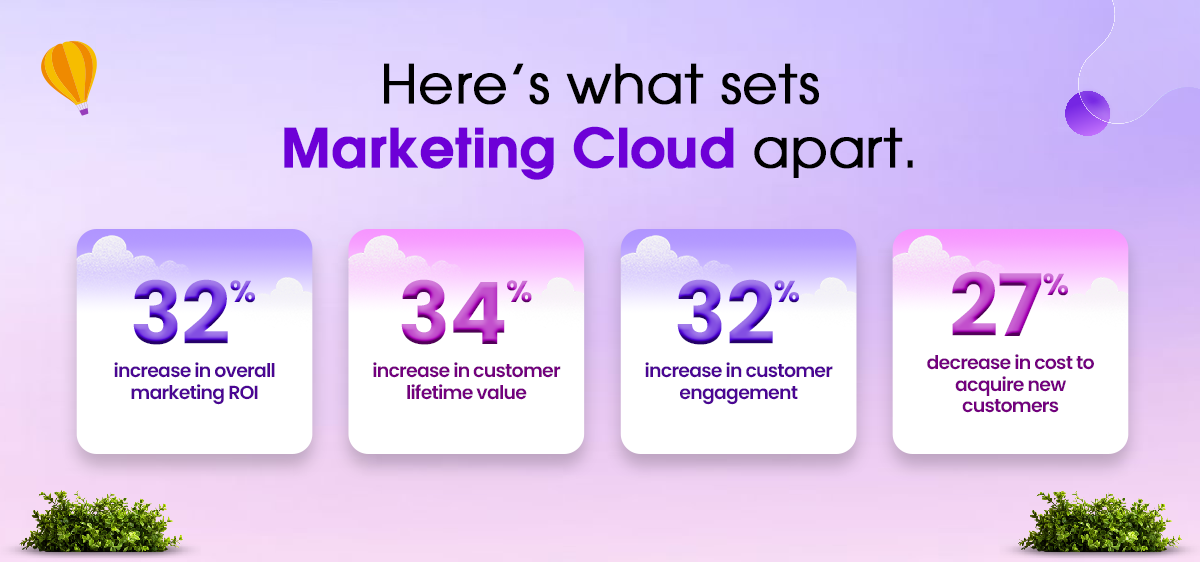
Salesforce cites a Forrester Total Economic Impact study in which the organizations studied achieved 299% ROI over three years from the Marketing Cloud suite. The study also reported improvements such as higher email and web conversion rates.
However, these results should be treated as a reference point rather than an expected return for every business. Your actual ROI will depend on your starting performance, implementation quality, customer data, adoption, campaign strategy, and ability to use the platform effectively.
What Can Increase or Reduce Your Marketing Cloud ROI?
Marketing Cloud is more likely to deliver value when your business:
-
Starts with clear marketing and revenue goals
-
Prioritizes high-value customer journeys
-
Maintains clean and reliable customer data
-
Integrates Marketing Cloud with relevant CRM and business systems
-
Trains teams to use automation, segmentation, and AI effectively
-
Measures campaign performance and continuously optimizes journeys
On the other hand, poor data quality, unnecessary add-ons, low platform adoption, and overly complex implementations can increase costs without producing equivalent business value.
Buyer takeaway: Don’t build your Marketing Cloud business case around someone else’s ROI percentage. Establish your current conversion rates, campaign revenue, customer acquisition cost, retention, marketing technology spend, and operational effort first. Then measure whether Marketing Cloud improves those numbers enough to justify its total cost.
How Do Contacts and Messaging Volume Affect Marketing Cloud Pricing?
Contacts and messaging volume can significantly affect Salesforce Marketing Cloud costs, but the way they affect your bill depends on the Marketing Cloud product and edition you choose.
Marketing Cloud Engagement+
Engagement+ editions include different contact and messaging allowances. As you move from Pro+ to Corporate+ and Enterprise+, the included capacity increases significantly.
Businesses running high-volume email or mobile campaigns should therefore estimate both their contact database and expected messaging volume before selecting an edition.
Marketing Cloud Account Engagement+
Account Engagement+ also includes different contact allowances by edition.
Growth+, Plus+, and Advanced+ include up to 10,000 contacts, while Premium+ includes up to 75,000 contacts. Businesses requiring additional capacity should factor that requirement into their pricing discussions.
Marketing Cloud Next
Marketing Cloud Next introduces a greater consumption-based element to pricing. In addition to the base Growth or Advanced subscription, businesses may incur additional costs based on messaging, customer data, AI usage, and other add-on capabilities.
Before estimating your Marketing Cloud budget, calculate:
-
Current number of marketable contacts
-
Expected database growth
-
Monthly and annual email volume
-
SMS and WhatsApp requirements
-
Number and complexity of customer journeys
-
Customer data requirements
-
Expected AI and Agentforce usage
Buyer tip: Don’t choose a Marketing Cloud edition based only on your current contact database. Forecast your expected contacts, messaging, data, and AI usage over the contract period to reduce the risk of unexpected capacity or usage costs later.
Before You Buy: Check How Contacts Are Counted
Don’t assume that your current email subscriber count will be the same number used for licensing or capacity calculations.
How contacts, subscribers, profiles, and messaging usage are counted can vary by Marketing Cloud product, edition, and contract. Imported records, duplicate customer data, inactive audiences, or rapid database growth can also affect the capacity your business requires.
Before signing a contract, ask Salesforce or your implementation partner to confirm:
-
What counts toward your contact or profile allowance
-
How duplicate and inactive records are handled
-
What happens when you exceed the included capacity
-
Whether additional contacts or usage can be purchased
-
How expected database growth will affect your contract
This helps prevent unexpected costs after implementation.
How to Calculate ROI from Salesforce Marketing Cloud
The ROI of Salesforce Marketing Cloud depends on how effectively your business uses automation, customer data, personalization, and cross-channel journeys to improve marketing performance.
Instead of relying on a generic ROI percentage, businesses should compare Marketing Cloud's measurable financial benefits against its total cost of ownership.
A simple Marketing Cloud ROI calculation is:
Marketing Cloud ROI = (Financial Benefits − Total Marketing Cloud Cost) ÷ Total Marketing Cloud Cost × 100
For example, if your total Marketing Cloud investment is $100,000 and it generates $150,000 in measurable financial benefits:
ROI = ($150,000 − $100,000) ÷ $100,000 × 100 = 50%
When measuring financial benefits, consider:
-
Revenue generated or influenced by marketing campaigns
-
Higher lead-to-customer conversion rates
-
Improved customer retention and repeat purchases
-
Reduced manual campaign management
-
Lower dependency on disconnected marketing tools
-
Improved marketing team productivity
Your cost calculation should include licenses, implementation, integrations, data migration, additional usage, training, support, and required add-ons.
What Does Salesforce Report About Marketing Cloud ROI?
Salesforce cites a Forrester Total Economic Impact study that reported 299% ROI over three years for the organizations studied using the Marketing Cloud suite.
This should be treated as a benchmark rather than an expected return. Actual ROI will vary depending on implementation quality, data maturity, platform adoption, campaign strategy, and your starting marketing performance.
Buyer tip: Build your Marketing Cloud business case around your own baseline metrics rather than industry-wide ROI claims. Compare campaign revenue, conversion rates, customer acquisition costs, retention, and operational effort before and after implementation to determine the platform's actual value.
Case Study 1: Purti Realty — Real Estate
The Challenge
Purti Realty's marketing communication was scattered across Email, SMS, and WhatsApp with no central system. Campaigns were managed manually, there was no journey mapping across the customer lifecycle, and their Sales Cloud CRM wasn't integrated with Gmail — making lead follow-up slow and inconsistent.
The Solution
Codleo implemented Salesforce Marketing Cloud's Email Studio, Mobile Studio, Journey Builder, and Ad Studio. The team set up dynamic content and audience segmentation, automated notifications for leads, site visits, and missed calls, and integrated Sales Cloud with Gmail and other communication tools. They built, tested, and rolled out custom customer journeys with real-time monitoring, along with training for the internal marketing and admin teams.
The Results
-
Higher engagement through personalized, timely messaging
-
Faster response times to leads and inquiries
-
Better lead tracking and improved conversion rates
-
Reduced manual campaign work through automation
-
A centralized, real-time view of every customer journey
Case Study 2: Caliber Autism & Pediatric Therapy — Healthcare
The Challenge
Caliber's patient data was fragmented across multiple systems, making it difficult for therapists, coordinators, and support staff to collaborate. There was no real-time visibility into patient activity or therapy delivery logistics, which slowed down care coordination.
The Solution
Codleo built a 360-degree patient view in Salesforce, integrated with Pardot, and automated personalized follow-up communication. Codleo implemented Salesforce Maps for real-time location tracking of therapy delivery and aligned Pardot with Salesforce for streamlined lead capture, nurturing, and patient intake.
The Results
-
20% improvement in patient satisfaction from personalized, timely communication
-
Increased operational efficiency through real-time location tracking and streamlined scheduling
-
Better care coordination with faster response times across teams
-
More efficient patient intake, improving lead-to-patient conversion rates
Case Study 3: HR Technology Provider — B2B SaaS
The Challenge
This HR technology company's sales and marketing platforms were disconnected, causing lead leakage. Lead qualification was manual and inconsistent, campaigns lacked personalization, and the quoting/contract process was slow.
The Solution
Codleo unified sales operations on Salesforce Sales Cloud and implemented Account Engagement (Pardot) with connected campaigns and Einstein Lead Scoring. Interaction Studio enabled UTM-based personalization and dynamic CTAs on their website, Salesforce CPQ automated quoting and e-signatures, and an Agentforce multi-agent layer supported lead qualification and follow-ups.
The Results
-
Higher lead conversion and sales efficiency
-
Stronger alignment between sales and marketing teams
-
Faster deal closures with less manual effort
-
Improved visibility into pipeline performance through real-time dashboards
What Can Increase or Reduce Your Marketing Cloud ROI?
Paying for a higher Marketing Cloud edition does not automatically produce a higher return. ROI depends on how effectively the platform is implemented, adopted, and optimized around your marketing goals.
Businesses are more likely to get value from their investment when they:
-
Start with clearly defined marketing and revenue goals.
-
Prioritize high-value customer journeys instead of automating everything at once.
-
Maintain clean and reliable customer data.
-
Integrate Marketing Cloud with the systems that matter to the customer journey.
-
Train marketing teams to use automation, segmentation, and AI capabilities effectively.
-
Measure campaign performance and continuously optimize journeys after launch.
On the other hand, poor data quality, unnecessary add-ons, low platform adoption, and overcomplicated implementations can increase costs without producing equivalent business value.
The goal should not be to buy the most Marketing Cloud functionality—it should be to invest in the capabilities your team can realistically use to improve measurable marketing outcomes.
How to Choose the Right Salesforce Marketing Cloud Pricing Plan
The right Salesforce Marketing Cloud plan depends on your use case, channels, customer data, messaging volume, and marketing complexity—not simply the size of your business.
Before choosing an edition, answer these five questions.
1. Are You a B2B or B2C Marketing Team?
If your priority is B2B lead generation, nurturing, scoring, and sales alignment, Marketing Cloud Account Engagement+ may be the better fit.
For high-volume B2C email, mobile messaging, and cross-channel customer journeys, evaluate Marketing Cloud Engagement+.
Businesses adopting Salesforce’s newer AI-powered marketing capabilities should compare Marketing Cloud Next Growth and Advanced.
2. Which Marketing Channels Do You Actually Need?
List the channels your team will actively use, such as:
-
Email
-
SMS
-
WhatsApp
-
Mobile
-
Web
-
Cross-channel customer journeys
More channels can increase both platform complexity and usage costs, so avoid paying for capabilities without a clear use case.
3. How Much Marketing Volume Do You Expect?
Estimate your requirements for the full contract period, including:
-
Marketable contacts
-
Email sends
-
SMS and WhatsApp usage
-
Customer data
-
Campaign frequency
-
Expected database growth
-
AI and Agentforce usage
Planning for future usage helps reduce the risk of selecting an edition that your business quickly outgrows.
4. How Complex Are Your Data and Integrations?
Consider whether Marketing Cloud needs to connect with Salesforce CRM, ecommerce platforms, ERP systems, websites, mobile apps, data warehouses, or other business applications.
More complex data and integration requirements can increase both implementation effort and ongoing maintenance.
5. Can Your Team Manage Marketing Cloud Internally?
Evaluate whether your team has the skills and capacity to manage customer journeys, automation, segmentation, data, integrations, deliverability, and platform administration.
If not, include training and ongoing support in your total cost estimate.
Quick Marketing Cloud Plan Decision Guide
| Your Primary Requirement | Plan to Evaluate |
|---|---|
| Basic CRM, sales, service, and marketing capabilities | Starter or Pro Suite |
| AI-powered marketing automation and customer journeys | Marketing Cloud Next Growth |
| Advanced AI, scoring, experimentation, and complex journeys | Marketing Cloud Next Advanced |
| High-volume B2C email and cross-channel engagement | Marketing Cloud Engagement+ |
| B2B lead nurturing, scoring, and marketing automation | Marketing Cloud Account Engagement+ |
| Enterprise personalization, analytics, or loyalty requirements | Evaluate relevant Marketing Cloud add-ons |
Buyer takeaway: Start with the marketing outcomes you need, then work backward to the required capabilities and edition. This is usually more effective than choosing a plan based on the longest feature list or the lowest starting price.
Is Salesforce Marketing Cloud Worth the Cost?
Salesforce Marketing Cloud can be worth the investment for businesses that need to manage customer data, automate marketing journeys, personalize engagement, and coordinate campaigns across multiple channels at scale.
However, the right question is not simply whether Marketing Cloud is expensive. It is whether the platform can generate enough revenue impact, operational efficiency, and customer value to justify its total cost.
Marketing Cloud may be a strong fit if your business:
-
Manages a growing customer or prospect database.
-
Runs frequent or complex marketing campaigns.
-
Needs better alignment between CRM data and marketing activities.
-
Wants to automate customer journeys across multiple channels.
-
Requires advanced segmentation, personalization, or AI capabilities.
-
Has measurable marketing goals that can be tied to the investment.
For businesses with simpler marketing requirements, paying for advanced capabilities that will rarely be used can increase costs without delivering equivalent value.
Before making a final decision, compare the license, implementation, integration, usage, training, and ongoing support costs against the business outcomes you expect Marketing Cloud to deliver.

Alternatives to Salesforce Marketing Cloud
Salesforce Marketing Cloud is a strong option for businesses that need advanced marketing automation, customer journeys, AI, personalization, and close integration with the Salesforce ecosystem. However, it may not be the right fit for every marketing team.
If you are comparing platforms before making an investment, these are three alternatives worth evaluating:
| Platform | Best For | Pricing Approach | Consider It If |
|---|---|---|---|
| Salesforce Marketing Cloud | Businesses using Salesforce that need advanced cross-channel marketing | Growth starts at $1,500/org/month; Advanced at $3,250/org/month | You want marketing, CRM data, AI, automation, and customer journeys within the Salesforce ecosystem |
| HubSpot Marketing Hub | Growing teams prioritizing ease of use and inbound marketing | Free/Starter available; Professional and Enterprise scale with features, seats, and marketing contacts | You want a simpler marketing platform with CRM, lead generation, content, and automation capabilities |
| Adobe Marketo Engage | B2B and enterprise demand-generation teams | Custom pricing across Growth, Select, Prime, and Ultimate packages | You need sophisticated lead management, account-based marketing, automation, and attribution |
| Braze | B2C brands focused on real-time customer engagement | Custom pricing based on platform edition, active users, and usage | You need high-scale cross-channel messaging, mobile engagement, personalization, and journey orchestration |
Salesforce Marketing Cloud vs. HubSpot
HubSpot may be easier to evaluate for businesses that want marketing automation, CRM, content, lead generation, and campaign management in a more streamlined platform.
Its Marketing Hub ranges from entry-level plans to Professional and Enterprise editions, with pricing also influenced by marketing contacts and seats.
Salesforce Marketing Cloud may be a better fit when your organization already relies heavily on Salesforce and needs more sophisticated customer data, AI, cross-channel journeys, and enterprise marketing capabilities.
Salesforce Marketing Cloud vs. Adobe Marketo Engage
Adobe Marketo Engage is particularly relevant for B2B organizations focused on demand generation, lead and account-based marketing, automation, and attribution.
Adobe offers Growth, Select, Prime, and Ultimate packages but requires businesses to request pricing.
The choice between Marketo and Salesforce Marketing Cloud often depends on your existing technology stack, CRM strategy, B2B marketing requirements, and the level of customer journey orchestration you need.
Salesforce Marketing Cloud vs. Braze
Braze is another strong alternative for businesses focused on real-time B2C customer engagement.
Its platform supports email, SMS, WhatsApp, push notifications, in-app messaging, personalization, AI, and journey orchestration. Pricing scales based on the selected platform edition, active users, and usage.
Braze may be worth evaluating for digital-first or mobile-heavy customer engagement, while Salesforce Marketing Cloud can be more attractive to organizations that want marketing deeply connected with Salesforce CRM, customer data, and the wider Salesforce ecosystem.
Buyer takeaway: There is no universally “best” marketing automation platform. Compare Salesforce Marketing Cloud with alternatives based on your CRM ecosystem, B2B or B2C use case, required channels, customer data, integrations, automation complexity, internal expertise, and total cost of ownership.

Conclusion
Salesforce Marketing Cloud pricing is not just about choosing a plan—it is about understanding the total investment required to achieve your marketing goals. Your final cost can include the subscription, messaging and data usage, implementation, integrations, add-ons, training, and ongoing support.
Before choosing a Marketing Cloud edition, define the customer journeys you want to build, the channels you need, your expected contact and messaging volumes, and how the platform will connect with your existing technology stack. This will help you avoid paying for capabilities you do not need while ensuring the platform can support future growth.
The right choice should ultimately come down to business requirements, expected ROI, and total cost of ownership—not simply the lowest starting price.
Need Help Estimating Your Salesforce Marketing Cloud Cost?
Not sure which Marketing Cloud edition fits your requirements or what your total investment could look like?
Codleo can help you assess your marketing goals, expected usage, integrations, and implementation requirements to build a more realistic Marketing Cloud cost estimate.
Get a Marketing Cloud Cost Estimate
 0
0
About the Author

FAQ
Salesforce Marketing Cloud is a digital marketing platform that lets brands manage multi-channel campaigns, customer journeys, audience segmentation, and pre- and post-campaign analytics from a single system. It brings email, mobile, social, and customer data tools together so marketing teams can plan, execute, and measure campaigns without switching platforms.
Salesforce Marketing Cloud's core features let brands run every stage of digital marketing from one platform:
- Journey Builder — maps and tracks each stage of the customer journey, pulling in data from every customer interaction.
- Social Studio — monitors and analyzes how customers engage with a brand across social media.
- Mobile Studio — delivers targeted SMS and mobile messaging to specific customer segments.
- Email Studio — sends personalized, automated email campaigns to segmented audiences.
(Note: your source text said Email Studio sends messages "via SMS" — that's almost certainly a copy-paste slip; Email Studio is the email channel, Mobile Studio is SMS. Fixed above.)
Salesforce Marketing Cloud starts at $25 USD per user per month in 2026 with the Starter Suite edition—Salesforce's entry-level plan for small to mid-sized businesses that need core marketing tools without enterprise-level cost or complexity.
Growth Edition gives you the tools to run marketing campaigns; Advanced Edition adds the AI-driven intelligence to optimize them, at a premium of $1,750/month per org. In short: Growth executes, Advanced optimizes.
Choose Account Engagement (formerly Pardot) if you're B2B and need lead nurturing and sales pipeline alignment. Choose Marketing Cloud Engagement if you're marketing to consumers at scale across multiple channels. Rule of thumb: B2B pipeline → Account Engagement. B2C volume → Engagement.
No — Data Cloud (now Data 360) is not required for the base Marketing Cloud license. You only need it to unlock Marketing Cloud Next features, which come via Salesforce Foundations, including Data 360 access at no extra cost.
Implementation typically costs $10,000 for a basic setup and can run $100,000+ for complex enterprise deployments, scaling with integrations, automations, and org complexity.
Yes. Enterprises evaluating Growth or Advanced Edition can negotiate contract length, bundle size, and timing within Salesforce's sales cycle—list pricing is rarely fixed for larger deals.
Small businesses typically pay for a base edition plus basic usage credits. Enterprises pay for the full stack — base edition, premium add-ons, and support plans — with costs scaling as the organization grows.
No — Data 360 (formerly Data Cloud) isn't bundled into standard pricing. Engagement+ Editions include Data Cloud credits within the base price, though, making costs more predictable for existing Engagement customers.

 603 D-Mall Netaji Subhash Place, Delhi 110034 IND


