


Publish date:
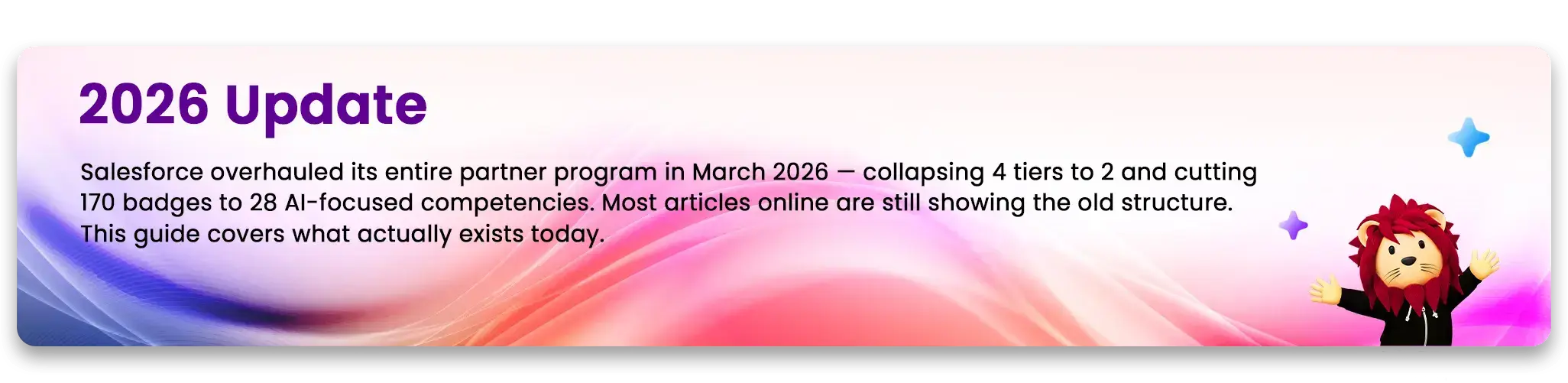
Choosing the right Salesforce partner starts with understanding how the Salesforce Partner Program works in 2026—not how it worked two years ago. In March 2026, Salesforce retired its old four-tier structure (Base, Ridge, Crest, Summit) and replaced it with a simplified two-tier model: Select Partner and Summit Partner, backed by a new 28-competency framework instead of the old 170-badge Navigator system.
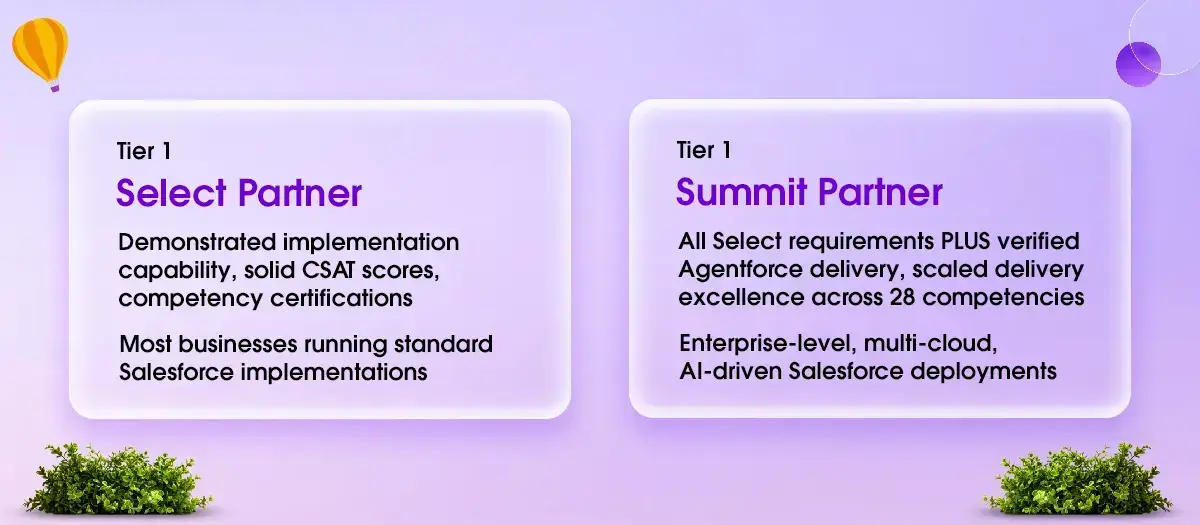
Quick Answer: As of FY27, Salesforce recognizes two Consulting Partner tiers — Select Partner, which confirms proven, baseline delivery capability, and Summit Partner, the highest tier, reserved for firms with verified customer outcomes, high CSAT scores, and demonstrated competency in priority areas like Agentforce and Data Cloud (Data 360). Tier alone should never be the deciding factor — competencies, verified projects, and the actual delivery team matter just as much.
This guide covers what changed, what Select and Summit mean today, the different types of Salesforce partners, how Salesforce evaluates consulting partners under the Trailblazer Score model, real project examples, cost benchmarks, and a practical framework for choosing between a Salesforce Select Partner and a Salesforce Summit Partner.
What Is a Salesforce Partner?
A Salesforce partner is a company that Salesforce has officially reviewed and authorized to sell, implement, customize, integrate, and support the Salesforce platform on behalf of other businesses. Partners are independent consulting firms, not Salesforce employees—they're listed on Salesforce AppExchange, where Salesforce maintains their tier, competencies, and CSAT data directly rather than relying on self-reporting.
A typical Salesforce consulting partner or Salesforce implementation partner offers:
-
Implementation — setting up a new Salesforce org or restructuring an existing one
-
Customization — Lightning components, custom objects, Apex, Flow-based business logic
-
Integration — connecting Salesforce to ERP, finance, marketing, or e-commerce systems
-
Data migration — moving records safely from legacy CRMs or spreadsheets
-
Optimization — improving adoption, performance, and reporting accuracy
-
Managed services — ongoing administration and support after go-live
-
AI and Agentforce delivery — building and governing Salesforce's autonomous AI agents
Because Salesforce doesn't implement the platform for most customers itself, the Salesforce-certified partner you choose is often the single biggest factor in whether your Salesforce investment actually pays off. A mismatched partner can mean months of rework; a well-matched one can significantly shorten time-to-value.
Types of Salesforce Partners: Which One Do You Need?
Before comparing tiers, it helps to understand what kind of Salesforce partner your project actually requires. Partner type describes what a company does; partner tier (Select/Summit) describes how well it does it.
| Partner Type | What They Do | Best For |
|---|---|---|
| Consulting / Implementation Partner | Strategy, implementation, customization, integration, migration | Businesses deploying, migrating, or transforming Salesforce |
| AppExchange ISV Partner | Build and sell apps that extend Salesforce natively | Businesses needing a pre-built app or industry extension |
| Managed Service Provider (MSP) | Ongoing administration, support, release management | Organizations that already use Salesforce and need continuous care |
| Cloud Reseller Partner | Sell Salesforce licenses, guide edition selection | Businesses just starting their Salesforce license purchase |
| System Integrator (SI) | Connect Salesforce with ERP, marketing, and other platforms | Complex, multi-system environments |
Most businesses evaluating "Select vs Summit" are specifically looking at the Consulting Partner track, since that's where tier and competency comparisons matter most for implementation decisions. Some firms — including Codleo — operate across both Salesforce consulting and Salesforce managed services, so the same partner can carry you from implementation through long-term support.
What Changed in the Salesforce Partner Program in 2026?
Quick Answer: On March 2, 2026, Salesforce collapsed its four-tier Consulting Partner structure (Base, Ridge, Crest, Summit) into two tiers — Select and Summit — and replaced its 170 legacy Navigator badges with 28 outcome-based competencies, as part of what it calls the shift to the "Agentic Enterprise."
| What Changed | Old Structure (Pre-March 2026) | Current Structure (FY27, 2026) |
|---|---|---|
| Partner tiers | Four tiers: Base, Ridge, Crest, Summit | Two tiers: Select and Summit |
| Credentials | ~170 legacy Navigator badges | 28 core competencies |
| Advancement model | Points-based (certifications + deal volume) | Outcome-based: CSAT, verified projects, competency certification |
| Recognition levels | Single badge per specialization | Two levels per competency: Accredited and Expert |
| Scoring system | Consulting Trailblazer Scorecard (points-based) | Trailblazer Score retained, reweighted toward outcomes |
| AI/Agentforce visibility | Minimal | Central to Summit qualification |
If a consulting firm still markets itself as a "Gold Partner," "Platinum Partner," or "Crest Partner," that label reflects Salesforce's pre-2026 program and is no longer an officially recognized designation. Existing FY26 Summit partners retained their Summit status into FY27, but Salesforce reassessed every other partner under the new framework.
Why did Salesforce make this change?
In Salesforce's own words, Nick Johnston, SVP of Global Consulting Partners & Partner Sales, said specialization is becoming the defining currency of the AI era for Salesforce's partner ecosystem. With partners already driving most Agentforce implementations globally, Salesforce is investing more than $1 billion in partner incentives to accelerate the shift from generalist implementation firms to verified, outcome-driven specialists. The underlying goal: reward proven customer outcomes over certification volume and deal count, which was the core weakness of the old points-based system.
The safest way to confirm any partner's current status is to check their live listing on Salesforce AppExchange, not their website — badges on a homepage can be outdated by months.
What Is a Salesforce Select Partner?
Quick Answer: A Salesforce Select Partner is a consulting firm verified as a proven delivery partner that meets the program's core performance standards. It's the entry- and mid-level tier under the current two-tier structure, replacing the former Base and Ridge tiers.
Select status confirms that a partner has demonstrated real, Salesforce-verified delivery capability — not just program enrollment. It does not, by itself, guarantee depth in your specific industry, your specific Salesforce Cloud, or complex AI and integration work.
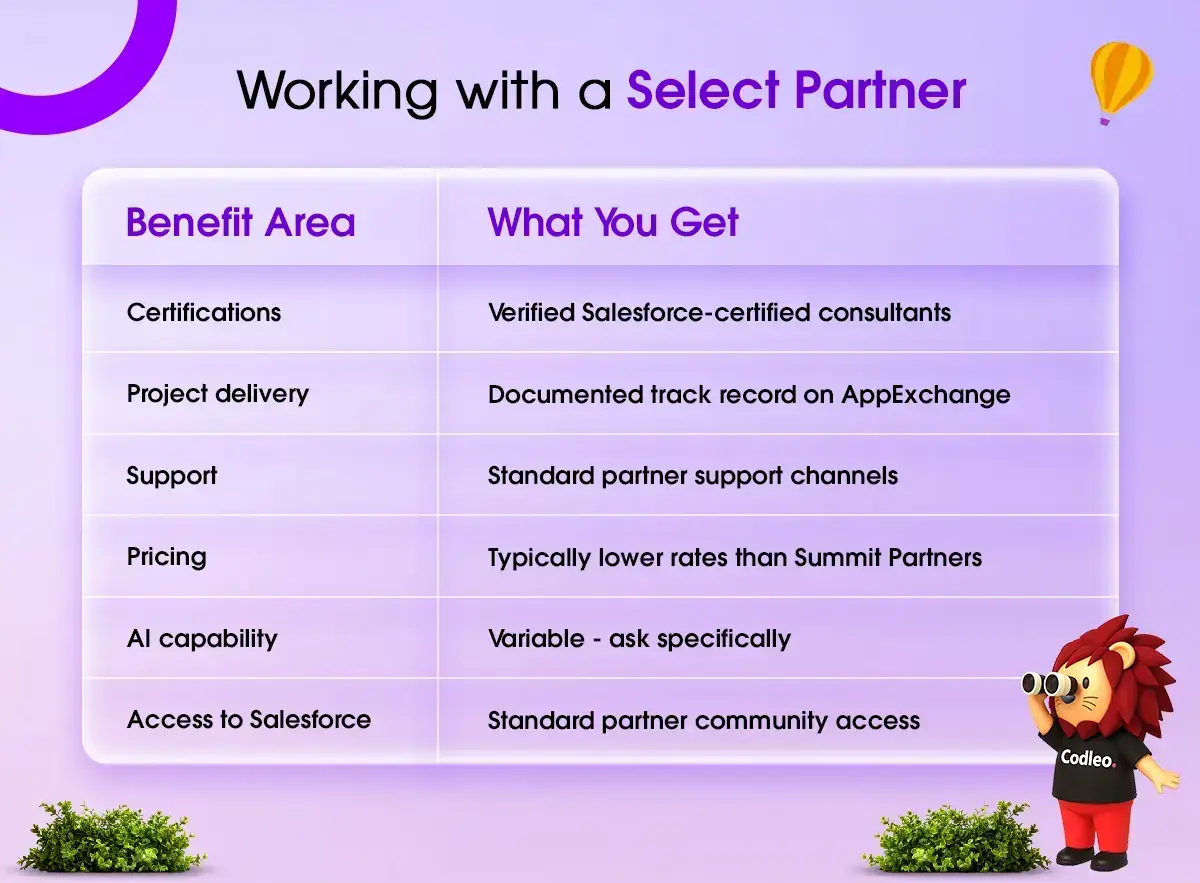
A Select Partner is a strong choice when:
-
Your project scope is clearly defined
-
You need a focused, single-Cloud Salesforce implementation
-
The partner can show relevant competencies and comparable completed projects
-
Cost-efficiency matters alongside quality
-
Your delivery team requirement is modest (2–5 consultants) rather than an enterprise program office
A Select Partner with deep Service Cloud experience, for example, can outperform a generalist Summit Partner whose strongest work lies elsewhere. Tier is a starting filter — competency match is the real decision-maker.
What Is a Salesforce Summit Partner?
Quick Answer: A Salesforce Summit Partner is the highest tier in Salesforce's Consulting Partner Program, reserved for top-performing firms with verified customer outcomes, high CSAT scores, and demonstrated competency in strategic priority areas — particularly Agentforce and Data Cloud (Data 360).
Summit differs from Select mainly in the depth and breadth of verified evidence required. Where Select confirms baseline proven capability, Summit confirms a track record across a wider set of competencies — typically spanning multiple Salesforce Clouds, complex integrations, and AI-driven delivery.
Summit status carries more weight when your project involves:
-
Multiple Salesforce Clouds (Sales + Service + Marketing, etc.)
-
Enterprise-scale or multi-region transformation
-
Heavy integration or data architecture complexity
-
Agentforce, Data Cloud, or broader AI initiatives
-
Regulated or high-stakes industries (finance, healthcare)
-
Long-term, multi-phase transformation programs rather than a single deployment
For a simpler, single-cloud implementation, Summit status isn't required — a well-matched Select Partner can be equally capable and more cost-effective. Summit partners also tend to offer deeper co-marketing, priority Salesforce support escalation, and executive-level engagement, which matters more for large enterprise buyers than for a focused SMB rollout.
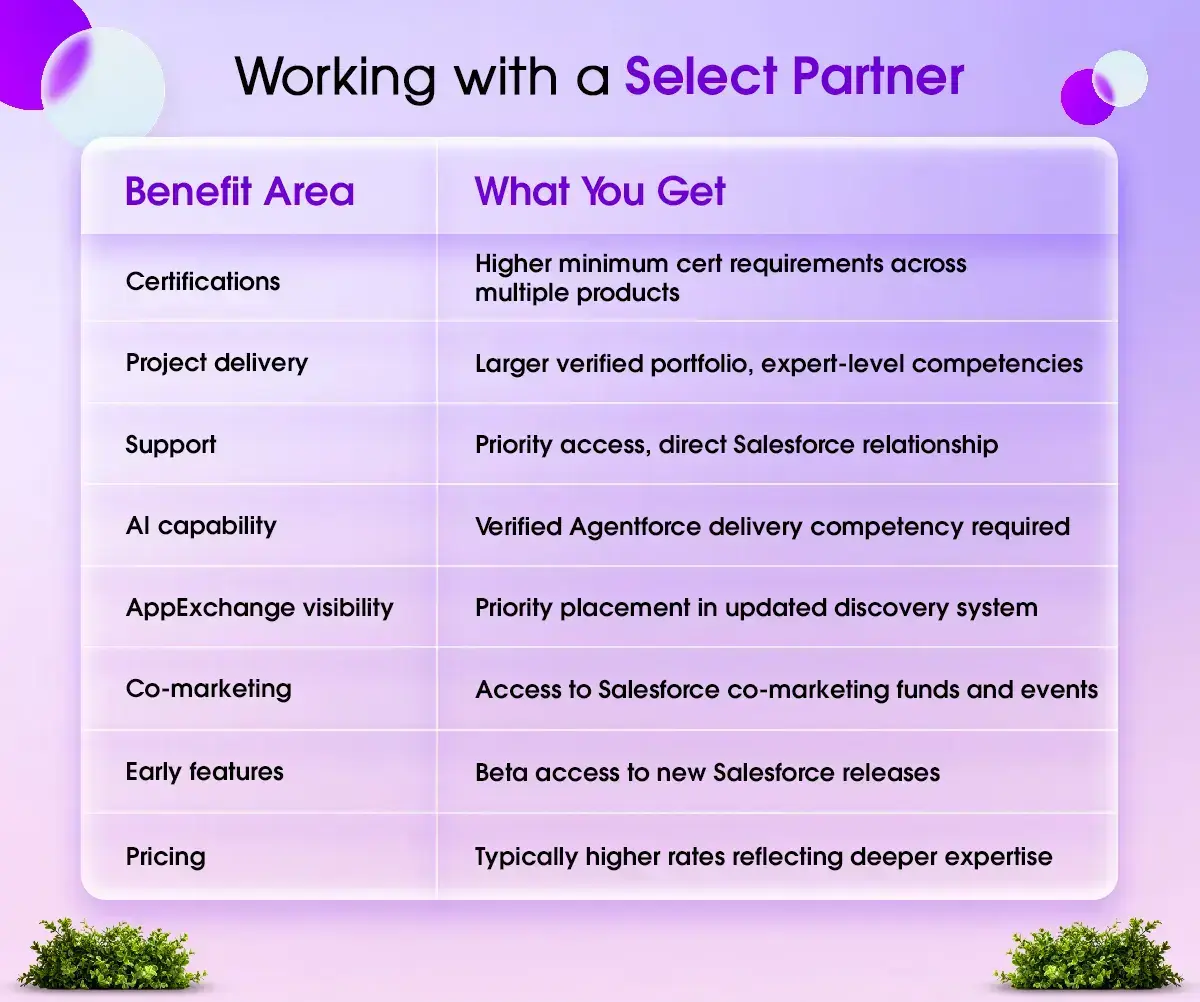
Salesforce Select vs Summit Partner: Full Comparison
Quick Answer: Summit sits above Select on almost every measurable factor — broader competencies, a higher CSAT bar, deeper Agentforce/Data Cloud experience, and higher hourly rates. Select is the better fit for clearly scoped, single-Cloud projects; Summit is the better fit for complex, multi-cloud, or AI-heavy transformations.
| Factor | Select Partner | Summit Partner |
|---|---|---|
| Program status | Proven delivery, meets core performance standards | Highest tier, strategic-growth designation |
| Specialization depth | Often narrower, focused competency set | Broader, spans multiple competencies/Clouds |
| Customer outcomes bar | Meets Salesforce's baseline CSAT and verification standards | Higher, more consistently verified bar |
| Agentforce / AI delivery | Varies — verify directly | Central to maintaining Summit status |
| Enterprise-scale experience | Varies by partner | More commonly associated with large programs |
| Typical hourly rate (US market) | Roughly $150–$250/hour at boutique firms | Roughly $300–$400/hour at large Summit firms |
| Co-marketing & Salesforce support access | Standard | Priority escalation, executive engagement |
| Best-fit project | Defined-scope, single-Cloud implementations | Multi-cloud, complex integration, AI transformation |
| What to verify before hiring | Relevant competencies, references, industry experience | Same, plus verified Agentforce/Data Cloud delivery history |
Important nuance: A Summit Partner with no experience in your industry, or whose best specialists are tied up elsewhere, can still be the wrong choice. A Select Partner with deep, verified experience in your exact use case can outperform a Summit firm treating your project as a lower priority in its pipeline. Use tier as a first filter — not the final decision.
The 28 Salesforce Partner Competencies (Replacing Navigator)
Quick Answer: Competencies are how Salesforce now measures partner expertise in specific areas, replacing the old Navigator framework's 170 badges with 28 focused competencies, each earned at one of two levels — Accredited (demonstrated capability) or Expert (scaled delivery excellence with multiple verified outcomes).
| Competency Area (Examples) | Relevant For |
|---|---|
| Sales Cloud | Lead-to-cash, pipeline, forecasting |
| Service Cloud | Customer support, case management |
| Marketing Cloud | Campaign automation, customer journeys |
| Data Cloud (Data 360) | Unified customer data, identity resolution |
| Agentforce | AI agents, autonomous workflows |
| Experience Cloud | Customer/partner self-service portals |
| Revenue Cloud & CPQ | Quoting, billing, revenue operations |
| Field Service | Dispatch, scheduling, mobile workforce |
| MuleSoft / Integration | System-to-system integration architecture |
| Financial Services Cloud | Banking, wealth management workflows |
| Health Cloud | Healthcare and life sciences |
| Nonprofit Cloud | Nonprofit and NGO operations |
| Manufacturing Cloud | Sales agreements, demand planning |
| Commerce Cloud | B2B/B2C digital storefronts |
Why competencies matter more than tier: Two Select Partners — or two Summit Partners — can have completely different strengths. One might hold Expert-level Service Cloud recognition with zero Marketing Cloud experience; another could be the reverse. When shortlisting, don't ask "how many competencies does this partner have?" Ask: "Which competencies are relevant to my project, and are they Accredited or Expert?" A partner's competency profile on AppExchange is a far more actionable signal than the tier badge alone.
Agentforce and Data Cloud: How Much Should They Matter?
Agentforce has become central to Salesforce's platform strategy, but not every project should be evaluated primarily on AI expertise. If you're implementing a straightforward Sales Cloud solution, Sales Cloud delivery experience matters more today than the number of AI projects a partner has completed. If Agentforce, AI automation, or unified customer data is part of your near-term roadmap, the evaluation changes significantly — certification alone is not enough proof of real delivery capability.

Ask these questions if AI is part of your Salesforce roadmap:
-
What Agentforce use cases have you actually taken into production (not just demoed)?
-
What measurable business outcome was the agent designed to improve?
-
How do you assess data readiness — sources, quality, access, integrations — before implementation?
-
How do you approach security, permissions, and AI governance?
-
How will the agent be tested before go-live — what scenarios and acceptance criteria?
-
Who monitors and optimizes agent performance after launch?
An AI agent is only as useful as the data and processes it can reliably work with. If your Agentforce use case depends on customer data spread across Salesforce and external systems, the partner also needs Data Cloud, integration architecture, and data governance expertise — not just Agentforce configuration skills.
How Salesforce Evaluates Partners: The Trailblazer Score
Quick Answer: Salesforce evaluates consulting partners using the Trailblazer Score, a quarterly-reviewed scorecard built on measurable outcomes rather than certification volume — scored across four pillars: Customer Success, Innovation, Growth, and Impact, adding up to a maximum of 1,000 points.
| Trailblazer Score Pillar | What It Measures |
|---|---|
| Customer Success | CSAT scores, verified completed projects, retention |
| Innovation | Adoption of new Salesforce capabilities (e.g., Agentforce, Data Cloud) |
| Growth | New business, expansion within existing accounts |
| Impact | Overall contribution to customer outcomes and ecosystem health |
This matters to buyers for a simple reason: a partner's public tier and competency badges are no longer just marketing claims — they reflect data Salesforce itself has checked against real project outcomes, not self-reported testimonials. That said, "verified" doesn't mean "identical to your situation." A partner with strong CSAT in retail implementations isn't automatically right for a complex financial-services compliance project.
Because tier and competency status are reassigned quarterly, always confirm the "last reviewed" date on a partner's AppExchange listing rather than assuming their badge is permanent.
Does a Higher Tier Always Mean Better Service?
Quick Answer: No. Tier reflects verified program standing, not a guarantee of fit for your specific project. The team actually assigned to your engagement matters more than the badge on the company homepage.
Factors that matter alongside tier:
-
Relevant project experience in your specific industry and use case
-
Certifications held by the actual delivery team, not just the company overall
-
Salesforce-verified project history and independently collected reviews
-
Integration, data migration, and architecture experience matched to your scope
-
Agentforce/AI delivery expertise, if relevant to your roadmap
-
Post-launch support model and communication style
-
Project methodology and how clearly it's documented before signing
Partner tier answers: "Has this company met a verified bar?" Your outcome depends on a different question: "Will the specific people assigned to my project meet that bar for my problem?" You need answers to both before signing anything.
The 6-Factor Framework for Choosing a Salesforce Partner
Use these six factors together—tier alone should never drive the final decision.
| Factor | What to Check |
|---|---|
| Requirement Fit | Salesforce products involved, business processes being transformed, integrations, data migration needs, AI/Agentforce scope, timeline, post-launch support expectations |
| Competency Match | Which of the 28 competencies are relevant — Accredited or Expert level? Do they match the specific Cloud and use case? |
| Delivery Evidence | 2–3 completed projects most similar to yours in scope, complexity, and industry, with measurable outcomes shown |
| Delivery Team | Named solution architect, functional consultant, developer, integration specialist, QA lead, project manager |
| Delivery Model | Documented process: discovery → solution design → development → testing → deployment → training → optimization |
| Long-Term Ownership | Who owns support, Salesforce release management, custom code maintenance, and knowledge transfer after go-live? |
If even one of these is weak, a higher Salesforce partner tier won't automatically compensate.
Salesforce Partner Evaluation Scorecard
Score each shortlisted partner from 1–5 across ten factors to compare objectively, beyond Select/Summit status alone.
| Evaluation Factor | Score |
|---|---|
| Project Fit | /5 |
| Relevant Competency (Accredited/Expert) | /5 |
| Comparable Completed Projects | /5 |
| Customer Evidence (CSAT, verified reviews) | /5 |
| Delivery Team Quality | /5 |
| Delivery Process Clarity | /5 |
| Industry Experience | /5 |
| Integration & Data Capability | /5 |
| Post-Go-Live Ownership | /5 |
| Commercial/Pricing Clarity | /5 |
How to interpret the total (out of 50):
| Score Range | Interpretation |
|---|---|
| 41–50 | Strong fit — proceed to reference checks and commercial due diligence |
| 31–40 | Potential fit — investigate weaker areas before deciding |
| 21–30 | Significant gaps — ask the partner to substantiate capabilities |
| 20 or below | Reconsider the shortlist |
One rule: Don't add points just because a partner is Summit-tier. A Summit Partner scoring 2/5 on relevant competency and comparable projects should not automatically beat a Select Partner scoring 5/5 on those same factors. Score what matters to your project, not the badge.
Real Salesforce Projects: What They Reveal About Partner Fit
Multi-Cloud Fit Over Badge Alone
A luxury real estate company needed Sales Cloud and Marketing Cloud connected around one business process — matching client requirements with available inventory. A three-person Codleo team handled the complete Sales Cloud + Marketing Cloud setup. Per the client's verified Clutch review, the implementation made inventory matching significantly easier, and the client rated the engagement 5/5 for quality, cost/value, and willingness to refer.
Broader Technical Capability for Complex Environments
An AI transformation company needed ongoing Salesforce support, data architecture cleanup, and Agentforce implementation assistance. A 2–5 person Codleo team handled ticket-based development, resource-flow architecture improvements, and legacy technical-debt cleanup. The result: a 30% improvement in data accuracy, 90+ Apex classes cleaned, and 10 custom objects addressed — with the client rating the engagement 5/5 for cost/value.
Industry Process Understanding, Not Just Product Knowledge
A manufacturing company needed Salesforce to reflect its full sales-to-order lifecycle — supplier information, quotations, approvals, and connected documents. The engagement combined Sales Cloud, Supplier360, quotation automation, and system integrations. The reported outcome included faster order processing, better supplier visibility, and reduced manual work across departments.
Lesson for buyers: In all three cases, the deciding factor wasn't the partner's tier badge — it was whether the delivery team had handled a comparable combination of Salesforce products, integrations, and business-process complexity before.
7 Red Flags to Watch Before Signing a Salesforce Partner
| Red Flag | What to Ask Instead |
|---|---|
| Only generic "we've done hundreds of projects" claims | "Show us 2–3 projects most similar to ours" |
| You meet sales, not the delivery team | "Who specifically will be assigned — architect, consultant, developer?" |
| Certifications used as a substitute for outcomes | "What measurable outcomes came from comparable projects?" |
| Attractive price, vague scope | "What's explicitly included — integrations, testing, training, support?" |
| Unclear delivery governance | "Who owns requirements, approves architecture, and escalates risk?" |
| Case studies can't be independently verified | Check Salesforce AppExchange verified reviews and CSAT directly |
| No clear post-go-live plan | "Who owns production issues and ongoing optimization?" |
A single red flag shouldn't mean automatic rejection — it should trigger a direct question and a request for evidence.
10 Questions to Ask a Salesforce Partner Before You Sign
-
What projects have you delivered that are most similar to ours?
-
Which Salesforce competencies are relevant to our project, and at what level?
-
Who will actually work on our project — will these be the people assigned after signing?
-
What will you need from our internal team during discovery, testing, and training?
-
How do you handle scope changes and what triggers a change request?
-
How will you manage integrations, data migration, and technical risk?
-
How will we measure whether the project succeeded — beyond "it went live"?
-
Can we speak with customers who had similar requirements?
-
What happens if the project starts going off track — who gets escalated to?
-
What happens after go-live — hypercare, documentation, and ongoing ownership?
How Much Does a Salesforce Partner Cost?
Pricing depends heavily on partner tier, project complexity, and region. Use this as a directional benchmark, not a quote.
| Project Type | Typical Partner Tier | Approximate Cost Range (US) |
|---|---|---|
| Single-Cloud quickstart (Sales or Service Cloud) | Select | $15,000–$40,000 |
| Mid-size implementation with integrations | Select or Summit | $40,000–$120,000 |
| Multi-cloud enterprise transformation | Summit | $150,000–$500,000+ |
| Agentforce / Data Cloud initiative | Summit (Agentforce-competent) | $50,000–$250,000+ depending on scope |
| Ongoing managed services (monthly) | Either | $3,000–$15,000/month |
The lowest-cost proposal is not necessarily the lowest total cost — vague scope on integrations, testing, or post-launch support often surfaces later as expensive change requests. Compare total project value and delivery risk, not the hourly rate alone.
How to Verify a Salesforce Partner's Current Status
-
Search the partner's name directly on Salesforce AppExchange.
-
Check their current tier (Select or Summit) — not a badge on their own website.
-
Review their competency list and confirm Accredited vs. Expert level for the areas relevant to you.
-
Read verified customer reviews and CSAT score, sourced by Salesforce itself.
-
Cross-check the "last reviewed" or listing update date, since tiers are reassessed quarterly.
-
Ask the partner directly for their current standing if AppExchange data looks outdated.
Select or Summit — Which Should You Choose?
Quick Answer: There's no universal rule. Choose based on project complexity and verified fit, not the badge alone.
Consider a Select Partner when:
-
Scope is clearly defined
-
You need a focused, single-Cloud implementation
-
Cost-efficiency is a priority alongside proven competency
Give Summit more weight when:
-
Your program spans multiple Salesforce Clouds
-
Agentforce or Data Cloud is central to your roadmap
-
Integration and data complexity is high
-
The engagement is business-critical or enterprise-scale
Either way: verify competencies, request comparable project evidence, and interview the actual delivery team before signing — Salesforce partner tier is your starting filter, not your final answer.

Choosing a Verified Salesforce Partner
Codleo is a Salesforce Summit Partner with completed Salesforce consulting, implementation, integration, and managed-services projects across the US. Before choosing any partner — including us — verify current tier and competencies directly on AppExchange, review comparable project evidence, and confirm who will actually be on your delivery team.
 0
0
About the Author

FAQ
Salesforce partner status has four levels: Base, Ridge, Crest, and Summit. Each level shows a different amount of expertise and offers distinct benefits. Higher-level partners, like Crest and Summit, provide the best support and have a proven track record with Salesforce implementations.
The Independent Software Vendor Partner creates custom apps and solutions for Salesforce AppExchange to improve Salesforce's capabilities. On the other hand, a Salesforce Consulting Partner offers expert advice on planning the Salesforce implementation and provides complete customization services.
Look for your partner�s expertise in Salesforce and check if they have a record of successful projects. Also, make sure they understand the latest Salesforce services and products well.
Higher-tier partners, such as Crest and Summit, receive more visibility, chances for co-marketing, access to advanced Salesforce resources, and priority support.
FAQ
As of March 2026, Salesforce has two consulting partner tiers: Select Partner and Summit Partner. The previous four-tier system of Base, Ridge, Crest, and Summit has been retired as part of Salesforce's partner program overhaul.
Gold (Ridge) and Platinum (Summit) partner names were retired in March 2026. Partners previously holding those designations are being transitioned into the new two-tier system based on their Agentforce delivery competency and verified project outcomes. Partners without Agentforce capability are being placed in the Select tier by default.
For most small to mid-sized, single-cloud implementations with a well-defined scope, a Select Partner can deliver excellent results. The case for Summit Partners strengthens significantly for enterprise deployments, multi-cloud environments, complex integrations, and any project involving Agentforce and AI agent deployment.
Agentforce is Salesforce's autonomous AI agent platform. In 2026, Salesforce made verified Agentforce delivery competency a requirement for Summit Partner status. This reflects a broader shift in the Salesforce ecosystem: partners are now expected to deliver AI-driven outcomes, not just traditional CRM configuration. A partner's Agentforce capability is an increasingly important quality signal regardless of your immediate project scope.
Visit appexchange.salesforce.com, search for the partner by company name, and check their official listing. Their current tier � Select or Summit � will be displayed. You can also use the Find a Partner tool on salesforce.com. Be cautious of any partner who describes their tier using the old naming system (Gold, Platinum, Base, Ridge, Crest) without referencing the new structure.
The old 170 badges covered general Salesforce product knowledge across a wide range of topics. The 28 new competencies are narrower and more specific � focused on products, industries, and AI capabilities. Each competency has two recognition levels: Accredited (demonstrated capability) and Expert (scaled delivery excellence). Partners are evaluated based on actual project outcomes, CSAT scores, and certifications within each competency area.
Ask for at least one live Agentforce deployment they have completed, the measurable business outcome it achieved, how they handled the Data Cloud foundation for trusted agent inputs, and what governance framework they use to ensure AI compliance. A partner who can only discuss Agentforce in theoretical terms has certification but not operational delivery experience.
Rates vary significantly by geography, project scope, and partner size. Summit Partners typically charges higher day rates reflecting deeper expertise and the cost of maintaining Summit-level certifications and program requirements. The right question is not which is cheaper, but which delivers better ROI for your specific project. For complex, enterprise-scale implementations, underinvesting in implementation quality consistently produces higher total costs than the initial savings suggest.
Yes. Codleo offers end-to-end Salesforce services: consulting and strategy, implementation, integration with third-party platforms, Agentforce deployment, Data Cloud setup, training, and ongoing managed support. Our support services are available as post-project retainer engagements or as standalone managed service agreements for organizations that need continuous Salesforce administration.

 603 D-Mall Netaji Subhash Place, Delhi 110034 IND


