


Publish date:
Choosing the right Salesforce Marketing Cloud partner can determine how quickly your business turns customer data into personalized journeys, automated campaigns, and measurable marketing results.
The best Marketing Cloud partners do more than configure Journey Builder or Email Studio. They help businesses plan the right data architecture, integrate Salesforce with existing systems, build scalable customer journeys, improve personalization, and support the platform after launch.
With so many Salesforce consulting firms offering Marketing Cloud expertise, however, finding the right partner can be difficult. Some specialize in enterprise transformations, while others suit mid-market implementations, integrations, campaign optimization, or ongoing support.
This guide compares 15 Salesforce Marketing Cloud partners in 2026 based on their Marketing Cloud expertise, implementation capabilities, industry experience, integration knowledge, Salesforce credentials, and ability to support long-term marketing transformation.
Whether you're planning a new Marketing Cloud implementation, improving an existing environment, integrating Data Cloud, or looking for ongoing Salesforce Marketing Cloud consulting services, this comparison will help you shortlist partners that fit your requirements.
Which Salesforce Marketing Cloud Partner Should You Choose?
The right Salesforce Marketing Cloud partner depends on your project scope, company size, industry, existing Salesforce environment, and required level of support.
For example, organizations planning complex implementations should prioritize partners with proven experience in Marketing Cloud implementation, Data Cloud integration, Journey Builder, Automation Studio, personalization, data architecture, and cross-cloud integrations.
Businesses should also evaluate a partner's Salesforce credentials, relevant case studies, industry expertise, implementation methodology, post-launch support, and ability to connect marketing activity with measurable business outcomes.
Below, we compare leading Marketing Cloud partners and the types of projects each is best suited to handle.
How to Choose the Right Salesforce Marketing Cloud Partner
Choosing among Marketing Cloud partners requires more than comparing company size or Salesforce certifications. The right partner should understand your marketing goals, customer data, technology stack, and the Salesforce products needed to connect them.
Here are the most important factors to evaluate before selecting a partner:
| What to Evaluate | Why It Matters | What to Ask the Partner |
|---|---|---|
| Marketing Cloud Expertise | Your partner should have hands-on experience with the Salesforce Marketing Cloud products relevant to your project. | Which Marketing Cloud products and use cases has your team implemented? |
| Proven Implementations | Relevant projects demonstrate practical delivery experience beyond certifications. | Can you share case studies similar to our requirements? |
| Data & Integration Experience | Marketing Cloud often needs to connect with CRM, websites, commerce platforms, analytics tools, and other data sources. | How will you integrate our existing systems and customer data? |
| Data Cloud Capabilities | Data Cloud may be important when the project requires unified customer profiles, segmentation, or activation across Salesforce. | Does our use case require Data Cloud, and how would you architect it? |
| Personalization & Journey Design | Successful implementations should support meaningful segmentation and customer journeys rather than simply deploying features. | How will you design, test, and optimize customer journeys? |
| Industry Experience | Industry familiarity can help a partner understand customer journeys, compliance requirements, and common workflows faster. | Have you delivered Marketing Cloud projects in our industry? |
| Salesforce Credentials | Certifications and Salesforce partner status provide useful signals of platform knowledge, but should be considered alongside project experience. | Which certifications will the people assigned to our project hold? |
| Post-Launch Support | Marketing Cloud requires ongoing optimization, troubleshooting, campaign improvements, and platform governance. | What support is available after go-live? |
| Measurement & ROI | A strong partner should connect technical implementation with measurable marketing objectives. | Which KPIs will you use to measure success? |
Quick Evaluation Checklist
Before hiring a Salesforce Marketing Cloud partner, verify these five things:
-
Relevant Marketing Cloud implementation experience
-
Case studies that match your industry or use case
-
Strong data, integration, and customer journey capabilities
-
A clearly defined implementation and post-launch support model
-
A measurement framework tied to marketing and business KPIs
A partner that performs well across these areas is more likely to help you build a Marketing Cloud environment that can scale beyond the initial implementation.
Top Salesforce Marketing Cloud Partners in 2026: Quick Comparison
The Salesforce ecosystem includes global consulting firms, specialized Salesforce partners, and teams with dedicated Marketing Cloud capabilities. However, not every partner offers the same level of expertise across implementation, integration, customer data, personalization, campaign management, and ongoing support.
The table below provides a quick comparison of leading Marketing Cloud partners and their core areas of focus.
| Marketing Cloud Partner | Key Capabilities | Suitable For |
|---|---|---|
| Codleo Consulting | Marketing Cloud consulting, implementation, integration, migration, campaign support, training | Businesses looking for end-to-end Salesforce Marketing Cloud services and ongoing support |
| Worxwide | Salesforce consulting, Marketing Cloud solutions, implementation, integration, digital transformation | Businesses looking for Salesforce-led marketing and digital transformation support |
| Noltic | Marketing Cloud implementation, Salesforce architecture, integrations, custom development | Businesses with complex Salesforce transformation requirements |
| Merkle | Customer experience, data, personalization, marketing technology | Large enterprises managing complex digital customer experiences |
| DEPT® | Digital experience, CRM, data, technology, marketing transformation | Brands combining Salesforce with broader digital transformation initiatives |
| Coastal | Salesforce consulting, Marketing Cloud solutions, digital transformation | Organizations looking for Salesforce-focused consulting and delivery |
| Horizontal Digital | Salesforce, customer experience, personalization, digital transformation | Enterprises building connected digital customer experiences |
| Sercante | Salesforce marketing automation consulting, implementation, optimization | B2B organizations focused on Salesforce marketing automation |
| CloudMasonry | Salesforce consulting, implementation, integration, platform optimization | Businesses requiring Salesforce implementation and advisory support |
| Silverline | Salesforce consulting, industry solutions, digital transformation | Organizations seeking industry-focused Salesforce expertise |
How to Shortlist Marketing Cloud Partners
Don't select a Salesforce Marketing Cloud partner based only on company size, certifications, or the number of Salesforce products it supports. Your shortlist should reflect the actual requirements of your Marketing Cloud environment.
Consider whether the partner has experience with:
-
Marketing Cloud implementation and optimization
-
Journey Builder and customer journey design
-
Marketing automation and campaign workflows
-
Customer data and segmentation
-
Salesforce Data Cloud integration
-
CRM and third-party integrations
-
Personalization and cross-channel engagement
-
Data migration and platform architecture
-
Marketing analytics and performance measurement
-
Post-launch Marketing Cloud support
The right partner should also demonstrate relevant project experience, explain its implementation methodology, define responsibilities clearly, and show how it will measure success after deployment.
Quick Tip: Before requesting a proposal, give shortlisted Marketing Cloud partners the same project brief. Compare their proposed architecture, implementation approach, timeline, team structure, support model, and expected outcomes rather than evaluating cost alone.
This makes it easier to identify a partner whose technical capabilities and delivery model align with your Marketing Cloud requirements and long-term marketing strategy.
1. Codleo Consulting
Codleo Consulting is a Salesforce Summit Partner providing Salesforce Marketing Cloud consulting, implementation, integration, migration, and ongoing support to businesses looking to improve how they engage customers across digital channels.
Rather than treating Marketing Cloud as a standalone campaign tool, Codleo helps organizations connect customer data, CRM processes, marketing automation, and customer journeys within the broader Salesforce ecosystem.
Salesforce Marketing Cloud Capabilities
Codleo's Marketing Cloud team can support businesses across:
-
Marketing Cloud strategy and consulting
-
Marketing Cloud implementation
-
Journey Builder setup and optimization
-
Email marketing and campaign automation
-
Automation Studio workflows
-
Customer segmentation and personalization
-
Salesforce CRM and Marketing Cloud integration
-
Data Cloud-related integration and activation requirements
-
Data migration
-
Campaign management and optimization
-
User training and adoption
-
Ongoing Marketing Cloud support
This end-to-end approach can help businesses that need more than initial platform configuration and want a Salesforce Marketing Cloud partner that can support the environment as marketing requirements evolve.
Why Consider Codleo for Marketing Cloud?
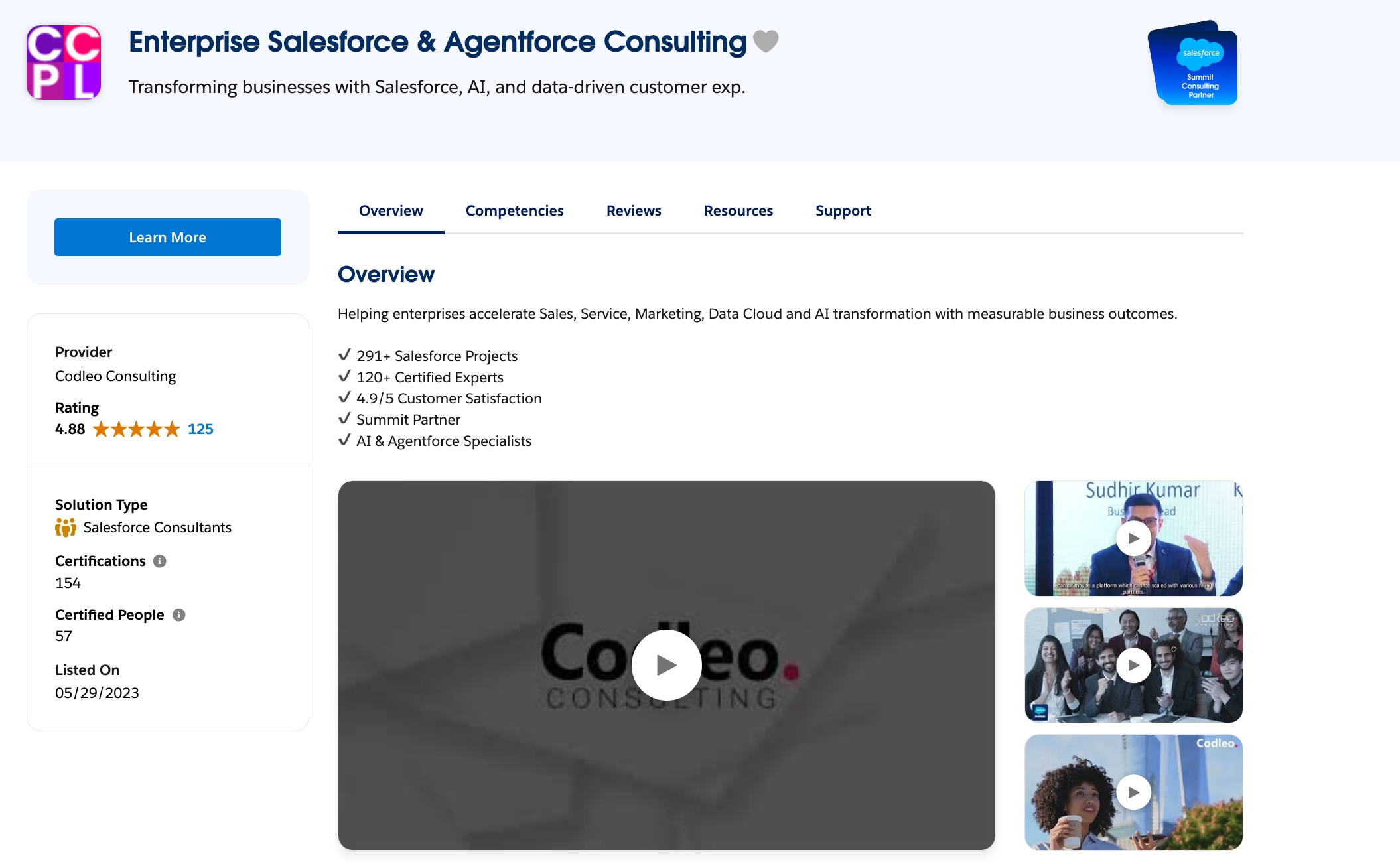
Salesforce-focused expertise: Codleo works across the Salesforce ecosystem, helping businesses connect Marketing Cloud with their wider CRM and customer-data strategy.
End-to-end delivery: Businesses can work with the same partner across consulting, implementation, integration, migration, training, and post-launch support.
Integration capabilities: Marketing Cloud projects often depend on data from Salesforce CRM and other business systems. Codleo can support the integration work required to create more connected marketing workflows.
Industry experience: Codleo has worked with organizations across industries including healthcare, education, retail, real estate, financial services, and nonprofit sectors.
Ongoing optimization: Support can continue beyond go-live for troubleshooting, campaign improvements, platform enhancements, and evolving Marketing Cloud requirements.
When Codleo May Be a Suitable Fit
Codleo may be worth evaluating if your organization is:
-
Implementing Salesforce Marketing Cloud for the first time
-
Reworking an underperforming Marketing Cloud environment
-
Integrating Marketing Cloud with Salesforce CRM or other systems
-
Building automated and personalized customer journeys
-
Migrating marketing data or processes to Salesforce
-
Looking for ongoing Marketing Cloud consulting and support
The right implementation approach will depend on your existing Salesforce architecture, customer data, marketing objectives, integrations, and internal resources.
Planning a Salesforce Marketing Cloud Project?
If you're evaluating Marketing Cloud partners, start by reviewing your current marketing stack, customer data, campaign processes, integration requirements, and business goals.
Talk to a Salesforce Marketing Cloud Consultant →
2. Worxwide
Worxwide provides Salesforce consulting and digital transformation services, including marketing automation and customer engagement solutions. Its broader Salesforce capabilities can be relevant for organizations that want Marketing Cloud initiatives to work alongside CRM, customer experience, and other transformation programs.
Organizations evaluating Worxwide should compare its Marketing Cloud project experience, proposed delivery team, integration capabilities, and post-launch support against their specific requirements.
Suitable for: Businesses looking for Salesforce-led digital transformation with marketing automation requirements.
3. Noltic
Noltic is a Salesforce consulting and implementation company with experience across Salesforce architecture, development, integrations, and Marketing Cloud projects.
Its technical Salesforce focus can make it relevant for organizations where Marketing Cloud needs to operate within a more complex Salesforce architecture rather than as a standalone marketing platform.
When evaluating Noltic, businesses should consider the team's experience with the specific Marketing Cloud products, integrations, data architecture, and customer journeys required for their project.
Suitable for: Organizations with technically complex Salesforce environments and integration requirements.
4. Merkle
Merkle operates across customer experience, data, technology, and digital marketing. Its capabilities extend beyond Salesforce into broader customer experience and marketing transformation initiatives.
This type of delivery model can be relevant for large organizations where Marketing Cloud is one component of a wider data, personalization, customer experience, or digital marketing program.
Suitable for: Large enterprises managing complex customer experience and marketing technology ecosystems.
5. DEPT®
DEPT® is a digital agency working across technology, customer experience, data, and digital marketing. Its broader capabilities can support organizations combining Salesforce technology with larger digital experience initiatives.
For businesses evaluating Marketing Cloud partners, this approach may be relevant when Salesforce is part of a wider transformation involving customer experience, creative, data, commerce, or digital channels.
Suitable for: Brands combining Salesforce with broader digital experience and transformation programs.
6. Coastal
Coastal provides Salesforce consulting and implementation services across different areas of the Salesforce ecosystem. Its Salesforce-focused approach can be relevant for businesses looking to connect Marketing Cloud requirements with their wider CRM environment.
Before selecting Coastal, organizations should evaluate relevant Marketing Cloud case studies, technical resources, integration experience, and the post-implementation support available for their project.
Suitable for: Organizations looking for Salesforce-focused consulting and implementation support.
7. Horizontal Digital
Horizontal Digital works across Salesforce, customer experience, personalization, data, and digital transformation.
Its capabilities can be relevant for enterprises seeking to connect Marketing Cloud with broader customer experience initiatives across multiple digital touchpoints. Organizations with complex personalization and customer journey requirements may want to evaluate its experience across Salesforce and adjacent digital technologies.
Suitable for: Enterprises building connected and personalized digital customer experiences.
8. Sercante
Sercante specializes in Salesforce marketing technology and marketing automation. Its services are particularly relevant to organizations looking to improve how their Salesforce marketing stack supports campaigns, automation, data, and customer engagement.
Its focused marketing-technology positioning makes it worth evaluating for businesses where ongoing marketing operations and platform optimization are as important as the initial implementation.
Suitable for: B2B organizations focused on Salesforce marketing automation and ongoing optimization.
9. CloudMasonry
CloudMasonry is a Salesforce consulting company offering implementation, advisory, integration, and platform optimization services.
Organizations considering CloudMasonry for Marketing Cloud should evaluate its experience with their required Salesforce products, customer-data architecture, integrations, and marketing workflows.
Its broader Salesforce consulting capabilities may matter when Marketing Cloud needs to connect with other parts of an organization's Salesforce environment.
Suitable for: Businesses seeking Salesforce consulting alongside Marketing Cloud-related requirements.
10. Silverline
Silverline provides Salesforce consulting and digital transformation services with experience across multiple industries and Salesforce products.
Its industry-oriented approach may suit organizations that want their Salesforce strategy to reflect sector-specific business processes and customer experiences.
When considering Silverline, businesses should evaluate the proposed delivery team's Marketing Cloud expertise, relevant industry experience, and integration capabilities.
Suitable for: Organizations looking for industry-focused Salesforce consulting and transformation support.
How Much Does a Salesforce Marketing Cloud Partner Cost?
The cost of working with a Salesforce Marketing Cloud partner varies significantly because implementation requirements differ from one business to another.
A straightforward Marketing Cloud setup with limited integrations and customer journeys will typically require less consulting effort than an enterprise implementation involving multiple business units, complex customer data, Data Cloud, personalization, and several third-party systems.
Your total Marketing Cloud investment can include two separate components:
-
Salesforce licensing and product costs
-
Partner consulting, implementation, integration, and ongoing support costs
Salesforce currently lists Marketing Cloud Next Growth Edition starting at $1,500 per organization per month and Advanced Edition starting at $3,250 per organization per month, billed annually. Additional products, usage, messaging, and capabilities can increase the overall platform cost.
What Affects Marketing Cloud Implementation Cost?
| Cost Factor | Why It Affects Your Budget |
|---|---|
| Project Scope | A basic setup requires fewer resources than a multi-cloud marketing transformation. |
| Customer Data | Data cleansing, migration, mapping, and complex data models increase implementation effort. |
| Integrations | Connecting CRM, websites, commerce platforms, data warehouses, or third-party applications adds architecture and development work. |
| Customer Journeys | The number and complexity of automated journeys affect configuration, testing, and optimization effort. |
| Business Units | Multi-brand or multi-region environments may require more complex architecture and governance. |
| Data Cloud | Unified profiles, segmentation, activation, and additional data requirements can expand project scope. |
| Personalization | Advanced personalization usually requires additional strategy, data, configuration, and testing. |
| Training | Teams may require administrator, marketer, or end-user enablement before and after launch. |
| Ongoing Support | Post-launch optimization, troubleshooting, campaign support, and platform enhancements add to long-term costs. |
Don't Compare Marketing Cloud Partners on Price Alone
The lowest implementation quote is not necessarily the lowest-cost option over the life of the platform.
When comparing Marketing Cloud partners, give each shortlisted company the same requirements and ask for a breakdown covering:
-
Discovery and solution design
-
Implementation and configuration
-
Data migration
-
Integrations
-
Customer journey development
-
Testing and quality assurance
-
Training and documentation
-
Go-live support
-
Ongoing optimization and support
This makes it easier to compare proposals on scope, delivery approach, and expected outcomes rather than hourly rates alone.
For an accurate estimate, businesses should first define their Marketing Cloud products, customer-data requirements, integrations, channels, journeys, expected user volumes, and post-launch support requirements.
Salesforce Marketing Cloud Partner vs Freelancer vs In-House Team
Not every Marketing Cloud project requires the same delivery model. Some businesses need an experienced Salesforce Marketing Cloud partner, while others can handle specific requirements with a freelancer or an internal team.
The right choice depends on your project complexity, internal Salesforce expertise, integrations, timeline, and ongoing support requirements.
| Option | Suitable When | Key Considerations |
|---|---|---|
| Marketing Cloud Partner | You need implementation, integrations, data architecture, migration, complex journeys, or ongoing support | Provides access to multiple skills, structured delivery, and broader Salesforce expertise |
| Freelancer | You have a defined, limited requirement such as configuration, troubleshooting, or campaign assistance | Cost-effective for smaller tasks, but capacity and specialist coverage may be limited |
| In-House Team | Marketing Cloud is a long-term strategic platform and you have enough workload to justify dedicated resources | Provides internal ownership but requires hiring, training, governance, and continuous skill development |
| Hybrid Model | Your internal team manages day-to-day operations while a partner handles architecture, complex development, or optimization | Can combine internal platform knowledge with specialist external expertise |
When Should You Hire a Marketing Cloud Partner?
Working with a Marketing Cloud implementation partner may make sense when your project involves:
-
A new Marketing Cloud implementation
-
Multiple Salesforce clouds or business units
-
Complex CRM and third-party integrations
-
Customer data migration or restructuring
-
Data Cloud requirements
-
Advanced segmentation and personalization
-
Complex Journey Builder automation
-
Multi-channel customer journeys
-
Platform governance and scalability
-
Limited Marketing Cloud expertise internally
A specialized partner can bring consultants, architects, developers, integration specialists, and marketing automation expertise into the same project rather than requiring businesses to source each capability separately.
When Could an In-House Team or Freelancer Be Enough?
A freelancer or internal specialist may be sufficient when your Marketing Cloud environment is already established, and the requirement is narrow—for example, maintaining existing journeys, creating campaigns, resolving configuration issues, or making smaller platform enhancements.
For larger transformation projects, businesses should compare the risks, capabilities, ownership model, and long-term support requirements of each approach before deciding.
The goal isn't simply to hire the largest team. It is to choose a delivery model that matches the complexity of your Marketing Cloud environment and the outcomes your business needs to achieve.
10 Questions to Ask a Salesforce Marketing Cloud Partner Before Hiring
Before selecting a Marketing Cloud partner, use the discovery call to understand how the team will approach your data, integrations, customer journeys, implementation, and long-term platform strategy.
Here are 10 questions worth asking:
1. What Salesforce Marketing Cloud projects have you delivered?
Ask for examples that are similar to your industry, business model, project scope, or Marketing Cloud requirements. Relevant project experience can be more useful than a long list of general Salesforce projects.
2. Who will actually work on our project?
Understand whether your project will involve Marketing Cloud consultants, solution architects, developers, integration specialists, and campaign experts—and which resources will remain involved after kickoff.
3. How will you approach our customer data?
Ask how the partner will assess data quality, segmentation, consent, migration, data models, and activation requirements before building journeys.
4. What is your Marketing Cloud implementation process?
A potential partner should be able to explain its approach from discovery and solution design through configuration, integration, testing, training, go-live, and post-launch support.
5. How will Marketing Cloud integrate with our existing technology stack?
Discuss Salesforce CRM as well as websites, commerce platforms, analytics tools, data warehouses, and other systems that need to exchange customer data.
6. Do we actually need Salesforce Data Cloud?
Don't assume every Marketing Cloud implementation requires Data Cloud. Ask the partner to explain whether your use cases justify it and what additional architecture, data, and operational requirements it would introduce.
7. How will you measure implementation success?
Agree on measurable outcomes before development begins. Depending on the project, these could include campaign efficiency, journey performance, data quality, automation, customer engagement, adoption, or operational improvements.
8. What happens after go-live?
Ask whether the partner provides Marketing Cloud support services, troubleshooting, campaign assistance, platform optimization, training, and enhancement work after implementation.
9. What will the implementation cost, and what is excluded?
Request a clear breakdown of assumptions, deliverables, integrations, migration, testing, training, support, and potential out-of-scope costs.
10. Can you provide relevant customer references or case studies?
Look for evidence that demonstrates how the partner addressed a real business requirement—not simply that the company holds Salesforce certifications.
Red Flags to Watch For
Be cautious if a potential Salesforce Marketing Cloud implementation partner:
-
Recommends products before understanding your requirements
-
Cannot provide relevant project examples
-
Gives a fixed timeline without assessing integrations and data
-
Focuses only on configuration and ignores adoption or business outcomes
-
Cannot explain who will be assigned to the project
-
Has no clear testing or go-live methodology
-
Provides unclear post-launch support terms
-
Cannot explain how project success will be measured
A strong partner evaluation process should leave you with a clear understanding of what will be delivered, who will deliver it, how success will be measured, and what happens after launch.
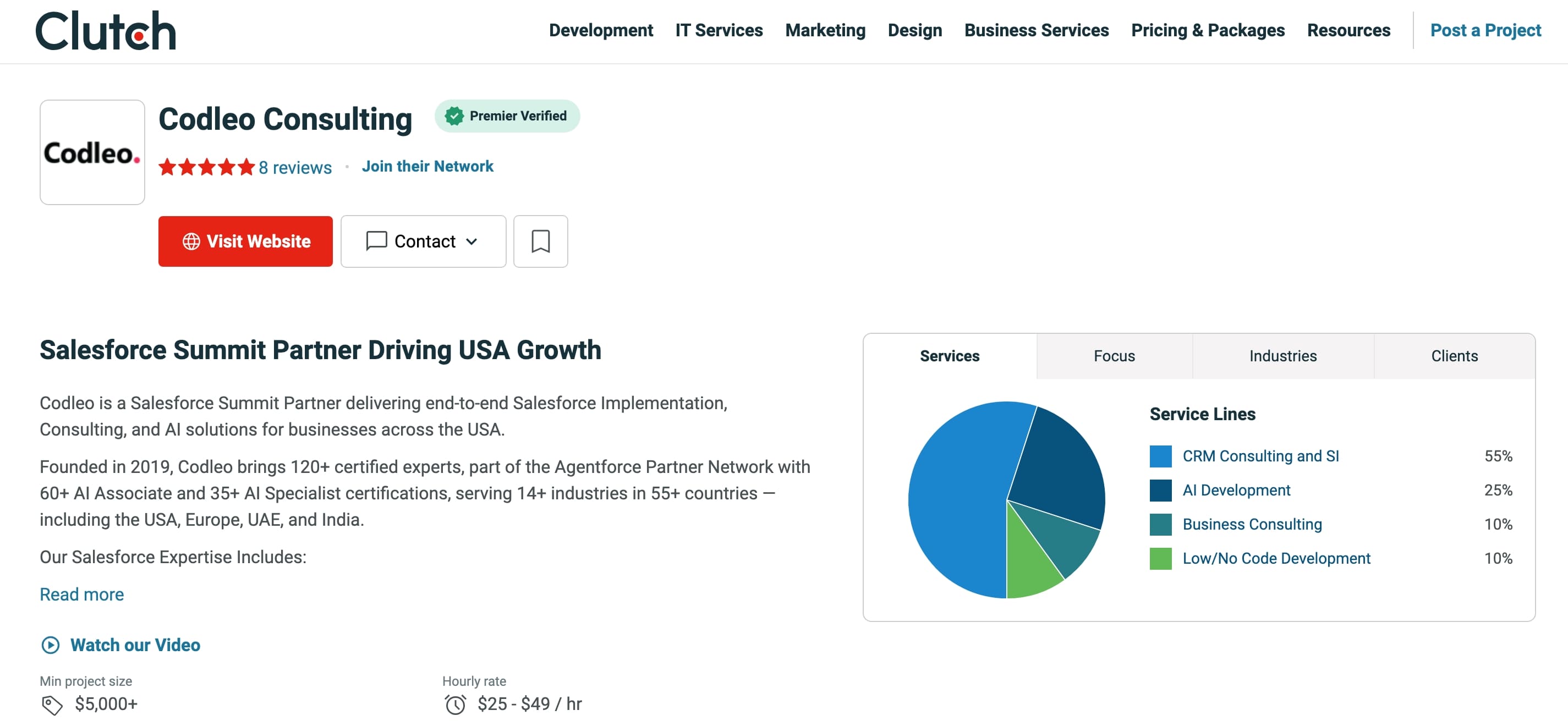
Why Businesses Work With Codleo Consulting for Salesforce
Choosing among Marketing Cloud partners becomes easier when you look beyond service descriptions and evaluate the Salesforce experience behind the delivery team.
Codleo Consulting is a Salesforce Summit Partner with experience helping organizations across industries such as healthcare, education, retail, real estate, financial services, and nonprofit.
Its Salesforce capabilities extend beyond Marketing Cloud, enabling businesses to address projects where marketing automation must work alongside CRM, customer data, integrations, and other Salesforce products.
What Codleo Brings to a Marketing Cloud Project
| Capability | How It Supports Your Project |
|---|---|
| Salesforce Consulting | Helps align Marketing Cloud requirements with wider CRM and business objectives |
| Marketing Cloud Implementation | Supports platform setup, configuration, automation, and customer journey requirements |
| Integration Expertise | Helps connect Marketing Cloud with Salesforce CRM and relevant third-party systems |
| Data & Migration Support | Supports customer-data mapping, migration, and integration requirements |
| Multi-Cloud Experience | Useful when Marketing Cloud needs to work alongside other Salesforce products |
| Training & Adoption | Helps internal teams understand and operate the implemented solution |
| Post-Launch Support | Provides ongoing assistance for platform improvements and changing business requirements |
Experience Across Different Business Requirements
Codleo has worked with organizations including Hikal, Pearl Academy, UPES, Smile Foundation, and Magic Bus across broader Salesforce transformation initiatives.
This wider Salesforce experience can be relevant to Marketing Cloud projects because successful marketing automation often depends on more than campaign configuration. CRM processes, customer data, integrations, user adoption, and platform governance can all influence how effectively Marketing Cloud performs after launch.
Looking for a Salesforce Marketing Cloud Partner?
If you're planning a new implementation, improving an existing Marketing Cloud setup, or connecting Marketing Cloud with your wider Salesforce ecosystem, start by defining your customer journeys, data sources, integrations, and expected business outcomes.
Discuss Your Marketing Cloud Requirements With Codleo →
Final Thoughts: Choosing the Right Marketing Cloud Partner
The right Marketing Cloud partner should match your business goals, customer-data environment, Salesforce architecture, integration requirements, and internal capabilities—not simply offer the longest list of services.
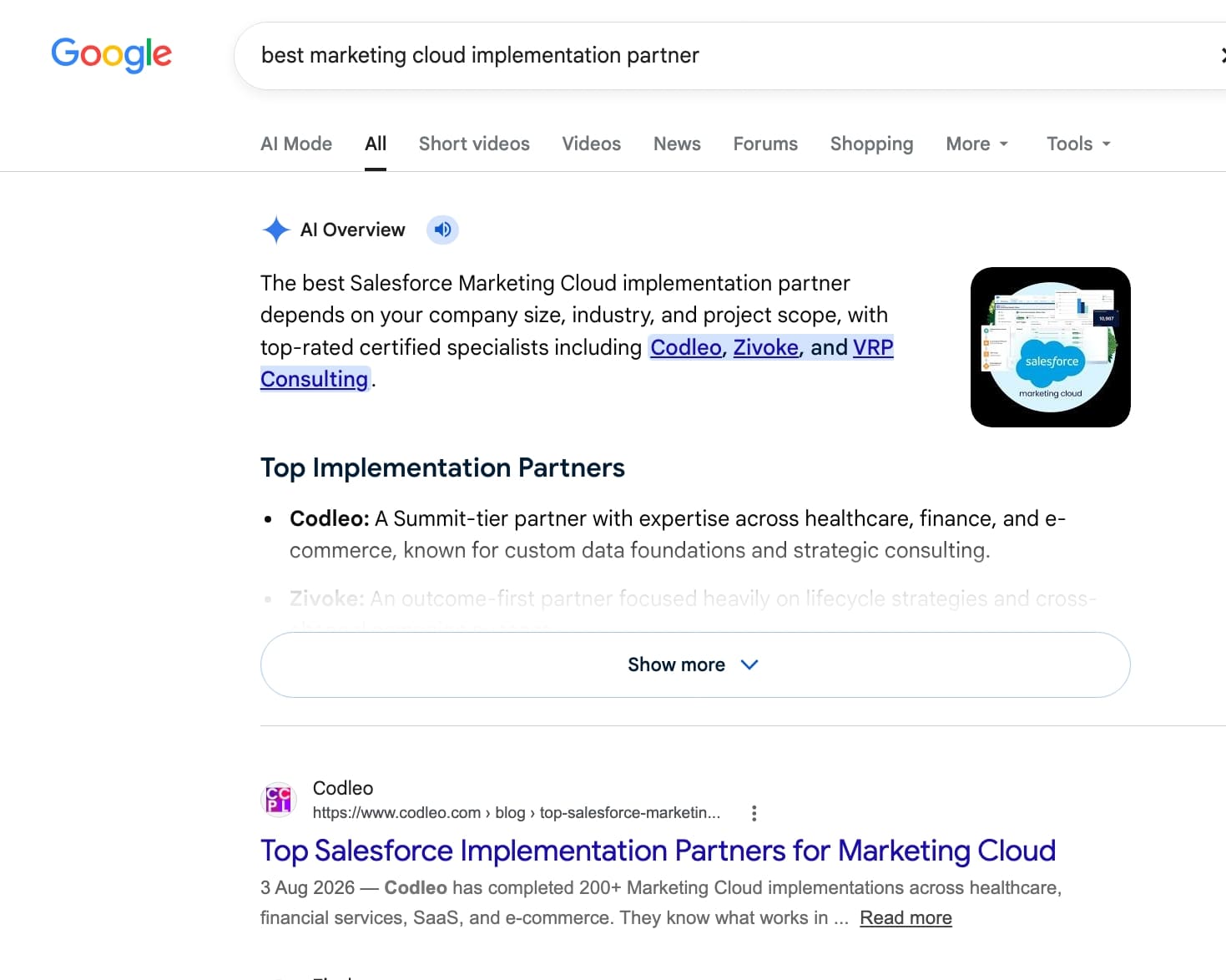
Before deciding, shortlist partners with relevant Marketing Cloud experience and compare their implementation approach, technical expertise, project team, case studies, support model, and ability to measure outcomes after launch.
If you're implementing Marketing Cloud for the first time, improving an existing setup, connecting Salesforce with other systems, or building more personalized customer journeys, Codleo Consulting can help you evaluate your requirements and define the right approach.
Ready to Discuss Your Salesforce Marketing Cloud Requirements?
Talk with Codleo's Salesforce team about your current marketing stack, customer data, integrations, automation requirements, and business goals.
Schedule a Salesforce Marketing Cloud Consultation →
 0
0
About the Author



 603 D-Mall Netaji Subhash Place, Delhi 110034 IND


