


Publish date:
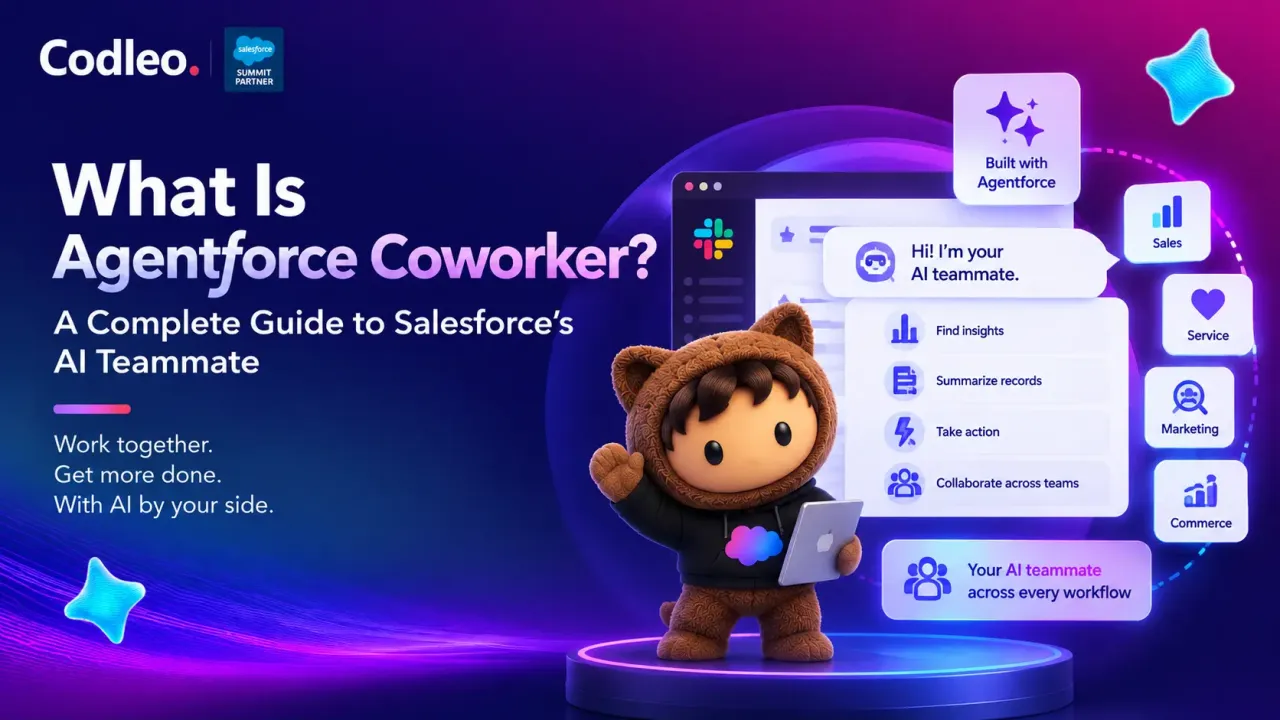
Agentforce Coworker is changing the way people interact with Salesforce. Instead of searching through records, switching between applications, opening multiple dashboards, or figuring out which AI agent can handle a task, employees can simply describe what they need in natural language.
Salesforce introduced Coworker as an autonomous AI teammate built to understand business context, surface relevant information, and help users take action directly within their everyday workflow.
That means Salesforce is moving beyond the idea of AI as a chatbot that only answers questions.
Coworker can help employees find information, analyze business context, initiate workflows, and connect with specialized Agentforce agents to move work forward.
Quick Answer: What Is Agentforce Coworker?
Agentforce Coworker is Salesforce’s AI-powered teammate that uses enterprise data, Salesforce context, workflows, permissions, and Agentforce agents to help employees complete work through natural-language conversations.
Powered by Data 360, it can understand information across accounts, opportunities, cases, customer history, documents, workflows, and other connected enterprise sources.
For example, instead of a sales representative manually checking an opportunity, recent customer conversations, open service cases, and account activity before a meeting, they could ask:
“What should I know before my meeting with this customer?”
Coworker can bring together relevant context, identify key issues or opportunities, and help the employee decide or take the next action.
The key difference is simple:
Traditional Salesforce search helps you find records. Agentforce Coworker helps you understand the situation and get work done.
Salesforce is also extending this experience beyond a single screen. Coworker is designed to work across Salesforce and other workplace environments, making it easier for employees to access trusted business context without constantly switching between systems.
For organizations already investing in Salesforce AI and Agentforce, this creates an important shift: instead of employees learning how to interact with multiple specialized agents, Coworker becomes a single conversational entry point to the wider agentic workforce.
In this guide, we’ll look at how Agentforce Coworker works, its key capabilities, business use cases, its relationship with Agentforce and AIforce, security considerations, and what organisations should evaluate before adopting it.
How Does Agentforce Coworker Work?
Agentforce Coworker connects the information your employees already use with Salesforce’s AI, workflows, and specialized agents.
Instead of making users decide where to search or which agent to open, Coworker provides a conversational starting point. An employee can describe what they need, and the system determines how to find the relevant context and move the request forward.
At a high level, the experience can be understood in four stages:
1. Discover the Right Information
The first step is understanding what the employee needs.
Agentforce Coworker can search across Salesforce CRM data and connected enterprise sources to bring relevant information into one response. Salesforce says Coworker can connect and index across 300+ enterprise sources, depending on the organization's connected environment.
This can include information related to:
-
accounts and contacts
-
opportunities and pipeline
-
service cases
-
internal knowledge
-
Salesforce records
-
Slack conversations
-
connected enterprise data
Instead of returning a long list of records like a traditional search experience, Coworker can synthesize the available context into an answer.
For example, a sales manager could ask:
“What changed with the Acme opportunity this week?”
Instead of manually opening the opportunity, reviewing activities, checking related records, and searching internal conversations, the user can get the relevant context in one interaction.
2. Analyse the Business Context
Finding information is only part of the experience.
Coworker can reason across connected business data to help employees understand what that information means.
A user might ask:
“Which deals in my pipeline need attention?”
The goal is not simply to retrieve opportunity records. Coworker can use the available business context to surface useful insights that help the employee understand where attention may be required.
This is where the experience moves beyond conventional CRM search.
Search gives employees information. Coworker helps them work with that information.
3. Plan and Take Action
When a request requires action, Agentforce Coworker can do more than generate an answer.
Depending on the organization's configuration and the user's permissions, it can work with Salesforce workflows and Agentforce capabilities to help move a task forward.
For example, a user could ask Coworker to:
-
create or update a Salesforce record
-
initiate an existing workflow
-
prepare the next step for an opportunity
-
route a task to an appropriate agent
-
continue a business process using connected automation
This creates a more natural path from question → insight → action.
Employees don't necessarily have to know which Salesforce Flow, automation, or AI agent sits behind the process. They can focus on the business outcome they want to achieve.
4. Activate the Right Specialized Agent
One of the most important parts of the architecture is agent orchestration.
As companies create more specialized AI agents for sales, service, HR, operations, finance, and other functions, employees could otherwise face a new problem: Which agent should I use?
Agentforce Coworker simplifies that experience.
It can serve as a single entry point to an organization's agentic workforce and route a request to an appropriate specialized Agentforce agent when necessary.
Imagine an employee asking:
“Review this opportunity, identify any risks, and help me prepare the next steps.”
Coworker can understand the request and, where configured, involve the relevant specialized agent or workflow rather than forcing the employee to find the right tool manually.
The overall experience therefore looks something like this:
Employee Request → Enterprise Context → AI Reasoning → Workflow or Specialized Agent → Action
That combination of data, reasoning, automation, and agents is what makes Agentforce Coworker different from a standard enterprise search bar or standalone AI assistant.
Key Features of Agentforce Coworker
Agentforce Coworker brings search, conversational AI, automation, and specialized AI agents into one experience. Instead of adding another tool employees need to learn, it works through familiar Salesforce interfaces and natural-language requests.
Here are its core capabilities.
Search: Find Information Across Your Business
Coworker turns enterprise search into a more intelligent experience.
Employees can search Salesforce CRM records and connected data sources without knowing exactly where the information is stored.
For example:
“Show me everything related to the Acme renewal.”
Coworker can surface relevant information and provide an AI-generated summary, helping users understand the situation without opening multiple records manually.
Salesforce also says Coworker can connect to and index information across 300+ enterprise sources, expanding its usefulness beyond CRM data.
Ask: Have Context-Aware Conversations
Sometimes one search isn't enough.
The Ask capability allows employees to have multi-turn conversations while Coworker maintains the context of previous questions.
For example:
-
Employee: “Summarize the Acme opportunity.”
-
Employee: “What are the biggest risks?”
-
Employee: “What should I discuss in tomorrow's meeting?”
Instead of starting from scratch each time, Coworker can continue working with the existing context.
This makes interacting with Salesforce feel more like collaborating with an AI teammate than navigating a traditional CRM interface.
Act: Move From Answers to Action
Coworker isn't limited to answering questions.
It can route requests to appropriate Agentforce agents and, when enabled by administrators, help users create or update Salesforce records.
For example, a sales representative could request:
“Update this opportunity to Negotiation and add today's meeting notes.”
A coworker can prepare the proposed changes for review before they are confirmed.
The important shift here is from AI that explains work to AI that helps execute work.
Build: Turn Successful Workflows Into Reusable Skills
When employees discover an effective way of completing a task with Coworker, that interaction doesn't always need to remain a one-time conversation.
The Build capability can turn successful conversations into reusable skills.
These skills can combine instructions, context, agents, and tools into repeatable workflows that other employees can use.
For organizations adopting agentic AI at scale, this can help transform individual AI interactions into standardized business processes.
Resume: Continue Previous Work
Complex work rarely happens in one conversation.
With Resume, users can return to previous Coworker interactions through their history and continue working from where they stopped.
This is useful for activities such as account research, opportunity reviews, case investigation, or other tasks that develop over time.
Agent Orchestration Behind the Experience
One of Coworker's most valuable capabilities happens behind the scenes.
If Coworker cannot complete a request itself, it can identify an appropriate specialized Agentforce agent available to the user and delegate the task.
That could include a sales agent, Tableau agent, or another custom Agentforce agent created for a specific business process.
Salesforce currently supports delegation across up to 50 accessible agents, making Coworker a potential front door to a much larger agentic workforce.
In practical terms, employees don't need to remember every AI agent their company has created.
They can simply explain what they want to accomplish, while Coworker helps determine which data, workflow, or specialized agent should handle the request.
Agentforce Coworker vs Traditional Salesforce Search
Salesforce users have always been able to search for accounts, contacts, opportunities, cases, and other records. Agentforce Coworker does not simply replace that search bar with a chatbot. It changes what employees can do after they ask a question.
Traditional Salesforce search is primarily designed to help users find information.
Agentforce Coworker is designed to help users find, understand, and act on information.
Here is a simple comparison:
| Capability | Traditional Salesforce Search | Agentforce Coworker |
|---|---|---|
| Find Salesforce records | Yes | Yes |
| Natural-language questions | Limited | Yes |
| AI-generated answers | No | Yes |
| Multi-turn conversations | No | Yes |
| Understand previous context | No | Yes |
| Search connected enterprise data | Limited | Yes |
| Analyse information across sources | No | Yes |
| Create or update records | No | Yes, when enabled |
| Route work to specialized agents | No | Yes |
| Continue previous AI interactions | No | Yes |
From Finding Records to Understanding Context
Consider a sales representative preparing for an important customer meeting.
With traditional search, the representative might search for the account, open the opportunity, review recent activities, check related cases, and then look elsewhere for additional customer information.
With Agentforce Coworker, the interaction can begin with a question such as:
“Give me a summary of this account before my meeting.”
Coworker can reason across the information available to that user and provide a more direct answer.
The employee can then continue:
“Are there any open issues I should know about?”
And then:
“What should my next steps be?”
Because the conversation maintains context, employees can progressively explore a business situation instead of repeatedly searching for individual records.
From Answers to Actions
The bigger difference appears when the employee wants something done.
For example:
“Update the opportunity with the latest meeting notes.”
When record actions have been enabled by the Salesforce administrator, Coworker can identify the relevant fields and present proposed changes for the user to review before confirmation.
This reduces the gap between discovering information and acting on it.
Coworker Can Also Orchestrate Specialized Agents
Organizations may eventually have multiple Agentforce agents built for different departments and processes.
One agent might support sales teams. Another could handle service workflows, while others could support analytics or organization-specific processes.
Employees shouldn't have to memorize which agent handles every task.
Agentforce Coworker can act as the conversational entry point.
When a request requires capabilities beyond Coworker's built-in search and reasoning, it can evaluate the Agentforce agents available to that user and delegate the request to an appropriate specialized agent.
This creates a simpler experience:
Ask Coworker → Understand Context → Find the Right Agent or Workflow → Take Action
Instead of employees adapting their work around dozens of AI tools, the AI layer adapts to the employee's request.
That is one of the biggest differences between Agentforce Coworker and the search experiences Salesforce users have traditionally relied on.
Agentforce Coworker Use Cases Across Business Teams
The real value of Agentforce Coworker becomes clearer when you look at everyday work.
Employees often spend time searching for information, checking different systems, summarizing records, preparing for meetings, and figuring out what to do next. Coworker can bring these activities into a conversational experience while connecting employees with the appropriate data, workflow, or specialized agent.
Here are some practical examples.
Agentforce Coworker for Sales Teams
Sales representatives often need information from several places before speaking with a prospect or customer.
A rep could ask:
“Prepare me for my meeting with this account.”
A coworker can help bring together relevant account information, opportunity details, previous interactions, open issues, and other accessible business context.
The rep could then continue:
“What has changed since our last meeting?”
or:
“Are there any risks with this opportunity?”
This can reduce manual account research and help sellers spend more time on customer conversations.
Coworker can also work with enabled agents and actions for tasks such as opportunity management, lead-related workflows, or follow-up activities.
Agentforce Coworker for Customer Service
Service teams frequently need to understand a customer's complete situation before resolving an issue.
Instead of manually moving between account records, previous cases, knowledge articles, and other sources, a service representative could ask:
“Summarize this customer's recent support history.”
A coworker can help surface the relevant context available to that employee.
The representative could follow up with:
“Are there any unresolved issues?”
and then:
“What should we address first?”
Specialized service agents can also be involved when a request requires a specific action or process.
The result is not simply faster search. It can create a more connected path from understanding the customer to resolving the issue.
Agentforce Coworker for Marketing Teams
Marketing teams work across campaign data, customer information, performance metrics, audience insights, and multiple Salesforce products.
Coworker can provide another way to explore this information conversationally.
A marketer might ask:
“How did our latest campaign perform for this account?”
Then continue:
“Compare it with our previous campaigns.”
Instead of building a new search for every question, the marketer can keep exploring the same context.
When connected with appropriate Agentforce capabilities, this experience can complement AI-powered marketing workflows such as campaign development, personalization, segmentation, and performance analysis.
Agentforce Coworker for Managers and Leadership
Managers often spend considerable time gathering updates before pipeline reviews, customer meetings, or operational discussions.
Coworker can help summarize available information and surface areas that deserve attention.
For example:
“What are the major changes in my team's pipeline this week?”
A manager could then ask:
“Which opportunities need attention?”
followed by:
“Summarize the key risks for my pipeline review.”
This conversational approach makes it easier to move from high-level questions to specific business situations without repeatedly rebuilding reports or searches.
Agentforce Coworker for Employee and Operational Work
The concept extends beyond customer-facing teams.
Organizations can build specialized Agentforce agents for internal processes such as employee support, IT service, finance, HR, or other operational workflows.
Coworker can become the common entry point for those agents.
An employee could ask:
“Help me find our parental leave policy.”
Another might ask:
“What is the status of my IT support request?”
Or a manager could request information from a specialized internal agent without first deciding which agent should handle the task.
This is where Coworker's orchestration model becomes especially useful.
As an organization adds more AI agents, employees don't necessarily need to learn a new interface for every use case.
They can start with Coworker and let the system connect their request with the appropriate enterprise context, workflow, or specialized agent.
One Interface, Multiple Business Processes
The broader opportunity isn't about adding another AI chatbot to Salesforce.
It is about creating a common AI interaction layer across everyday work.
A sales representative may use it to prepare for an account.
A service employee may use it to investigate a customer issue.
A marketer may use it to explore campaign performance.
A manager may use it to understand pipeline changes.
And another employee may use the same interface to access an internal specialized agent.
That makes Agentforce Coworker particularly relevant for organizations planning to deploy multiple AI agents across different departments.
Instead of asking employees to understand the underlying AI architecture, Coworker can give them a simpler starting point:
Tell Salesforce what you need to accomplish and let the agentic layer help determine how the work gets done.
How Agentforce Coworker Connects Data 360, Slack, ChatGPT, Claude, and Microsoft Teams
One of the more interesting ideas behind Agentforce Coworker is that employees should not have to return to a single Salesforce screen every time they need business information.
Salesforce is positioning Coworker as an AI teammate that can follow employees across the tools where they already work, while keeping Salesforce business context at the center of the experience.
Data 360 Provides the Business Context
Data 360 plays an important role in the Coworker architecture.
Rather than working only with isolated prompts, Coworker can use connected enterprise information to understand the context behind a request.
Depending on the organization's setup, this can include Salesforce CRM records, Data 360 objects, Slack data, and other connected enterprise sources.
For example, asking:
“Which customers should I focus on today?”
could require information from opportunities, account activity, service history, and other business data.
The value comes from bringing that context together before the AI reasons about the request.
Slack Brings Coworker Closer to Everyday Collaboration
For many teams, important business context does not live only inside CRM records.
It also appears in Slack conversations.
Salesforce allows organizations to make authenticated Slack workspace data searchable through Agentforce Coworker.
That means a user could potentially ask about a customer or project and retrieve relevant information from both Salesforce and connected Slack data, subject to the permissions available to that user.
This reduces the need to search Salesforce and Slack separately just to understand one business situation.
Coworker Across ChatGPT and Claude
Salesforce is also extending the Coworker concept into external AI experiences such as ChatGPT and Claude.
The broader idea is important.
An employee working inside an AI assistant should not necessarily have to leave that environment, open Salesforce, locate the right records, and rebuild the context manually.
Instead, Salesforce is developing ways to make its business context and Agentforce capabilities accessible from the AI environments employees already use.
Salesforce also supports exposing compatible Agentforce agents through Model Context Protocol (MCP), creating a path for external assistants such as ChatGPT and Claude to invoke specialized Salesforce capabilities.
For businesses already experimenting with multiple enterprise AI platforms, this can reduce another form of application switching.
Microsoft Teams and Other Work Surfaces
The same strategy extends to Microsoft Teams and other employee interfaces.
Salesforce describes Coworker as a headless-first experience designed to work across multiple surfaces rather than being tied to one application.
In practical terms, the long-term experience looks like this:
Employee → Preferred Work App → Agentforce Coworker → Salesforce Context → Specialized Agent or Action
The interface may change, but the underlying business context and agentic capabilities can remain connected.
Why This Matters for Enterprises
Companies are rapidly adding AI assistants, agents, copilots, automation tools, and data platforms.
Without orchestration, that can create another fragmented technology stack.
Employees may end up asking:
Should I use Salesforce? Slack? ChatGPT? Claude? A custom Agentforce agent?
Coworker is designed to reduce that complexity by providing a more consistent entry point into Salesforce business context and the organization's agentic workforce.
For companies evaluating Agentforce implementation, the question therefore isn't only which AI agents they should build.
They also need to consider how employees will discover and interact with those agents across their existing workflows.
Agentforce Coworker could become the layer that connects those experiences together—allowing employees to focus less on which AI tool to open and more on what work they need to accomplish.
Agentforce Coworker Security, Permissions, and Governance
Giving an AI teammate access to enterprise information naturally raises an important question:
What can Agentforce Coworker actually see and do?
Agentforce Coworker is designed to operate within Salesforce's existing security and governance framework rather than giving AI unrestricted access to company data.
Coworker Respects Existing User Access
Coworker works within the permissions assigned to Salesforce users.
This means two employees asking similar questions may receive different information depending on the records, objects, data sources, and agents they are authorized to access.
For organizations, this matters because introducing an AI interface should not automatically expand an employee's access to sensitive business information.
Salesforce states that Coworker respects existing governance and sharing rules while working with enterprise data.
Admins Control Who Can Use Coworker
Salesforce administrators remain responsible for enabling access.
Users need the appropriate permission set group before they can use Agentforce Coworker. Admins can grant or remove this access through Coworker Setup.
Organizations can therefore introduce Coworker gradually—for example, starting with selected sales or service teams before expanding it across the business.
AI Actions Can Be Controlled Separately
Searching information and changing business records are very different levels of AI access.
Salesforce provides administrators with an Agent Actions control that determines whether Coworker can create or update CRM records for users.
When actions are enabled, Coworker can propose a change such as updating an opportunity or creating a record.
The user can review the proposed values before confirming the action.
The actual change is still executed using that user's Salesforce permissions. If the employee lacks sufficient permission, the operation fails.
This provides an important layer of human oversight for business-critical actions.
Data Governance Extends Beyond CRM
As organizations connect Data 360 and other enterprise sources, governance becomes even more important.
Salesforce describes Coworker's governance capabilities as including:
-
permission-based access controls
-
source-level permissions
-
automatic data classification
-
dynamic data masking
-
existing Salesforce sharing rules
These controls help organizations determine which information should be available to AI and which users should be allowed to access it.
Built on Salesforce's AI Trust Architecture
The broader Agentforce platform also uses Salesforce's trust and governance capabilities.
The Einstein Trust Layer includes protections such as secure data retrieval, dynamic grounding, data masking, toxicity detection, and AI-related audit capabilities.
For businesses deploying AI across customer, employee, financial, or operational processes, these controls can be as important as the AI model itself.
The goal isn't simply to make Coworker capable of doing more.
It is to ensure the right employee can access the right information and perform the right action within defined business controls.
For enterprises evaluating Agentforce Coworker, permissions and governance should therefore be part of the implementation strategy from the beginning—not something added after deployment.
How to Implement Agentforce Coworker in Your Salesforce Org
Turning on Agentforce Coworker is relatively straightforward. Making it genuinely useful for employees requires more planning.
Organizations need to decide what data Coworker should access, which employees should use it, what actions they should be allowed to perform, and where specialized Agentforce agents fit into the experience.
You can approach a practical implementation in six stages.
1. Define the Business Use Cases
Start with the work you want Coworker to improve.
Instead of enabling AI across the entire organization immediately, identify a small number of high-value scenarios.
For example:
-
preparing sales reps for customer meetings
-
summarizing accounts and opportunities
-
helping service teams investigate customer issues
-
finding information across CRM and Slack
-
updating Salesforce records through natural language
-
connecting employees with specialized Agentforce agents
Clear use cases make it easier to determine which data, permissions, workflows, and agents to configure.
2. Prepare Your Salesforce and Data 360 Environment
Data quality directly affects the usefulness of AI responses.
Before deployment, review the Salesforce records and connected enterprise data that Coworker will rely on.
Salesforce CRM is automatically available as a Coworker data source. Organizations can also add selected Data 360 objects and other supported sources.
The goal should not be to connect every possible dataset.
Instead, connect the information employees actually need to complete the selected business processes.
3. Configure Searchable Data Sources
Next, determine where Coworker should retrieve information.
Depending on your environment, this could include:
Salesforce CRM → Data 360 → Slack → other connected enterprise sources
For Data 360 objects, administrators can select which objects and fields should be indexed and searchable.
This step matters because better data architecture and indexing can lead to more relevant responses.
4. Configure Permissions and Agent Actions
Organizations should decide what Coworker can read separately from what it can change.
Some employees may only need AI-powered search and answers.
Others may need Coworker to create or update Salesforce records.
Salesforce provides an Agent Actions setting that administrators can use to control record actions.
A sensible rollout can therefore begin with:
Search → Ask → Analyze → Controlled Actions
rather than enabling every capability from day one.
5. Connect Specialized Agentforce Agents
Coworker becomes more powerful when it can delegate tasks to specialized agents.
Organizations should review their existing and planned Agentforce agents and determine which ones employees should be able to access through Coworker.
For example, a company might have separate agents for:
-
sales support
-
customer service
-
employee support
-
analytics
-
industry-specific processes
-
internal operational workflows
Coworker can then provide a common conversational entry point instead of requiring employees to manually choose between multiple agents.
6. Start With a Controlled Rollout
A phased implementation is usually more practical than launching Coworker across the entire organization at once.
Start with a defined team and a small number of repeatable use cases.
Then measure:
-
Are employees finding information faster?
-
Are AI answers grounded in the right business data?
-
Which questions repeatedly fail or require manual intervention?
-
Which workflows should become reusable skills or specialized agents?
-
Are permissions and actions behaving as expected?
These findings can guide the next stage of deployment.
Why Agentforce Coworker Implementation Requires More Than Activation
Salesforce automates much of the technical activation process, but enterprise implementation involves more than switching the feature on.
Organizations still need to align their:
Data → Permissions → Search Sources → Workflows → Agents → Governance
A poorly prepared Salesforce environment can limit what Coworker can accomplish, while a well-designed implementation can make it a useful interface between employees and an organization's wider Salesforce ecosystem.
Businesses with complex Salesforce environments may therefore choose an experienced Salesforce consulting partner or Agentforce implementation partner to evaluate data readiness, identify suitable use cases, configure Agentforce capabilities, and establish governance before scaling adoption.
The objective should not be to deploy AI everywhere.
It should be to identify the business processes where Coworker can reduce friction and then build the data, automation, and agent architecture required to support them.
Agentforce Coworker Pricing, Licensing, and Availability
Agentforce Coworker does not have one simple standalone price. The cost depends on your Salesforce edition, licensing model, users, connected data sources, and how much Agentforce usage your organization consumes.
Salesforce currently supports two primary ways to access Coworker:
1. Seat-Based Access
Organizations using eligible Agentforce 1 Editions or Agentforce for Sales, Service, and Industries licenses can provide licensed employees with unmetered Coworker access when they configure the required user permissions correctly.
This model may be more suitable for organizations expecting employees to use Coworker frequently as part of their everyday Salesforce workflows.
2. Usage-Based Access
Organizations can also use Coworker through a consumption-based model.
Depending on the Salesforce contract and configuration, usage can consume Flex Credits, Einstein Requests, or Data Services Credits.
Salesforce currently lists Flex Credits at $500 per 100,000 credits, although pricing and contractual terms can change. Salesforce Foundations also includes a path for customers to start using Agentforce capabilities.
What Can Increase the Cost?
The Coworker interface itself is only one part of the cost equation.
Additional consumption can come from connecting and processing enterprise information through Data 360.
For example, when organizations add Data 360 sources, Salesforce may consume credits to:
-
process enterprise data
-
create semantic search indexes
-
query connected information
-
perform intelligent or unstructured data processing
Salesforce CRM is automatically available as a Coworker source, while additional Data 360 objects must be selected and indexed.
Where Is Agentforce Coworker Available?
Agentforce Coworker is currently documented for Enterprise, Unlimited, and Agentforce 1 Editions, subject to the required licenses, entitlements, Data 360 activation, and permissions.
Before estimating the total cost, businesses should therefore evaluate:
Number of Users → Expected Usage → Salesforce Licensing → Data Sources → Agent Actions → Specialized Agents
For a small deployment, requirements can differ greatly from an enterprise rollout connecting multiple data sources and AI agents.
This is why organizations planning a larger Agentforce deployment should estimate both licensing and ongoing AI/data consumption rather than looking only at the advertised per-user price.
Agentforce Coworker vs Agentforce vs AIforce: What's the Difference?
With Salesforce expanding its AI portfolio, terms such as Agentforce, Agentforce Coworker, and AIforce can easily sound interchangeable. However, they describe different parts of Salesforce's broader AI strategy.
Here is the simplest way to understand them:
| Salesforce AI | What It Is | Primary Role |
|---|---|---|
| Agentforce | Salesforce's platform for AI agents | Build and deploy agents that perform specific business tasks |
| Agentforce Coworker | An AI teammate and employee interface | Helps employees search, reason, act, and access specialized agents |
| AIforce | Salesforce's broader AI experience and interface direction | Makes AI more accessible across Salesforce experiences and workflows |
What Is Agentforce?
Agentforce is Salesforce's platform for creating and deploying AI agents.
Organizations can build specialized agents for different processes, such as sales, customer service, employee support, analytics, and industry-specific workflows.
These agents can use business data, instructions, actions, and automation to perform defined tasks.
Think of Agentforce as the agent platform and workforce underneath the experience.
What Is Agentforce Coworker?
Agentforce Coworker sits closer to the employee.
Instead of asking employees to decide which specialized agent they need, Coworker can become a conversational starting point for work.
An employee might simply ask:
“Help me prepare for my customer meeting tomorrow.”
Coworker can understand the request, retrieve relevant enterprise context, and use an appropriate workflow or specialized Agentforce agent when required.
Think of Coworker as the AI teammate employees interact with to access data, actions, and the wider agentic workforce.
Where Does AIforce Fit?
AIforce represents Salesforce's broader effort to make AI a more native part of how users interact with its platform.
Instead of treating AI as a separate destination, Salesforce is moving toward experiences where employees can work with AI directly from the interfaces and applications they already use.
Coworker fits naturally into this direction because it gives employees a conversational way to access Salesforce data, workflows, and agents.
A simple way to visualize the relationship is:
AIforce Experience → Agentforce Coworker → Specialized Agentforce Agents → Salesforce Data & Workflows
These layers work together rather than competing with one another.
For businesses evaluating Salesforce AI, understanding this distinction matters. The goal isn't necessarily to choose between Agentforce and Coworker.
Instead, organizations can use Agentforce to build specialized AI capabilities and Coworker to make those capabilities easier for employees to discover and use in everyday work.
Is Your Business Ready for Agentforce Coworker?
Agentforce Coworker represents a shift in how employees can work with Salesforce. Instead of navigating multiple records, tools, and AI agents, users can ask questions, understand business context, and take action through a more unified conversational experience.
But getting value from Coworker requires more than enabling the feature. Your Salesforce data, permissions, workflows, Data 360 environment, and Agentforce agents need to work together around clearly defined business use cases.
If your organization is exploring Agentforce Coworker, start with a few high-value workflows and determine where AI can genuinely reduce manual work or context switching.
Need help planning your Agentforce strategy?
Codleo Consulting helps businesses assess Agentforce use cases, prepare Salesforce data and workflows, configure AI agents, and build scalable Salesforce AI solutions.
Talk to our Agentforce consultants →
 0
0
About the Author


 603 D-Mall Netaji Subhash Place, Delhi 110034 IND


