


Publish date:
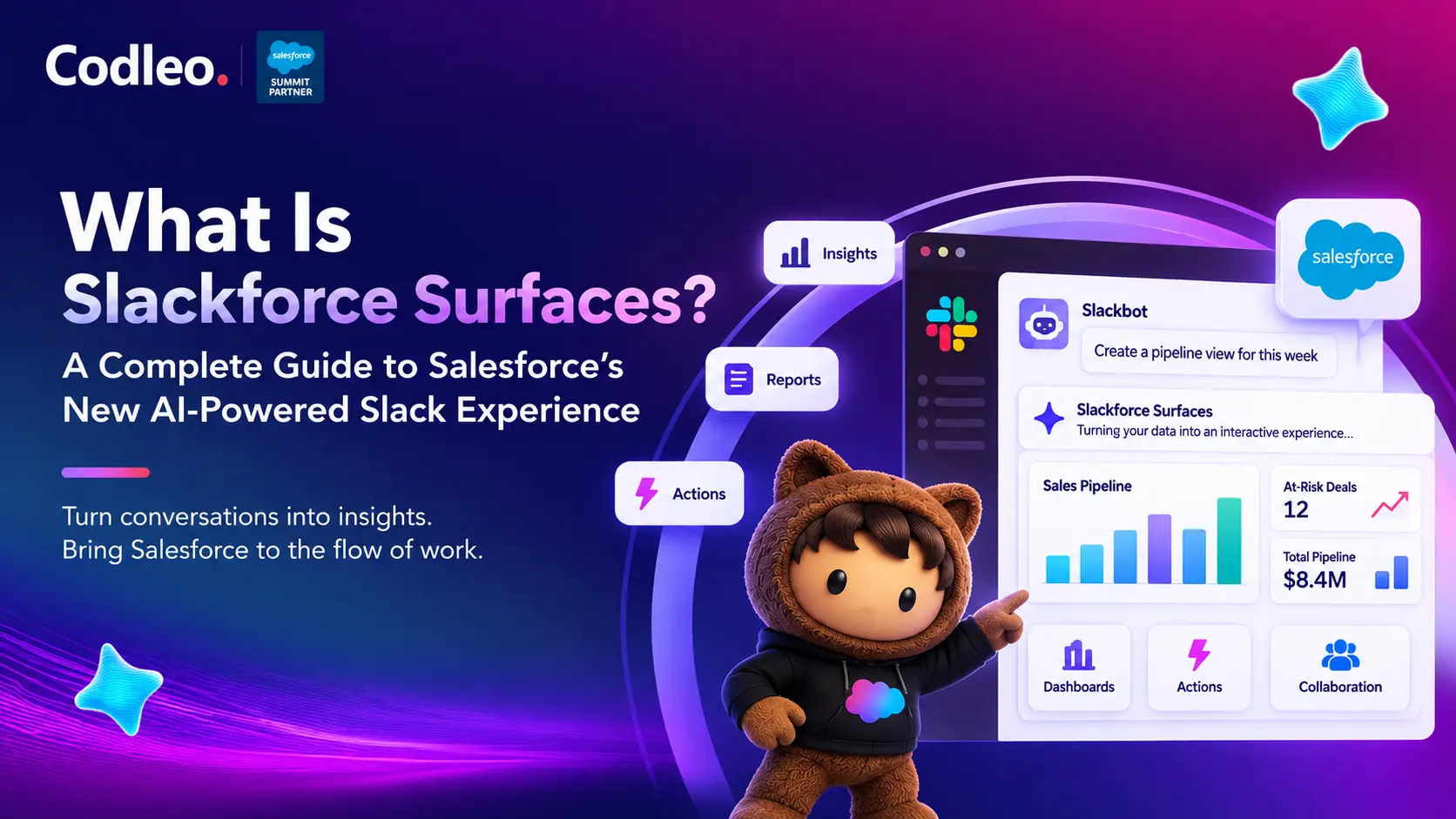
Quick Answer: Slackforce Surfaces is a Salesforce capability that lets users turn business data and work context into interactive experiences directly inside Slack. Using natural-language prompts, teams can ask Slackbot to create dashboards, reports, presentations, calculators, and other business views using context from Salesforce, Slack, and connected enterprise systems.
Salesforce is changing how employees interact with CRM data.
Traditionally, a sales manager might discuss a deal in Slack, open Salesforce to review the opportunity, check a dashboard for pipeline data, and then return to Slack to continue the conversation.
Slackforce Surfaces is designed to bring more of that experience into one place.
According to Salesforce's official Slackforce Surfaces overview, users can describe what they need in plain language, and Slackbot can transform available business context into an interactive interface.
For example, a user could ask:
“Create a dashboard showing the health of my sales pipeline and highlight deals that need attention.”
Instead of returning only a text answer, Slackbot can create a Surface that helps the team visualize and explore the relevant information.
Salesforce has demonstrated Surfaces for use cases such as:
-
Sales pipeline dashboards
-
Customer service triage boards
-
Marketing campaign views
-
Financial forecasts
-
Executive presentations
-
AI usage dashboards
-
Interactive calculators
Salesforce Ben's Dreamforce '26 coverage also highlights an important difference: Surfaces aren't simply static AI-generated reports. They are designed to become interactive experiences inside Slack and, as Salesforce's live-data capabilities roll out, can stay connected to the underlying business data.
This makes Slackforce Surfaces more than another dashboard feature.
It is part of Salesforce's broader move toward making CRM data, AI, business context, and actions available inside the tools where employees already work.
In this guide, we'll explain how Slackforce Surfaces works, its key features and use cases, how it differs from Slackbot and traditional Salesforce dashboards, its availability and security considerations, and what businesses should evaluate before adopting it.
What Is Slackforce and How Does It Connect to AIforce?
Slackforce is Salesforce's approach to bringing CRM data, business context, intelligence, and actions directly into Slack. Instead of requiring employees to open Salesforce every time they need customer information or want to update a record, Slackforce makes Slack another way to work with Salesforce.
Salesforce describes Slackforce as a way to turn Slack into a live, multiplayer interface for Salesforce, bringing Salesforce context and intelligence into conversations and workflows.
Slackforce is part of Salesforce's broader AIforce strategy.
AIforce is designed to make Salesforce capabilities available across the interfaces where employees and AI agents already work. According to Salesforce's AIforce announcement, this includes access to Salesforce data, workflows, business logic, permissions, security, and governed actions.
The relationship looks like this:
AIforce → Slackforce → Slackbot + Slack CRM + Slackforce Surfaces
| Technology | What It Does |
|---|---|
| AIforce | Extends Salesforce data, workflows, and business capabilities into AI-powered interfaces. |
| Slackforce | Brings the Salesforce experience into Slack conversations and workflows. |
| Slackbot | Acts as the conversational AI assistant employees interact with inside Slack. |
| Slack CRM | Lets users work with Salesforce records and CRM activities from Slack. |
| Slackforce Surfaces | Turns business context into interactive dashboards, reports, presentations, and other interfaces. |
This distinction is important because Slackforce Surfaces and Slackbot aren't the same thing.
A sales manager could ask Slackbot:
“Show me which opportunities need attention before this week's pipeline review.”
Slackbot handles the conversational request and relevant context, while Slackforce Surfaces can turn that information into an interactive experience the team can explore.
As Salesforce Ben explains, Surfaces extend Salesforce's Slack strategy by allowing users to create live interfaces from plain-language requests and their work context.
In simple terms:
Slackbot is who you ask. Slackforce Surfaces is what gets built. Slack is where your team works with it.
How Does Slackforce Surfaces Work?
Slackforce Surfaces follows a simple idea: start with a business question instead of starting with a dashboard.
Rather than manually finding a report, choosing fields, applying filters, and building a visualization, users can tell Slackbot what they want to understand.
Here's how the process works.
1. Ask Slackbot in Natural Language
A user starts by describing the required outcome.
For example:
“Create a view of our sales pipeline and highlight opportunities that may be at risk this quarter.”
The request could also relate to customer service cases, marketing campaigns, financial forecasts, or another business process.
2. Slackbot Uses Available Business Context
Slackbot can work with information the user is permitted to access across Salesforce, Slack, and supported connected systems.
That matters because the context behind a business decision may exist across multiple places.
A sales opportunity, for example, may have structured pipeline data in Salesforce, while recent discussions and internal decisions happen in Slack.
Salesforce explains in its AIforce and Slackforce announcement how it can bring Salesforce context into the interfaces where employees already work.
3. Slackbot Creates the Surface
Based on the request, Slackbot can determine an appropriate format for presenting the information.
According to Salesforce's Slackforce Surfaces overview, this could include an:
-
Interactive dashboard
-
Business report
-
Executive presentation
-
Campaign tracker
-
Financial forecast
-
Calculator
-
Microsite
There isn't one fixed template. You can build the Surface around the question, context, and intended audience.
4. Teams Explore and Collaborate
Once created, the Surface becomes an interactive experience inside Slack.
Teams can explore information, apply filters, discuss what they're seeing, and ask Slackbot follow-up questions.
For example:
“Why are these opportunities considered at risk?”
Salesforce Ben's Slackforce Surfaces coverage also describes this conversational approach, where users can continue interacting with the information after the initial Surface is created.
The overall workflow becomes:
Ask → Connect Context → Create Surface → Explore → Collaborate → Act
That's the main difference from conventional reporting: the user begins with what they need to accomplish, and the interface is created around that need.
Key Features of Slackforce Surfaces
Slackforce Surfaces goes beyond displaying Salesforce data inside Slack. Its key difference is combining natural-language requests, business context, interactive interfaces, and collaboration in the same workspace.
Here are the most important features.
1. Dynamic Interfaces Instead of Fixed Templates
Users aren't limited to one dashboard format. Depending on the request, Slackbot can create different types of Surfaces for different business needs.
For example:
| Business Need | Possible Surface |
|---|---|
| Review sales pipeline | Pipeline dashboard |
| Prioritize support cases | Case triage board |
| Track a product launch | Campaign tracker |
| Review business performance | Executive presentation |
| Analyze financial performance | Forecast view |
| Calculate potential impact | Interactive calculator |
According to Salesforce's Slackforce Surfaces overview, there is no single prescribed format—the experience can adapt to what the user is trying to accomplish.
2. Salesforce, Slack, and Enterprise Context
A business question often requires more than CRM records alone.
Slackforce can bring together relevant context from Salesforce, Slack, and supported connected systems. This could help users understand not only what is happening, but also the conversations and business context surrounding it.
For example, a pipeline Surface could combine opportunity information with relevant Slack discussions around important deals.
3. Interactive and Collaborative Experiences
Surfaces are designed to be worked with, not simply viewed.
Teams can explore information, apply filters, discuss findings, and continue asking questions from within Slack.
A Surface can therefore become part of the team's workflow rather than another report that gets exported and shared as a screenshot.
4. Permission-Aware Access
Bringing CRM information into Slack doesn't mean removing Salesforce security controls.
Salesforce says Surfaces operate under a user's existing permissions, so the experience should respect the business information that person is authorized to access.
This becomes particularly important for customer records, sales opportunities, service cases, financial information, and other sensitive data.
5. Connected Data Experiences
Salesforce is also designing Surfaces to remain connected to their underlying data rather than becoming static outputs.
For example, changes to an opportunity or support case could eventually be reflected in the associated Surface as the source data changes.
Salesforce notes that this live-data functionality begins rolling out in October 2026.
As Salesforce Ben explains, this ability to create interactive experiences that remain connected to business context is one of the key distinctions between Surfaces and conventional AI-generated summaries.
Together, these capabilities move Slackforce Surfaces from “show me an answer” toward “give my team an interface we can work with.”
Slackforce Surfaces Use Cases Across Business Teams
Slackforce Surfaces can support different teams because the interface isn't restricted to one type of report or workflow. The Surface can be shaped around the business question a user is trying to answer.
Here are some practical use cases.
Sales: Find Deals That Need Attention
A sales manager could ask:
“Show me the opportunities most likely to need attention before this week's pipeline review.”
Instead of manually reviewing every opportunity, a Surface could organize relevant information such as deal value, stage, close date, recent activity, and other available account context.
Salesforce shows a similar pipeline scenario in its Slackforce Surfaces overview, where opportunities can be organized by pipeline health.
Customer Service: Prioritize Critical Cases
Service teams could create a triage Surface focused on cases that require immediate attention.
For example:
“Show high-priority cases that are approaching an SLA breach.”
The resulting experience could help teams review relevant factors such as case severity, status, customer context, ownership, and escalation information in one place.
Marketing: Track Campaign Execution
Marketing teams often work across CRM data, campaign systems, documents, and Slack conversations.
A marketer could ask Slackbot to create a Surface for an upcoming campaign or product launch, bringing together relevant milestones, performance information, deadlines, and campaign context.
This gives marketing and leadership teams a shared workspace rather than relying on multiple disconnected reports.
IT: Monitor AI Adoption and Usage
Slackforce Surfaces can also support technology teams.
Salesforce has demonstrated examples of AI usage where IT leaders can visualize adoption, token consumption, costs, and usage trends.
As companies deploy more AI agents, having this information accessible in a collaborative environment could support ongoing AI governance and operational reviews.
Finance: Create Executive Forecast Views
Finance leaders could use Surfaces to turn complex business information into an easier executive view.
For example:
“Create a forecast showing our biggest positive drivers, risks, and budget variances.”
Instead of sharing another spreadsheet or static presentation, leaders could organize the information into an interactive experience for discussion.
Salesforce Ben's coverage of Slackforce Surfaces also highlights examples ranging from sales and marketing to finance and IT.
Where Could Slackforce Surfaces Deliver the Most Value?
The strongest use cases are likely to be workflows where teams currently need to collect information from several places before making a decision.
| Team | Example Surface |
|---|---|
| Sales | Pipeline risk dashboard |
| Service | Case triage board |
| Marketing | Campaign tracker |
| IT | AI usage dashboard |
| Finance | Forecast and variance view |
The opportunity isn't simply to create more dashboards. It is to make relevant Salesforce and business context easier to access where teams are already discussing and acting on it.
Slackforce Surfaces vs. Traditional Salesforce Dashboards
Slackforce Surfaces and traditional Salesforce dashboards can both help teams understand business data, but they support different ways of working.
A traditional Salesforce dashboard is generally built around predefined reports, metrics, filters, and components. Slackforce Surfaces takes a more conversational approach: the user starts with a question, and the interface is built around the available business context.
| Capability | Slackforce Surfaces | Salesforce Dashboards |
|---|---|---|
| Starting point | Natural-language request | Preconfigured reports |
| Primary interface | Slack | Salesforce |
| Experience | Dynamically generated | Designed in advance |
| Context | Salesforce, Slack, and connected sources | Primarily Salesforce reporting data |
| Collaboration | Built around Slack workflows | Primarily CRM/reporting workflows |
| Best suited for | Contextual, collaborative questions | Consistent KPI monitoring |
Does Slackforce Surfaces Replace Salesforce Dashboards?
No. Salesforce has not positioned Slackforce Surfaces as a replacement for traditional Salesforce dashboards.
Dashboards remain useful when a business needs standardized metrics, consistent calculations, fixed reporting periods, and established KPI definitions.
Surfaces become more interesting when the request is contextual.
For example:
Salesforce Dashboard:
“Show quarterly pipeline by region.”
Slackforce Surface:
“Show the deals that need attention this week and include the relevant business context.”
According to Salesforce's Slackforce Surfaces overview, Surfaces can take multiple forms depending on what the user is trying to accomplish, rather than being limited to a conventional dashboard structure.
Salesforce Ben's analysis similarly highlights the ability to create experiences dynamically from natural-language requests.
The practical distinction is:
-
Traditional reporting: Data → Report → Dashboard → Analyze
-
Slackforce Surfaces: Question → Context → Surface → Collaborate → Act
For many Salesforce customers, the two approaches could therefore complement each other rather than compete.
Slackforce Surfaces vs. Slackbot vs. Slack CRM vs. Agentforce
Slackforce Surfaces, Slackbot, Slack CRM, and Agentforce are connected parts of Salesforce's AI and Slack ecosystem, but they don't perform the same role.
The easiest way to understand them is:
Slackbot = Ask | Slackforce Surfaces = Visualize | Slack CRM = Work with CRM | Agentforce = Execute
| Salesforce Capability | Primary Role | Example |
|---|---|---|
| Slackbot | Conversational AI assistant | “What's happening with this account?” |
| Slackforce Surfaces | Creates interactive business experiences | “Build a view of at-risk opportunities.” |
| Slack CRM | Brings CRM data and actions into Slack | Review or update an opportunity from Slack. |
| Agentforce | AI agents for business tasks | An agent handles steps within a sales or service workflow. |
How Can They Work Together?
Consider a sales manager preparing for a pipeline review.
The manager could ask Slackbot which opportunities need attention. A Slackforce Surface could organize those opportunities into an interactive view. Salesforce information could be accessed or updated through Slack CRM, while an Agentforce agent could support specific tasks or workflows.
This creates a connected flow:
Ask → Understand → Visualize → Take Action
Salesforce's broader AIforce announcement describes this direction as extending Salesforce's trusted data, metadata, workflows, and business logic into the interfaces where people and AI agents work.
Salesforce Ben's Slackforce Surfaces coverage also shows how Surfaces fit alongside Slackbot rather than functioning as a separate conversational assistant.
For businesses evaluating Salesforce AI, the important point is that these capabilities can complement one another. Slackbot provides the conversational entry point, Surfaces provides an interactive way to work with context, Slack CRM brings CRM activity closer to Slack, and Agentforce extends the experience with AI-powered agents.
Slackforce Surfaces Pricing, Availability, and Requirements
Before planning a Slackforce Surfaces rollout, businesses should understand three things: availability, Slackbot access, and the Salesforce data behind the experience.
Is Slackforce Surfaces Available Now?
Yes. According to Salesforce's official Slackforce Surfaces announcement, Slackforce Surfaces is available to customers on Enterprise+, Business+, Pro, Legacy, and Free Teams where Slackbot is enabled for the workspace.
However, not every capability is arriving at the same time.
Salesforce states that the live-data feature begins rolling out in October 2026. Businesses evaluating Surfaces should therefore confirm which capabilities are currently enabled in their specific Slack environment.
How Much Does Slackforce Surfaces Cost?
Salesforce's current Surfaces announcement does not list a separate standalone price specifically for Slackforce Surfaces.
Slack itself has separate subscription plans, and pricing varies by edition. Businesses can review the latest information on the official Salesforce Slack pricing page rather than relying on fixed prices that may change over time.
What Do Businesses Need to Get Started?
The technical requirements will depend on the use case, but organizations should review these core areas:
| Requirement | What to Check |
|---|---|
| Slack Workspace | Your current Slack plan and workspace configuration |
| Slackbot | Whether Slackbot is enabled and available to the required users |
| Salesforce Data | CRM records and business context needed for the use case |
| Integration | Whether Salesforce, Slack, and other required systems are properly connected |
| Permissions | Which records, fields, channels, and connected data users can access |
The important point is that having access to Salesforce Surfaces doesn't automatically mean an organization is ready to use it effectively.
The quality of the experience will still depend on the Salesforce data, integrations, permissions, and business processes behind it.
Is Slackforce Surfaces Secure? Key Limitations to Consider
Slackforce Surfaces can make Salesforce information easier to access inside Slack, but that convenience makes permissions, data quality, and AI governance especially important.
How Does Slackforce Surfaces Handle Data Access?
Salesforce says Surfaces work within a user's existing permissions and access controls. In practice, organizations should review who can access the Salesforce records, fields, Slack channels, and connected business data used by a Surface.
This is particularly important when Surfaces involve:
-
Customer and account information
-
Sales opportunities and pricing
-
Service cases
-
Financial information
-
Private Slack conversations
-
External Slack Connect users
Salesforce also states in its Slack AI security guidance that Slack customer data isn't used to train third-party large language models used for Slack's native AI features.
However, security isn't the only consideration.
Key Limitations Businesses Should Consider
-
Data quality still matters. If Salesforce contains outdated opportunities, incomplete customer records, or inconsistent fields, an AI-generated Surface may also provide an incomplete business picture.
-
Not every dashboard needs to become a Surface. Traditional Salesforce dashboards can remain a better option for standardized KPIs, fixed reporting definitions, and recurring management reporting.
-
Integration complexity can vary. A company using one Salesforce org and Slack may have a very different implementation experience from an enterprise connecting multiple Salesforce orgs, custom applications, and external data platforms.
-
AI still requires human judgment. A Surface might flag a deal as at risk or identify a service case needing attention, but employees remain responsible for interpreting the context and deciding what to do next.
Salesforce's Slackforce Surfaces overview emphasizes that Surfaces use trusted business context while respecting existing permissions.
For businesses, the practical takeaway is simple:
Slackforce Surfaces can simplify the interface, but they don't remove the need for clean Salesforce data, properly configured permissions, reliable integrations, and strong governance.
How to Prepare Your Salesforce Org for Slackforce Surfaces
Before rolling out Slackforce Surfaces across teams, businesses should first make sure their Salesforce and Slack environments are ready.
A simple readiness approach can help.
1. Start With One Business Use Case
Don't begin with “We need Slackforce.”
Start with a specific problem, such as improving pipeline reviews, prioritizing service cases, monitoring campaigns, or simplifying executive reporting.
A focused use case makes it easier to measure whether Surfaces actually improve the workflow.
2. Review Salesforce Data Quality
Check whether the records needed for the use case are accurate and consistently maintained.
Review areas such as:
-
Missing CRM fields
-
Duplicate records
-
Outdated opportunities
-
Inconsistent sales stages
-
Account ownership
-
Incomplete customer information
The Surface is only as useful as the business data behind it.
3. Validate Salesforce and Slack Integration
Businesses should confirm that Salesforce, Slack, and any required enterprise systems are connected correctly.
Salesforce provides official guidance for integrating Salesforce with Slack, including setup considerations for bringing CRM workflows into Slack.
Organizations with multiple Salesforce orgs, custom applications, or external data platforms may require a broader integration strategy.
4. Audit Permissions and Governance
Review who should be able to access the Salesforce records and Slack information involved in each use case.
This includes Salesforce roles, permission sets, field-level security, sharing rules, Slack channels, and external users.
5. Pilot, Measure, and Expand
Start with one team rather than launching across the entire organization.
The rollout can follow a simple model:
Use Case → Data → Integration → Permissions → Pilot → Measure → Expand
If the pilot reduces manual work, improves access to business context, or makes collaboration easier, the organization can then evaluate additional workflows.
Where Can a Salesforce Consulting Partner Help?
Businesses with complex Salesforce environments may benefit from working with an experienced Salesforce consulting partner before scaling Slackforce.
A partner can help assess Salesforce architecture, CRM data, Slack connectivity, security requirements, Agentforce readiness, and integration dependencies.
Organizations may also require broader Salesforce consulting services or Salesforce integration services when Slackforce needs to connect multiple Clouds, custom applications, legacy platforms, or other enterprise systems.
For Codleo Consulting, the goal shouldn't simply be to enable another Salesforce AI capability. The focus should be on identifying where Slackforce can solve a real workflow problem while keeping the underlying Salesforce architecture, data, integrations, and governance ready to support it.
Businesses evaluating Slackforce can work with Codleo as their Salesforce consulting partner to assess their Salesforce + Slack environment and build a practical adoption roadmap.
Final Thoughts: What Does Slackforce Surfaces Mean for Salesforce Users?
Slackforce Surfaces represents an important shift in how teams can interact with Salesforce.
Instead of always navigating CRM records, reports, dashboards, and multiple business applications, users can start with a question and bring relevant business context into Slack—where many teams already collaborate.
The real opportunity isn't simply creating another dashboard. It's making Salesforce data and business context easier to access, understand, discuss, and act on.
However, successful adoption will still depend on the foundations behind the experience: clean CRM data, reliable integrations, appropriate permissions, well-designed workflows, and clear governance.
For businesses already using Salesforce and Slack, the best approach is to start with one meaningful workflow, measure the impact, and expand only where Slackforce adds practical value.
Ready to Explore Slackforce for Your Business?
Codleo Consulting can help organizations assess their Salesforce and Slack environment, identify suitable Slackforce use cases, improve integration readiness, and build a practical adoption roadmap.
Whether you need Salesforce consulting services, integration expertise, Agentforce support, or an experienced Salesforce consulting partner, focus on building an AI-enabled Salesforce environment that supports real business outcomes.
Talk to Codleo's Salesforce experts to explore how Slackforce Surfaces can fit into your Salesforce strategy.
 0
0
About the Author





 603 D-Mall Netaji Subhash Place, Delhi 110034 IND


