


Publish date:
Hiring a Salesforce developer is not simply a choice between adding a permanent employee and paying a contractor by the hour. The better question is: which hiring model gives your business the right Salesforce expertise at the right time, without creating unnecessary long-term cost or delivery risk?
A full-time Salesforce developer can be the better fit when you need continuous platform ownership, frequent customization, and someone who understands your business and Salesforce roadmap long term. A contract developer can make more sense when you need to move quickly, add temporary capacity, or bring in specialized expertise for an implementation, integration, migration, or complex development project.
The decision can become even more important when your requirement is cloud-specific. A business looking to hire a Salesforce developer for ongoing platform development may need a different hiring model than one looking to hire a Salesforce Marketing Cloud developer for a specialized project.
This guide compares full-time and contract Salesforce developers across cost, expertise, hiring speed, flexibility, scalability, and long-term ownership. It will also help you identify when a full-time hire, contractor, or hybrid Salesforce team makes the most business sense.
Full-Time vs Contract Salesforce Developer: Which Is Better?
A full-time Salesforce developer is usually the better choice when Salesforce requires continuous development, long-term ownership, and regular support. A contract Salesforce developer is often a better fit when you need specialized expertise, faster access to talent, or additional development capacity for a defined project.
Consider a full-time Salesforce developer when:
-
Salesforce is a long-term, business-critical platform for your organization.
-
You have a consistent development backlog throughout the year.
-
The developer needs deep knowledge of your internal processes and systems.
-
You want long-term ownership of customizations, integrations, and technical debt.
Consider a contract Salesforce developer when:
-
You have a defined implementation, migration, integration, or development project.
-
You need specialist skills that your internal team does not have.
-
Your project needs to start before a permanent hiring process can realistically be completed.
-
Your Salesforce workload changes significantly from project to project.
For some organizations, the best answer is neither. A hybrid model can combine an internal Salesforce team for platform ownership with contract specialists for complex integrations, implementations, or cloud-specific projects.
The right choice ultimately depends on four things: how long you need the expertise, how specialized the work is, how quickly the project needs to start, and whether Salesforce requires continuous technical ownership.
When Should You Hire a Full-Time Salesforce Developer?
A full-time Salesforce developer makes the most sense when development is an ongoing business requirement rather than a temporary project. If your Salesforce roadmap includes continuous customization, automation, integrations, releases, and platform improvements, having dedicated technical ownership can provide greater continuity.
Advantages of a Full-Time Salesforce Developer
-
Long-term platform knowledge: A permanent developer gradually builds a deeper understanding of your Salesforce architecture, business processes, integrations, custom code, and technical dependencies. This can be valuable when Salesforce supports business-critical operations.
-
Continuous development capacity: If your development backlog remains consistent throughout the year, an internal developer can continuously handle enhancements, technical issues, integrations, testing, and new requirements without starting a new hiring process for every project.
-
Better knowledge retention: Custom Apex, Lightning Web Components, integrations, automation, and architectural decisions require documentation and context. Keeping technical expertise internally can reduce knowledge-transfer risks between projects.
-
Closer collaboration with internal teams: A full-time developer can work continuously with Salesforce admins, business analysts, sales, service, marketing, and IT teams as requirements evolve.
Where Full-Time Hiring Can Become Challenging
The biggest limitation is not simply salary. A permanent hire creates a long-term commitment even when the type or volume of Salesforce work changes.
It can also be difficult for one developer to cover every skill your roadmap requires. Salesforce identifies APIs and integrations, programming, data modeling, testing, DevOps/CI/CD, automation, and business-requirement analysis among important developer capabilities. A developer strong in core platform development may not automatically be the right specialist for every Salesforce Cloud or complex integration project.
Full-Time Hiring Is Usually a Better Fit When:
-
You have a predictable Salesforce development backlog throughout the year.
-
Salesforce requires continuous customization and technical ownership.
-
Your organization has a mature internal Salesforce or IT team.
-
Deep knowledge of your internal systems and processes is important.
-
You have enough ongoing work to justify a permanent specialist.
-
Long-term knowledge retention is more important than rapidly changing team capacity.
When Should You Hire a Contract Salesforce Developer?
A contract Salesforce developer is often a better fit when your business needs specific expertise for a defined period rather than permanent development capacity. This can include a new Salesforce implementation, complex integration, data migration, custom development, platform optimization, or temporary support for an overloaded internal team.
The key advantage is not simply lower cost. It is the ability to match the developer's expertise and engagement period to the project's actual requirements.
Advantages of Hiring a Contract Salesforce Developer
Access specialized expertise when you need it: Salesforce projects can require very different technical capabilities. One project may involve Apex and Lightning Web Components, while another may depend heavily on APIs, third-party integrations, automation, data migration, or a specific Salesforce Cloud.
Instead of expecting one permanent developer to cover every requirement, contract hiring allows businesses to bring in specialists for the work they actually need.
-
Scale development capacity around your roadmap: Contract developers can supplement an existing Salesforce team during implementations, migrations, integrations, major releases, or periods when the internal development backlog increases.
Once that requirement decreases, the business does not necessarily need to maintain the same development capacity permanently.
-
Faster access to project-specific skills: When a project depends on expertise your existing team lacks, recruiting and onboarding a permanent employee can delay delivery. Contract hiring can be useful when the required skill is specialized or needed only for a particular phase of the Salesforce roadmap.
-
More flexible cost structure: A contractor converts some long-term employment costs into project-based or time-based expenditure. However, contract hiring is not automatically cheaper in every situation. The commercial advantage depends on project duration, utilization, required seniority, contractor rates, and how much ongoing Salesforce work the organization expects after the project ends.
Where Contract Hiring Can Become Challenging
Contract developers may not develop the same long-term knowledge of your business and Salesforce environment as someone working continuously inside your organization.
Poor documentation can also create knowledge-transfer problems when an engagement ends. Businesses should therefore define documentation standards, code ownership, access controls, handover requirements, and internal ownership before development begins.
Contract Hiring Is Usually a Better Fit When:
-
You have a clearly defined Salesforce project or delivery timeline.
-
Your internal Salesforce team temporarily needs additional capacity.
-
You need expertise that is missing internally.
-
The required Salesforce skill may not justify a permanent position.
-
You need to scale the development team up or down as project requirements change.
-
You need specialist support for an implementation, integration, migration, customization, or complex development initiative.
Full-Time vs Contract Salesforce Developer: Quick Comparison
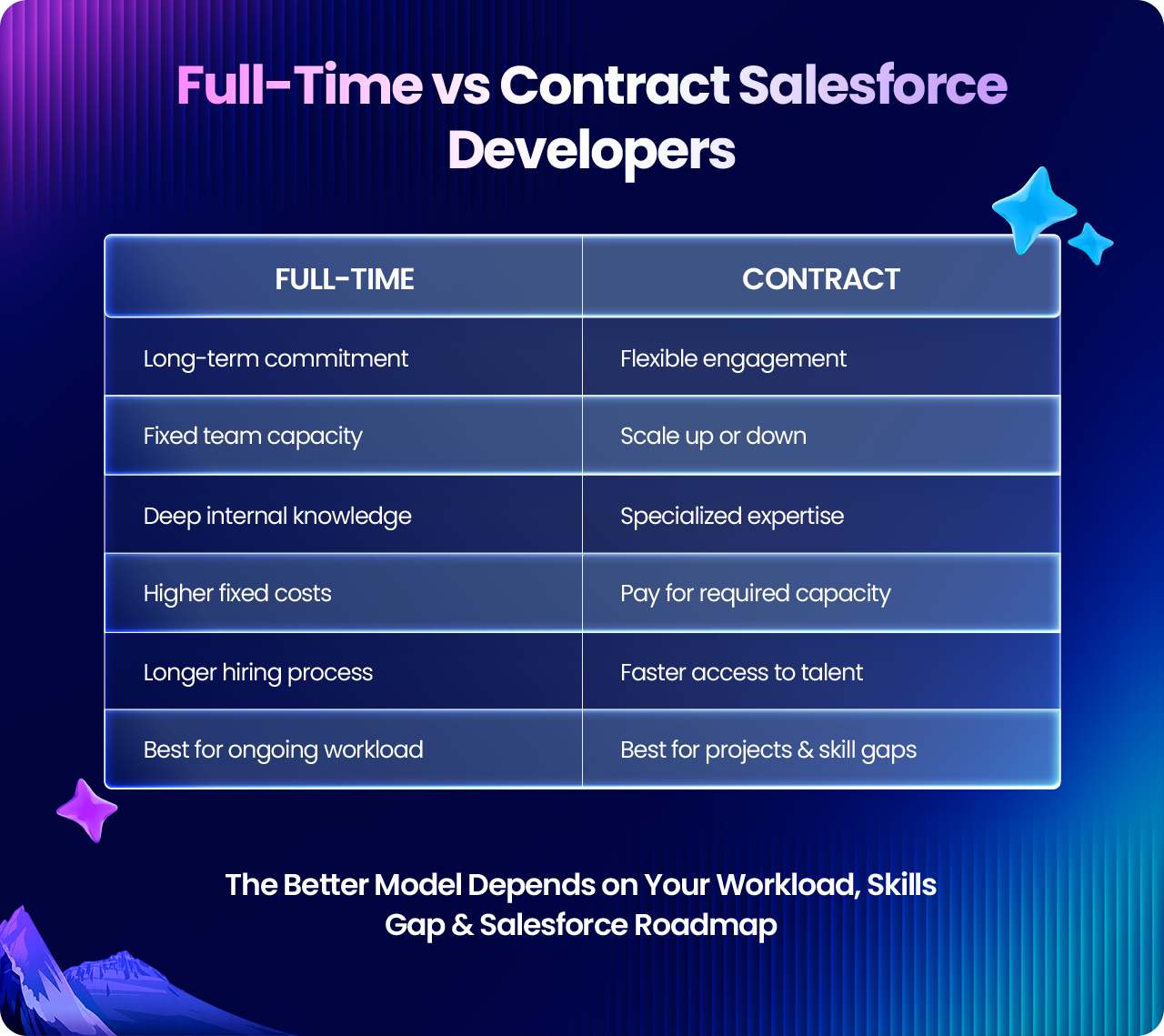
Choosing between a full-time and contract Salesforce developer becomes easier when you compare the two models against your actual business requirements.
| Factor | Full-Time Salesforce Developer | Contract Salesforce Developer |
|---|---|---|
| Best for | Continuous Salesforce development and ownership | Defined projects and specialist requirements |
| Commitment | Long-term employment | Project-based or fixed-duration engagement |
| Hiring flexibility | Lower | Higher |
| Specialist access | Limited to the skills of your internal hire | Easier to bring in expertise for a specific requirement |
| Scaling capacity | Requires additional permanent hiring | Can scale up or down around project demand |
| Business knowledge | Builds deeper institutional knowledge over time | Requires structured onboarding and knowledge transfer |
| Cost structure | Salary plus benefits, recruitment, training, tools, and other employment costs | Hourly, monthly, or project-based cost depending on engagement |
| Knowledge retention | Usually stronger internally | Depends heavily on documentation and handover |
| Best Salesforce scenarios | Continuous customization, support, optimization, and roadmap delivery | Implementations, integrations, migrations, specialist development, and temporary capacity |
| Primary risk | Paying for permanent capacity when demand decreases | Losing project knowledge if documentation and handover are weak |
The simplest way to decide: if Salesforce development is a continuous capability your business needs year-round, a full-time developer may provide greater long-term value. If the requirement is temporary, highly specialized, or tied to a defined project, a contract developer may provide greater flexibility. When both needs exist, a hybrid model can be more practical than choosing only one.
How Much Does It Cost to Hire a Full-Time vs Contract Salesforce Developer?
Cost is often the first factor businesses compare, but salary and hourly rates alone do not show the full picture.
As of August 2026, Salary.com reports an average U.S. Salesforce Developer salary of approximately $98,345 per year, with the 25th–75th percentile ranging from about $90,707 to $105,705. More experienced developers can command considerably higher compensation.
Contract developers use a different cost model. ZipRecruiter reports an average U.S. Salesforce Developer contract rate of approximately $62 per hour, with most reported rates falling around $53 to $71 per hour as of 2026.
Treat these figures as market benchmarks rather than fixed hiring prices. Actual costs can vary significantly based on experience, location, certifications, engagement model, project complexity, and the Salesforce expertise required.
Compare Total Cost, Not Just Salary vs Hourly Rate
When evaluating a full-time Salesforce developer, consider:
-
Base salary
-
Employee benefits and payroll costs
-
Recruitment and onboarding
-
Training and certifications
-
Equipment and software
-
Management overhead
-
The cost of maintaining permanent capacity when development demand decreases
When evaluating a contract Salesforce developer, consider:
-
Hourly, monthly, or project rate
-
Expected project duration
-
Required seniority and specialization
-
Onboarding time
-
Project management requirements
-
Documentation and knowledge-transfer effort
-
Whether ongoing support will be required after delivery
A contractor can therefore have a higher hourly rate while still making commercial sense for a short-term or specialist requirement. Conversely, if your business needs consistent Salesforce development throughout the year, repeatedly using contractors may not always be the most economical option.
The better comparison is total cost against the amount, duration, and type of Salesforce expertise your business actually needs.

Do You Need a General Salesforce Developer or a Cloud Specialist?
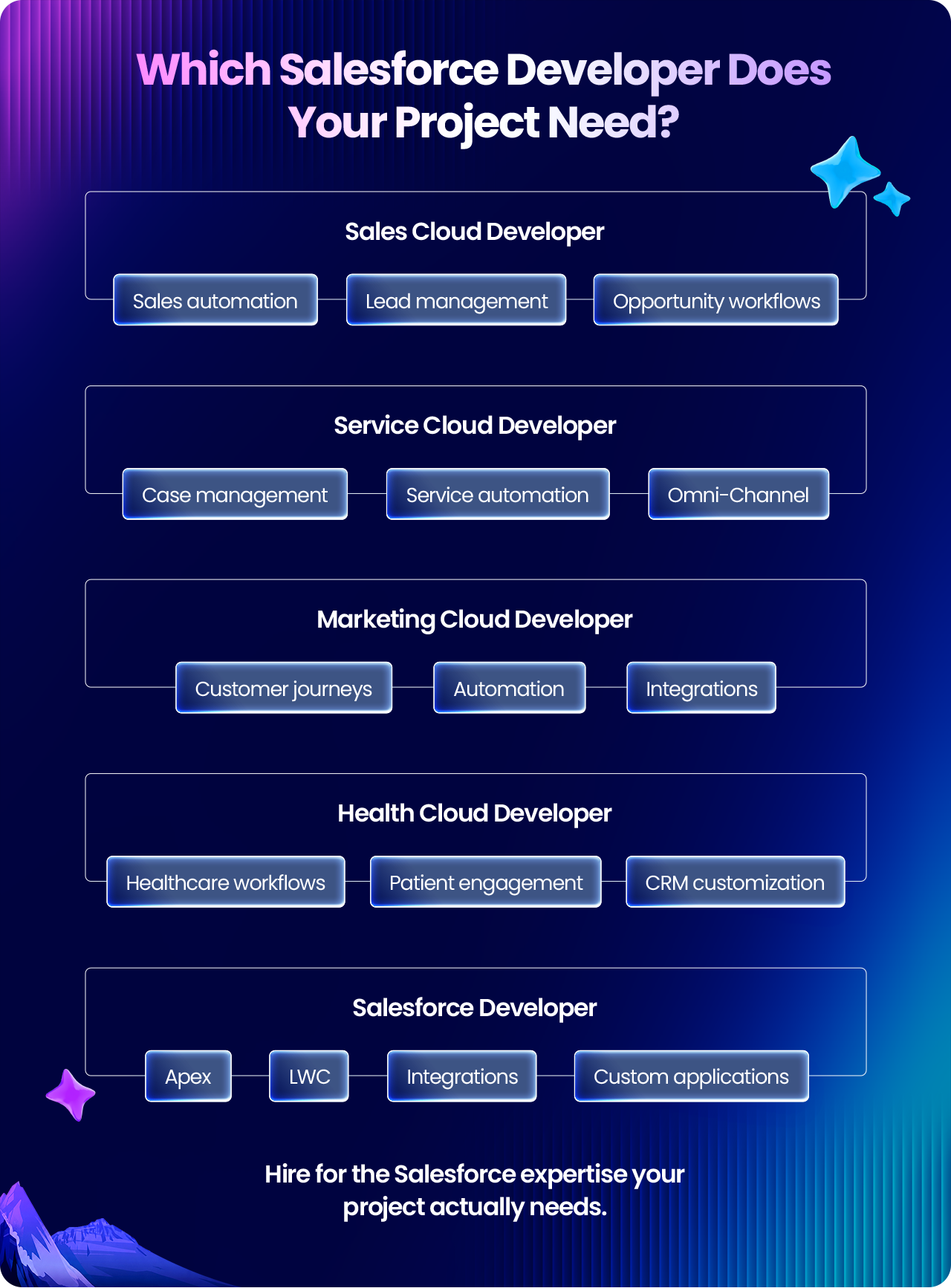
Before deciding between a full-time and contract developer, define the expertise your project actually requires. Salesforce development spans different products, APIs, data models, integrations, and business processes, so the right developer for one Salesforce environment may not fit another.
Here is how to think about some common hiring requirements:
Hire a Salesforce Sales Cloud Developer
If your project involves complex sales processes, custom opportunity or lead workflows, automation, integrations, Lightning components, or improvements to an existing Sales Cloud environment, look for a developer with hands-on experience solving similar Sales Cloud requirements.
A full-time developer can make sense when Sales Cloud requires continuous development. For a defined implementation, integration, or major customization project, a contract specialist may be more practical.
Hire a Salesforce Service Cloud Developer
Businesses running complex customer service operations may need expertise in case management, service automation, integrations, custom agent experiences, and other Service Cloud capabilities.
Consider a full-time developer when Service Cloud requires continuous technical ownership. For a major implementation, contact-center transformation, integration, or specialist development requirement, contract expertise can help fill a specific capability gap.
Hire a Salesforce Marketing Cloud Developer
Marketing Cloud development can require a different technical skill set from core Salesforce platform development, particularly when the project involves API integrations, custom applications, Journey Builder components, data flows, or programmatic marketing requirements.
If you need to hire a Salesforce Marketing Cloud developer for a defined implementation, integration, or technical enhancement, evaluate candidates based on relevant Marketing Cloud experience rather than general Salesforce development experience alone.
Hire a Salesforce Health Cloud Developer
Health Cloud projects can introduce industry-specific requirements around healthcare data models, care management, interoperability, integrations, and healthcare workflows.
When you hire a Salesforce Health Cloud developer, look beyond general Salesforce development skills. Relevant Health Cloud implementation experience and an understanding of healthcare-specific data and integration requirements can become important selection criteria.
For organizations with continuous Health Cloud development needs, an internal specialist may provide stronger long-term ownership. For a defined implementation or specialized integration, contract expertise may offer greater flexibility.
Match the Hiring Model to the Requirement
The question is therefore not simply whether you should hire a Salesforce developer full-time or on contract.
First identify the Salesforce product, technical problem, project duration, and level of specialization required. Then choose the hiring model that gives you access to that expertise without creating unnecessary long-term capacity or project risk.
7 Questions to Ask Before Hiring a Full-Time or Contract Salesforce Developer
Still unsure which hiring model fits your business? Answer these seven questions before you start evaluating developers.
1. Is the requirement ongoing or project-based?
If you expect a consistent Salesforce development backlog throughout the year, a full-time developer may provide better continuity. If the requirement has a clear start, scope, and end date, a contract developer may be more practical.
2. Do you need general development or specialist expertise?
Core Salesforce development and specialized work are not always interchangeable. A complex integration, Marketing Cloud project, Health Cloud implementation, or other specialist requirement may justify bringing in expertise specifically for that project.
3. How quickly does the developer need to start?
If delaying development could affect an implementation, migration, release, or business deadline, consider whether your permanent recruitment timeline matches the project's urgency.
4. What happens after the current project ends?
Look beyond go-live. If you expect a continuous pipeline of enhancements, integrations, and custom development, permanent capacity may make sense. If development demand will fall significantly, a flexible model can reduce unused capacity.
5. Who will own Salesforce internally?
A contractor can deliver development work, but your organization still needs clear ownership of requirements, approvals, architecture decisions, documentation, security, and knowledge transfer.
If you don't have an internal owner, address that gap before scaling external development.
6. Are you comparing rates or total cost?
Don't make the decision based on salary versus hourly rate alone. Compare the total cost of acquiring, onboarding, managing, and retaining the required expertise for the period you actually need it.
7. Could a hybrid model work better?
The decision does not have to be full-time or contract.
Many organizations can keep long-term Salesforce ownership internally while using contract specialists for integrations, migrations, cloud-specific expertise, major releases, or temporary workload spikes.
Quick decision: Choose full-time when the need is continuous and long-term ownership matters. Choose contract when the requirement is defined, temporary, or highly specialized. Consider hybrid when you need both platform continuity and access to changing specialist skills.
When Does a Hybrid Salesforce Development Team Make More Sense?
For some businesses, choosing exclusively between full-time and contract developers creates an unnecessary trade-off. A hybrid Salesforce team combines long-term internal ownership with on-demand specialist expertise.
For example, your internal Salesforce team might manage the roadmap, day-to-day enhancements, releases, user requirements, and platform governance, while contract specialists support projects that require skills your permanent team does not use every day.
A hybrid model can work particularly well when:
-
Salesforce is business-critical and requires continuous internal ownership.
-
Your development workload rises and falls throughout the year.
-
Major implementations or integrations temporarily exceed internal capacity.
-
You occasionally need specialized Salesforce expertise.
-
Your internal team needs additional support during migrations, releases, or transformation projects.
What Could a Hybrid Salesforce Team Look Like?
A business might keep a Salesforce Admin, developer, or technical lead in-house while bringing in specialists as needed.
For example:
-
Internal team: Platform ownership, roadmap, governance, routine enhancements, stakeholder coordination, and ongoing support.
-
Contract specialists: Complex integrations, data migrations, architecture, cloud-specific development, major implementations, or temporary delivery capacity.
This approach can give businesses continuity without requiring every specialist skill to exist permanently in-house.
However, a hybrid model only works when responsibilities are clear. Define who owns architecture decisions, development standards, code reviews, deployments, documentation, security, production support, and knowledge transfer before external developers begin contributing.
The goal is not to outsource Salesforce ownership. It is to keep ownership clear while bringing in the right expertise when the roadmap requires it.
Freelancer vs Contract Developer vs Salesforce Partner: Which Should You Choose?
Once you decide to bring in external Salesforce expertise, there is another important choice to make: should you hire an individual freelancer, a contract developer, or work with a Salesforce consulting partner?
The right option depends on project complexity, required skills, delivery risk, and how much responsibility you want the external resource to take.
Salesforce Freelancer
A freelancer can be a practical option for smaller, clearly defined development tasks where one person can handle the scope.
Best suited for:
-
Small enhancements or bug fixes
-
Clearly scoped development tasks
-
Short-term technical assistance
-
Businesses that already have strong internal Salesforce ownership
The key consideration is dependency on one individual. Before hiring, evaluate availability, relevant project experience, documentation practices, security requirements, and who will support the work after the engagement ends.
Individual Contract Salesforce Developer
A contract developer can be a stronger fit when you need dedicated development capacity or specialist expertise for a defined period.
Best suited for:
-
Temporary development capacity
-
Salesforce implementations or migrations
-
Custom development
-
Complex integrations
-
Specialist technical requirements
-
Supporting an existing Salesforce team during high-demand periods
This model works particularly well when your organization can manage requirements, architecture, quality assurance, deployment, and overall project ownership internally.
Salesforce Consulting or Development Partner
A Salesforce partner can make more sense when the requirement extends beyond a single developer's skills or capacity.
Instead of relying on one resource, businesses can access a broader team that may include developers, architects, consultants, business analysts, QA specialists, and cloud-specific experts depending on the engagement.
Consider a Salesforce partner when:
-
The project involves multiple Salesforce products or workstreams.
-
Business processes need to be translated into technical requirements.
-
Complex integrations or architecture decisions are involved.
-
You need development, testing, deployment, and project governance.
-
Different specialist skills will be required during different phases.
-
Long-term support or continuous optimization is part of the roadmap.
Salesforce itself describes consulting and implementation partners as experts that provide strategic guidance and technical services to integrate Salesforce products with a company's business workflows.
The decision should therefore be based on delivery complexity—not simply hourly cost. A freelancer may be sufficient for a contained task, a contract developer may provide the specialist capacity your existing team needs, while a Salesforce consulting partner can be more appropriate when successful delivery requires multiple disciplines working together.
How to Evaluate a Salesforce Developer Before Hiring
A Salesforce certification can help validate platform knowledge, but it should not be the only reason you hire a developer. The stronger candidate is the one who can demonstrate relevant experience with problems similar to the ones your business needs to solve.
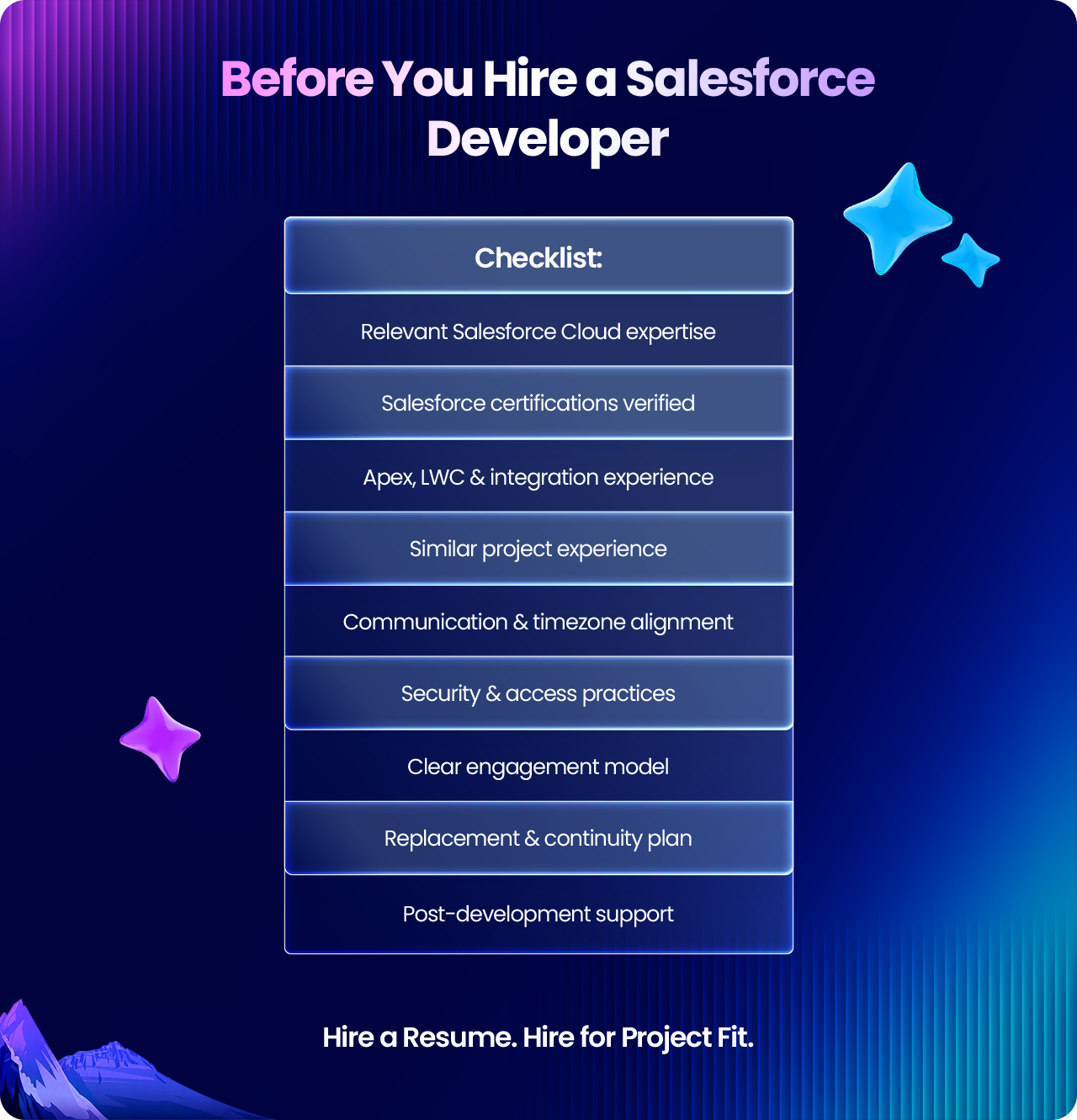
Use this checklist before hiring a full-time developer, contractor, or external Salesforce development team.
1. Verify Relevant Salesforce Experience
Ask candidates to explain projects similar to yours:
-
What business problem were they solving?
-
What Salesforce products and technologies were involved?
-
What did they personally design or develop?
-
What technical challenges occurred?
-
How did they test and deploy the solution?
Look for specific examples rather than general claims about years of Salesforce experience.
2. Match Their Skills to Your Actual Requirement
Evaluate the skills your project needs instead of looking for a developer who claims to “know Salesforce.”
Depending on the project, this could include Apex, Lightning Web Components, SOQL, APIs, integrations, automation, data migration, testing, or CI/CD.
For cloud-specific projects, verify hands-on experience with the relevant Salesforce product rather than assuming core platform experience automatically transfers to every Salesforce Cloud.
3. Verify Salesforce Credentials
Salesforce certifications can provide an additional signal of platform knowledge. Verify claimed credentials and check whether they match the work you are hiring the developer to do.
Treat certification as one evaluation factor alongside practical experience, not as a replacement.
4. Review Their Approach to Code Quality and Security
Ask how the developer handles code reviews, testing, source control, deployment, access permissions, integration security, and Salesforce development standards.
A developer should be able to explain not only how they would build a feature, but how they would make it maintainable and safe to operate.
5. Evaluate Communication and Business Understanding
Strong Salesforce development requires translating business requirements into technical solutions.
During evaluation, give the developer a real business scenario and ask how they would approach it. Their questions can tell you as much as their answer.
6. Ask About Documentation and Knowledge Transfer
Before signing a contract, establish what will be documented and how knowledge will be transferred.
This is especially important for contract engagements because your internal team should still understand and maintain the solution after the developer leaves.
7. Check References and Delivery Evidence
For significant projects, ask for relevant case studies, references, or examples of previous delivery.
Focus on evidence related to your requirement rather than logos or project counts alone.
Hiring tip: Don't choose a Salesforce developer based solely on the lowest rate, most certifications, or longest résumé. Evaluate the combination of relevant experience, technical capability, business understanding, delivery practices, and fit with your Salesforce roadmap.
What Real Salesforce Projects Reveal About Hiring the Right Expertise
The difference between hiring a Salesforce developer and hiring the right Salesforce expertise becomes much clearer when you look at real projects.
Across Salesforce engagements, we have seen that resource requirements often change with the scope of the work. Some businesses need a small development team with specific cloud expertise. Others need ongoing access to developers who can continuously improve an existing Salesforce environment.
Here are two examples that illustrate the difference.
When Two Salesforce Clouds Required a Focused Delivery Team
The Client
A luxury real estate company needed Salesforce to connect its sales operations with marketing better and make it easier for teams to match customer requirements with available inventory.
The Challenge
This was not a standard Salesforce development requirement. The business needed both Sales Cloud and Marketing Cloud implemented and configured around its operating model.
That meant the project required expertise spanning two Salesforce products rather than relying on a developer whose experience was limited to general platform customization.
The Delivery Model
Codleo assigned a three-person team to the engagement and handled the complete setup of Sales Cloud and Marketing Cloud.
Instead of treating Salesforce as an isolated technical implementation, the solution was structured around how customer requirements, inventory, sales activity, and marketing needed to work together.
The Impact
After implementation, the business reported that the new Salesforce environment made it easier to match client requirements with available inventory.
The client also rated the engagement 5/5 for quality and 5/5 for value for cost, while specifically highlighting the team's professionalism and dedication.
The hiring lesson: A defined multi-cloud implementation may not require another permanent developer on payroll. What matters is whether the delivery team already has the cloud expertise needed to take the project from requirements through implementation.
When Ongoing Salesforce Development Needed Flexible Technical Capacity
The Client
A large AI transformation company already had Salesforce in place. Its challenge was different: the organization needed continuous technical support while improving its Salesforce data architecture.
The Challenge
The requirement was not a one-time CRM implementation.
The existing environment required ongoing ticket-based development, process improvements, data architecture work, Apex cleanup, custom-object optimization, and implementation of newer Salesforce capabilities including Agentforce.
This meant the skills required could change depending on the issue or development ticket being addressed.
The Delivery Model
Instead of adding a single permanent resource for every possible Salesforce requirement, the company worked with a 2–5-person Codleo team providing Salesforce support and development as requirements emerged.
The engagement combined ongoing development capacity with access to different technical capabilities when required.
The Impact
According to the client's verified review, the engagement:
-
Improved Salesforce data accuracy by 30%
-
Cleaned and optimized 90+ Apex classes
-
Addressed 10 custom objects
-
Simplified existing processes
-
Supported the implementation of Agentforce
The client also reported that work was frequently completed in less time than initially estimated and gave Codleo 5/5 for value for cost.
The hiring lesson: When Salesforce requirements are continuous but vary significantly in technical complexity, the decision does not always have to be “hire another permanent developer” or “hire one freelancer.” Access to a flexible Salesforce development team offers another model—particularly when different skills are needed at different stages.
The 5S Framework for Choosing the Right Salesforce Developer
Before deciding who to hire, evaluate the requirement in the right order. Starting with hourly rates or résumés can lead businesses to choose a resource before they have clearly defined the work.
A practical way to make the decision is to evaluate five areas: Scope, Skills, Scale, Structure, and Sustainability.
1. Scope — What Exactly Needs to Be Delivered?
Start with the business requirement, not the developer profile.
Define whether you need:
-
Ongoing Salesforce enhancements
-
A new implementation
-
Custom development
-
An integration or data migration
-
Platform optimization
-
A cloud-specific project
-
Temporary support for an existing team
Then estimate the expected duration and development workload.
A clearly defined project with an end date may suit contract delivery, while a continuous development backlog can strengthen the case for permanent capacity.
2. Skills — What Expertise Does the Work Actually Require?
Map the technical and Salesforce product skills required before evaluating candidates.
This might include Apex, Lightning Web Components, APIs, integrations, data migration, automation, DevOps, or expertise in a specific Salesforce product.
The objective is simple: hire for the work you actually have, not for the longest list of Salesforce skills on a résumé.
If the project requires several specialist capabilities, also consider whether expecting one developer to cover the entire scope creates unnecessary delivery risk.
3. Scale — How Much Development Capacity Do You Need?
One developer may be enough for an ongoing backlog of enhancements.
A larger implementation may require developers working alongside architects, consultants, business analysts, QA specialists, or integration experts.
Ask:
Do we need one person—or do we actually need a delivery capability?
This distinction can determine whether a full-time employee, contractor, or Salesforce development team is the more appropriate model.
4. Structure — Who Will Own Delivery?
Decide how responsibilities will be divided before development starts.
Clarify ownership of:
-
Requirements
-
Solution architecture
-
Development
-
Code reviews
-
Testing
-
Deployment
-
Security
-
Documentation
-
Production support
-
Knowledge transfer
If your internal team can own most of these areas, an individual developer may integrate well into the existing structure.
If the external resource is expected to own several of them, evaluate whether a broader delivery team is required.
5. Sustainability — What Happens After Go-Live?
Finally, look beyond the immediate project.
Ask who will maintain custom code, manage integrations, handle future releases, troubleshoot issues, document changes, and continue improving Salesforce after the initial work is complete.
This is where the right hiring model often becomes clear.
-
Continuous development + long-term ownership → Consider full-time
-
Defined project + specialist requirement → Consider contract
-
Continuous ownership + changing specialist needs → Consider hybrid
-
Complex multi-disciplinary delivery → Consider a Salesforce development partner
The best hiring decision is not the model with the lowest visible rate. It is the model that gives your business the required expertise, capacity, ownership, and continuity with the least unnecessary delivery risk.
7 Salesforce Developer Hiring Mistakes That Can Cost More Than the Hire
Hiring the wrong Salesforce resource rarely creates only a recruitment problem. It can result in rework, fragile customizations, poor integrations, technical debt, delayed releases, and a Salesforce environment that becomes harder to maintain over time.
Here are seven mistakes worth avoiding.
1. Choosing the Lowest Rate Instead of the Right Expertise
A lower hourly rate does not automatically mean a lower project cost.
If the developer lacks relevant experience, additional debugging, rework, supervision, or missed requirements can quickly offset the initial saving.
Compare total delivery value and risk, not rate alone.
2. Treating Certifications as Proof of Delivery Experience
Salesforce certifications are useful credentials, but they do not tell you everything about how someone will perform on your project.
Ask candidates to explain comparable projects, technical decisions they made, problems they encountered, and what they personally delivered.
Verify credentials—but validate experience separately.
3. Assuming Every Salesforce Developer Has the Same Expertise
Salesforce development covers a broad technical ecosystem.
A developer experienced in Apex and Lightning development may not automatically have deep experience with Marketing Cloud, Health Cloud, complex integrations, data migrations, or another specialist requirement.
Define the work first. Then hire against the required skill set.
4. Expecting One Developer to Do Everything
Some projects genuinely need only one developer. Others involve architecture, integrations, development, testing, deployment, business analysis, and multiple Salesforce products.
Trying to make one resource responsible for every discipline can create unnecessary dependency and delivery risk.
Ask whether you need a developer or a delivery team.
5. Ignoring Documentation and Knowledge Transfer
This becomes particularly risky with contract development.
Code, integrations, architecture decisions, deployment processes, and important configuration changes should not leave with the developer when the engagement ends.
Agree on documentation and knowledge-transfer expectations before development begins.
6. Hiring Before Defining Post-Go-Live Ownership
Implementation is not the end of a Salesforce roadmap.
Someone still needs to maintain integrations, respond to platform changes, troubleshoot custom development, manage releases, and prioritize future improvements.
Decide who owns Salesforce after delivery before choosing the hiring model.
7. Choosing a Hiring Model That Does Not Match the Workload
A permanent developer can become unnecessary fixed capacity if the requirement lasts only a few months.
On the other hand, continuously extending short-term contracts for predictable year-round development may not always be the most efficient model.
Match the engagement model to the duration, predictability, specialization, and complexity of the work rather than defaulting to the hiring model your organization has used before.
A better hiring question is not “Who can we hire for the lowest cost?” but “What combination of expertise, capacity, and ownership gives this Salesforce project the best chance of succeeding?”
Salesforce Developer Hiring Scorecard: Full-Time, Contract, or Hybrid?
Use this scorecard to identify which hiring model is more closely aligned with your Salesforce requirements.
| Your Situation | Full-Time | Contract | Hybrid |
|---|---|---|---|
| Salesforce development is required throughout the year | ✓ | ✓ | |
| You have a defined project with a clear end date | ✓ | ||
| You need deep long-term knowledge of your Salesforce environment | ✓ | ✓ | |
| You need a specialist skill for a limited period | ✓ | ✓ | |
| Your Salesforce workload changes significantly during the year | ✓ | ✓ | |
| You already have an internal Salesforce team but lack certain technical skills | ✓ | ✓ | |
| Multiple Salesforce products or specialist skills are involved | ✓ | ✓ | |
| You need permanent day-to-day technical ownership | ✓ | ✓ | |
| You need additional capacity for an implementation or migration | ✓ | ✓ | |
| You need internal ownership but also access to specialists as requirements change | ✓ |
How to Read Your Results
Mostly Full-Time
Your organization probably needs Salesforce development as a permanent internal capability. A full-time developer may make sense when the workload is predictable, continuous, and requires deep knowledge of your systems and business processes.
Mostly Contract
Your requirements appear to be project-based, temporary, or specialized. A contract developer can provide targeted expertise without automatically turning a temporary requirement into permanent development capacity.
Mostly Hybrid
You need continuity and flexibility at the same time. Consider keeping platform ownership internally while bringing in contract developers or specialists when your roadmap requires skills or capacity the permanent team does not have.
One Important Exception
Do not use the scorecard as a substitute for evaluating project complexity.
If your requirement involves multiple Salesforce products, architecture, integrations, data migration, development, testing, and significant process transformation, the better question may no longer be “Which developer should we hire?”
It may be:
“Do we need an individual developer or a complete Salesforce delivery team?”

What Happens When You Hire Salesforce Developers Through Codleo?
Lekin publish-ready section banane ke liye mujhe tumse Codleo ka actual process chahiye.
Tum simple Hinglish mein bas ye bata do:
-
Requirement: Client requirement aati hai to Codleo sabse pehle kya karta hai?
-
Developer selection: Developer kaise select/match hota hai? Skills, cloud experience, certifications, years of experience etc.?
-
Client interview: Kya client shortlisted developer ka interview leta hai?
-
Deployment time: Developer/team kitne time mein start kar sakti hai?
-
Engagement models: Hourly, monthly, dedicated resource, project-based — kya options hain?
-
Management: Developer directly client ke saath work karta hai ya Codleo PM/architect bhi involved hota hai?
-
Quality: Code review, QA, testing, security etc. ka process kya hai?
-
Replacement: Agar developer suitable na lage ya unavailable ho jaye to replacement policy/process kya hai?
-
Knowledge transfer: Documentation, handover aur KT kaise hota hai?
-
Post-project: Ongoing support/maintenance available hai?
So, Should You Hire a Full-Time or Contract Salesforce Developer?
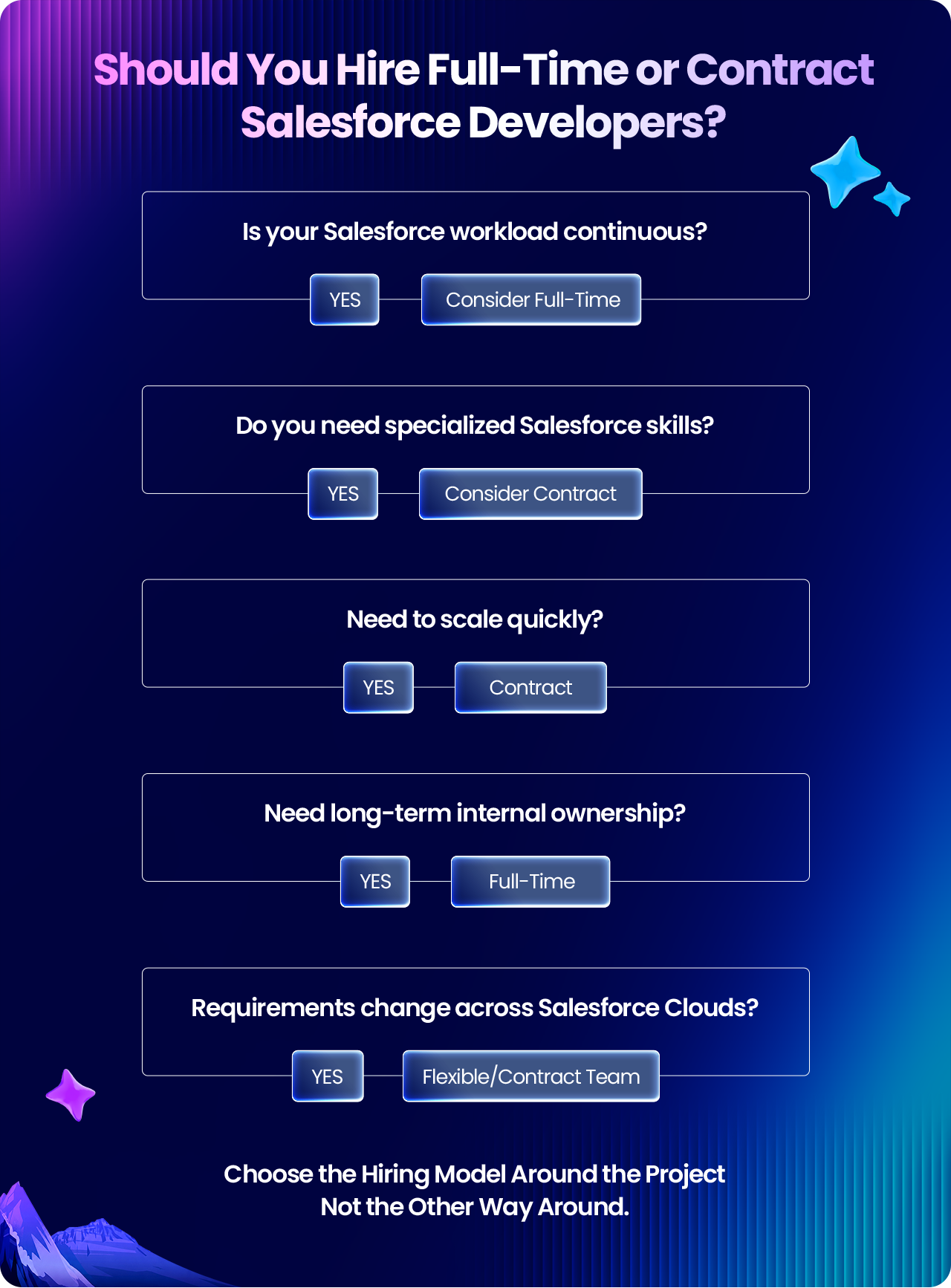
There is no single hiring model that works for every Salesforce team. The better choice depends on how frequently you need development, how specialized the work is, and who will own the platform after the immediate project is complete.
-
Hire a full-time Salesforce developer when Salesforce requires continuous development, you have a predictable year-round backlog, and retaining technical and business knowledge internally is a priority.
-
Hire a contract Salesforce developer when you have a defined project, need additional capacity for a limited period, or require specialist expertise that does not justify a permanent position.
-
Use a hybrid model when Salesforce needs continuous internal ownership but your roadmap periodically requires specialist skills, additional developers, or temporary delivery capacity.
-
Consider a Salesforce development partner when the requirement extends beyond an individual developer and involves multiple Salesforce products, integrations, architecture, development, testing, deployment, or business-process transformation.
The most important step is to define the work before choosing the resource. Start with the required outcomes, Salesforce products, technical skills, project duration, delivery capacity, and post-launch ownership. Then choose the hiring model around those requirements.
That approach helps you avoid two expensive mistakes: building permanent capacity for a temporary requirement or relying on temporary resources for a capability your business actually needs long term.
Not Sure What Kind of Salesforce Developer You Actually Need?
You may know the Salesforce work that needs to get done without knowing whether it requires a full-time developer, a contract specialist, or a broader delivery team.
That decision should come before you start comparing résumés and hourly rates.
Codleo can help you assess your Salesforce requirements, identify the technical and cloud expertise involved, and determine a suitable engagement model based on your project scope, timeline, existing team, and long-term Salesforce roadmap.
Whether you need additional development capacity, specialized Salesforce expertise, or support for a more complex implementation, start by defining the requirement.
Discuss Your Salesforce Requirement
 0
0
About the Author

FAQ
Hiring a dedicated Salesforce developer offers many benefits for your business, including cost savings and increased productivity. When using a CRM like Salesforce, you may need to access different Salesforce products. It�s rare for a single developer to understand all of them thoroughly. By hiring a dedicated Salesforce developer, you can bring in someone with the right skills for a specific time or project. This approach gives you the flexibility to adjust your team size as needed.
Many companies continue to hire full-time staff for Salesforce projects. But as project numbers increase, outsourcing Salesforce experts may be a smarter option. Contract workers can save time and money, as companies avoid lengthy hiring and training processes. These professionals already have the experience needed to tackle Salesforce challenges quickly. This approach can boost productivity and help deliver projects on time and at a high standard.
The main difference is in the tools and the work involved. A Salesforce Admin mainly handles setting up the platform, managing users, and creating simple automations using clicks, such as Flows and other easy tools. On the other hand, a Developer builds larger systems, connects different applications, and writes complex logic using code like Apex, LWC, and SOQL. They tackle problems that simple click methods can't solve.
A dedicated developer needs to know how to use Apex, Salesforce's back-end programming language. They should also be skilled in SOQL for database queries and in modern front-end development with Lightning Web Components (LWC) and JavaScript. This knowledge helps them create custom user experiences.
Developers build a system that can grow easily. It is essential for managing large amounts of data and for adding new features like AI, automated agents, or specific external applications. They create a strong foundation that can support future advancements.
The cost of hiring a Salesforce developer depends on the complexity of your project and the candidate's experience. Generally, the hourly rate ranges from USD 50 to 200.
We offer two engagement models for our Salesforce development services:
- Full-time dedicated Salesforce developer: This option provides 160 hours of work each month, with 8 hours a day for 5 days a week.
- Hourly basis: This is a flexible and cost-effective option. We track the time accurately using timesheets.
You can hire Salesforce developers from Codleo who will work in your time zone, whether it's EST, PST, CST, or MST. We are ready to help you, no matter if you need developers in the USA, UK, Australia, or any other location.
Salesforce is a cloud-based platform so that developers can work from anywhere with internet access. Most Salesforce teams work remotely for this reason. If your project requires close teamwork, we can send staff to your office if it is nearby. Get in touch with us to hire Salesforce developers.
You can hire Salesforce programmers, administrators, QA testers, architects, consultants, business analysts, and project managers from Codleo.
If you are unhappy with the developer you hired, we will provide a free replacement. A strong hiring process helps prevent dissatisfaction, but we want to support you in maintaining our business relationship.
We have more than 200 Salesforce developers ready to meet your hiring needs, whether you need employees right away or in larger numbers. If you want to rehire Salesforce developers you�ve worked with before, that will depend on their availability.
To verify a Salesforce developer's certification, visit the Trailhead verification page. You need to enter the candidate�s full name or email.

 603 D-Mall Netaji Subhash Place, Delhi 110034 IND


