


Publish date:
Let me be honest with you.
The partners themselves wrote most blogs about Salesforce implementation partners. They tell you to "check certifications" and "look for industry experience" — advice that's true but completely useless without context. It's like telling someone to "find a good doctor" without explaining what actually separates a great surgeon from a mediocre one.
This guide is different.
I've pulled together what actually matters in 2026 — when AI agents are changing how Salesforce works, when Agentforce is the thing everyone is asking about, and when a bad implementation can cost a mid-sized US business anywhere from $150,000 to $500,000 in lost productivity, rework costs, and shelfware licenses.
By the end of this, you'll know exactly what to ask, what to watch out for, and how to pick the partner who'll actually deliver results — not just a go-live date.
First, Let's Be Clear on What "Implementation" Actually Means in 2026
People use the word "implementation" loosely. Some think it means turning on Salesforce and configuring a few fields. Others think it means a full digital transformation. Neither is exactly right.
A proper Salesforce implementation in 2026 covers at least five things:
-
Discovery and process mapping — understanding how your business actually operates before touching any configuration. Who owns the lead? How does a deal move through your pipeline? What happens when a deal is lost?
-
Architecture and design — deciding which Salesforce clouds you need, how they connect to your existing systems (ERP, marketing tools, data warehouses like Snowflake or Databricks), and how data flows between them.
-
Configuration and customization — building the actual solution. This includes workflows, automations, custom objects, integrations, dashboards, and, in 2026, AI features such as Einstein and Agentforce.
-
Data migration — moving your existing customer data cleanly. This is where most projects quietly go wrong. Bad data in means bad data out, and no amount of good configuration fixes dirty data.
-
Change management and training — making sure your team actually uses what was built. This is the most underinvested step in most implementations, and it's why user adoption rates average around 26% at organizations without structured change management.
A partner who doesn't mention all five of these things in your first conversation is already showing you something important.
What Is Salesforce Implementation — and What Does a Partner Actually Do?
Let's start with the basics, because many businesses jump straight into partner evaluations without being clear about what they're actually buying.
Salesforce implementation is the end-to-end process of deploying Salesforce within your organization — from the first planning conversation to the day your team confidently uses it as part of their daily work. It's not a single event. It's a structured journey that typically moves through discovery, design, build, testing, data migration, and adoption.
Here's the part most vendors skip over: the technical setup is actually the easier half. What determines whether an implementation succeeds or quietly fails is everything around it — how clean your data is before it goes in, whether your team understands why the system was built the way it was, how well Salesforce connects with the other tools your business already runs on, and whether anyone is accountable for driving actual usage after go-live.
A Salesforce implementation partner is the company you bring in to own that entire process — not just the configuration work, but the strategy, the architecture decisions, the integrations, the training, and the post-launch support. The right partner doesn't just set up software. They make sure the software actually solves the business problem you brought it in to solve.
Practically speaking, a good implementation partner brings you:
A clear recommendation on which Salesforce products and editions actually fit your needs — because Salesforce's pricing structure is genuinely complex in 2026, and an experienced partner can help you avoid paying for capabilities you won't use for years.
An honest evaluation of whether a pre-built AppExchange solution covers your requirements before anyone writes a single line of custom code — because custom development is expensive to build and even more expensive to maintain.
A technically sound architecture that won't create headaches 18 months from now when your data model needs to scale, new features need to be added, or Salesforce releases its next major update.
Active risk management across the three things that most commonly derail implementations: scope that grows faster than the budget, timelines that weren't realistic from the start, and change resistance from the people who actually have to use the system every day.
Depending on the size and complexity of your project, the partner's team will likely include a mix of specialists. Here's who they are and what they actually do:
-
Salesforce Administrators are the day-to-day operators of the platform. During an implementation, they handle configuration — setting up fields, page layouts, workflows, and user permissions. After go-live, they keep the system running smoothly, answer user questions, troubleshoot issues, and roll out new Salesforce features as they're released three times a year. In 2026, admins are also increasingly responsible for managing AI automations and Agentforce workflows that sit on top of core Salesforce functionality.
-
Salesforce Consultants are the bridge between your business requirements and what gets built. They run discovery sessions, document your processes, define what the solution needs to do, and translate that into specifications that the technical team can act on. A strong consultant asks uncomfortable questions — about your current process gaps, your organizational politics around the project, and whether what you're asking for will actually solve the underlying problem.
-
Salesforce Developers handle custom work — anything that can't be done through clicks and configuration alone. That means writing Apex code, building Lightning Web Components, creating custom integrations, and developing solutions that go beyond what Salesforce's out-of-the-box tools support. In 2026, developers are also increasingly involved in building custom Agentforce agent actions and connecting Salesforce to AI pipelines.
-
Salesforce Architects design the overall technical structure of the solution. They make the high-stakes decisions: how data flows between systems, how the security model is structured, how the solution scales as your business grows, and how today's build sets you up for tomorrow's AI capabilities. For any project of meaningful complexity, you want an architect involved from day one — not brought in after the fact to fix structural problems.
The right mix of these roles on your project depends entirely on your scope. A straightforward Sales Cloud rollout for a 30-person team needs a very different team composition than a multi-cloud enterprise implementation with ERP integrations and Agentforce deployment. Part of evaluating a partner is understanding whether they're putting the right people on your specific project — not just their most available ones.
The Real Salesforce Partner Tier System (And Why It Actually Matters)
Salesforce has a partner tiering system worth understanding — not because a higher tier automatically means better, but because it provides a baseline of accountability.
As of 2026, the tiers work like this:
-
Base / Registered — New or smaller partners are just starting out in the ecosystem. They are great for simple projects or specific needs, but they haven't yet built up their customer success scores, certifications, or revenue needed to advance.
-
Ridge — Mid-tier partners. They've demonstrated consistent delivery and hold a broader range of certifications. Good for small to mid-sized projects.
-
Crest — Upper mid-tier. These partners typically have deeper specialization, more certified team members, and a more established track record.
-
Summit (formerly Platinum) — This is the highest tier Salesforce awards. Summit partners have the highest customer satisfaction scores as measured by Salesforce, the most certified team members, and the most demonstrated revenue and delivery history. Only a small percentage of Salesforce partners globally reach this level.
Summit partners have more responsibility. Salesforce tracks its customer satisfaction scores. If a partner's scores drop, Salesforce can move them to a lower tier. This doesn’t mean that every Summit partner is suitable for every project, but it does mean they must consistently satisfy customers to keep their Summit status.
However — and this is important — a smaller Ridge or Crest partner with deep expertise in your specific industry may outperform a Summit partner whose team spans every vertical.
Tier matters. Specialization matters more.
Why a Salesforce Implementation Partnership Works for Everyone Involved
Most business relationships are transactional — one side pays, the other delivers, and that's the end of it. A Salesforce implementation partnership doesn't work that way. When it's done right, three parties genuinely benefit: your business, the implementation partner, and Salesforce itself. Understanding this dynamic actually helps you evaluate partners better, because a partner who's thinking long-term about this relationship will behave very differently from one who's just trying to close the deal.
What your business walks away with
The most obvious benefit is speed. An experienced partner has already solved the problems you're about to face — they've seen what goes wrong in your industry, they know which Salesforce features actually deliver value versus which ones look impressive in demos, and they've built the muscle memory to move faster than any internal team starting from scratch. That translates directly into faster time-to-value and a quicker return on what is, for most businesses, a significant technology investment.
Beyond speed, you're also buying expertise that would take years to build internally. Most companies don't need a full-time Salesforce architect on staff — but they absolutely need one during an implementation. A partner gives you on-demand access to that depth of knowledge, without the overhead of hiring, training, and retaining specialized talent in a competitive market.
And when the implementation is done well, your business doesn't just have a configured CRM — it has a platform built on proven practices, designed to scale, and ready for what's coming next in 2026 and beyond, including AI-powered workflows that are reshaping how Salesforce customers operate.
What the implementation partner gains
A good Salesforce partner isn't just thinking about your current project. They're thinking about what comes after. Every successful implementation builds its reputation in the market through AppExchange reviews, customer referrals, and the case studies it can use to win the next client. In the Salesforce ecosystem, word travels fast in both directions.
There's also a knowledge angle that matters more than most people realize. Every project a partner delivers — regardless of industry or complexity — adds to their team's collective experience. The edge cases, the integrations that required creative solutions, the change management challenges that nobody anticipated — all of that sharpens the partner's ability to deliver better work on the next engagement.
In 2026, partners who are building real depth in Agentforce and Data Cloud are also differentiating themselves in a market that's moving fast. Those investing in that expertise now will have the most to offer clients over the next several years.
What Salesforce gets from the equation
Salesforce carefully created its partner ecosystem for a good reason. A network of certified, responsible implementation partners helps Salesforce reach markets and industries that its direct sales team can't cover on its own. Each successful implementation led by a partner means a customer who renews their licenses, expands into more products, and becomes an advocate for the platform.
There's also a feedback loop that matters. Partners who work closely with customers in the field surface real-world friction — features that don't work as expected, gaps in functionality, integration pain points — in ways that help Salesforce improve the product over time. That's genuinely valuable to a company that releases major updates three times a year.
When everyone has the same goals, it creates a strong partnership. This leads to successful implementations, satisfied customers, and a platform that keeps getting better. Understanding this partnership model is important when deciding whom to include in your team.
What's Changed in 2026: The Agentforce Factor
If you're reading this in 2026, you cannot pick a Salesforce implementation partner without asking about Agentforce. Full stop.

Agentforce is Salesforce's AI agent platform. It allows businesses to deploy autonomous AI agents that can handle customer service, sales support, and operational tasks — working inside Salesforce without human intervention for routine decisions.
Here's why this matters for choosing a partner now: many Salesforce partners are still figuring things out. Agentforce became widely available only in late 2024, and the partners who adopted it early have a significant advantage over those still exploring their options.
If a potential partner cannot clearly explain how Agentforce would work in your specific business — what agents they'd build, what data they'd need, what human handoffs would look like — that's a meaningful gap. You don't want to implement Salesforce in 2026 only to need another expensive engagement in 18 months to layer in AI.
The right partner should be able to say: "Here's how we'd think about your AI readiness today so that your Agentforce deployment 6 months from now is smooth, not painful."
9 Things That Actually Separate Great Salesforce Partners from the Rest
This is the section most blogs get completely wrong. They list things like "check references" and "look for communication skills." Those things are obvious. Here's what actually separates the good ones.
1. They Start with Business Outcomes, Not Features
A good partner will first ask about your business, not about Salesforce. They want to understand what success looks like for you in 12 months. Is it shorter sales cycles? Faster case resolution? Better visibility into your pipeline for your leadership team?
Partners who immediately start talking about which Salesforce products you need are working backward from their toolkit, not from your goals. That's a subtle but critical difference.
2. They've Delivered in Your Industry — Specifically
Generic Salesforce experience and industry-specific Salesforce experience are two very different things. A partner who's spent 5 years implementing Salesforce for healthcare companies understands HIPAA data handling, patient journey workflows, and the specific compliance questions that come up in that space. A general-purpose partner trying to learn your industry on your dime is a risk you don't need to take.
-
Ask specifically: "How many clients in my industry have you implemented Salesforce for in the last 2 years? What were the 2-3 most common challenges, and how did you solve them?"
3. They Have a Clear Post-Go-Live Model
Go-live is not the finish line. It's more like the start of the real work. Your users will have questions. Processes will need adjustment. New Salesforce releases three times a year. Your business will change.
The partners who deliver lasting value have a structured model for what happens after go-live — not just "call us if you have issues." Ask specifically how they structure post-implementation support, whether it's managed services, a retainer model, or a defined hyper-care period.
4. They Can Explain Their Change Management Approach in Detail
Many implementations fail because partners often struggle in this area. User adoption doesn’t happen on its own. It needs a clear plan that includes strong leadership support, role-based training, communication schedules, mechanisms for gathering feedback, and a person responsible for encouraging behavior change.
Ask a potential partner to walk you through exactly what their change management process looks like. If they give you a vague answer about "training sessions," that's a red flag.
5. They're Honest About What Salesforce Can't Do
The best partners will tell you when Salesforce isn't the right tool for something. They'll tell you when a simpler solution would work better. They'll push back on the scope that doesn't serve your goals.
Partners who say "yes" to everything you ask for are not doing you a favor. They're either inexperienced or they're optimizing for their billing hours.
6. They Have Certified Technical Architects on Staff
For anything beyond a basic Sales Cloud configuration, you want a Salesforce Certified Technical Architect (CTA) or, at a minimum, a Salesforce Certified Application Architect involved in your project. These are among the hardest certifications in the Salesforce ecosystem to earn. Less than 1% of Salesforce professionals globally hold the CTA credential.
Ask directly: "Who will be the lead architect on our project, and what are their certifications?"
7. Their Project Managers Have Real Salesforce Experience
A generic project manager who can manage software projects but doesn't know Salesforce creates communication gaps between the client and the technical team. The best Salesforce partners have project managers who've been in the trenches on Salesforce projects — they know what usually goes wrong, when timelines are being set up to fail, and how to push back on scope creep before it becomes a problem.
8. They Have a Structured Discovery Process — and They Charge For It
Be wary of partners who offer free discovery. Discovery is where the foundation of the entire project is built. If a partner doesn't charge for it, it means either they're doing it superficially or they're baking that cost into a padded project price.
Good discovery takes time. It includes talking to stakeholders, mapping processes, reviewing technical setups, and assessing data. A good partner will explain the costs and why they matter.
9. They Can Show You Their Internal QA and Testing Process
Bad data migration or untested configurations are among the most common causes of failed Salesforce implementations. Ask any prospective partner to walk you through how they test before go-live.
How many rounds of QA? Who participates in UAT (User Acceptance Testing)? What's their bug-tracking process? What defines "done"?
What Does a Salesforce Implementation Actually Cost in 2026?
Let's talk real numbers, because vague ranges don't help anyone make decisions.
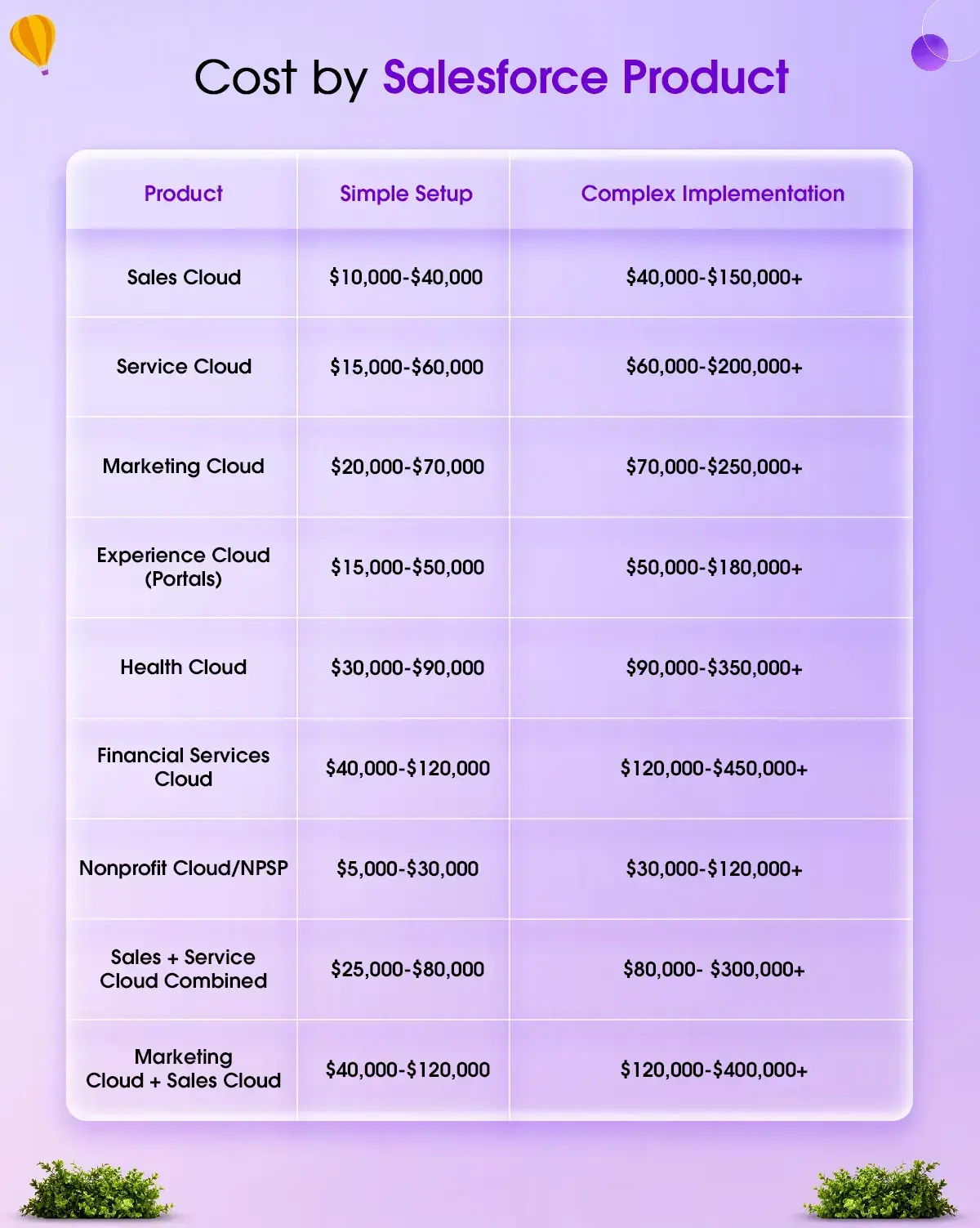
-
Small implementation (Sales Cloud or Service Cloud only, fewer than 50 users, minimal customization): $25,000 – $75,000
-
Mid-size implementation (multiple clouds, moderate customization, data migration, integrations with 1-2 external systems): $75,000 – $200,000
-
Enterprise implementation (complex multi-cloud, multiple system integrations, advanced automations, Agentforce, data cloud): $200,000 – $750,000+

These are US market figures for 2026. Offshore partners will quote lower, but the total cost of ownership often climbs when you factor in communication overhead, rework, and slower iteration cycles.
The variables that most affect the number are: the number of Salesforce clouds, the number of third-party integrations, data migration complexity, the degree of custom development vs. out-of-the-box configuration, and whether Agentforce or Data Cloud is in scope.
-
One more thing that most people underestimate: Salesforce license costs are separate from implementation costs. Make sure you're factoring in annual license fees, which typically run from $25/user/month for Essentials to $300+/user/month for enterprise editions, plus add-ons.
How to Choose the Right Salesforce Implementation Partner: What Actually Matters
Many businesses make mistakes when choosing a vendor. They send out a Request for Proposal (RFP), gather different proposals, compare hourly rates, and select the one that meets the most criteria on their checklist. Then, six months later, they wonder why the project is not going as planned.
The truth is, finding the right Salesforce implementation partner is less like hiring a vendor and more like choosing a business co-pilot for the next 12-18 months. Technical skills matter — but they're just the entry ticket. What separates a partner who delivers from one who disappoints almost always comes down to the factors that don't show up in a proposal document.
Here's what to actually look for.
1. Culture and Communication Fit — More Important Than Most People Admit
People often think this idea is weak, but it isn't. In fact, it's one of the best signs that a project stays strong under pressure.
When your implementation hits a difficult stretch — and every real implementation does — the question is whether your partner leans in or gets defensive. Do they communicate problems early, or do they wait until a deadline is already missed? Do they push back when your internal stakeholders are asking for something that will hurt the project, or do they say yes to keep the room happy?
None of that is about Salesforce skills. It's about working culture, communication values, and whether both sides are genuinely committed to the same outcome.
For US businesses specifically, this also plays out in practical ways. If your partner's core delivery team operates in a significantly different time zone, you need to understand how that affects decision-making speed.
When a question comes up on a Tuesday afternoon, and you need an answer before your Wednesday morning leadership call, does your partner's model support that, or are you waiting 16 hours for a response?
Before you sign anything, pay attention to how a partner communicates throughout the sales process. Are they responsive? Do they listen more than they pitch? Do they ask questions that suggest they're actually thinking about your business — or do they mostly talk about themselves? The sales process is a preview of the delivery relationship. Take it seriously.
2. Industry and Solution Expertise — Generic Experience Is Not Enough
A partner can have 200 Salesforce certifications and still be the wrong choice for your business if they've never worked in your industry.
Every industry has its own logic — its own compliance requirements, data structures, sales motions, and customer relationships. A Salesforce implementation built for a SaaS company looks fundamentally different from one built for a healthcare provider, a commercial real estate firm, or a financial services company. The workflows are different. The regulatory constraints are different. The way success is measured is different.
A partner with real industry experience doesn’t need six weeks to learn about your needs. They already understand common challenges, typical integration needs, compliance issues, and which features are actually useful versus those that look good in presentations. This knowledge speeds up timelines, reduces the need for rework, and provides a solution that works for your business right from the start, rather than one that needs constant changes after launch.
In 2026, this matters even more in the context of AI. An industry-experienced partner understands which Agentforce use cases are realistic for your sector, which data is actually available to power AI workflows, and where the regulatory boundaries are. A generalist partner figures that out on your time and budget.
When choosing a partner based on their industry knowledge, don’t just ask how many clients they’ve had in your field. Instead, ask them about the two or three most common challenges they see during projects in your industry. Pay close attention to their answer to see whether it shows real experience or sounds like a prepared response.
3. Certifications and Technical Skills — Know What You Actually Need
Certifications matter. But more certifications do not automatically make a partner better suited to your specific project.
Here's the practical reality: a small to mid-sized US business rolling out Sales Cloud and Service Cloud with moderate customization does not need a partner whose proposal leads with their five Salesforce Certified Technical Architects and their Application Architect bench. That expertise is real, it's valuable — but you're paying for it whether it shows up on your project or not.
What you need is the right certifications for your scope. If your project involves Sales Cloud, Service Cloud, and a MuleSoft integration, you want certified consultants in those specific products, plus developer resources if custom work is needed. If your project includes Agentforce or Data Cloud — and in 2026, more implementations do — you want to see that the partner's team has actually worked with those products, not just passed an exam.
The other thing certifications don't tell you is practical delivery quality. A partner's case studies and client references reveal things that a certification list never will — how they handled a difficult data migration, how they responded when a key integration didn't work as expected, and whether their clients actually achieved the business outcomes the project was supposed to deliver.
Look at both. Certifications confirm baseline competence. References and case studies confirm whether that competence translates into real results.
4. Verified Reviews and Client Satisfaction — Go Beyond the Partner's Own Website
Every Salesforce implementation partner has a testimonials page on their website. Every single one of those testimonials is positive. That tells you almost nothing.
What actually tells you something is what clients say on platforms where the partner doesn't control the narrative. In the US market, the three most relevant places to check are:
-
Salesforce AppExchange — Every certified Salesforce partner has a listing here, and Salesforce verifies client reviews before they're published. This is the most directly relevant source for evaluating a Salesforce-specific partner. Look at the overall rating, the number of reviews, and — just as importantly — how recently those reviews were posted. A partner with 40 five-star reviews from 2019 and nothing recent is telling you something.
-
Clutch.co — Clutch verifies reviewers through phone interviews and publishes detailed project reviews that include budget range, project duration, and specific outcomes. For US-based technology service providers, Clutch is one of the most credible independent review sources available.
-
G2 — More common for software products, but increasingly used for service providers as well. Please check whether the partner has a presence there.
When you read these reviews, look past the star ratings. Read the actual text. Pay attention to how clients describe the communication, what they say about how problems were handled, and whether they mention specific outcomes — not just that the project "went well." And if a partner has very few reviews despite claiming years of experience, ask why.
5. Training and Knowledge Transfer — The Step That Determines Whether Any of This Sticks
Here's an uncomfortable truth about Salesforce implementations: you can have a technically perfect build and still fail. The failure mode is adoption — your team either doesn't know how to use the system properly, doesn't trust it, or quietly reverts to spreadsheets and email because nobody invested enough in the transition.
According to Salesforce's own research, organizations that invest in structured training and change management achieve adoption rates that are dramatically higher than those that treat go-live as the finish line. In 2026, this is even more relevant because Salesforce's feature set — including AI tools, Agentforce, and Einstein analytics — is meaningfully more complex than it was even two years ago. Your team needs real preparation to use these tools confidently.
A good implementation partner does more than provide a system and leave you to figure it out. From the beginning, they focus on transferring knowledge. This means they offer training tailored to different user roles so everyone learns to use Salesforce effectively, rather than generic sessions that don’t help anyone. They also create sandbox environments that allow your team to practice before using the live system. Additionally, they provide documentation that reflects your specific setup rather than relying on general Salesforce help articles.
And it means post-go-live support that's actually structured — a defined hyper-care period, clear channels for questions, and a plan for how your internal team builds confidence and capability over the first 90 days after launch.
When you're evaluating partners, ask specifically: What does your training program look like for a project like ours? Who delivers it? What format does it take? What happens when a new employee joins six months after go-live and needs to get up to speed?
The partners who have thoughtful, specific answers to those questions are the ones who've actually seen what happens when training is done poorly — and learned from it.
The 10 Questions You Must Ask Before Signing Any Contract
Many people ask the wrong questions when evaluating partners. They focus on timelines and tools instead of looking at philosophy and process. Here are ten questions that can help you determine if a partner is a good fit for you.
1. "Can you walk me through a recent implementation in my industry where something went wrong — and how you handled it?"
Every experienced partner has had a project go sideways. What separates good ones is how they respond. If a partner tells you everything always goes perfectly, they're lying.
2. "Who specifically will be working on my project, and can I meet them before we sign?"
Partners often send their best people to pitch and their least experienced people to execute. You have every right to know exactly who will be on your team.
3. "What's your bench strength? If my project lead gets sick or leaves, what happens?"
Staff turnover mid-project is one of the most common and disruptive things that can happen. Ask how they handle it.
4. "How do you handle scope changes? Walk me through your change order process."
Scope creep is real. You need to understand how changes are priced and documented before you're in the middle of the project.
5. "What does your data migration process look like, specifically?"
Data migration is where many projects quietly go wrong. A partner who can't answer this in detail is not ready for your project.
6. "What metrics do you use to measure a successful implementation?"
This question separates partners who care about outcomes from those who care about closing the engagement.
7. "How do you approach user adoption, and what's your role after go-live?"
Listen for specifics: executive sponsorship plans, role-based training, feedback collection, and adoption monitoring.
8. "What's your position on Agentforce and AI readiness — and how would you approach it for our specific business?"
A partner without a concrete answer to this is operating from an outdated playbook in 2026.
9. "Can you share references from clients similar to us in size and industry, and would those clients take a 15-minute call with us?"
Written case studies are curated. A real reference call is not.
10. "If our project runs over timeline or over budget, how does your contract handle that?"
How a partner answers this tells you everything about whether they're optimizing for the relationship or the invoice.
Red Flags That Should Stop You Cold
These aren't just caution signs. These are walk-away signals.
A partner who can't clearly explain the difference between declarative configuration and custom Apex development — and when to use each — isn't technically strong enough for anything beyond a basic setup.

A partner who quotes a fixed price before doing any discovery is guessing. And you'll be the one paying for that guess.
A partner whose proposal is heavy on Salesforce feature descriptions and light on business outcomes has not really listened to what you told them your goals are.
A partner who has no named Salesforce certifications on their actual delivery team — only on their website — is misleading you.
A partner who has never mentioned your integration landscape is setting you up for surprises. No Salesforce instance lives alone. It always needs to talk to something.
Industry-Specific Considerations for US Businesses in 2026
Salesforce has invested heavily in industry-specific clouds, and in 2026, it matters more than ever whether your partner has genuine vertical depth.
-
Healthcare and Life Sciences: Salesforce Health Cloud helps manage patient journeys, care coordination, and provider relationships. However, meeting HIPAA regulations and handling patient information can be complex, and only partners with real healthcare experience can manage these challenges effectively. If you use Epic or Cerner, ask about their experience with integrating these systems.
-
Financial Services: Salesforce Financial Services Cloud is built for wealth management, banking, and insurance workflows. Regulatory requirements — FINRA, SEC, SOC2 — are not optional considerations. A partner without financial services compliance experience is a liability.
-
Manufacturing: Salesforce is increasingly used in manufacturing for channel management, dealer portals, and field service operations. If you're running MuleSoft integrations with SAP or Oracle, you want a partner who's done that combination before.
-
Nonprofit: Salesforce offers tools for nonprofits, such as the Nonprofit Success Pack (NPSP) and the newer Nonprofit Cloud. These tools help with grant management, donor management, and program delivery. Nonprofit partners know that managing budgets, tracking volunteer data, and measuring outcomes is different from commercial sales operations.
-
High Tech / SaaS: Product-led growth motions, usage-based billing, customer success platforms — if you're a SaaS company using Salesforce, your needs around CPQ, Revenue Cloud, and customer health scoring are specialized. You want a partner who speaks product-led growth, not just traditional sales.
A Simple Evaluation Framework: How to Compare Partners Side by Side
When you're down to 2-3 finalists, use this framework to compare them objectively rather than going with whoever made the best impression in the pitch.
Score each partner 1-5 on each dimension:
-
Technical depth — Certifications, architect credentials, demonstrated capability for your specific scope.
-
Industry expertise — Real experience in your vertical, not just claimed experience
-
Post-go-live model — Clarity and structure of ongoing support, not just "we'll be available."
-
Change management — Specific, structured approach to adoption, not just "we do training."
-
Communication — Responsiveness in the sales process (how they treat you when selling = how they'll treat you when delivering)
-
References — Quality and similarity of actual client references to your situation
-
AI readiness — Demonstrated Agentforce and AI knowledge relevant to your business
-
Value for cost — Not cheapest, not most expensive — most value for the investment
Total the scores. The highest score won't automatically be your pick, but it forces you to make the decision consciously rather than emotionally.
What a Great First 90 Days Looks Like
A good partner will set clear expectations for the first 90 days. Here's what a healthy engagement typically looks like:
Weeks 1-3: Discovery
During this phase, your partner should be running structured interviews with stakeholders from every department that will use Salesforce. We will also hold sessions to map processes, review the technical architecture, and audit data. This phase should focus on helping the partner understand your business in depth, rather than just completing a requirements document.
Weeks 4-6: Design and Architecture
The partner presents a solution design — how Salesforce will be configured, what will be built custom, how integrations will work, what data migration will look like, and the overall project roadmap with milestones. You should review and challenge this before any build begins.
Weeks 7-12: First Build Sprint
The first configurations go up. You should be seeing working software — not just plans — within 30-45 days of the design sign-off. Weekly demos of working functionality keep everyone aligned and surface issues early.
If you're 60 days in and haven't seen a single working Salesforce configuration for your business, that's a problem.
One More Thing Before You Start Talking to Partners
Before you send a single RFP or take a single intro call, do these three things:
-
Write down what success looks like in 12 months. Focus on business terms, not Salesforce terms. Consider key metrics like revenue, efficiency, and customer satisfaction that matter to your leadership team. Use these as your main points in every conversation with partners.
-
Audit your data. Before a partner gives you a quote on data migration, check your current CRM or contact database. Look at how complete it is, how many duplicates it has, and when it was last cleaned. A partner who has access to your data can provide a realistic quote. If a partner quotes data migration without seeing your data, they are just guessing.
-
Identify your internal project champion. Every successful Salesforce implementation has a strong internal champion — someone with the authority to secure stakeholder buy-in, the time to participate in the project actively, and the credibility to drive adoption. If you don't have this person identified before you start, find them. No partner can compensate for the absence of an internal champion.
The Bottom Line
Choosing a Salesforce implementation partner is one of the most consequential technology decisions your business will make in the next few years — particularly in 2026, when Salesforce's AI capabilities are maturing fast, and the decisions you make now about data models and architecture will determine how ready you are for the next wave.
The difference between a successful Salesforce implementation and a failed one is usually not about the software itself. It often comes down to having a partner who truly understands your business, focuses on your long-term success instead of their next payment, and has the technical skills and industry knowledge to help you succeed.
Use the questions in this guide. Trust the red flags. And verify everything independently before you sign.

If you're looking for guidance on evaluating your specific options or an honest assessment of where your current Salesforce setup stands, schedule a free 30-minute consultation or request a Salesforce audit.
 0
0
About the Author



 16192 Coastal Highway Lewes, Delaware 19958 USA


