


Publish date:
Not Sure How to Choose the Right Salesforce Consulting Partner?
Finding the right Salesforce partner takes more than comparing certifications and reviews. Learn what to look for, which questions to ask, and how to evaluate consulting firms based on your business goals.
Read Our Salesforce Partner Selection Guide →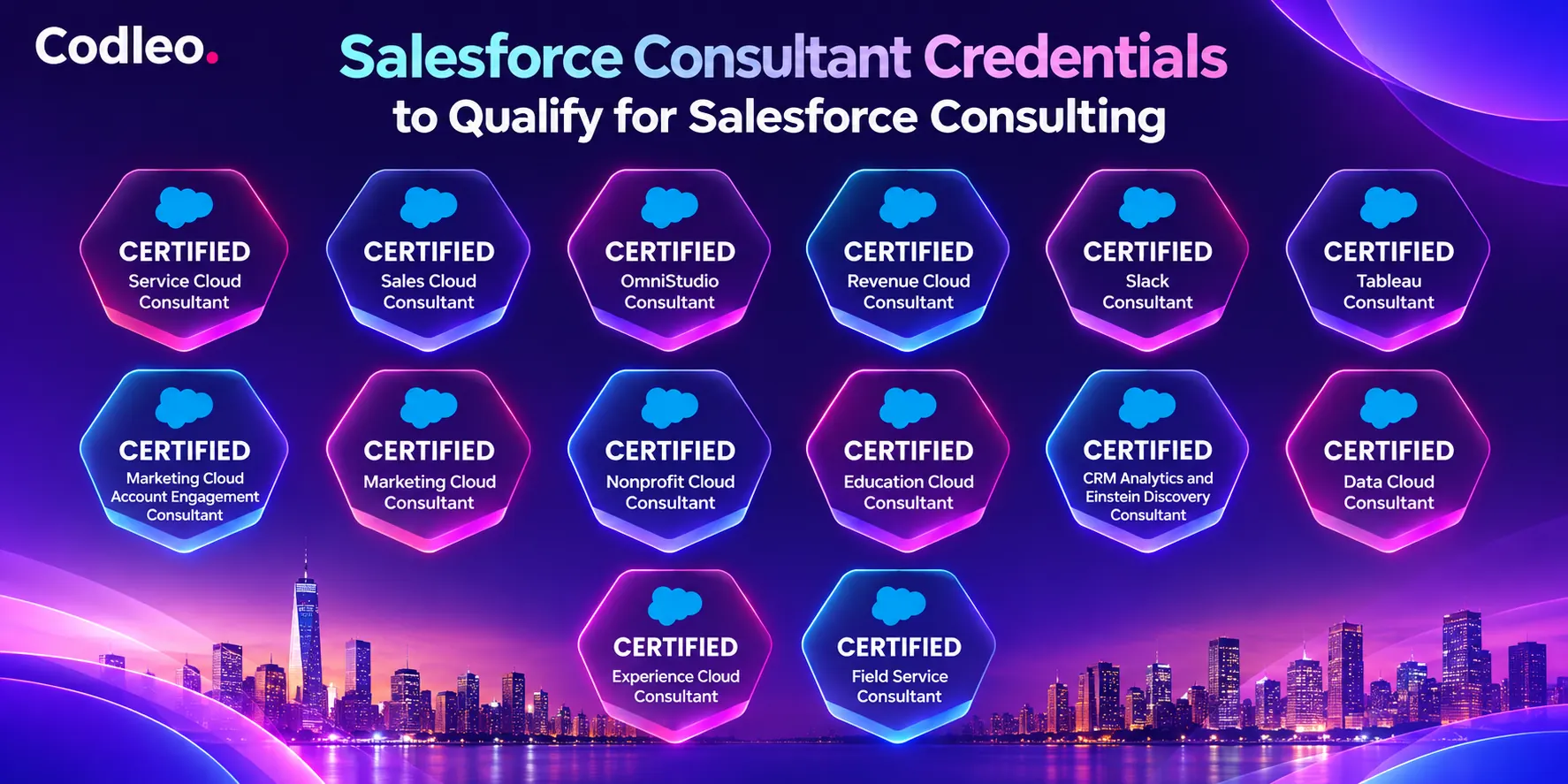
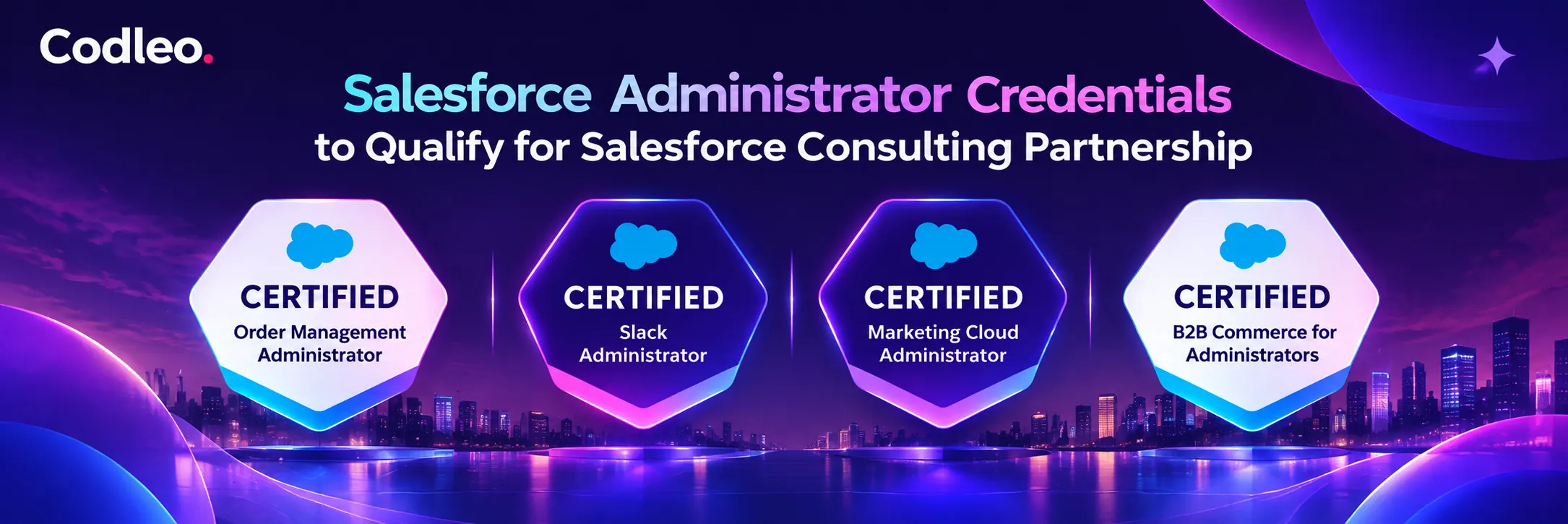
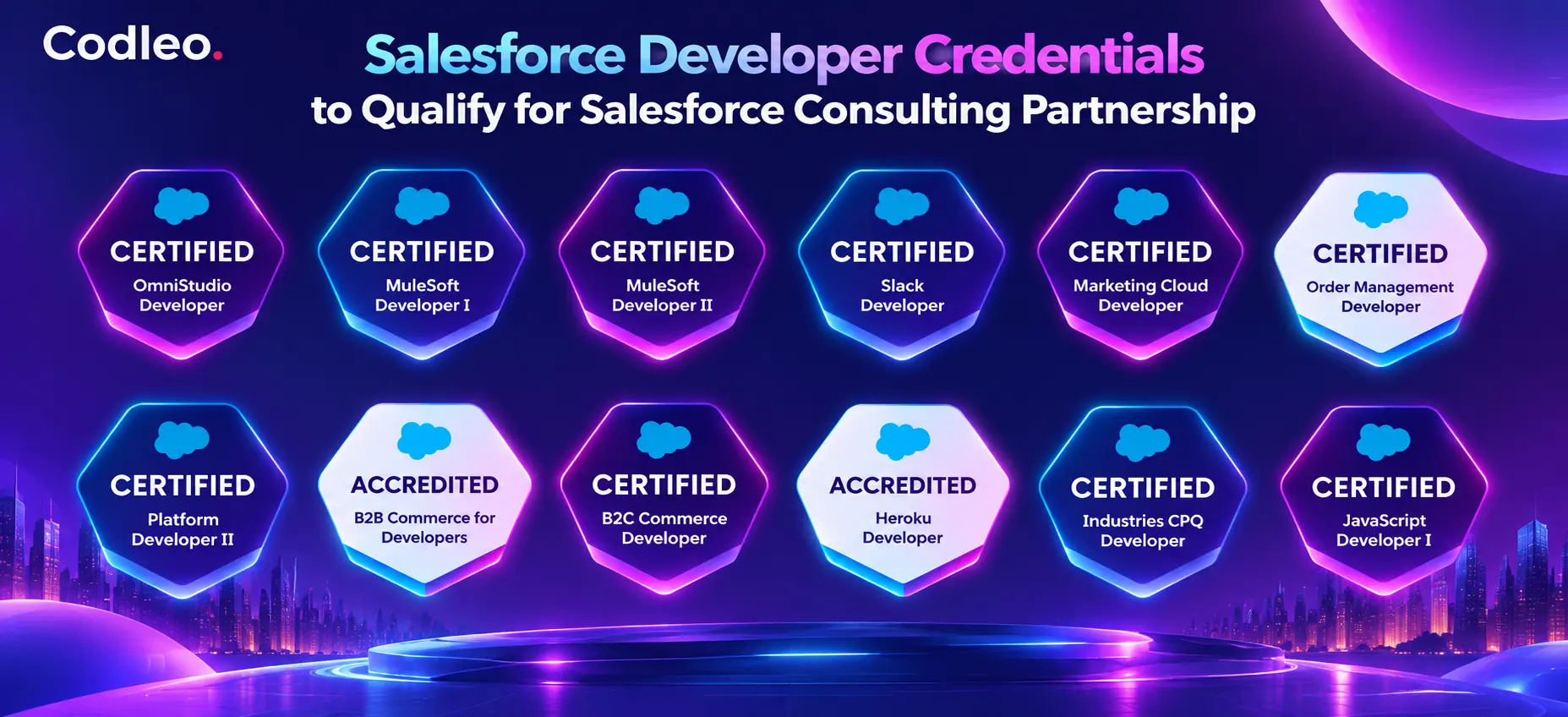
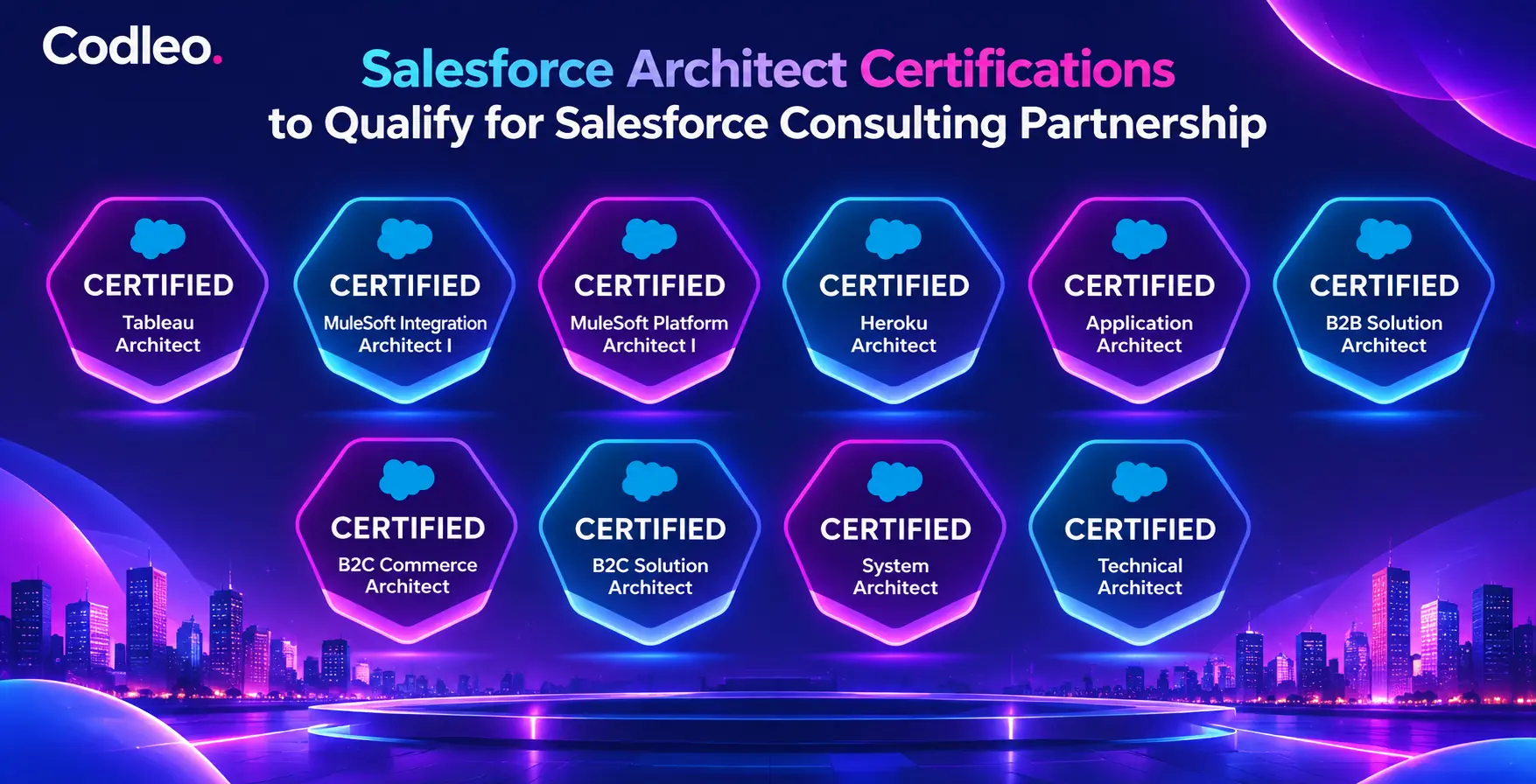
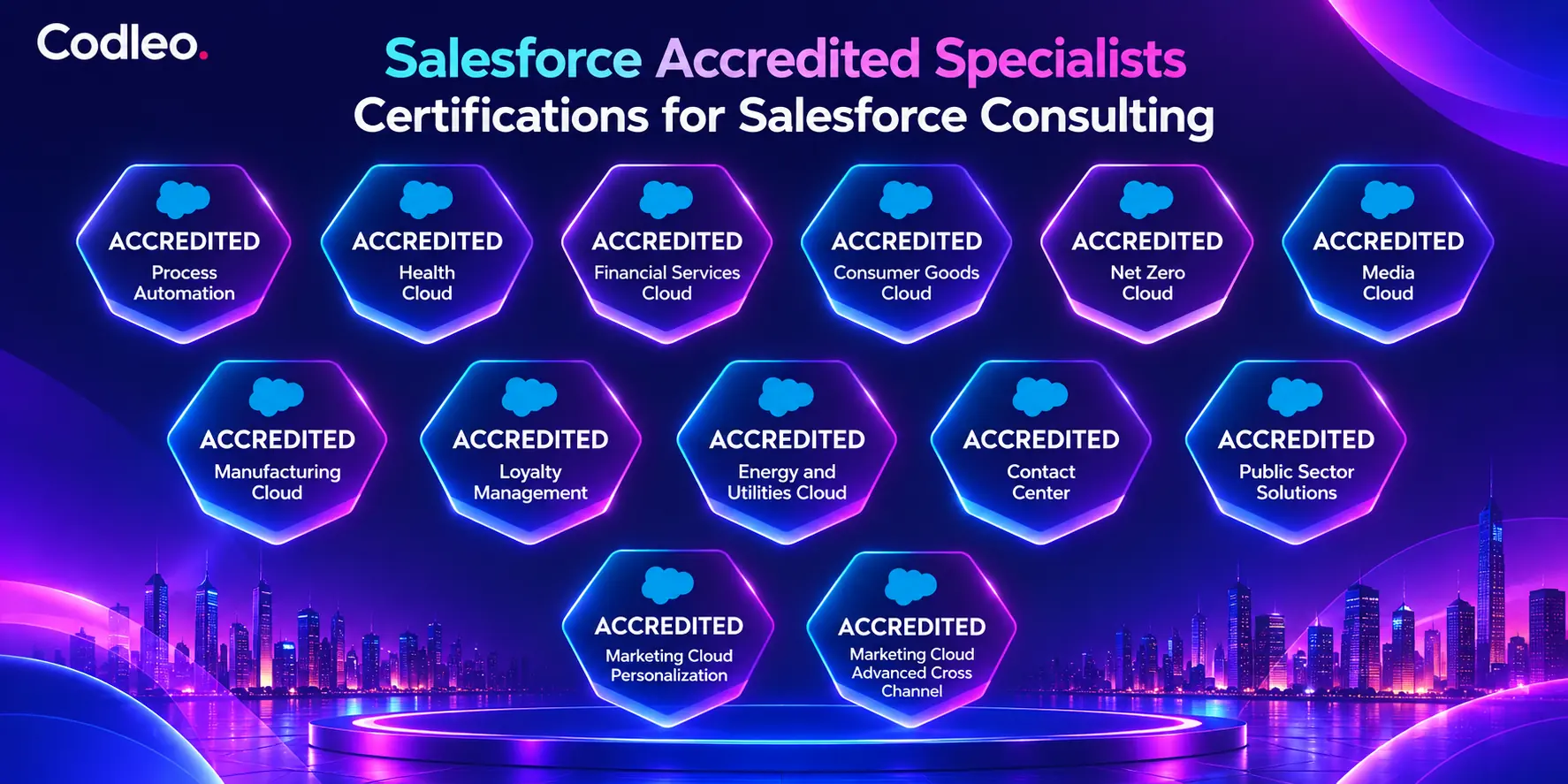
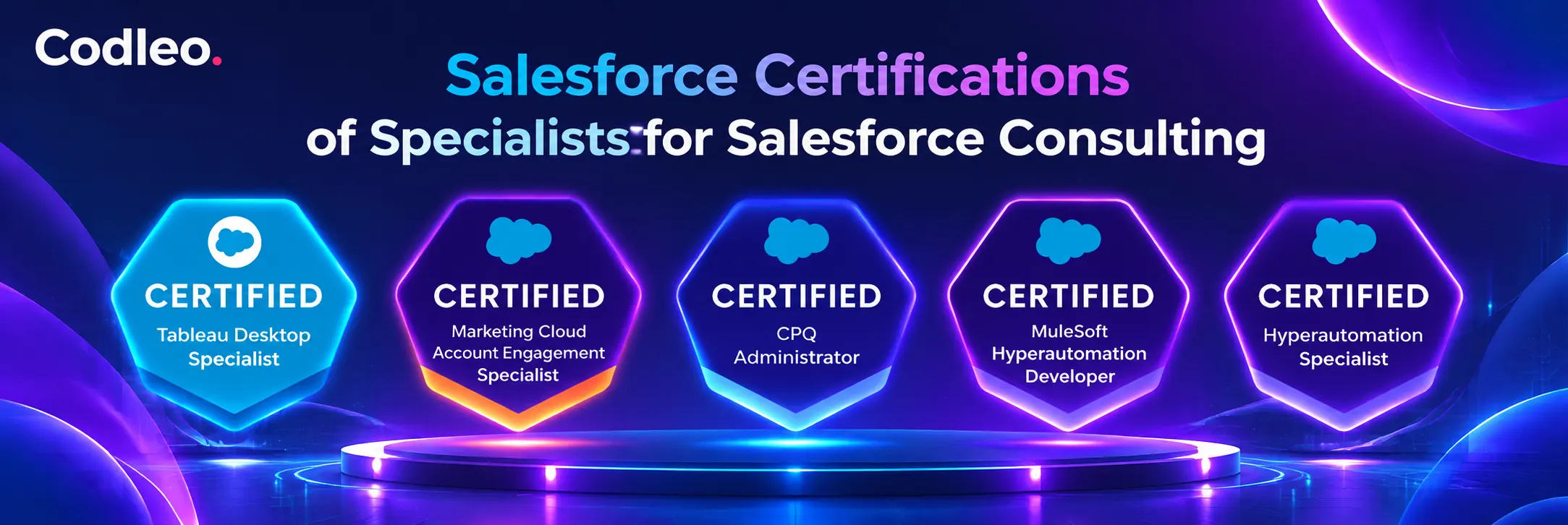
1. Codleo Consulting
Founded
2019
US Presence
Delaware and Dallas, Texas
Global Offices
USA, India, UAE, and Australia
Team
110+ team members and 18+ Salesforce architects
Salesforce Expertise
Salesforce Consulting Services, Salesforce Sales Cloud, Salesforce Service Cloud, Salesforce Marketing Cloud, Salesforce Experience Cloud, Salesforce Agentforce, Salesforce Data Cloud, Salesforce Development, Salesforce Implementation, Salesforce Integration, Salesforce Support Services, Salesforce Staff Augmentation, and Managed Services.
Industries
Financial Services, Manufacturing, Real Estate, Healthcare, Education, Retail, Nonprofit, and Professional Services.
Best for: Mid-sized businesses and large enterprises in the USA looking for an experienced Salesforce consulting partner for CRM implementation, multi-cloud customization, integrations, AI and Agentforce adoption, and long-term Salesforce support.
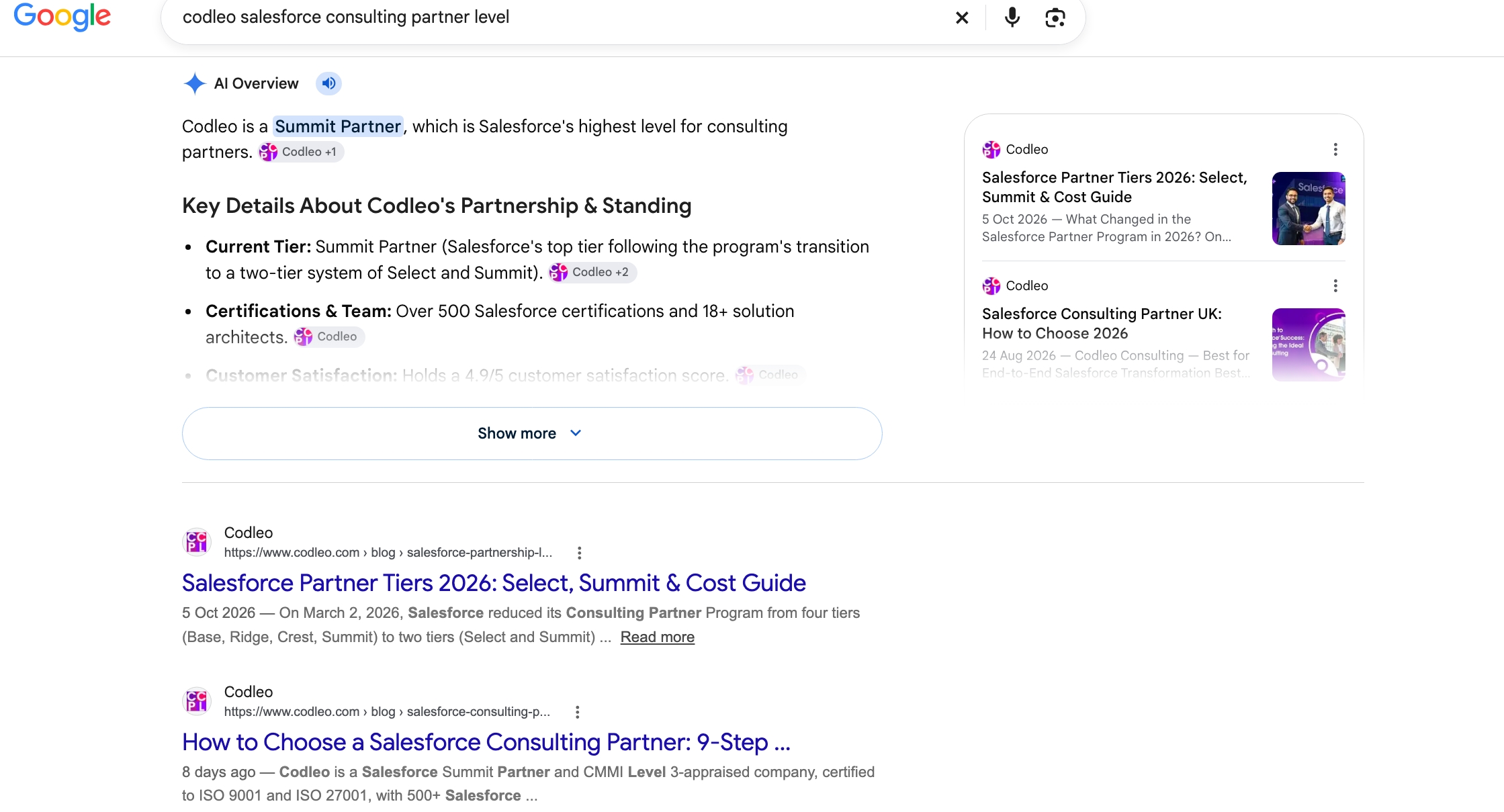
Codleo Consulting is a Salesforce Summit Partner that helps businesses plan, implement, customize, integrate, and optimize Salesforce CRM. Founded in 2019, the company serves organizations across the USA and international markets, offering Salesforce consulting and delivery services for businesses at different stages of their CRM journey.
Codleo's capabilities cover Salesforce implementation, cloud customization, third-party integrations, application development, data migration, process automation, and ongoing CRM support. Its teams work with organizations that need to modernize legacy processes, improve customer experiences, and connect Salesforce with their existing business systems.
The company also supports businesses exploring Salesforce AI and Agentforce, helping them identify practical automation opportunities, prepare customer data, and design workflows that fit their operational needs. Its industry experience includes financial services, manufacturing, real estate, healthcare, education, and nonprofit organizations.
With a multidisciplinary team of Salesforce consultants, developers, and architects, Codleo offers flexible engagement models for new Salesforce implementations, existing CRM improvements, dedicated development resources, and ongoing support. This makes it a strong option for businesses that want one partner for consulting, delivery, and post-launch optimization.
Explore Codleo Salesforce Consulting Services →2. Ascendix Technologies
Founded
1996
Headquarters
Dallas, Texas, USA
Offices
Dallas (USA), Porto (Portugal), Krakow (Poland)
Team
48 Salesforce-certified experts; 200+ total employees
Salesforce Expertise
Sales Cloud, Service Cloud, Experience Cloud, Nonprofit Cloud, Marketing Cloud, Agentforce, Customer 360 Platform, and Managed Services.
Industries
Commercial Real Estate, Capital Markets, Private Equity, Venture Capital, Nonprofits, Finance, Transportation, Professional Services, Agriculture and Mining, and High Tech.
Best for: Medium-sized and specialized businesses in commercial real estate and capital markets looking to optimize operations through tailored Salesforce solutions.
Ascendix Technologies is a Salesforce consulting and product development company founded in 1996 and headquartered in Dallas, Texas. The company is a Salesforce Summit Partner with experience delivering CRM solutions for organizations in commercial real estate, capital markets, private equity, and other specialized industries.
Ascendix combines Salesforce consulting with custom product development. Its reported portfolio includes 150+ Salesforce certifications, 300+ completed projects, and three AppExchange applications serving more than 25,000 daily users.
The company focuses on industries with complex data management and compliance requirements. Its services include custom AI agents, Agentforce implementation, custom portals, and AppExchange app development. Ascendix also advertises an Agentforce quick-start package with an estimated two-to-three-week setup.
With delivery teams across the United States and Europe, Ascendix offers flexible engagement models for businesses implementing Salesforce for the first time, improving existing CRM environments, or exploring advanced AI capabilities. Its combination of industry-focused consulting and product engineering makes it particularly relevant to real estate and financial services organizations.
Visit Ascendix Technologies →3. Kelley Austin
2020
Richardson, Texas, USA
76 Salesforce-certified experts; up to 200 employees
Clients
Shiftkey, Green Brick Partners, Atmosphere, Island, Nelnet, Stack Sports, Circuit of the Americas, Shell, University of Utah, PMG, Saber Power, and Cadence.
Salesforce Expertise
Service Cloud, Marketing Cloud, Experience Cloud, Revenue Cloud, Data Cloud, Sales Cloud, Agentforce, Salesforce Spiff, Managed Services, Field Service, and Custom CRM Development.
Industries
Healthcare, Education, Nonprofit, Financial Services, Professional Services, Manufacturing, Technology, Retail and Consumer Goods, Energy and Utilities, Media and Entertainment, and Communications.
Best for: Large enterprises and medium-sized businesses managing complex processes and seeking fast Salesforce implementation and user adoption.
Kelley Austin is a Salesforce Summit Consulting Partner co-founded by Hunter Austin and Waylon Kelley in 2020. The company reportedly achieved Summit status within two and a half years, reflecting its rapid growth in the Salesforce consulting ecosystem.
The company specializes in full-service Salesforce consulting and implementation, including Agentforce implementation, custom CRM development, integrations, and managed services. Its broad industry coverage makes it relevant to organizations looking to improve complex business processes and accelerate Salesforce adoption.
4. Passion Fruit Partners
2020
Toronto, Ontario, Canada
Toronto and Vancouver, Canada
23 Salesforce-certified experts; up to 50 employees
Clients
David Suzuki Foundation, Alpha USA, Honeymoon Israel, Table to Table, Sunrise Children's Services, Health in Harmony, International Brotherhood of Boilermakers, North Edge, Positivity Project, Team Red, White & Blue, Bible League Canada, and Free Wheelchair Mission.
Salesforce Expertise
Nonprofit Cloud, Nonprofit Success Pack (NPSP), Sales Cloud, Service Cloud, Experience Cloud, Marketing Cloud, Marketing Cloud Account Engagement (Pardot), Agentforce, and Data Architecture and Management.
Industries
Nonprofits, environmental organizations, faith-based ministries, healthcare and human services, education, youth services, food security, and economic development.
Best for: Small and medium-sized nonprofit organizations seeking specialized Salesforce implementation and ongoing CRM improvement.
Passion Fruit Partners is a Canadian Salesforce consulting company founded in 2020, focused exclusively on helping nonprofit organizations implement and optimize Salesforce. Its services support fundraising, constituent engagement, program management, and nonprofit data operations.
The company reports completing more than 100 projects, including work with Alpha USA associated with a 50% revenue increase over 12 months. Passion Fruit Partners is also described as a Salesforce Impact Partner and a Pledge 1% member.
5. Prolocity
2010
Covington, Kentucky, USA
Cincinnati, Ohio; Toronto, Canada
39 Salesforce-certified experts
Clients
Child Bridge, HealthFinders Collaborative, Gift of Hope, Food Banks of Alaska, Leadership North Carolina, Youth Guidance, and Quilez and Associates Inc.
Salesforce Expertise
Customer 360 Platform, Experience Cloud, Education Solutions, Managed Services, Nonprofit Solutions, AppExchange App Development, Custom App Development, Sales Cloud, and Service Cloud.
Industries
Financial Services, Healthcare and Life Sciences, Nonprofit, and Professional Services.
Best for: Nonprofit organizations seeking comprehensive Salesforce implementation alongside business process optimization.
Prolocity is a Salesforce consulting partner founded in 2010, helping businesses and nonprofits use Salesforce to improve sales, marketing, service delivery, and constituent management.
As a Salesforce Summit Partner, Prolocity provides strategy, design, implementation, training, and optimization services. Its experience is particularly relevant to nonprofit organizations, and the company has reported recognition as a Best Place to Work for five consecutive years.
6. Elevation Solutions
2016
Denver, Colorado, USA
Frisco, Texas
30 Salesforce-certified experts; up to 50 employees
Clients
Chime Scholars Foundation, LA Promise Fund, Cherry Creek School District, and AHA! Santa Barbara.
Salesforce Expertise
Education Solutions, Experience Cloud, Marketing Cloud, Nonprofit Solutions, Sales Cloud, and Service Cloud.
Industries
Education and Nonprofit.
Best for: Small and medium-sized nonprofits, K–12 schools, and higher education institutions.
Elevation Solutions is a Salesforce consulting partner founded in 2016, specializing in nonprofit and educational organizations. Its work focuses on helping institutions manage constituents, students, programs, and operational processes through Salesforce.
The company operates with a remote delivery model and reports more than 30 professionals holding approximately 195 Salesforce certifications. Its primary areas of focus include Education Cloud, Nonprofit Cloud, and Salesforce solutions for K–12 institutions.
7. Centelon
2015
San Jose, California, USA
Singapore; Melbourne and Sydney; Pune, Bengaluru, Chennai, Kochi, and Thiruvananthapuram
44 Salesforce-certified experts; 400+ total employees
Clients
Public client information was not provided.
Salesforce Expertise
Sales Cloud and Service Cloud.
Industries
Nonprofit, Retail, Government, Financial Services, and Education.
Best for: Medium and large enterprises requiring Salesforce consulting and global technology delivery capabilities.
Centelon is a global technology solutions company specializing in digital transformation for medium-sized and large enterprises. Its services support organizations in financial services, education, government, retail, and nonprofit sectors.
The company has an international delivery presence spanning the United States, Australia, Singapore, and India. Its supplied company profile describes a team of more than 400 employees, with Salesforce expertise focused on Sales Cloud and Service Cloud implementations.
8. NTT DATA
1988
Plano, Texas, USA
50+ countries
29 Salesforce-certified experts in supplied listing; global workforce up to 200,000
Clients
Embraer, RIMAC Seguros, BCBSRI, BBVA, and Panasonic Sales Taiwan.
Salesforce Expertise
Managed Services, MuleSoft, Multi-Cloud Integration, AppExchange App Development, Custom Salesforce Development, Sales Cloud, Service Cloud, and Salesforce Commerce.
Industries
Communications, Engineering, Construction and Real Estate, Financial Services, High Tech, Media and Entertainment, Healthcare, Manufacturing, and Public Sector.
Best for: Large international enterprises managing complex Salesforce environments, enterprise integrations, and multi-country transformation programs.
NTT DATA is a global IT services company and Salesforce Summit Partner with extensive enterprise technology delivery experience. Its Salesforce consulting work supports organizations across industries, including financial services, healthcare, manufacturing, and government.
The company provides digital transformation services such as application rationalization, legacy modernization, MuleSoft integration, multi-cloud implementation, and managed services. Its international delivery capabilities make it particularly relevant to enterprises requiring coordinated technology programs across multiple countries.
9. ShellBlack
2010
Lewisville, Texas, USA
29 Salesforce-certified consultants; up to 50 employees
Clients
Public client names were not provided.
Salesforce Expertise
Customer 360, Salesforce Industry Products, Sales Cloud, Financial Services Cloud, Data Migration, Marketing Automation, and Custom Development.
Industries
Financial Services, including Wealth Management, Banking, Credit Unions, Mortgage Services, and Insurance.
Best for: Mid-sized and large financial services businesses seeking specialized Salesforce consulting and implementation.
ShellBlack is a Salesforce consulting company headquartered in Lewisville, Texas, with a strong focus on the financial services industry. According to its profile, about 95% of its engagements involve financial services organizations.
The company reports 115 Salesforce certifications and more than 2,700 completed projects for over 850 US clients. Its services include Financial Services Cloud implementation, CRM data migration, marketing automation, and custom Salesforce development for wealth management firms, banks, credit unions, mortgage providers, and insurers.
10. Momentum
2022
New York, New York, USA
Alberta, British Columbia, and Ontario, Canada
17 Salesforce-certified consultants; up to 50 employees
Clients
American Battery Solutions, Brain Mind, Girls With Impact, Hotel Inc., New York Urban League, Philadelphia Federation of Teachers, and Ontario Tech University.
Salesforce Expertise
Customer 360, Managed Services, Nonprofit Solutions, AppExchange App Development, Custom Salesforce Development, Sales Cloud, Service Cloud, Experience Cloud, Manufacturing Cloud, and Financial Services Cloud.
Industries
Nonprofit, Education, Public Sector, and Commercial Organizations.
Best for: Small to large educational, nonprofit, and public sector organizations requiring Salesforce implementation and application development.
Momentum is a Salesforce consulting and application development firm serving commercial, nonprofit, and public sector organizations. It helps organizations use Salesforce to manage operations, improve engagement, and support digital transformation.
The company reports serving more than 200 clients and delivering Salesforce solutions across Sales Cloud, Service Cloud, Nonprofit Cloud, Public Sector Solutions, Experience Cloud, Manufacturing Cloud, and Financial Services Cloud. Its approach emphasizes collaboration, user adoption, and long-term customer relationships.
11. Plumlogix Inc.
2016
Reston, Virginia, USA
22 Salesforce-certified consultants; up to 50 employees in supplied listing
Clients
City of Boston, Mattress Firm, College Possible, Warren Controls, and Integral Molecular.
Salesforce Expertise
Experience Cloud, Service Cloud, Managed Services, Salesforce DevOps, Industry Cloud Implementation, and AI Solutions.
Industries
Education, Government and Public Sector, Nonprofit, Retail, and Ecommerce.
Best for: Small and medium-sized organizations in government, education, nonprofit, retail, and ecommerce seeking Salesforce transformation services.
Plumlogix Inc. is an MBE-certified Salesforce consulting and digital transformation company founded in 2016. The company supports organizations implementing Salesforce solutions across public sector, education, nonprofit, and commercial environments.
Its supplied profile describes a global consulting team across the United States, Pakistan, and India, with 77 Salesforce certifications. Plumlogix has also been recognized as a Salesforce Impact Accelerator Partner and provides managed services, DevOps, AI, and industry-specific Salesforce implementations.
12. Idlewild
2015
New York, New York, USA
26 Salesforce-certified experts; up to 50 employees
Clients
Kids Creative, Mass, Red Hook Initiative, Union Settlement, and Lower East Side Ecology Center.
Salesforce Expertise
Managed Services, Nonprofit Solutions, Sales Cloud, Fundraising Systems, and Program Management Solutions.
Industries
Nonprofit.
Best for: Nonprofit organizations seeking Salesforce fundraising, constituent management, and program delivery solutions.
Idlewild Partners is a Salesforce consulting company based in Brooklyn, New York, specializing in Salesforce solutions for nonprofit organizations. Its services focus on improving fundraising operations, donor relationships, and program management.
The team reportedly holds 92 Salesforce certifications and supports nonprofit organizations through implementation, customization, and managed services. Its nonprofit-only focus makes it relevant to organizations looking for consultants familiar with fundraising and mission-driven operational processes.
13. Vanguard Cloud Consulting
2019
Dublin, Ireland
30 Salesforce-certified experts; 40+ employees
Clients
Burke Bros, Learnosity, AccelerateHER, Totalmobile, Prolennium, Loop, Eunomia, RWAF, GridBeyond, MOORE, First Choice Nursing, Aspen, British Nannies, and Saint-Gobain.
Salesforce Expertise
Sales Cloud, Service Cloud, Experience Cloud, Marketing Cloud, Data Cloud, Agentforce, Net Zero Cloud, and Field Service.
Industries
Manufacturing, High Tech, Telecommunications, Travel and Hospitality, Transport, Media, Nonprofit, Healthcare, Professional Services, Business Services, Legal, Marketing, Energy and Utilities, Public Sector, Financial Services, Retail, and Automotive.
Best for: Small and medium-sized organizations seeking agile, lower-risk Salesforce implementations and multi-cloud consulting services.
Vanguard Cloud Consulting is a Salesforce Summit Implementation Partner headquartered in Dublin, Ireland. The company delivers multi-cloud Salesforce implementations covering Sales Cloud, Service Cloud, Marketing Cloud, Experience Cloud, and other Salesforce products.
Beyond Salesforce, Vanguard is described as an Asana Gold Partner and Agentforce Implementation Partner. Its services combine CRM implementation, business process improvements, and AI automation to help organizations modernize operations while maintaining an agile delivery approach.
10 Common Mistakes to Avoid When Choosing a Salesforce Consulting Partner
Common mistakes when choosing a Salesforce consulting partner include skipping a clear definition of your needs, choosing based on price alone, relying on a single review site, rushing the decision, picking a partner without relevant experience, and ignoring AI and Agentforce expertise. Each one can turn a promising implementation into a costly rebuild.
Whether you hire an independent Salesforce consultant or a full consulting partner, these are the oversights that most often lead to delays, budget overruns, and a CRM nobody wants to use:
| # | Mistake | Why It Hurts | How to Avoid It |
|---|---|---|---|
| 1 | Ignoring your real business needs and pain points | The partner builds what's easy to sell, not what you need. | Write down your goals, problems, and success metrics before talking to anyone. |
| 2 | Not learning the Salesforce basics yourself | You can't judge proposals or spot overselling. | Spend a few hours on Trailhead to understand core products and terms. |
| 3 | Choosing on price over quality | Low bids often skip discovery, testing, or training, and costs return as change requests. | Compare total value, scope, and team experience, not just the hourly rate. |
| 4 | Ignoring reviews, or relying on one review site | One platform rarely gives the full picture. | Check AppExchange, G2, and Clutch, and speak to references directly. |
| 5 | Deciding too quickly | You miss red flags and better-fit options. | Shortlist three to five partners and compare them on the same brief. |
| 6 | Overlooking a partner's own AppExchange products | You miss ready-made solutions that could save time and money. | Ask whether the partner offers apps or accelerators relevant to your industry. |
| 7 | Hiring a partner without relevant experience | They learn your industry or product on your budget. | Ask for case studies in your sector and with your Salesforce clouds. |
| 8 | Choosing an order-taker instead of an advisor | They build exactly what you ask for, even when it's the wrong approach. | Look for partners who challenge assumptions and suggest better options. |
| 9 | Treating it as a short-term project | Salesforce changes three times a year, and your business keeps evolving. | Choose a partner that can support and improve your Salesforce org after go-live. |
| 10 | Ignoring AI and Agentforce expertise | You may need to rebuild later to use AI agents and unified data. | Ask about real Agentforce and Data 360 projects, not just certifications. |
Key Takeaway
The right Salesforce consulting partner should do more than deliver a working CRM. Look for a team that understands your business, challenges assumptions, demonstrates relevant experience, and can support your Salesforce investment as your requirements evolve.
10 Salesforce Consulting Partner Mistakes Explained
Mistake #1: Not Defining Your Business Goals and Pain Points First
If you're hoping a consultant will tell you how your business should work, you're starting in the wrong place.
Before you talk to any Salesforce consulting partner, get clear internally on why you need Salesforce in the first place. Which problems should it solve? Which processes should it simplify? Which business goals should it help you hit, whether that's faster lead response, better forecasting, or fewer service escalations?
Skip this step, and you risk paying for a CRM that looks impressive in a demo but barely gets used.
What to do instead: Document your objectives, pain points, timeline, budget range, preferred engagement model, key stakeholders, and the roles you expect the partner to play. Use that as the backbone of your RFP, so every partner responds to the same brief.
Mistake #2: Going In Without Basic Salesforce Knowledge
You don't need to become a Salesforce expert, but you do need to speak enough of the language to follow the conversation and spot overselling.
Spend a little time with free Salesforce product demos, introductory videos, and Trailhead modules that cover your industry and the clouds you're considering. Knowing the difference between Sales Cloud and Service Cloud, or what Agentforce and Data 360 actually do, makes every partner conversation more productive.
What to do instead: Prepare four or five key discussion points to raise with each partner. Don't try to master the technical details, though. A good Salesforce consulting partner will explain those clearly and in plain language.
Mistake #3: Choosing on Price Instead of Value
When budgets are tight, the lowest quote is tempting. But choosing the cheapest Salesforce partner often leads to higher running costs, longer timelines, and in some cases a project that has to be rebuilt from scratch.
Price-led decisions also tend to focus on the wrong things. A company that hires only developers might get technically solid code that nobody uses, because no one looked at processes, data, training, or adoption as a whole.
Nonprofits and educational institutions may be able to use Salesforce's Pro Bono program, which connects them with volunteer Salesforce experts at no cost. It helps with small, short-term needs, but the limited hours make it unsuitable for full implementations.
What to do instead: Compare proposals on total value: scope, team experience, discovery, testing, training, and post-launch support. A slightly higher quote that includes these is usually cheaper in the long run. For budgeting help, see our Salesforce consulting cost guide.
Mistake #4: Ignoring Reviews, or Trusting Just One Source
Every partner's website shows polished case studies and happy logos. That's only half the story.
Start with verified reviews on Salesforce AppExchange. They're tied to real customer accounts and can't be edited by partners, which makes them one of the most reliable sources available.
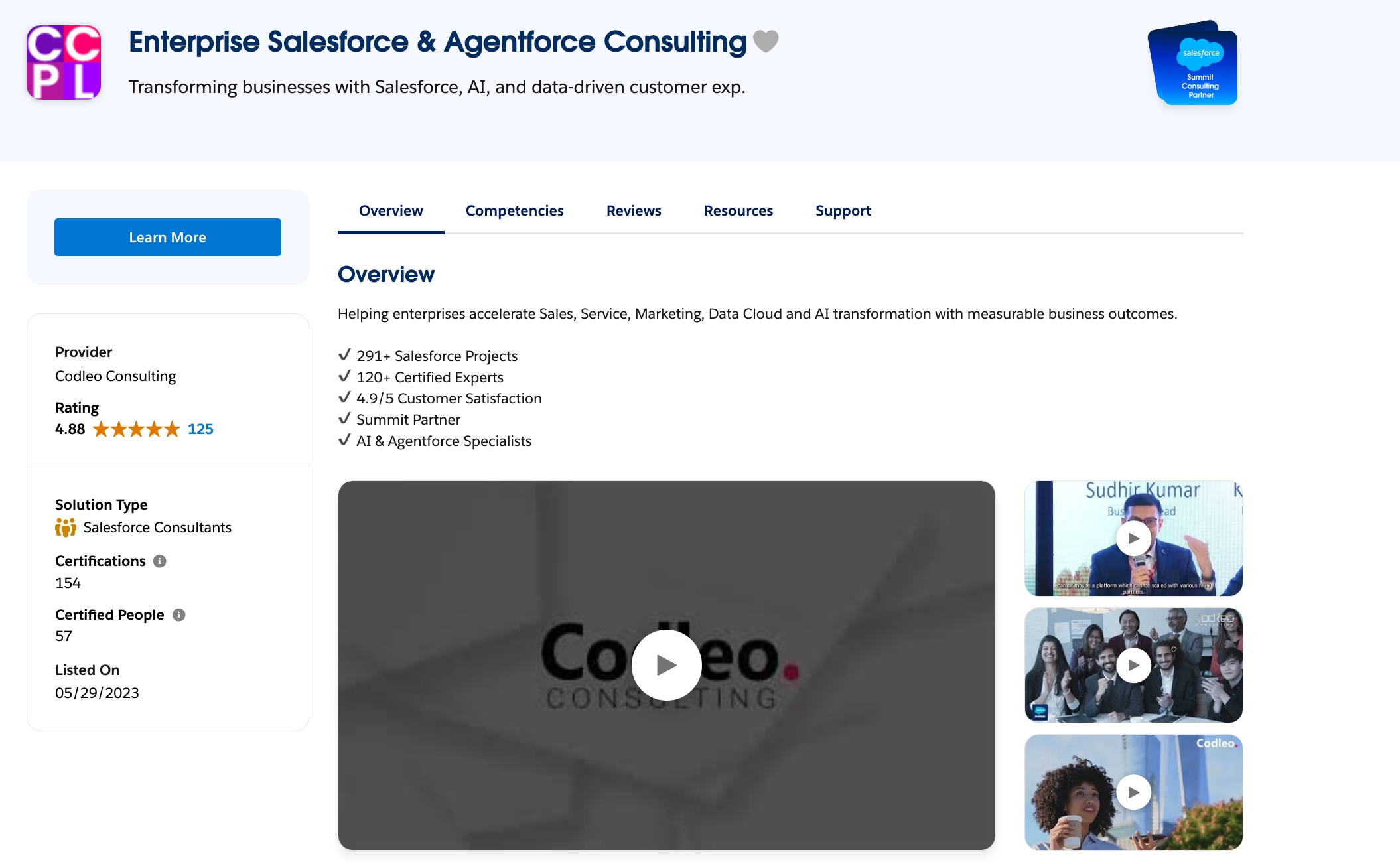
Then check independent review platforms such as Clutch and G2. These often go deeper, showing what clients liked and disliked at every stage, from the first sales call through delivery and support. Together, they give you a much fuller picture than the references a partner chooses to share.
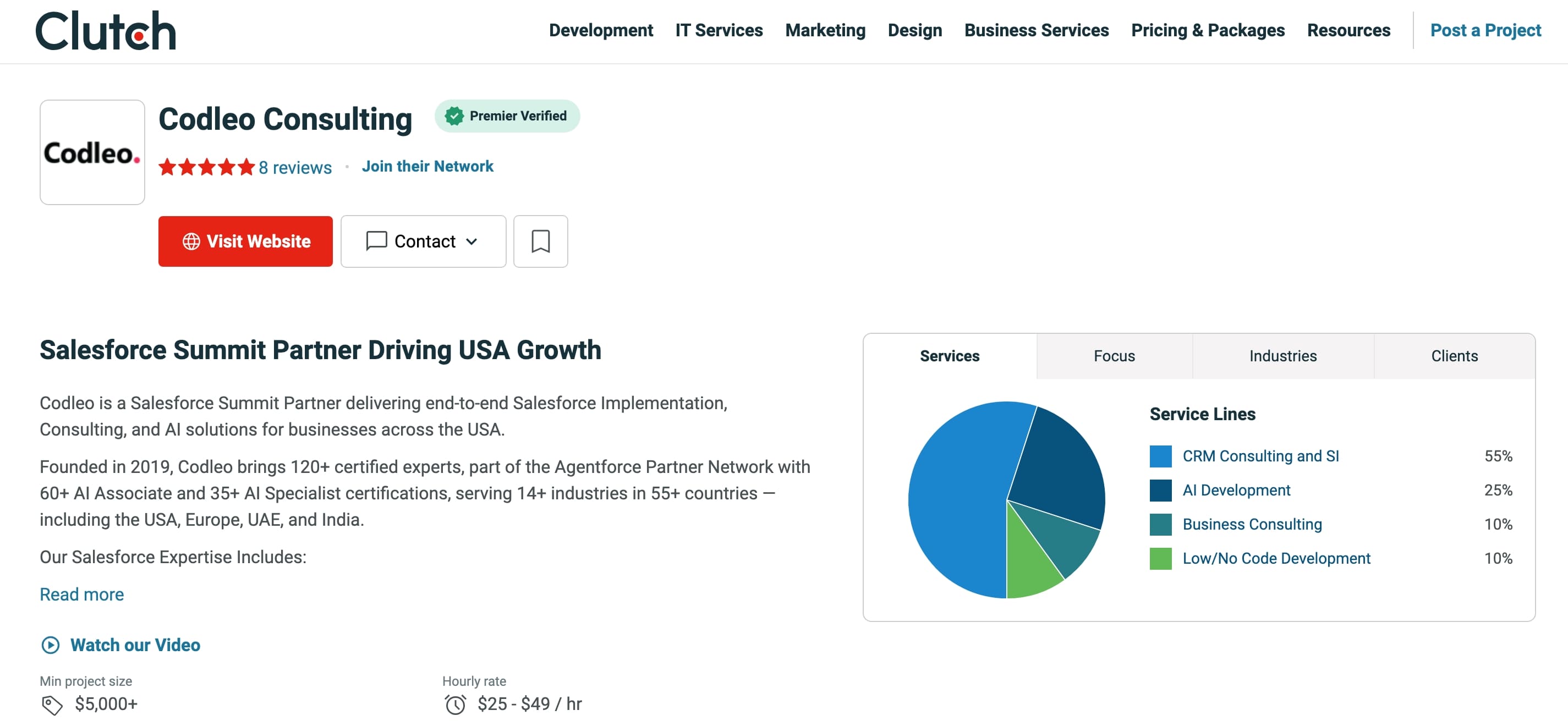
What to do instead: Read recent reviews from companies similar to yours in size and industry, look for patterns rather than single comments, and still speak to two or three references directly.
Mistake #5: Rushing the Decision
A Salesforce investment involves real budget, time, and effort from your team. It deserves more than a quick decision based on one good sales call.
What to do instead: Ask your professional network for recommendations, explore AppExchange and the Trailblazer Community, study partners' portfolios and case studies, and hold detailed conversations with each shortlisted firm. Compare the pros and cons side by side before you commit. A few extra weeks of evaluation can save months of rework.
Mistake #6: Overlooking Partners with Their Own AppExchange Solutions
One of the clearest signs of real Salesforce expertise is a partner that has built and published its own solutions on AppExchange.
Partners with their own apps have gone through the entire product cycle: designing, building, passing Salesforce's security review, deploying, and supporting real users at scale. That experience usually means stronger technical depth, a better understanding of user needs, and practical knowledge of the challenges you'll face.
What to do instead: Ask each partner whether they've built AppExchange apps, accelerators, or reusable frameworks relevant to your industry. Even if you don't use their products, their experience is valuable.
Mistake #7: Hiring a Partner Without Relevant Industry Experience
Certifications and technical skills matter, but industry experience matters just as much.
If your business operates in a specialized field, such as commercial real estate, fintech, healthcare, or manufacturing, you need a partner that already understands your workflows, regulations, and terminology. Without that context, you miss important details, and those gaps show up later as poor adoption and weak return on investment.
Bigger doesn't always mean better here. Large consultancies may give smaller or niche projects less attention, and their teams may not have deep experience in your sector.
What to do instead: Ask for case studies and references from companies in your industry with similar Salesforce clouds and integrations. Codleo, for example, has reported a 30% productivity increase for Razorpay and a 20% sales productivity gain for JK Lakshmi Cement through its Salesforce work.
Mistake #8: Choosing a "Yes-Man" Instead of an Advisor
You're bringing in a Salesforce consultant because they know more about the platform than your team does. The last thing you need is someone who agrees with every request and builds exactly what you ask for, even when a better approach exists.
What to do instead: Look for a partner that asks hard questions about your processes, challenges assumptions, takes the lead when needed, and recommends the best approach based on real project experience, even when it's not what you originally had in mind. A good partner will also tell you when something isn't worth building at all.
Mistake #9: Planning for a Short-Term Relationship
Your relationship with a Salesforce partner shouldn't end at go-live. That's when the real adoption work begins.
After launch, you'll need help training users, fixing issues, testing each of Salesforce's three annual releases, keeping data clean, and adding improvements as your teams settle in. And as your business grows, you'll need a partner who can help you scale, add new clouds, and introduce AI.
What to do instead: Choose a partner that offers ongoing managed services, not just implementation. Codleo, for example, provides 24x7 L1 to L5 Salesforce support through an ITIL-aligned helpdesk, covering user requests, data loads, release testing, integration monitoring, and continuous optimization. Explore Codleo's Salesforce support services.
Mistake #10: Ignoring a Partner's AI and Agentforce Expertise
AI is quickly becoming part of how businesses sell and serve customers, and Salesforce's Agentforce brings AI agents directly into your CRM to automate routine work, qualify leads, and support customers around the clock.
But not every Salesforce consultant knows how to deliver it. Many can configure standard workflows but struggle to design AI agents, ground them in the right data, set guardrails, and measure results.
What to do instead: Ask specific questions about each partner's Agentforce projects: their implementation process, how they prepare and connect data, how they test and monitor agents, which metrics they track, and what timelines are realistic. Look for partners with real Agentforce deployments, not just certifications. Codleo, for instance, has implemented Agentforce for India Sotheby's International Realty alongside Sales Cloud, real-time inventory, and CTI to support AI-assisted selling.
Final Thoughts: Choose a Partner, Not Just a Provider
Choosing a Salesforce consulting partner is a big decision, and it deserves the same planning you'd give any major business investment. The right partner helps you get Salesforce live, and then keeps it working for you as your teams, processes, and goals evolve.
The best results come when the relationship runs both ways. Your partner should act as a trusted advisor who understands your business, shares responsibility for the outcome, and isn't afraid to challenge assumptions. In return, your team brings clear goals, quick decisions, and real involvement. That's when Salesforce stops being just a CRM and starts delivering long-term value.
Start by defining your goals, shortlisting partners with proven experience in your industry and in AI and Agentforce, checking verified reviews, and choosing a partner that will stay with you well beyond go-live.
Looking for a Salesforce Consulting Partner You Can Rely on Long Term?
Codleo Consulting is a Salesforce Summit Partner with 500+ certifications, 18+ solution architects, and 275+ engagements delivered. From new implementations and CRM migrations to Agentforce, integrations, and 24x7 support, our team will share honest recommendations and a clear roadmap for your project.
Talk to a Salesforce Expert →Discuss your Salesforce requirements with our consulting team.
Frequently Asked Questions
What is a Salesforce consulting partner?
A Salesforce consulting partner is a company enrolled in Salesforce's official partner program that helps businesses plan, implement, customize, integrate, and optimize Salesforce to meet their goals. Partners employ certified Salesforce professionals, such as consultants, developers, and architects, who understand the platform in depth and can manage everything from simple setups to complex, multi-cloud deployments and integrations. The best partners also act as long-term advisors, helping you improve Salesforce as your business grows and adopt new capabilities like Agentforce and Data 360.
How many consulting partners does Salesforce have?
Salesforce works with thousands of consulting partners worldwide, and the number changes as new firms join and others leave the program. They range from small boutique firms that specialize in one industry or Salesforce product, to mid-sized partners offering end-to-end services, to global consultancies running large enterprise programs. You can browse and filter current consulting partners, including their tiers, certified experts, industries, and verified reviews, on Salesforce AppExchange.
How does a company become a Salesforce consulting partner?
A company becomes a Salesforce consulting partner by enrolling in the Salesforce Partner Program and maintaining certified Salesforce professionals on its team. Every active consulting partner needs at least two Salesforce certifications, and new partners may start with a provisional status while they meet that requirement. Partners are then recognized at the Select or Summit tier based on their certified talent, customer satisfaction, and business impact, and can earn Competencies in specific products and industries. Staying in good standing means continuing to invest in certifications, delivering successful projects, and maintaining strong customer feedback.
How do I choose the right Salesforce consulting partner?
Start by defining your business goals, pain points, budget, and timeline. Then shortlist partners with proven experience in your industry and the Salesforce products you need, and check their current tier and competencies on AppExchange. Read verified reviews on AppExchange, G2, and Clutch, ask for case studies with measurable results, and speak with references from similar companies. Make sure you meet the actual team who'll work on your project, ask about their AI and Agentforce experience, and confirm they offer support after go-live. For a step-by-step approach, see our guide on how to choose a Salesforce consulting partner.
How much does a Salesforce consulting partner cost?
The cost depends on your project scope, the number of Salesforce clouds, integrations, data migration, and the partner's delivery model. As a general guide, an org health check or audit costs around $5,000–$20,000, small business implementations usually range from $10,000–$30,000, mid-market projects from $40,000–$150,000, and enterprise programs from $150,000 to $500,000 or more. Ongoing managed support typically costs $2,500–$15,000+ per month. Certified partners in the US usually charge $150–$250 per hour, while global delivery teams offer lower blended rates. For a detailed breakdown, see our Salesforce consulting cost guide.
What are the benefits of hiring a Salesforce consulting partner?
Hiring a Salesforce consulting partner gives you access to certified expertise and proven implementation methods that most in-house teams don't have. Partners design solutions around your business goals, help you use the right Salesforce features instead of building unnecessary customizations, and manage complex integrations with ERP, marketing, and finance systems. They also reduce project risk, speed up time to value, support user adoption through training, and keep your org healthy after launch with ongoing support and release management. Increasingly, partners also help businesses adopt AI responsibly with Agentforce and Data 360, so your Salesforce investment keeps delivering value as your business grows.
 0
0
About the Author


 16192 Coastal Highway Lewes, Delaware 19958 USA


