


Publish date:
The Real Opportunity You're Probably Missing
Your competitor just sent a message to a customer via WhatsApp. The customer responded within 3 minutes. By the time your email landed in their inbox, the deal was already halfway closed.
This isn't hypothetical. It's happening right now in 2026.
Every day, 100 billion messages flow through WhatsApp. Your customers are there. Your prospects are there. But most B2B companies are still relying on email, which has a 20-30% engagement rate and takes days to get a response. WhatsApp? 70% engagement. Average response time: under 5 minutes.
Here's what makes this even more interesting: most companies aren't actually using WhatsApp strategically. They're either ignoring it completely or treating it like another spam channel. The ones who figured out how to integrate it properly into their Salesforce Marketing Cloud—the ones treating it as a premium communication layer—they're seeing 35-45% faster sales cycles, 40-50% higher engagement rates, and significantly cleaner customer data.
And the best part? The technical complexity everyone fears—it's not as bad as you think. Yes, there are challenges. Yes, it requires planning. But thousands of companies have already solved this puzzle. You're not pioneering; you're following a proven path.
The question isn't whether WhatsApp integration matters anymore. It's whether you're going to implement it before your market share shifts to competitors who did.
This guide walks you through everything: the three different implementation approaches (and why each exists), the actual costs you'll face, the hidden challenges nobody talks about, how to choose between building it yourself versus hiring a Salesforce consulting partner, and the real ROI you can expect. We're not giving you marketing fluff here—we're giving you the honest version that companies use to make actual decisions.
By the time you finish reading, you'll know exactly whether WhatsApp integration is right for your company in 2026. You'll understand which implementation approach fits your situation. And if you decide to move forward, you'll have a realistic timeline and the right questions to ask before hiring a partner.
Let's get into it.
Table of Contents
-
Introduction
-
Why Marketers Are Betting on WhatsApp Integration
-
The Real Search: Who's Actually Looking for This
-
Understanding Your Integration Options:
-
Option 1: Native Salesforce Unified Conversations
-
Option 2: Sinch Chat Messaging Integration
-
Option 3: Third-Party Solutions
-
The Implementation Reality: What Actually Takes Time Getting Your WhatsApp Business Account Verified
-
Defining Your Message Templates
-
Integrating with Your Existing Data
-
Building Your Journeys
-
-
Cost Considerations That Actually Matter
-
Industry-Specific Use Cases
-
Quick ROI Calculator: Should You Invest?
-
Five Red Flags That Your Implementation Will Struggle
-
The Partner Question: When to Hire a Salesforce Implementation Firm
-
What to Ask a Potential Salesforce Consulting Partner
-
The 2026 Reality: WhatsApp Is No Longer Cutting Edge
-
Salesforce Implementation Partners: Your Strategic Advantage
-
Building Support for Your Implementation
-
Common Implementation Challenges and How to Solve Them
-
Real-World Outcomes: What Companies Actually Achieve
-
Building Your Implementation Timeline
-
Making the Decision: Is WhatsApp Integration Right for You?
-
Choosing Between Implementation Approaches
-
Final Thoughts: Your Competitive Edge
Introduction
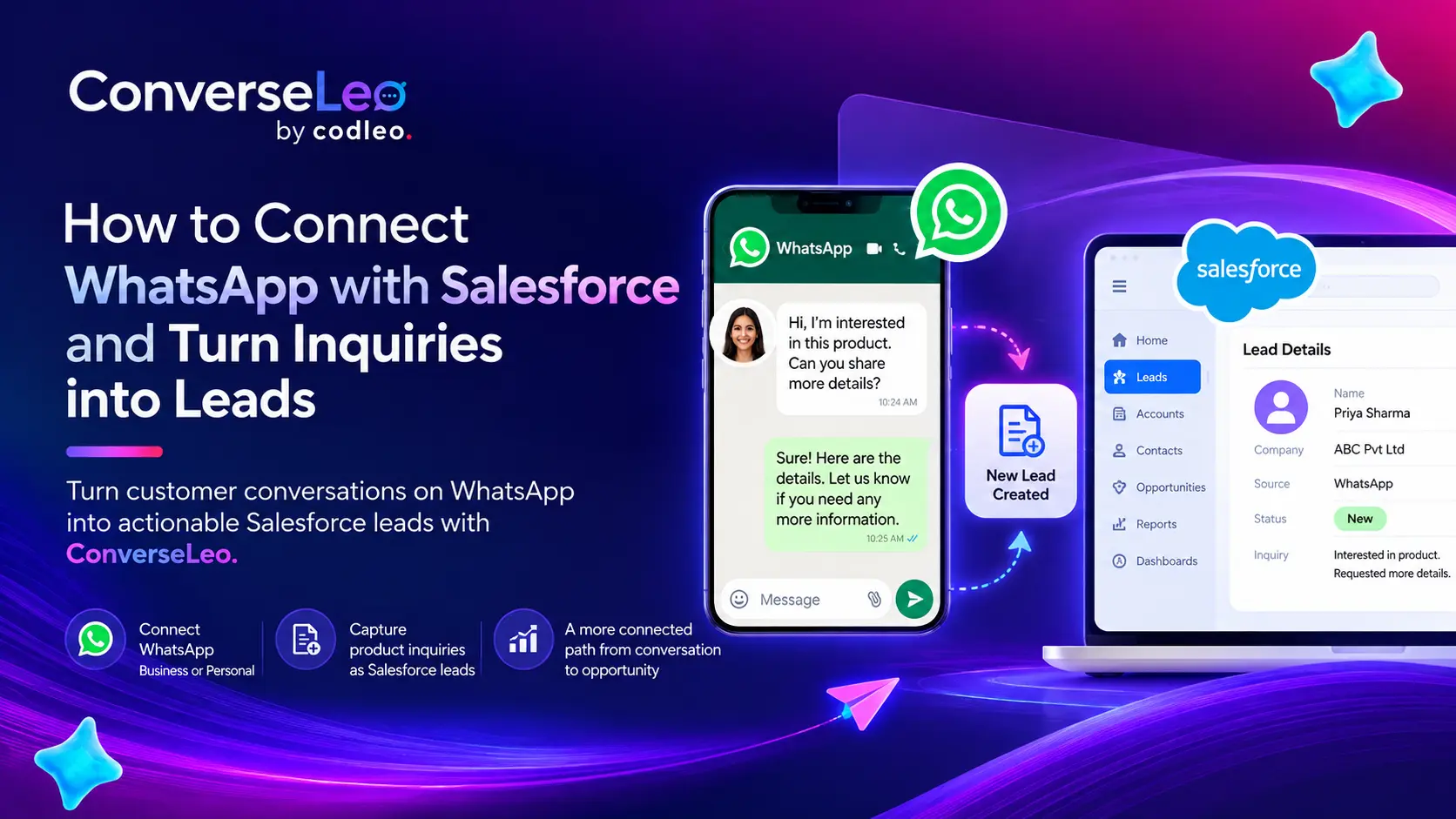
When your marketing team is juggling dozens of different customer communication channels, something always slips through the cracks. Your email campaigns reach some people, social media gets lost in the noise, and SMS costs add up quickly. But what if you could reach your customers where they spend most of their time—on WhatsApp?
With over 2 billion active users exchanging 100 billion messages daily, WhatsApp has become the de facto communication platform worldwide, including in North America. For B2B companies offering Salesforce implementation services or managing complex customer relationships, integrating WhatsApp into your Salesforce Marketing Cloud isn't just convenient—it's essential to staying competitive.
This isn't a surface-level overview. We're going to walk through exactly how to make this work, what challenges you'll actually face, and how to choose between different implementation approaches. Whether you're a mid-market company or an enterprise running sophisticated customer journeys, you'll find actionable guidance here.
Why Marketers Are Betting on WhatsApp Integration
Let's start with the numbers that matter. WhatsApp has a 70% engagement rate—compare that to email's 20-30% average, and you understand why companies are shifting strategy. But raw engagement rates don't tell the whole story.
For Salesforce Marketing Cloud users specifically, WhatsApp integration solves a critical problem: channel fragmentation. Right now, your customer journey data is scattered across different systems. Marketing Cloud handles email campaigns. Your SMS provider manages text messages. Support conversations live in Service Cloud. Your sales data stays in Sales Cloud. When customers expect a personalized, connected experience, the scattered data creates friction.
WhatsApp integration brings everything together. Your customer's entire journey—from first touchpoint to post-sale support—can flow through a single platform. That unified data means smarter decisions. When your Marketing Cloud instance knows that a customer viewed your pricing page, clicked your demo link, and messaged your support team about implementation timelines, you can trigger incredibly relevant follow-ups in real time.
This matters especially for B2B companies. If you're offering Salesforce implementation services, Salesforce consulting, or CRM customization, your sales cycles are long, and your customer relationships are complex. WhatsApp lets you stay in touch during those 6-12 month decision periods without feeling intrusive.
The Real Search: Who's Actually Looking for This {#real-search}
Before diving into the technical side, understand what companies are actually searching for. The keyword landscape breaks into three clear groups:
Group 1: Implementation & Setup ("How do I make this work?")
-
People searching for "Salesforce Marketing Cloud implementation."
-
Looking for step-by-step setup guides
-
Trying to figure out which integration method to choose
Group 2: Cost & ROI ("Should we do this?")
-
Searching "Salesforce marketing cloud pricing."
-
Asking about "implementation cost."
-
Wondering if it's worth the investment
Group 3: Partner Services ("Who should help us?")
-
Looking for "best Salesforce consulting firms."
-
Searching "Salesforce implementation partners" or "Salesforce summit partner."
-
Asking for "Salesforce implementation consultant" or specific service types
If you're reading this, you probably fall into at least one of these categories. The good news is they're all solvable problems.
Understanding Your Integration Options
This is where it gets real. There's no single "right way" to integrate WhatsApp with Salesforce Marketing Cloud. Instead, there are three main approaches, each with different tradeoffs.
Option 1: Native Salesforce Unified Conversations (Newest Approach)
In 2024, Salesforce released Unified Conversations for WhatsApp, its native integration that doesn't require third-party intermediaries. This is the direction Salesforce is pushing hard.
How it works: You connect your WhatsApp Business Account directly to Marketing Cloud through a Meta API integration. Your marketing, sales, and service teams can all see the same conversation threads. When a customer messages you about an issue, your service rep can see all the marketing interactions that led to that moment.
Why companies love it:
-
Single WhatsApp number across all departments
-
Native two-way conversations (not just broadcasts)
-
Full integration with Journey Builder, Contact Builder, and Content Builder
-
Automatic handoffs from marketing to service teams
The catch: You'll need Salesforce Data Cloud enabled for full personalization capabilities. This means additional licensing costs. Setup isn't complicated, but it requires planning. You're also dependent on Salesforce's roadmap—when they update the feature, you adapt.
Who it's best for: Mid-market to enterprise companies already running Salesforce across multiple clouds, with budgets for premium features.
Option 2: Sinch Chat Messaging Integration
Before Unified Conversations, Salesforce partnered with Sinch (which works as Meta's official partner) to bring WhatsApp to Marketing Cloud. Many companies still use this approach.
How it works: You download the Sinch Chat Messaging app from AppExchange, configure your WhatsApp Business Account through their setup app, and template messages flow through Journey Builder like any other channel activity.
Why some companies prefer it:
-
Well-documented (lots of guides available)
-
Mature integration (been around longer)
-
Doesn't require Data Cloud
-
Good for sending templated messages at scale
The limitation: It's primarily one-way messaging. You can send campaigns and notifications, but two-way conversations require workarounds. If customer service needs to respond, you're jumping to a different tool.
Who it's best for: Companies that want to add WhatsApp as a marketing and notification channel without overhauling their entire stack. Simpler use cases.
Option 3: Third-Party Solutions (360 SMS, Message Blink, Conversive)
A handful of companies have built Salesforce-native apps that handle WhatsApp integration, each with a different philosophy. These range from simple message senders to full conversational platforms.
Common features:
-
No-code message composition
-
Cheaper per-message rates (sometimes 670x cheaper than native solutions, marketing claims)
-
Easier setup for simpler use cases
-
Good automation capabilities
Trade-offs: Your data goes through a third-party system. Reporting might not fully integrate with Salesforce dashboards. You're dependent on a smaller vendor to maintain and update the integration.
Who it's best for: Smaller companies, startups, or organizations with tight budgets and straightforward WhatsApp needs.
The Implementation Reality: What Actually Takes Time
Let's skip the oversimplified step-by-step guides you'll find elsewhere. Real implementation involves decisions and challenges that matter.
Getting Your WhatsApp Business Account Verified {#whatsapp-account}
Before anything technical works, you need a verified WhatsApp Business Account. This typically takes 2-3 weeks, sometimes longer.
What's involved:
-
Create a Facebook Business Manager account (if you don't have one)
-
Register a dedicated phone number for your business (not personal)
-
Verify that number through Meta's verification process (SMS or voice call)
-
Link your WhatsApp Business Account to Business Manager
-
Get approval from Meta (this is where delays happen—they review for compliance)
Timelines matter. If you're planning a Q2 launch, you need to start this in Q1. Delays are common, especially if Meta flags your account for a compliance review. Have a backup phone number ready.
Defining Your Message Templates {#message-templates}
WhatsApp's regulatory model requires pre-approval of message templates. You can't just free-form message customers as you do in email. Meta must approve every template, and it takes 24 hours to a few days per template.
This is critical: Don't guess what templates you'll need. Map out your entire customer journey first. How many different message types do you actually send?
-
Welcome messages: 1-2 templates
-
Appointment reminders: 2-3 templates
-
Follow-up offers: 3-5 templates
-
Problem resolution: 2-3 templates
-
Educational content: 2-4 templates
That's easily 10-15 templates you might need. If even one gets rejected for compliance reasons (too promotional, wrong language, etc.), you're waiting another few days. Plan this meticulously.
Integrating with Your Existing Data {#existing-data}
This is where the real complexity lives. Your WhatsApp subscribers need to match your Marketing Cloud database. If you have customers in multiple systems, you need a data unification strategy.
Common scenario: Your sales team has customer phone numbers in Sales Cloud. Your marketing team has email addresses in Marketing Cloud. Customer service has chat histories in Service Cloud. To send WhatsApp messages through Marketing Cloud, you need a single customer view that includes phone numbers.
The work:
-
Create a unified contact list (or enhance your existing one with phone numbers)
-
Add phone number fields to Contact Builder
-
Decide which subscribers can receive WhatsApp messages (compliance requirement: explicit opt-in)
-
Build lists or segments based on this data
-
Set up journey entry criteria that include phone number validation
This isn't a plug-and-play exercise. You're potentially touching multiple systems and making data governance decisions that impact your entire organization.
Building Your Journeys {#building-journeys}
Once templates are approved and data is ready, building the actual journeys is straightforward—if you have good Salesforce Marketing Cloud expertise.
You'll need to:
-
Design journey logic (who gets which messages, when, under what conditions)
-
Configure WhatsApp message activities (which template, personalization, handling delivery failures)
-
Set up listen activities for two-way conversations (if using Unified Conversations)
-
Build fallback paths (what happens if someone unsubscribes, doesn't respond, etc.)
-
Test with real phone numbers before going live
Time estimate: 40-80 hours, depending on journey complexity, data readiness, and team expertise.
Cost Considerations That Actually Matter
Salesforce doesn't publish standard pricing for WhatsApp integration—which means you need to ask a lot of questions.
What you'll likely need to budget for:
Licensing:
-
WhatsApp Messaging Access SKU: Typically $1,000-5,000 annually (ranges based on volume and edition)
-
Personalization SKU: Additional cost if you want advanced personalization
-
Data Cloud: Required for Unified Conversations, often $50,000+ annually for meaningful segmentation
Setup and Implementation:
-
If you hire a Salesforce implementation partner or Salesforce consulting firm: $15,000-100,000+, depending on complexity
-
Internal team effort: Easily 200-300 hours across marketing, IT, and compliance
Ongoing:
-
Per-message costs: $0.01-0.10 per message, depending on message type and volume
-
Support and maintenance: Ongoing partner support runs $5,000-30,000 annually
What's easy to overlook:
-
Compliance training for your team (WhatsApp has strict guidelines)
-
Opt-in infrastructure (you need a documented, compliant way to collect WhatsApp numbers)
-
International considerations (WhatsApp rates vary by country; if you're global, costs spike)
The real question: Does WhatsApp integration make sense financially?
For a company sending 100,000 marketing messages monthly, WhatsApp might cost $2,000- $ 5,000 in message fees alone. But if that improves engagement by 40-50% and your average customer lifetime value is $10,000, the math becomes simple. If you're a small company with 5,000 monthly messages, the overhead might be disproportionate.
Industry-Specific Use Cases: Why Different Businesses Need This
Understanding how other industries use WhatsApp integration helps clarify whether it's right for your company.
-
B2B Technology and Consulting Services (like Salesforce implementation partners). Your sales cycles are months-long. Customers need guidance, have questions about timelines, want case studies, and testimonials. WhatsApp becomes your always-on sales support channel. Send implementation milestone updates via WhatsApp. Answer contract questions in real time. Result: 35-45% faster deal cycles in pilot implementations.
-
Financial Services and Fintech Customers need quick responses to account questions, loan status updates, and payment confirmations. WhatsApp's compliance-friendly message templates work perfectly for transactional communications. Two-way conversations through Unified Conversations let customers ask follow-up questions immediately.
-
E-commerce and Retail (especially international) WhatsApp is the preferred platform in Southeast Asia, Latin America, the Middle East, and Africa. For e-commerce businesses serving these regions, WhatsApp isn't optional—it's expected. Order updates, shipping notifications, and support conversations all flow through WhatsApp.
-
Healthcare and Professional Services Appointment reminders via WhatsApp have 40%+ higher show-up rates than email or SMS. Post-appointment follow-ups, prescription refills, and patient education can be handled beautifully through WhatsApp's message templates.
Each industry has different regulatory requirements, different customer expectations, and different ROI metrics. But all share one thing: WhatsApp integration through Salesforce Marketing Cloud becomes a serious revenue lever once you get it right.
Quick ROI Calculator: Should You Invest?
Let's get concrete. Use this framework to estimate whether WhatsApp integration makes financial sense for your company.
-
Monthly Marketing Message Volume: How many marketing/transactional messages do you currently send? Include emails, SMS, and push notifications. Use your Q4 peak as the estimate. (Example: 500,000 messages/month)
-
Expected WhatsApp Adoption: How many of your customers would you realistically reach on WhatsApp with compliant opt-in? (Example: 40% of 50,000 customers = 20,000 subscribers)
-
Message Frequency: How many messages per subscriber per month through WhatsApp? (Example: 3 messages/month)
-
Monthly WhatsApp Volume: 20,000 × 3 = 60,000 messages/month
Implementation Costs (one-time):
-
WhatsApp Business Account setup and compliance: $2,000-5,000
-
Salesforce licensing (WhatsApp Messaging SKU): $3,000-8,000 annually (amortize to ~$250/month)
-
Templates and journey design: $8,000-20,000 (via partner) or 200 internal hours
-
Staff training and launch: $2,000-5,000
Ongoing Monthly Costs:
-
WhatsApp message fees: 60,000 × $0.01-0.05 = $600-3,000/month
-
Journey maintenance and optimization: $1,000-2,000/month (partner) or internal capacity
-
Support and platform licensing: $1,000-3,000/month
Total First-Year Cost: ~$35,000-70,000
Expected Benefits (conservative):
-
Engagement rate lift: 40-50% over email baseline = 20,000 more engaged customers/month
-
Conversion rate improvement: 2-5% of engaged customers = 400-1,000 additional conversions/month
-
Average conversion value: (depends on your business, but use your LTV metric)
-
Average order/deal value: $1,000 (B2B services), $100 (B2C e-commerce), or adjust for your business
Conservative Scenario: 500 additional conversions × $1,000 = $500,000 additional revenue annually. First-year net ROI after implementation costs: ~410% (with $50,000 implementation cost)
This is why: The numbers work more often than not, especially for B2B companies with higher customer values.
The math breaks down if:
-
Your customer LTV is under $500
-
Your list is small (under 10,000 subscribers)
-
You're in an industry where WhatsApp adoption is low
-
Your team can't execute the strategy properly
Five Red Flags That Your Implementation Will Struggle
-
Red Flag 1: No Clear Opt-in Documentation. If your sales team can't produce compliant phone number opt-in records, you don't have a WhatsApp foundation. You'll spend your first two months just fixing data. Get this right before starting.
-
Red Flag 2: "We'll send WhatsApp Offers to Everyone." Anyone on your team saying this doesn't understand WhatsApp culture. WhatsApp users react viscerally to spam. One bad campaign burns thousands of opt-ins.
-
Red Flag 3: No Cross-Functional Buy-In. If sales, marketing, and service aren't aligned on WhatsApp's purpose, you'll have conflicts. Marketing wants campaigns. Service wants a support channel. Sales wants lead nurturing. Without agreement on the primary use case, you'll waste months arguing internally.
-
Red Flag 4: Vague Success Metrics "We want to improve engagement." That's not a metric. Define: engagement rate (% of messages resulting in response or click), conversion lift (incremental sales from WhatsApp), or response time improvement (hours to customer resolution). Without this clarity, you can't measure success.
-
Red Flag 5: Underestimating the Timeline. Any partner or vendor promising a 4-week implementation is overpromising. Six months is more realistic for enterprise implementation, 8-12 weeks for mid-market with clean data.
The Partner Question: When to Hire a Salesforce Implementation Firm
This decision comes down to three variables:
-
Your Internal Expertise: Do you have someone on staff who has built complex Marketing Cloud journeys before? Do you have someone who understands data governance and compliance? If you're nodding yes, you can probably execute this internally with partner support for specific gaps. If you're shaking your head, you need a deeper partnership.
-
Your Project Capacity: Even with experienced staff, this takes 200-400 hours. Do you have that capacity without slowing down existing initiatives? If your team is already running 110%, the timeline will slip, or the quality will suffer. Better to bring in a Salesforce consulting firm and compress the timeline.
-
Your Risk Tolerance: WhatsApp integration mistakes are expensive. A poorly configured journey doesn't just underperform—it can damage customer trust, create compliance exposure, and waste investment. If you're risk-averse, a Salesforce implementation partner who brings battle-tested methodologies reduces your risk ceiling.
What to Ask a Potential Salesforce Consulting Partner
When you're vetting firms, go beyond certifications:
"Walk me through your last three WhatsApp implementations. What was the customer's starting point? What were the biggest challenges? How did you solve them? What was the timeline?"
Listen for specificity. Bad answers sound like "We built out the integration and configured the journeys." Good answers sound like "The customer had phone numbers scattered across three systems. We first built a data consolidation process, which took 4 weeks. Templates were initially rejected for compliance reasons—we worked with their legal team to revise the messaging. The full journey was live in 14 weeks, and they saw 35% engagement lift in month one."
Ask about certifications, but don't stop there. A Salesforce-certified consultant who's never touched WhatsApp is less useful than a senior marketer with hands-on integration experience.
Ask about their Salesforce Summit Partner status. This is the highest tier of partnership and indicates deep investment in the platform and ongoing education.
Most importantly, ask about their level of involvement. Will a senior consultant be hands-on, or are you working with junior staff? Are you getting strategic guidance about business model alignment, or just technical implementation?
The 2026 Reality: WhatsApp Is No Longer Cutting Edge
By now, your competitors have probably evaluated WhatsApp. Some have implemented it. Some are seeing real results. The companies that wait another 12 months are giving away a competitive advantage.
This doesn't mean you need to implement tomorrow. It means you should:
-
Assess your readiness (data quality, compliance infrastructure, organizational alignment)
-
Build your business case (estimated costs, expected benefits, timeline)
-
Define your use cases (what's most important to implement first)
-
Choose your approach (native, Sinch, or third-party)
-
Identify resources (internal bandwidth vs. partner help)
-
Create a timeline (realistic 6-month horizon minimum)
Companies implementing in Q2-Q3 2026 will have full-year results by end of year. That data will inform their 2027 strategy. If you're starting to evaluate now, you're on a reasonable timeline. If you're still in "someday we should look at this" mode, the window is closing.
Salesforce Implementation Partners: Your Strategic Advantage
Here's the truth most vendors won't tell you: the Salesforce platform is only as good as the people implementing it. You could have the best technology in the world, but if it's not woven into your business model correctly, it underperforms.
This is why Salesforce implementation partners exist. They bring:
-
Experience from hundreds of deployments: They've seen what works and what doesn't. You don't need to learn the hard way.
-
Specialized expertise: A Salesforce summit partner brings deep knowledge of how Marketing Cloud works with Sales Cloud, Service Cloud, Data Cloud, and other tools. They know the integration patterns that create the most value.
-
Vendor independence: Unlike Salesforce direct services, a consulting partner can be honest about which approach (Unified Conversations vs. Sinch vs. third-party) makes sense for your specific situation.
-
Business acumen: The best partners understand your business model, not just the technical implementation. They design solutions that support your revenue goals.
-
Risk mitigation: When things go wrong (and things do go wrong in any software project), you have a partner responsible for fixing them, not a handbook you're reading yourself.
If you're serious about WhatsApp integration, this isn't a software purchase decision. It's a business transformation decision. Partner selection matters.
Building Support for Your Implementation
This is organizational change, not just technical change.
-
Your sales team needs to understand they can't spam people on WhatsApp like they might with email. WhatsApp users expect relevance and respect. One bad campaign damages trust irreversibly.
-
Your compliance team needs documentation. WhatsApp is regulated. You need to prove you have opt-in consent. You need audit trails. You need unsubscribe handling.
-
Your customer service team needs training. When WhatsApp becomes an actual communication channel, your team's WhatsApp responses need to match your brand voice and reflect your expertise. If you're offering Salesforce implementation services, for example, your WhatsApp responses should reflect your technical knowledge.
-
Your leadership needs to understand this is a 6-12 month commitment before you see real ROI, not a 6-week project.
Common Implementation Challenges and How to Solve Them
Challenge 1: Opt-in Compliance
WhatsApp requires explicit opt-in. Many companies discover they don't actually have clean, compliant opt-in documentation for phone numbers.
Solution: Build WhatsApp opt-in into your primary conversion flows. When someone signs up, ask for their phone number with an explicit checkbox: "May we contact you via WhatsApp?" Document this timestamp and track the consent source. Don't repurpose old SMS lists without fresh consent.
Challenge 2: Message Template Rejections
You submit what you think is a simple message template. Meta rejects it as "too promotional" or "doesn't match declared use case."
Solution: Be specific in templates. Instead of "Amazing new offer just for you!", write "Your Salesforce implementation timeline: here are the next steps." Meta approves business-relevant messages more readily than promotional ones.
Challenge 3: Opt-out Management
WhatsApp has different opt-out rules than email or SMS. Users can block your number, report it as spam, or stop responding to your messages. You need to handle all three.
Solution: Monitor delivery reports obsessively. Set up quality checks to catch messages that fail to deliver. Have a team member review opt-outs weekly. The quality of the list matters more than its size.
Challenge 4: International Complexity
If you operate globally, WhatsApp implementation costs differently in India than in the USA. Regulations differ by country.
Solution: Phase by region if needed. Build compliance requirements into your data model early. Know where your customers are before you start integrating.
Real-World Outcomes: What Companies Actually Achieve
Industry data shows:
-
40-50% improvement in engagement rates compared to email
-
30-35% reduction in customer response time to support requests
-
25-40% improvement in conversion rates for time-sensitive offers
-
15-20% increase in customer satisfaction scores (when implementation is done well)
But these numbers come with an asterisk: they assume implementation is done right. Sloppy WhatsApp integration (spammy messages, poor timing, irrelevant content) damages brand reputation faster than it improves engagement.
The companies that see real results treat WhatsApp as a premium channel. Fewer, better-timed, more relevant messages. Data-driven segmentation. Respect for the medium.
Building Your Implementation Timeline
Realistic timeline for a mid-market company with existing Salesforce expertise:
Month 1: Planning and Compliance (40-60 hours)
-
Define use cases and message templates
-
Audit opt-in infrastructure
-
Identify data gaps
-
Get WhatsApp Business Account verification started
Month 2: Technical Setup (60-80 hours)
-
Complete WhatsApp Business Account setup
-
Choose integration approach (Unified Conversations vs. Sinch)
-
Configure data fields and contact lists
-
Get templates approved by Meta
Month 3: Journey Build and Testing (60-100 hours)
-
Design and build marketing journeys
-
Set up listening activities if two-way
-
Compliance and audit documentation
-
Test with real phone numbers
Month 4: Soft Launch and Optimization (20-40 hours)
-
Start with your smallest, most compliant audience
-
Monitor delivery and engagement metrics
-
Refine messages and timing based on real data
-
Staff training
Month 5-6: Scale and Refinement
-
Expand to broader audiences
-
Build additional journeys based on learnings
-
Optimize for conversion and engagement
-
Plan Year 2 expansion
This assumes internal expertise exists. If you hire a Salesforce consulting firm, the timeline might compress to 8-12 weeks, but you're factoring in onboarding and communication overhead.
Making the Decision: Is WhatsApp Integration Right for You?
Ask yourself these questions honestly:
-
Do you have strong customer phone numbers and compliant opt-in consent? (If no, you have prep work before starting)
-
Is your average customer value high enough to justify implementation costs? (Generally, if CLV is under $1,000, the math is tighter)
-
Do you have bandwidth for a 3-6 month implementation? (If your team is already maxed out on other projects, the timeline will slip.)
-
Are your customers actually on WhatsApp? (B2B enterprise? Probably. B2C in developing markets? Definitely. Local service business? Maybe not.)
-
Can your internal team or a consulting partner own this? (This isn't a "set it and forget it" channel—it needs ongoing care)
If you answered yes to most of these, WhatsApp integration should be on your 2026 roadmap. If you answered no to more than two, you might want to solve those problems first before starting.
Choosing Between Implementation Approaches
Go with Unified Conversations if:
-
You're an enterprise with Data Cloud and sophisticated segmentation needs
-
You want two-way conversations and customer journey continuity
-
You can justify premium licensing costs
-
You want native Salesforce updates and support
Go with Sinch if:
-
You want well-documented, mature integration
-
Your use case is primarily one-way marketing and notifications
-
You don't need Data Cloud personalization
-
You prefer established third-party partnerships
Go with third-party solutions if:
-
You're an early-stage and need quick wins
-
Budget is a primary constraint
-
Your use cases are relatively simple
-
You're willing to sacrifice some native Salesforce integration for ease
Final Thoughts: Your Competitive Edge
WhatsApp integration with Salesforce Marketing Cloud isn't a luxury anymore. It's a business tool that's becoming table stakes in customer engagement, especially for B2B companies running long, complex sales cycles.
The companies winning with WhatsApp right now share three things:
-
Clear Strategy: They know why they're doing this. Not "everyone else is" but "our customers expect faster response times, and we measured that WhatsApp can improve this by 40%."
-
Quality Over Volume: They send fewer, better-targeted messages. They respect the medium. Their opt-in rates stay high because their messaging earns the privilege.
-
Continuous Optimization: They measure results obsessively. They adjust based on data. They run A/B tests. They refine messaging based on what actually converts.
These aren't particularly innovative companies. They're just disciplined. They treat WhatsApp like a strategic channel, not a side project.
If you're evaluating Salesforce Marketing Cloud WhatsApp integration for 2026, start with these three foundations. Build your business case. Assess your readiness. And when the time is right, execute with either strong internal resources or a trusted Salesforce consulting partner.
The window for competitive advantage in WhatsApp integration is closing. The companies that implement well in the next 6-12 months will own this channel. Everyone else will be playing catch-up.
 0
0
About the Author

 603 D-Mall Netaji Subhash Place, Delhi 110034 IND


