


Publish date:
Search "Best Salesforce Consulting Company USA" and you'll get a dozen nearly identical listicles — 10, 15, 20 firms, ranked by criteria nobody explains, with descriptions that all sound interchangeable. That's not a buyer's guide. It's a directory.
This is different. This guide answers the question US buyers have: how do you evaluate a Salesforce consulting company well enough to avoid a $60,000 mistake? It covers what changed in Salesforce's partner program in 2026, what consulting actually costs in the US market right now, the evaluation criteria that predict delivery success, and the red flags that predict failure — based on patterns across hundreds of US Salesforce engagements.
Quick answer: A Salesforce consulting company helps businesses plan, implement, customize, integrate, and support their Salesforce CRM. In the US, engagement costs typically range from $15,000–$60,000 for a mid-market Sales Cloud or Service Cloud rollout, and $100,000+ for multi-cloud enterprise programs.
The right partner is judged less by size and more by three things: relevant industry delivery history, whether senior consultants stay on the project after the sales call, and whether pricing is fixed-scope or open-ended hourly billing.
What a Salesforce Consulting Company Actually Does
A Salesforce consulting company is a certified third-party firm — not Salesforce itself — that helps businesses get value out of the Salesforce platform. That work generally falls into five buckets:
- Strategy and architecture — mapping your sales, service, or operational processes to a Salesforce data model before anything gets built
- Implementation — configuring Sales Cloud, Service Cloud, Marketing Cloud, or industry clouds (Health Cloud, Financial Services Cloud, Manufacturing Cloud, etc.) around how your business actually runs
- Data migration — moving and cleaning data from legacy CRMs or spreadsheets so the new org isn't built on bad data
- Integration — connecting Salesforce to ERP, finance, marketing, and support tools via MuleSoft, APIs, or middleware
- Managed support — ongoing admin work, release management, and optimization after go-live
The distinction that matters most for buyers: a Salesforce admin handles day-to-day configuration and reporting. A Salesforce consultant brings strategic and architectural judgment — designing the system, not just operating it.
Most US businesses eventually need both, and increasingly, the same firm handles each as the relationship matures.
The 2026 Partner Tier Change Every US Buyer Should Know About
If you're researching partners right now, this matters more than almost anything else on this page, and most guides published before mid-2026 don't reflect it.
In March 2026, Salesforce restructured its consulting partner program from four tiers — Base, Ridge, Crest, and Summit — down to two: Select and Summit. Roughly 170 legacy certification badges were consolidated into 28 core competencies, with heavy weighting toward AI delivery capability, particularly Agentforce and Data Cloud.
Partners previously sitting at Ridge (formerly Gold) or Crest (formerly Silver) are being reassessed for placement in the new structure through a phased transition window running into 2026.
What this means practically:
- If a partner's website still lists "Gold," "Silver," or "Platinum" status, that's a signal they haven't kept their credentials current — those designations no longer exist in Salesforce's official program.
- Summit is now a meaningfully higher bar than the old Summit tier was. It requires deeper multi-cloud expertise and demonstrated AI delivery capability, not just certification volume and deal count.
- Select is the new baseline for small-to-mid scoped projects. A well-scoped, single-cloud implementation with a Select Partner can be a perfectly reasonable, lower-cost choice — the risk profile changes as project complexity increases.
Before you shortlist anyone, look them up directly on the Salesforce AppExchange partner directory — tier, CSAT score, and verified project history are maintained by Salesforce, not self-reported by the partner. If a firm's site and their AppExchange listing don't match, ask why.
What Salesforce Consulting Actually Costs in the US (2026)
Pricing varies by project scope, but here's the range US buyers should expect to see from legitimate, certified partners:
| Engagement Type | Typical US Price Range | Notes |
|---|---|---|
| Salesforce health check / roadmap session | $2,000 – $8,000 | Assessment of an existing org, usually a prerequisite before rescue work |
| QuickStart implementation (single cloud, SMB) | $8,000 – $20,000 | Pre-scoped, faster deployment, limited customization |
| Standard Sales Cloud or Service Cloud implementation | $15,000 – $60,000 | Mid-market, custom workflows, moderate integration |
| Multi-cloud enterprise implementation | $100,000+ | Multiple clouds, complex integrations, regulated industries |
| Managed services / ongoing support | $2,500 – $10,000+/month | Retainer-based; scales with org complexity and ticket volume |
| Certified consultant hourly rate | $150 – $300/hour | US-based delivery; offshore/hybrid models can run lower |
Two pricing structures dominate the market: hourly/time-and-materials and fixed-scope. Hourly billing is common but leaves budget exposure open-ended if requirements shift mid-project.
Fixed-scope proposals — where the deliverables, timeline, and price are agreed before work starts — protect buyers from scope creep, provided the discovery phase was thorough enough to actually define the scope accurately.
Ask any firm you're evaluating which model they use, and how they handle change requests once a fixed-scope project is underway.
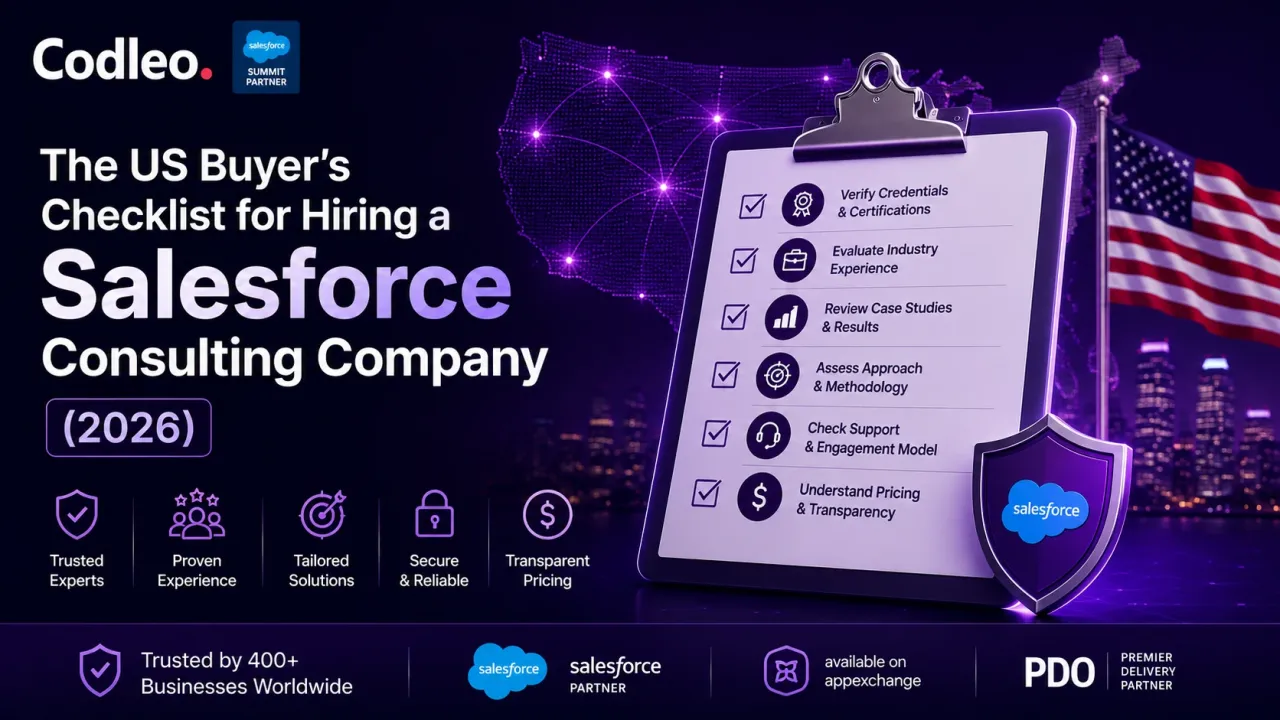
How to Evaluate a Salesforce Consulting Company: 7 Criteria That Actually Predict Outcomes
Certifications and partner tier are a floor, not a differentiator — most serious firms clear that bar. What separates a good engagement from a bad one usually comes down to these:
- Industry-specific delivery history, not just Salesforce experience. A firm with 40 completed implementations for mid-market financial services companies will typically outperform a generalist Summit partner on a financial services project, tier notwithstanding. Ask for two to three reference clients in your industry and company size band — not just logos on a homepage.
- Who actually does the work. A common complaint about larger US consulting firms: the senior partner shows up for the sales pitch, then hands the project to junior resources you never met. Ask directly: will the consultant scoping this project be the one delivering it?
- Delivery track record, measured concretely. Instead of asking about certifications, ask: of your last ten projects similar to mine, what was the average time from signed contract to go-live, and how much did the final scope deviate from the original plan? That question reveals delivery discipline in a way "we're a Summit Partner" doesn't.
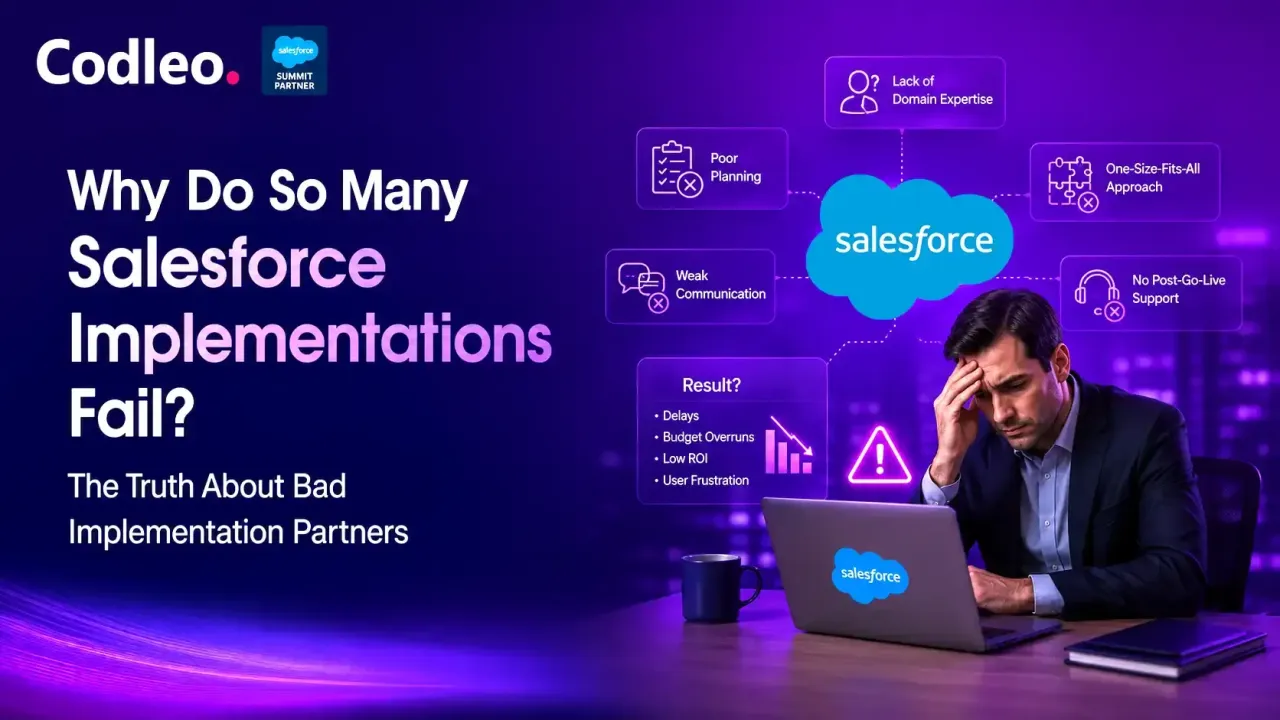
- Data migration and governance approach. Poor data quality from a rushed migration is one of the most common root causes of failed Salesforce implementations. Ask how the firm handles data cleansing, deduplication, and validation before go-live — not after.
- Change management and training plan. Technology fails without adoption. A partner who treats training as a line item at the end of the project, rather than a structured part of the rollout, is optimizing for go-live, not for whether your team actually uses the system six months later.
- AI and Agentforce readiness. Given the 2026 partner program's heavy tilt toward AI competencies, ask specifically about the firm's Agentforce and Data Cloud experience — not whether they've "heard of it," but how many live Agentforce deployments they've shipped.
- Pricing transparency. Get the fixed-scope proposal or a detailed hourly estimate in writing before you sign anything. Vague statements of work are where budget overruns start.
Red Flags to Watch For
- Partner tier claims that don't match the firm's AppExchange listing
- Reluctance to name reference clients in your industry
- No clear answer on who does discovery vs. who does delivery
- Pricing that's "we'll figure it out as we go"
- No mention of data migration or change management in the proposal
- A sales process that never involves the actual delivery team
Salesforce Consulting by Industry: Why Generic Implementations Fail
Salesforce configured the same way for every business is a common cause of low adoption. Industry context changes what "done well" looks like:
- Financial services & FinTech — needs compliance-ready workflows, KYC/AML integration, and advisor-specific productivity tools built around the regulatory environment.
- Healthcare & life sciences — requires HIPAA-aligned data models and provider-payer workflow automation, not a generic Service Cloud setup.
- Nonprofits — needs donor management, grant tracking, and recurring-gift automation through Nonprofit Cloud, with audit-ready dashboards.
- Manufacturing — depends on ERP integration and demand forecasting tied to real production capacity, not just a sales pipeline.
- Professional services — needs project pipeline, billable resource, and recurring engagement tracking that mirrors how services firms actually sell.
- Technology & SaaS — needs SDR-to-AE handoffs, product usage data integration, and renewal/expansion workflows built for recurring revenue.
If a prospective partner's pitch sounds identical regardless of your industry, that's worth noting.
Why US Businesses Work With Codleo
Codleo is a Salesforce Summit Partner — the highest tier under Salesforce's restructured 2026 program — with US offices in Dallas, TX and Lewes, DE, plus a delivery team that has completed 200+ engagements globally. A few things specific to how Codleo runs US engagements:
- The consultants who scope the project deliver it. No handoff to a junior team after the sales call.
- Fixed-scope pricing, agreed before work starts, with any changes discussed openly before costs shift.
- Rescue and re-implementation work is a core specialty, not an afterthought — a large share of US clients come to Codleo after a prior implementation underdelivered, and typically have a Salesforce org their team actually uses within 8–12 weeks.
- Dedicated Agentforce consulting, covering AI readiness assessment, agent workflow design, and data governance — directly aligned with where Salesforce's 2026 partner competencies are weighted.
- Industry depth across financial services, healthcare, nonprofits, manufacturing, real estate, education, and professional services.
See the full breakdown of services on the Salesforce Consulting Services USA page, or read more on how the 2026 partner tier changes affect your evaluation in Codleo's Salesforce Partnership Levels Comparison.
Frequently Asked Questions
What does a Salesforce consulting company do?
A Salesforce consulting company helps businesses plan, implement, customize, integrate, and maintain their Salesforce CRM — covering everything from initial strategy and data migration to user training and post-launch support.
How much does a Salesforce consulting company cost in the USA?
Most mid-market Sales Cloud or Service Cloud implementations run $15,000–$60,000. Health checks start around $2,000–$8,000. Multi-cloud enterprise programs commonly exceed $100,000. Certified US consultants typically bill $150–$300/hour, with fixed-scope pricing available from many firms.
What's the difference between a Select Partner and a Summit Partner?
Since Salesforce's March 2026 program overhaul, Select is the entry-to-mid tier (replacing the old Base and Ridge levels), suited to well-scoped, single-cloud projects. Summit is the highest tier (replacing the old Crest and Summit levels), reflecting deeper multi-cloud expertise and proven AI/Agentforce delivery capability — best suited to complex, regulated, or multi-cloud programs.
How do I verify a Salesforce partner's credentials?
Search the firm's name directly on the Salesforce AppExchange partner directory. Tier, CSAT score, verified review count, and completed project history are maintained by Salesforce itself, not self-reported by the partner.
Is it better to hire a large global firm or a boutique Salesforce consultancy?
It depends on project complexity and how much direct access to senior expertise you need. Large firms suit multi-country, multi-cloud programs with heavy integration requirements. Boutique and mid-sized firms often provide more direct senior access and can be a stronger fit for mid-market companies that don't need — or want to pay for — enterprise-scale overhead.
Can a US company work with a Salesforce partner that has offshore delivery teams?
Yes, and it's increasingly common. Many US businesses combine onshore strategy and account management with offshore or hybrid delivery to reduce cost while maintaining US time-zone coverage and governance. The key evaluation point isn't where the team sits, but whether communication, delivery discipline, and reference outcomes hold up.
What questions should I ask before signing with a Salesforce consulting company?
Ask for two to three reference clients in your industry and size range, confirm whether the scoping consultant will also deliver the project, request their average time-to-go-live and scope deviation on comparable past projects, and get pricing in writing — fixed-scope where possible.
Ready to talk through your Salesforce challenges? Book a free 30-minute strategy call with Codleo's Salesforce Summit Partner team.
 0
0
About the Author


 603 D-Mall Netaji Subhash Place, Delhi 110034 IND


