


Publish date:
Salesforce is changing how people interact with CRM.
Instead of requiring employees to open Salesforce, navigate dashboards, search records, and move between different applications, Salesforce AIforce brings CRM data, workflows, business logic, and actions directly into the AI tools where people already work.
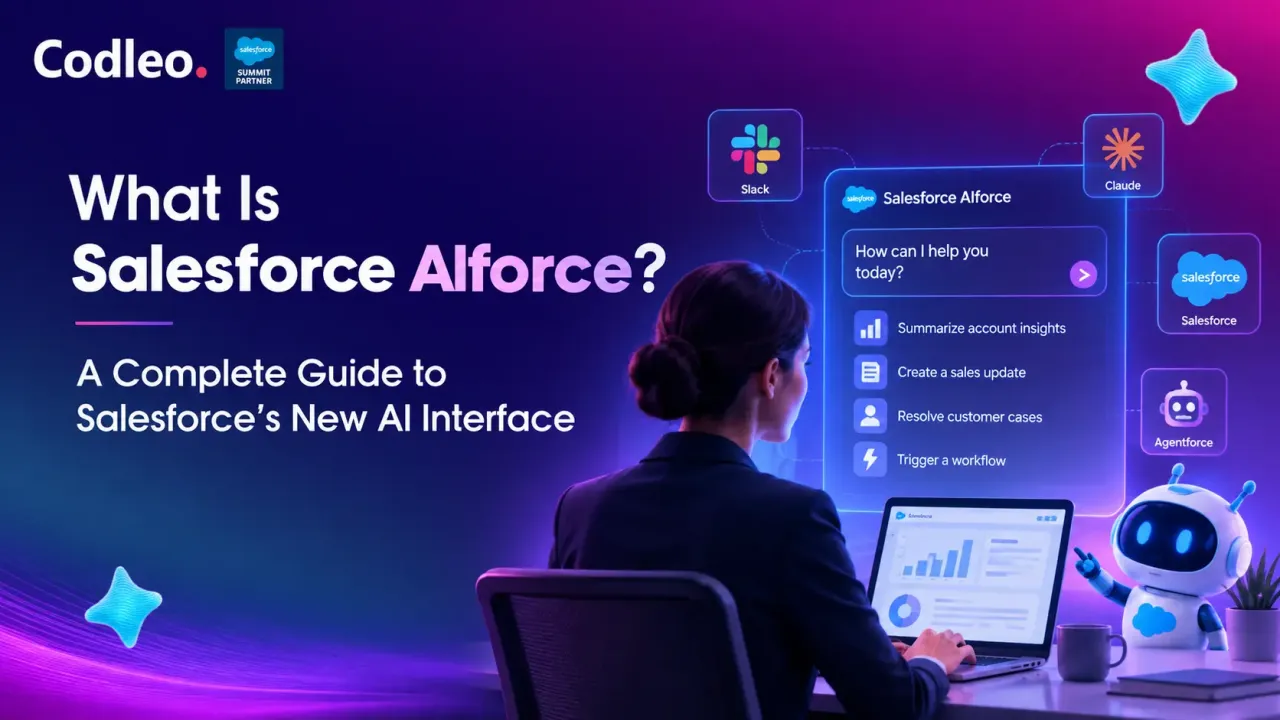
Introduced at Dreamforce 2026, Salesforce AIforce is a live interface layer that connects Salesforce with AI-powered work environments such as Claude, Slack, and Salesforce Lightning.
The idea is simple: users should not always have to go to Salesforce to get work done. AIforce allows Salesforce to come to them.
For example, a sales representative could ask an AI assistant which opportunities are at risk, review relevant account activity, update a record, or trigger a workflow without manually navigating multiple CRM screens.
But AIforce is more than another Salesforce AI assistant.
It sits across Salesforce's broader AI ecosystem—including Data 360, Customer 360, Agentforce, workflows, permissions, and enterprise data—and makes these capabilities accessible through different AI interfaces.
This guide explains how Salesforce AIforce works, its architecture, Claudeforce, Slackforce, Agentforce Coworker, the Headless Toolkit, practical business use cases, security considerations, and how AIforce differs from Agentforce.
Quick Answer: What Is Salesforce AIforce?
Salesforce AIforce is a live interface layer that makes Salesforce data, workflows, business logic, permissions, and AI agents accessible through external and native AI interfaces such as Claude, Slack, and Lightning.
Instead of forcing users to work through traditional CRM screens, AIforce lets employees and AI agents interact with Salesforce through natural-language conversations and dynamically generated interfaces.
AIforce currently brings this approach to three major experiences:
-
Claudeforce – brings Salesforce capabilities into Claude.
-
Slackforce – brings Salesforce context and actions directly into Slack.
-
Agentforce Coworker – provides an AI teammate inside Salesforce Lightning.
Salesforce's Headless Toolkit supports these experiences by giving developers access to MCP, APIs, skills, plugins, and development tools to build AI experiences on top of Salesforce.
AIforce at a Glance
| Area | Salesforce AIforce |
|---|---|
| What is it? | A live interface layer for Salesforce |
| Announced | Dreamforce 2026 |
| Primary purpose | Bring Salesforce capabilities to AI interfaces |
| Initial experiences | Claudeforce, Slackforce, Agentforce Coworker |
| Foundation | Salesforce Headless Toolkit |
| Data | Salesforce and connected enterprise data |
| Interaction | Natural-language and dynamic AI interfaces |
| Security | Existing Salesforce permissions and governance |
| Relationship with Agentforce | Makes Salesforce agents and capabilities accessible across different interfaces |
Why Did Salesforce Introduce AIforce?
For years, CRM software has required people to adapt to the software. Users open applications, move between records, search dashboards, fill out forms, and switch between multiple tools to complete everyday tasks.
Generative AI is beginning to reverse that model.
Instead of asking employees to find the right screen or report, businesses can increasingly allow them to describe what they need in natural language and let AI bring together the relevant data, context, and actions.
Salesforce introduced AIforce to make Salesforce available wherever AI-powered work happens—not only inside the traditional CRM interface.
This shift addresses three important challenges.
1. Business Data Is Often Separated From AI Conversations
Employees may use AI tools to research, summarize, plan, or make decisions, but those tools become far more useful when they can securely work with trusted business context.
AIforce creates a connection between AI interfaces and Salesforce's underlying customer data, workflows, business logic, and permissions.
For example, instead of copying opportunity information from Salesforce into an AI assistant, a sales user could ask for an account summary or next-step recommendation while the AI works with the relevant Salesforce context.
2. CRM Work Still Involves Too Much Application Switching
A typical workflow can involve Salesforce, Slack, email, documents, dashboards, and other business applications.
AIforce reduces that friction by bringing Salesforce capabilities into the environments employees already use.
With experiences such as Slackforce and Claudeforce, Salesforce interactions can become part of the user's existing workflow rather than another destination they need to visit.
3. Enterprise AI Needs Context, Actions, and Governance
A useful enterprise AI system needs more than the ability to generate an answer.
It needs to understand business context, respect user permissions, access appropriate enterprise data, and—when authorized—take actions through existing business processes.
This is where AIforce differs from a standalone AI chatbot.
AIforce connects the conversational layer with Salesforce's existing data, workflows, agents, permissions, and governance model. This means an AI experience can potentially move from answering “What happened?” to helping users determine “What should happen next?” and then supporting an authorized action.
From CRM as a Destination to Salesforce as a Live Interface
The bigger change behind AIforce is therefore not simply a new AI feature.
It represents a shift in how users consume Salesforce.
Traditional model:
User → Opens Salesforce → Finds Data → Interprets Information → Takes Action
AIforce model:
User → Expresses Intent → AIforce accesses permitted Salesforce context → Presents relevant information or interface → User or authorized agent takes action
This does not mean traditional Salesforce applications disappear. Instead, AIforce adds another way for employees, developers, and AI agents to interact with Salesforce—one built around intent, context, and natural-language interaction.
For businesses, the potential value is straightforward: less time navigating software and more time using Salesforce data to complete work.
How Does Salesforce AIforce Work?
Salesforce AIforce separates the power of the Salesforce platform from a fixed user interface.
Traditionally, users access Salesforce through predefined screens, dashboards, objects, and applications. AIforce takes a different approach: Salesforce data, business logic, workflows, permissions, and actions can be securely accessed through AI-powered interfaces where employees and agents already work.
In simple terms:
AI Interface → AIforce → Salesforce Context, Agents & Business Logic → Governed Action
This architecture lets a user express intent in natural language, while Salesforce provides the trusted business context and capabilities needed to respond or take an authorized action.
The Four Layers Behind Salesforce AIforce
Understanding AIforce is easier when you look at the Salesforce architecture that supports it.
| Layer | Role in AIforce |
|---|---|
| AIforce | Provides the live interface layer connecting Salesforce capabilities with AI experiences |
| Agentforce | Provides specialized AI agents that can reason and perform business tasks |
| Customer 360 | Provides business applications, processes, semantics, permissions, and actions across Salesforce |
| Data 360 | Provides unified customer and enterprise context that helps ground AI interactions |
Together, these layers allow AI interfaces to move beyond simply generating responses and interact with trusted business systems.
What Happens When Someone Uses AIforce?
Consider a sales manager asking an AI assistant:
“Which opportunities need my attention this week?”
Instead of requiring the manager to manually open Salesforce and review multiple reports, an AIforce-powered experience can follow a more contextual workflow:
1. The user expresses an intent
The request starts inside an AI-enabled interface such as Claude, Slack, or a Salesforce experience.
2. Salesforce identity and permissions are applied
AIforce carries Salesforce identity and access controls into the experience, helping ensure the user or agent can only access capabilities they are authorized to use.
3. Relevant business context is retrieved
Salesforce can provide the appropriate account, opportunity, activity, customer, or other enterprise context required for the request.
4. AI reasons over the available context
The AI experience can use that trusted context to identify relevant information and decide what to present to the user.
5. Salesforce workflows and actions can be invoked
When appropriate and authorized, the experience can go beyond answering a question and interact with Salesforce workflows or actions.
For example, the manager might review the opportunities, ask for additional context, and then initiate an appropriate follow-up workflow.
The result is a more dynamic way of interacting with CRM: users start with what they want to accomplish rather than where they need to click.
What Powers AIforce Under the Hood?
The Salesforce Headless Toolkit enables this approach.
The Headless Toolkit makes Salesforce capabilities accessible beyond a fixed browser-based interface through technologies and development resources such as:
-
Model Context Protocol (MCP)
-
Salesforce APIs
-
Skills
-
Plug-ins
-
Developer tools and CLIs
This gives developers a common foundation for bringing Salesforce into AI assistants, applications, custom interfaces, and agentic workflows.
Why MCP Matters for AIforce
Model Context Protocol, or MCP, provides a standardized way for compatible AI applications and agents to connect with external systems.
Within Salesforce's headless architecture, MCP lets authorized AI systems discover and use Salesforce capabilities without requiring businesses to build a completely different custom integration for every AI interface.
That makes AIforce more than a single product interface.
It provides an architectural approach for making Salesforce capabilities available across an expanding ecosystem of AI tools while continuing to use the organization's established Salesforce foundation.
AIforce Architecture at a Glance
User or AI Agent
↓
Claude / Slack / Salesforce / Custom AI Interface
↓
AIforce Live Interface Layer
↓
Headless Toolkit — MCPs, APIs, Skills & Developer Tools
↓
Agentforce + Customer 360 + Data 360
↓
Data, Business Logic, Workflows, Permissions & Actions
The key point is that AIforce does not replace the Salesforce platform underneath it. It changes how people and AI systems can securely reach and use the capabilities already built into Salesforce.
Key Components of Salesforce AIforce
Salesforce AIforce is not limited to a single chatbot or application. It brings Salesforce into different AI-powered work environments through ready-to-use experiences and developer capabilities.
The four areas businesses should understand are Claudeforce, Slackforce, Agentforce Coworker, and the Headless Toolkit.
1. Claudeforce: Salesforce Meets Claude
Claudeforce brings Salesforce data, context, workflows, and actions directly into Claude.
Its initial experience, Salesforce in Claude, uses a prebuilt Salesforce MCP server and includes 37 ready-to-use sales skills covering activities such as prospecting and pipeline management.
This means sales teams can use Claude's reasoning capabilities while working with authorized Salesforce context rather than manually moving information between the two systems.
For example, a sales representative could use Claude to:
-
Analyze the current state of the pipeline
-
Research an account before a meeting
-
Identify opportunities requiring attention
-
Review deal context
-
Update pipeline information
-
Initiate appropriate Salesforce actions
The important difference is context.
Claude is not simply generating an answer from a manually pasted CRM report. Claudeforce connects the AI experience with the organization's Salesforce environment while maintaining the relevant business rules and permissions.
Example: A sales manager could ask, “Which enterprise opportunities are showing signs of risk?” Claude could use permitted Salesforce context to surface relevant deals and help the manager investigate why they may need attention.
2. Slackforce: Turn Conversations Into Salesforce Actions
Slackforce brings Salesforce context and intelligence directly into Slack conversations and workflows.
Instead of constantly switching between Slack and CRM screens, teams can access Salesforce information and work with it where collaboration is already happening.
A major part of this experience is Slackforce Surfaces.
These interactive interfaces combine live context from Salesforce, Slack, and other connected tools, allowing teams to explore information and collaborate around it in real time.
For example, a team discussing an important customer could potentially:
Discuss the account → retrieve relevant CRM context → understand recent activity → decide on the next step → update Salesforce
without repeatedly moving between applications.
Slackforce also extends into experiences such as Slackbot and Slack CRM, making conversational CRM interactions possible directly from Slack.
For organizations where important customer decisions already happen in Slack, this can shorten the distance between conversation and action.
3. Agentforce Coworker: An AI Teammate Inside Salesforce
While Claudeforce brings Salesforce into Claude and Slackforce brings it into Slack, Agentforce Coworker brings the AIforce experience directly into Salesforce Lightning.
Agentforce Coworker can reason across Salesforce accounts, activities, history, and other available business context to help users discover information and take appropriate actions.
Because it operates within the Salesforce environment, it works with the organization's existing permissions and business rules.
A user could, for example, ask Coworker to:
-
Prepare an account briefing
-
Surface important customer developments
-
Find relevant CRM information
-
Analyze account or activity history
-
Trigger workflows
-
Coordinate with specialized Agentforce agents
This last capability is particularly important.
Agentforce Coworker can act as an entry point to an organization's broader agentic workforce, calling specialized Agentforce agents when a task requires them.
Instead of employees figuring out which agent or application they need, Coworker can help connect the request with the appropriate Salesforce capability.
4. Headless Toolkit: Build Your Own AIforce Experiences
The first three experiences show how you can use AIforce today.
The Headless Toolkit provides the underlying architecture developers can use to take the concept further.
It exposes Salesforce capabilities through technologies including:
-
Salesforce MCP
-
APIs
-
Skills
-
Plug-ins
-
CLIs
-
Developer tools
This allows organizations to bring Salesforce data, context, workflows, identity, permissions, and business logic into their own AI applications and interfaces.
For example, a company could use the Headless Toolkit to create:
A custom AI workspace
Employee → asks a business question → AI accesses authorized Salesforce capabilities → relevant context is returned → employee reviews the result → approved Salesforce action is executed.
The organization would not necessarily need to recreate its CRM logic in the new interface. The new experience can connect back to the Salesforce foundation already running the business.
This makes the Headless Toolkit particularly relevant for organizations building custom AI applications or integrating Salesforce with emerging agentic platforms.
Claudeforce vs Slackforce vs Agentforce Coworker vs Headless Toolkit
| AIforce Capability | Primary Environment | Best Suited For |
|---|---|---|
| Claudeforce | Claude | Working with Salesforce through conversational AI and advanced reasoning |
| Slackforce | Slack | Collaborative CRM work, conversations, workflows, and team actions |
| Agentforce Coworker | Salesforce | AI-assisted work directly inside the Salesforce experience |
| Headless Toolkit | Custom AI/apps | Building custom Salesforce-powered AI and agentic experiences |
The Simple Way to Understand the Difference
Think about AIforce based on where the employee wants to work:
Working in Claude? → Claudeforce
Working in Slack? → Slackforce
Working inside Salesforce? → Agentforce Coworker
Building your own AI experience? → Headless Toolkit
Different interfaces, but the underlying idea remains the same: make trusted Salesforce capabilities available wherever people and AI agents get work done.
Salesforce AIforce vs Agentforce: What’s the Difference?
The simplest difference is this: Agentforce provides AI agents that perform work, while AIforce provides the interface layer through which people and AI systems can access Salesforce capabilities.
The two technologies are therefore complementary rather than alternatives.
Agentforce focuses on building and deploying AI agents for specific business tasks. AIforce expands where users can interact with Salesforce data, workflows, business logic, and those agents—including environments such as Claude, Slack, Salesforce, and custom AI applications.
AIforce vs Agentforce at a Glance
| Area | Salesforce AIforce | Salesforce Agentforce |
|---|---|---|
| What it is | Live interface layer | Platform and ecosystem for AI agents |
| Primary role | Makes Salesforce capabilities accessible through AI interfaces | Enables AI agents to reason and perform business tasks |
| Focus | How and where users interact with Salesforce | What specialized AI agents can accomplish |
| Interaction | Natural-language and dynamic AI experiences | Task-oriented agent execution |
| Examples | Claudeforce, Slackforce, Agentforce Coworker | Sales, service, commerce, IT and other specialized agents |
| Business data | Brings permitted Salesforce context into the interface | Uses relevant business context to perform assigned work |
| Custom development | Headless Toolkit, MCP, APIs and skills | Agentforce tools for creating and managing agents |
| Relationship | Can provide access to Agentforce-powered capabilities | Can be invoked through AIforce experiences |
A Simple Example
Imagine a sales manager investigating an important opportunity.
They ask:
“Review the Acme opportunity, tell me what could delay the deal, and prepare the next steps.”
Here's how the technologies can work together.
AIforce provides the interaction layer.
The manager could make the request from an AI-enabled experience rather than manually navigating multiple Salesforce screens.
↓
Salesforce provides the business context.
The experience can access relevant opportunity data, account activity, permissions, workflows, and other authorized information.
↓
Agentforce provides specialized agents.
If the request requires work handled by an appropriate specialized agent, that agent can perform its configured role using Salesforce context and business rules.
↓
The result returns through the AI experience.
The manager can review the information and continue working without having to understand which underlying system or agent handled every part of the request.
Where Does Agentforce Coworker Fit?
Agentforce Coworker helps make the relationship between AIforce and Agentforce easier to understand.
Coworker gives employees a conversational AI teammate that understands business context and can activate specialized Agentforce agents when needed.
Instead of an employee thinking:
“Which Salesforce agent should I use for this task?”
the employee can start with:
“Here's what I need to accomplish.”
Coworker can then help connect that intent with the appropriate capabilities or specialized agents available to the organization.
As the organization adds more Agentforce agents, Coworker can become a unified entry point for interacting with that growing agentic workforce.
Does AIforce Replace Agentforce?
No. AIforce does not replace Agentforce.
They solve different parts of the enterprise AI experience.
A useful way to remember the relationship is:
Data 360 → provides trusted business context
Customer 360 → provides applications, processes, and business logic
Agentforce → provides specialized AI agents
AIforce → provides AI-powered interfaces for accessing Salesforce capabilities
Together, these technologies let employees move from asking a business question to understanding the context and initiating an appropriate action without relying entirely on traditional application navigation.
AIforce or Agentforce: Which One Does a Business Need?
For many organizations, this should not be viewed as an either/or decision.
A company may use Agentforce when it wants specialized AI agents to automate or assist with business processes.
It may use AIforce experiences when it wants employees or other AI systems to interact with Salesforce capabilities from the tools and interfaces where work already happens.
When combined, the model becomes:
Employee Intent → AIforce Experience → Salesforce Context → Agentforce or Salesforce Action → Business Outcome
In other words, Agentforce expands what AI can do across the business, while AIforce expands how and where people can interact with Salesforce-powered AI and business capabilities.
Salesforce AIforce Use Cases Across Business Teams
Salesforce AIforce becomes easier to understand when viewed through the work employees perform every day.
Instead of requiring users to move between CRM records, dashboards, collaboration tools, and AI assistants, AIforce can bring relevant Salesforce context and actions into the interface where the work is already happening.
Here are some practical ways businesses could use AIforce across different teams.
1. Sales: Turn CRM Data Into Actionable Deal Intelligence
Sales teams often have valuable information spread across opportunities, accounts, activities, emails, and internal conversations.
With AIforce, sellers can interact with this context using natural language.
For example, a sales representative could ask:
“Which opportunities in my pipeline are most likely to need attention this week?”
An AIforce-powered experience could help surface relevant opportunities, provide supporting account context, and help the seller determine the next action.
Potential sales use cases include:
-
Preparing account and opportunity briefings
-
Reviewing pipeline health
-
Identifying deals requiring attention
-
Researching prospects before meetings
-
Summarizing recent customer activity
-
Updating CRM information
-
Triggering approved sales workflows
Claudeforce is particularly relevant here because Salesforce in Claude includes prebuilt sales skills designed for activities ranging from prospecting to pipeline management.
2. Customer Service: Give Teams Faster Access to Customer Context
Service representatives frequently need to understand more than the case currently displayed on their screen.
They may need account history, previous interactions, related cases, internal discussions, and other customer information before deciding what to do next.
AIforce can help bring this context together through a conversational interface.
A service employee might ask:
“Summarize this customer's recent issues and show me anything that could affect the current case.”
Instead of manually searching several records, the employee could receive relevant context and continue with an appropriate Salesforce workflow.
Potential service use cases include:
-
Summarizing customer histories
-
Investigating active cases
-
Finding related support interactions
-
Identifying recurring issues
-
Preparing case handoffs
-
Triggering service workflows
-
Coordinating complex issues across teams
The objective isn't simply to generate faster responses. It is to help service teams make decisions using broader customer context.
3. Marketing: Explore Customer Context Without Starting With a Dashboard
Marketing teams depend on customer, campaign, engagement, and audience data, but extracting useful answers can require multiple reports or applications.
AIforce introduces a more conversational way to explore that information.
A marketer could ask:
“What do we know about engagement from this customer segment, and where should we investigate further?”
Depending on the organization's connected data and permissions, AIforce could help surface the appropriate context without requiring the marketer to know exactly which dashboard or record to open first.
Potential marketing scenarios include:
-
Exploring audience and customer context
-
Reviewing campaign information
-
Investigating engagement patterns
-
Preparing campaign briefs
-
Summarizing customer signals
-
Coordinating marketing insights with sales teams
AIforce does not replace the underlying marketing applications or analytics. It provides another way to reach and interact with the information they contain.
4. Commerce: Bring Customer and Order Context Into the Conversation
Commerce teams frequently work across customer profiles, orders, service interactions, product information, and operational systems.
AIforce can help users query this information through AI interfaces rather than navigating each system separately.
For example:
“Give me the context behind this customer's recent order issue before I respond.”
The AI experience could bring together permitted Salesforce and connected business context so employees have a clearer picture before taking action.
Potential commerce applications include:
-
Reviewing customer and order context
-
Investigating purchase histories
-
Understanding service issues related to orders
-
Supporting customer-facing teams
-
Coordinating commerce and service information
5. IT: Make Enterprise Knowledge and Workflows Easier to Access
AIforce can also be useful beyond customer-facing teams.
IT employees regularly work with support requests, internal documentation, workflows, applications, and enterprise data sources.
Agentforce Coworker, for example, can discover information across connected enterprise sources and trigger flows or specialized agents when appropriate.
Potential IT scenarios include:
-
Finding internal technical information
-
Investigating support requests
-
Summarizing incidents
-
Accessing relevant enterprise knowledge
-
Triggering approved workflows
-
Coordinating specialized AI agents
This could let employees start with the problem they need to solve rather than figuring out which system has the answer.
6. Executives and Managers: Ask Business Questions in Natural Language
Business leaders often rely on dashboards and reports prepared by different teams.
AIforce enables a more interactive experience.
A sales leader might ask:
“Which large opportunities changed significantly this week, and what happened?”
A service leader might ask:
“Which customer issues are escalating and need management attention?”
Instead of receiving another static dashboard, leaders can potentially explore the underlying context through follow-up questions.
This creates an important shift:
Traditional BI: Dashboard → Interpret → Investigate
AIforce: Ask → Understand → Explore → Act
Dashboards remain valuable, but conversational interfaces can provide another way to investigate business information.
AIforce Use Cases at a Glance
| Team | Example AIforce Use Case | Potential Outcome |
|---|---|---|
| Sales | Review pipeline and opportunity context | Faster deal preparation |
| Service | Summarize customer and case history | More contextual service |
| Marketing | Explore audience and campaign information | Faster insight discovery |
| Commerce | Review customer and order context | Better-informed interactions |
| IT | Find enterprise knowledge and activate workflows | Reduced application switching |
| Leadership | Explore business questions conversationally | Faster investigation and decision support |
From Searching for Information to Expressing Intent
The bigger opportunity behind these examples isn't simply faster CRM search.
It is a change in how employees communicate with enterprise software.
Instead of thinking:
“Where is the report or record that contains this information?”
employees can increasingly start with:
“Here is what I need to know or accomplish.”
AIforce can then connect that intent with Salesforce data, business logic, workflows, permissions, and appropriate AI agents.
That is where AIforce could have its biggest impact: reducing the distance between business intent and business action.
Key Benefits of Salesforce AIforce for Businesses
Salesforce AIforce is not valuable simply because it adds another AI interface. Its bigger potential lies in reducing the gap between enterprise data, employee intent, and business action.
Here are the key benefits organizations should consider.
1. Less App Switching, More Work in Context
Employees often move between Salesforce, Slack, AI assistants, dashboards, and other business applications just to complete a single task.
AIforce brings Salesforce capabilities closer to the environments where employees already work.
A seller working in Claude, for example, can interact with relevant Salesforce capabilities through Claudeforce, while a team collaborating in Slack can use Slackforce to bring CRM context into the conversation.
The potential result is less time navigating software and more time acting on business information.
2. Natural-Language Access to Salesforce
Traditional CRM usage depends heavily on knowing where information lives.
Users need to understand objects, records, reports, dashboards, and how to navigate the application.
AIforce introduces a more intent-driven model.
Instead of finding the correct report first, a user can start with a business question such as:
“Which strategic accounts have had no meaningful activity recently?”
The system can then use authorized Salesforce context to help the user investigate.
This can make sophisticated CRM capabilities easier to access for employees who may not be Salesforce power users.
3. AI Grounded in Business Context
Generic AI tools can generate useful responses, but enterprise decisions often require trusted company context.
AIforce connects AI experiences with Salesforce data, business logic, workflows, and other authorized enterprise information.
That grounding can make an AI interaction more relevant to the actual customer, account, opportunity, case, or process being discussed.
In other words:
Generic AI = intelligence without full business context
AIforce = AI interaction connected to governed enterprise context
4. Move From Answers to Actions
Many AI assistants stop after providing information.
Enterprise work usually does not.
After understanding a problem, employees may need to update Salesforce, start a workflow, involve another team, or activate a specialized agent.
AIforce is designed to connect conversational interactions with Salesforce actions and workflows when appropriate and authorized.
That creates a progression from:
Ask → Understand → Decide → Act
rather than:
Ask → Receive an answer → Manually switch systems → Find the record → Take action
5. Extend Existing Salesforce Investments Into New AI Experiences
Organizations may already have significant investments in Salesforce data models, automation, flows, permissions, business processes, and Agentforce agents.
AIforce can provide additional ways to access those existing capabilities rather than requiring every AI experience to rebuild them from scratch.
The Headless Toolkit is particularly important here because developers can use MCP, APIs, skills, plug-ins, and developer tools to bring Salesforce capabilities into custom AI experiences.
For organizations experimenting with multiple AI platforms, this could become an important architectural advantage.
6. Maintain Enterprise Security and Governance
Bringing CRM information into AI interfaces creates an obvious question:
How do you prevent AI from exposing information a user should not see?
Salesforce positions AIforce around carrying existing Salesforce identity, permissions, and governance into these experiences.
This means AIforce is designed to respect the access controls already governing the Salesforce environment rather than treating the AI interface as an unrestricted layer over company data.
Security therefore remains part of the architecture, not an afterthought added to the conversation layer.
7. Give Employees One Entry Point to a Growing Agentic Workforce
As organizations deploy more AI agents, another problem can emerge: employees need to know which agent handles which task.
Agentforce Coworker can help reduce that complexity.
A user can start by describing what they want to accomplish, and Coworker can coordinate with relevant specialized Agentforce agents when needed.
This creates the possibility of a simpler employee experience:
One request → appropriate context → appropriate agent or workflow → action
rather than requiring employees to manually select from a growing catalog of agents.
8. Create More Flexible User Experiences
AIforce also challenges the assumption that every business process needs a fixed application screen.
With AI-powered interfaces, the experience can become more responsive to the user's current intent and context.
A salesperson investigating a deal may need opportunity history.
A service representative investigating a case may need customer interactions.
An executive investigating pipeline movement may need summarized trends.
The interface can focus on what is relevant to the task instead of presenting every available field and navigation option at once.
AIforce Business Benefits at a Glance
| Benefit | What It Means for Businesses |
|---|---|
| Reduced app switching | Employees can access Salesforce capabilities closer to where they work |
| Natural-language interaction | Users can begin with business intent instead of application navigation |
| Trusted context | AI experiences can work with authorized enterprise information |
| Action-oriented AI | Conversations can connect to Salesforce workflows and actions |
| Existing Salesforce reuse | Current data, automation and agents can support new AI experiences |
| Governed access | Existing permissions and controls remain important to AI interactions |
| Agent orchestration | Employees can access specialized agents through simpler experiences |
| Flexible interfaces | Information can be presented according to the user's current task |
The Bigger Business Value of AIforce
The most important benefit of AIforce may ultimately be simplicity.
Enterprise software has traditionally required employees to understand how the system works before they can get value from it.
AIforce moves toward a different model:
Employees describe the outcome they need, while Salesforce helps connect that intent to the right data, logic, workflow, or agent.
If implemented effectively, that shift can make Salesforce less about navigating CRM software and more about getting work done with the customer and business context already stored inside it.
Is Salesforce AIforce Secure? Security, Privacy, and Governance Explained
Salesforce AIforce is designed to extend existing Salesforce identity, permissions, security controls, and governance into AI-powered interfaces.
This is important because bringing CRM data into Claude, Slack, custom AI applications, or other agentic environments introduces a critical enterprise question:
Who can access what—and what should an AI agent be allowed to do with that information?
AIforce addresses this by keeping Salesforce's existing security and business rules connected to the interaction rather than creating an unrestricted path to enterprise data.
1. Existing Salesforce Permissions Still Apply
Using an AI interface does not mean users automatically gain broader access to Salesforce.
Salesforce states that AIforce requests operate using existing permissions and business rules. In practical terms, the AI experience should only expose Salesforce information the requesting user is authorized to access.
For example, if a salesperson does not have permission to access a particular record or field in Salesforce, using an AIforce-powered interface should not become a shortcut around that restriction.
This principle can be summarized as:
User Identity → Salesforce Permissions → Authorized Context → AI Interaction
The interface changes, but the underlying access controls remain important.
2. Zero Data Retention Protects Business Data
One of the most important privacy features highlighted for AIforce is Zero Data Retention (ZDR).
Salesforce states that business data used to answer an AIforce request is not retained by the model provider.
This matters when organizations connect sensitive CRM and enterprise information with external AI models.
Instead of treating business data as information the underlying model provider can retain for future use, AIforce is designed to use the data to process the request at hand without retaining it.
3. AI Agents Should Follow the Principle of Least Privilege
AI security is not only about controlling what an employee can see.
Organizations also need to control what an AI agent is allowed to access and do.
Salesforce recommends a least-privilege approach for headless AI experiences: users, applications, and agents should receive only the minimum access required to complete their tasks.
For example:
-
Low-risk action: Read permitted account information.
-
Moderate-risk action: Propose a CRM update and ask the user for confirmation.
-
High-risk action: Route a consequential change through an established approval process.
This becomes increasingly important as organizations move from AI systems that simply answer questions to agents that can modify records and trigger workflows.
4. Actions Continue Through Salesforce Business Rules
AIforce is designed to do more than retrieve information. AI experiences can also connect to Salesforce actions and workflows.
But an AI interface should not bypass the business logic already controlling those processes.
Salesforce says actions route back through Salesforce, allowing organizations to keep applying their existing rules and controls.
That means governance can extend beyond:
“Can this user see the information?”
to:
“Is this user or agent authorized to perform this action?”
5. Governance Becomes More Important as AI Gains Autonomy
Traditional application security largely focuses on users and access.
Agentic systems introduce additional questions:
-
Which tools can an agent use?
-
Which records can it access?
-
Which actions can it execute?
-
Does an action require confirmation?
-
Should a human approve sensitive changes?
-
How will actions be monitored?
-
Can an action be reversed if something goes wrong?
Organizations should address these questions before giving AI agents broader authority.
A sensible approach is to increase oversight as an action's potential impact increases.
Read-only request → Lower friction
Reversible update → Confirmation may be appropriate
Sensitive or consequential action → Strong authorization and human approval
This helps organizations balance AI automation with responsible control.
AIforce Security at a Glance
| Security Area | How AIforce Approaches It |
|---|---|
| Identity | Uses Salesforce identity in connected experiences |
| Permissions | Existing access controls continue to govern available information |
| Business Rules | Requests and actions remain connected to Salesforce rules |
| Data Privacy | AIforce is designed with Zero Data Retention |
| Agent Access | Least-privilege access should limit unnecessary capabilities |
| Sensitive Actions | Higher-impact actions can require additional oversight or approval |
| Governance | Salesforce trust and governance extend into headless AI experiences |
Does AIforce Make Enterprise AI Risk-Free?
No enterprise AI architecture should be treated as automatically risk-free.
AIforce provides important security and governance foundations, but organizations still need to configure access correctly, review data sensitivity, control agent permissions, test workflows, and determine where human approval should remain mandatory.
The more authority an AI agent receives, the more important these controls become.
For businesses evaluating AIforce, security therefore should not be considered only after implementation.
Identity, data access, agent permissions, workflow authority, monitoring, and human oversight should be part of the AIforce design from the beginning.
How to Prepare Your Business for Salesforce AIforce
Adopting Salesforce AIforce should not begin with choosing an AI interface.
It should begin with a simpler question:
Which business processes would become more effective if employees or AI agents could securely access Salesforce context and take actions through conversational interfaces?
Organizations with clean data, well-designed permissions, reliable automation, and clearly defined use cases will generally be better positioned to explore AIforce than those trying to add AI on top of fragmented CRM processes.
Here is a practical readiness framework.
1. Start With High-Value Use Cases
Avoid trying to make every Salesforce process AI-powered at once.
Identify repetitive or high-friction workflows where easier access to Salesforce context could create meaningful value.
Examples might include:
-
Sales account preparation
-
Pipeline investigation
-
Customer case summaries
-
Internal knowledge discovery
-
CRM record updates
-
Cross-team customer handoffs
-
Workflow initiation
For each use case, define the user, required data, expected action, and measurable business outcome.
2. Review Your Salesforce Data Foundation
AI is only as useful as the business context it has access to.
Before introducing new AI experiences, review:
-
Duplicate or incomplete records
-
Inconsistent fields
-
Outdated customer information
-
Disconnected data sources
-
Data ownership
-
Access to relevant enterprise knowledge
If an AI system receives incomplete or unreliable context, a better conversational interface will not solve the underlying data problem.
3. Audit Permissions Before Expanding AI Access
AIforce can make Salesforce capabilities easier to reach, which makes permission design even more important.
Review profiles, permission sets, record access, connected applications, sensitive fields, and agent permissions before exposing important workflows through AI interfaces.
The objective should be straightforward:
Give each user or agent enough access to perform the intended task—without unnecessary privileges.
4. Review Existing Salesforce Automation
Organizations may already have valuable Salesforce Flows, APIs, business rules, and Agentforce agents.
Rather than rebuilding these capabilities for AIforce, determine which existing assets can safely support new conversational experiences.
This can include reviewing:
-
Salesforce Flow
-
Existing APIs
-
Approval processes
-
Business rules
-
Agentforce agents
-
Custom actions
-
External integrations
AIforce can become significantly more useful when the Salesforce foundation underneath it is already reliable.
5. Decide Where AIforce Should Be Available
Not every team needs the same interface.
The right experience depends on where employees already work.
Claude-heavy workflows → evaluate Claudeforce
Slack-centric collaboration → evaluate Slackforce
Salesforce-focused work → evaluate Agentforce Coworker
Custom AI application → evaluate the Headless Toolkit
This prevents organizations from implementing AI simply because a capability exists and instead connects the technology to real employee workflows.
6. Define Human Oversight Before Automation
Organizations should decide which AI actions can happen automatically and which require human confirmation.
A useful model is:
Read information → AI can assist
Recommend an action → User reviews
Update important data → Confirmation may be required
High-impact action → Human approval and governance
Design these controls before agents receive broader operational authority.
7. Start Small, Measure, and Expand
A focused pilot is often more useful than an enterprise-wide rollout.
Choose one clearly defined workflow and measure whether AIforce improves it.
Useful metrics could include:
-
Time required to complete a task
-
Number of application switches
-
CRM adoption
-
Data-update completion
-
Employee usage
-
Workflow completion time
-
Human intervention rate
The results can then guide whether to expand, redesign, or stop the use case.
When Should You Work With a Salesforce AIforce Partner?
AIforce can involve CRM architecture, enterprise data, permissions, Agentforce, integrations, APIs, MCP, workflows, and AI governance.
Organizations with complex Salesforce environments may therefore benefit from working with an experienced Salesforce consulting partner that can evaluate both the AI experience and the platform architecture behind it.
The engagement should begin with readiness—not with deploying AI everywhere.
A structured assessment can determine:
Business Use Case → Data Readiness → Security → Salesforce Architecture → AIforce Experience → Pilot → Measurement → Scale
Codleo Consulting can help organizations assess where AIforce fits within their existing Salesforce environment and identify the data, integration, automation, security, and Agentforce requirements needed before implementation.
For organizations already planning broader CRM or AI transformation initiatives, Codleo's Salesforce consulting services can also help align AIforce with existing Salesforce processes rather than treating it as an isolated AI project.
AIforce Readiness Checklist
Before moving forward, ask:
-
Do we have a clearly defined business use case?
-
Is the required Salesforce data reliable?
-
Are permissions correctly configured?
-
Are existing workflows ready for AI-driven interactions?
-
Do we know which AIforce experience employees actually need?
-
Have we defined what AI agents can and cannot do?
-
Which actions require human approval?
-
How will success be measured?
-
Do we have a plan for monitoring and governance?
If several answers are “No,” the priority should be improving the Salesforce foundation before expanding AI autonomy.
The goal is not to deploy AIforce as quickly as possible.
The goal is to create an AIforce experience that is useful, governed, measurable, and connected to the way the business actually works.
Salesforce AIforce Implementation Challenges and Considerations
Salesforce AIforce can simplify how employees interact with CRM data and workflows, but a conversational interface does not automatically simplify the architecture behind it.
Before adopting AIforce, businesses should consider data quality, access controls, existing automation, integration architecture, governance requirements, and employee readiness.
Here are the major challenges to plan for.
1. Poor Data Quality Can Limit AIforce Results
AIforce depends on the Salesforce and enterprise context available to it.
Duplicate accounts, incomplete opportunities, inconsistent fields, outdated customer information, or disconnected systems can reduce the usefulness of AI-generated responses.
Before implementation, businesses should identify which data sources each AIforce use case depends on and determine whether that information is reliable enough to support AI-assisted decisions.
AIforce cannot compensate for an unreliable CRM foundation.
2. Permissions Become More Important, Not Less
Natural-language interfaces make enterprise information easier to access.
That convenience also increases the importance of properly configured permissions.
Organizations should review:
-
User access
-
Permission sets
-
Record-level access
-
Sensitive fields
-
Connected applications
-
Agent permissions
-
Available actions
An AI agent should not receive broad access simply because doing so makes implementation easier.
Access should follow the principle of least privilege.
3. Moving From AI Answers to AI Actions Increases Risk
There is an important difference between an AI system that summarizes an opportunity and one that can modify it.
As AIforce experiences become connected to workflows and business actions, organizations need to decide which activities can happen automatically.
For example:
Read customer information → Lower operational risk
Recommend a next step → Human reviews recommendation
Modify an important record → Confirmation may be required
Execute a consequential business process → Strong authorization or approval
The more consequential the action, the stronger the governance should be.
4. Integration Architecture Can Become Complex
Businesses rarely operate Salesforce in isolation.
Their environment may include ERP systems, data warehouses, collaboration platforms, custom applications, marketing platforms, and other enterprise tools.
AIforce and the Headless Toolkit can help connect Salesforce capabilities with AI interfaces, but organizations still need to design how these systems interact.
This can involve:
-
APIs
-
Salesforce MCP
-
Authentication
-
Data mapping
-
Existing integrations
-
Custom applications
-
Agent skills and actions
The objective should not be to connect every system immediately. Start with the minimum architecture required for the selected business use case.
5. AI Outputs Still Need Appropriate Oversight
Connecting an AI experience to trusted enterprise data does not mean every generated interpretation will always be correct.
Organizations should determine where employees need to validate AI-generated summaries, recommendations, or proposed actions before relying on them.
This is particularly important when AI outputs could influence:
-
Customer communications
-
Financial decisions
-
Contractual processes
-
Sensitive record updates
-
Compliance-related workflows
AIforce should therefore be treated as part of a governed business process, not an unquestioned source of truth.
6. Employee Adoption May Be Harder Than the Technology
A technically successful AIforce deployment can still fail if employees do not trust or understand it.
Users need clarity about:
-
What AIforce can do
-
What data it can access
-
Which actions it can perform
-
When human approval is required
-
How to validate important outputs
-
Where to report incorrect results
Organizations should introduce AIforce around specific workflows rather than simply announcing another AI tool.
7. ROI Needs to Be Measured Against a Business Process
AI adoption should not be measured only by the number of prompts submitted or employees who log in.
Instead, businesses should measure whether AIforce improves the process it was introduced to support.
For example:
| Use Case | Possible Success Metric |
|---|---|
| Account research | Time required to prepare for meetings |
| Pipeline review | Time spent identifying deals requiring attention |
| Service investigation | Time required to understand customer context |
| CRM updates | Completion rate and time per update |
| Internal knowledge search | Time required to find relevant information |
| Workflow automation | Completion time and human intervention rate |
A successful pilot should demonstrate measurable improvement before the organization expands AIforce into additional workflows.
The Key Principle: Fix the Foundation Before Scaling AI
AIforce can change the way employees interact with Salesforce, but it does not eliminate the need for good CRM architecture.
Before scaling, organizations should have:
Reliable Data + Appropriate Permissions + Stable Workflows + Secure Integrations + Clear Governance + Measurable Use Cases
When these foundations are weak, adding a conversational AI layer can expose existing problems instead of solving them.
When they are strong, AIforce has a much better foundation for becoming part of everyday business operations.
Salesforce AIforce Pricing, Availability, and Licensing
One of the first questions businesses evaluating AIforce are likely to ask is: How much does Salesforce AIforce cost?
At the time of writing, Salesforce has not published a single standalone public price for the complete AIforce offering.
AIforce is an interface layer spanning multiple Salesforce and partner experiences, so the commercial model may depend on the specific products, capabilities, usage, and AIforce experience an organization plans to use.
How Much Does Salesforce AIforce Cost?
There is currently no universal public AIforce price for every organization.
Businesses should avoid treating AIforce as a conventional Salesforce add-on with one fixed per-user price.
The eventual cost of an AIforce deployment may depend on factors such as:
-
Existing Salesforce products and editions
-
Agentforce requirements
-
Data and AI usage
-
Slack requirements
-
Claude or other third-party AI services
-
Number and type of users
-
Custom Headless Toolkit development
-
APIs and integrations
-
Implementation requirements
-
Consumption-based services
Salesforce has also stated that AIforce pricing and packaging are subject to change.
Organizations planning an implementation should therefore confirm current commercial terms directly with Salesforce before making purchasing decisions.
Is Salesforce AIforce Available Now?
AIforce was introduced at Dreamforce 2026 and launched with three primary experiences:
Claudeforce, Slackforce, and Agentforce Coworker.
However, availability differs between individual AIforce capabilities.
Claudeforce
Salesforce in Claude is currently available to Salesforce customers in beta.
It launches with a prebuilt Salesforce MCP server and 37 prebuilt sales skills covering activities from prospecting to pipeline management.
Salesforce has also announced plans to expand the experience with additional capabilities across service, marketing, commerce, industries, and Tableau analytics.
Agentforce Coworker
Salesforce states that Agentforce Coworker is available to Salesforce customers and can be activated without migrating to a new permissions model.
Coworker works with existing Salesforce permissions and business rules and can interact with specialized Agentforce agents already deployed within an organization.
Slackforce
Slackforce brings Salesforce context, intelligence, and actions into Slack through experiences including Slackforce Surfaces, Slackbot, and Slack CRM.
Businesses interested in these capabilities should verify the availability and licensing requirements of the specific Slackforce experience they plan to deploy.
Headless Toolkit
The Headless Toolkit provides the underlying developer architecture for creating custom AI experiences using capabilities such as:
-
Salesforce MCP
-
APIs
-
Skills
-
Plug-ins
-
Developer tools
Licensing and overall implementation costs for a custom AIforce experience can therefore vary considerably depending on the architecture and Salesforce products involved.
AIforce Availability at a Glance
| AIforce Area | Current Position |
|---|---|
| AIforce | Announced at Dreamforce 2026 |
| Salesforce in Claude | Available to Salesforce customers in beta |
| Agentforce Coworker | Available to Salesforce customers |
| Slackforce | Capabilities rolling out across the Slack/Salesforce experience |
| Headless Toolkit | Developer foundation powering AIforce and custom experiences |
| Public standalone AIforce price | No universal standalone price currently published |
What Should Businesses Budget for Beyond Licensing?
The license or consumption price is only one part of the potential investment.
Organizations evaluating AIforce should also consider the cost of preparing the Salesforce environment itself.
That may include:
-
Data preparation: Cleaning and connecting the customer and enterprise data required by the selected use case.
-
Security and governance: Reviewing permissions, agent access, approval requirements, and AI governance.
-
Integration: Connecting external applications, enterprise systems, APIs, or custom AI experiences.
-
Agentforce configuration: Creating or adapting specialized agents where the use case requires agentic actions.
-
Implementation and development: Configuring AIforce experiences or building custom solutions with the Headless Toolkit.
Testing and employee enablement: Validating outputs, testing workflows, training users, and measuring adoption.
As a result, businesses should evaluate total implementation cost, not just the eventual AIforce license or consumption charge.
Before You Buy or Implement AIforce
Before committing budget, organizations should confirm four things:
1. Which AIforce experience do we actually need?
Claudeforce, Slackforce, Coworker, and a custom Headless Toolkit implementation solve different interaction requirements.
2. What Salesforce products do we already have?
Existing Salesforce, Agentforce, Data 360, and Slack investments may affect the architecture and commercial requirements.
3. What additional products or consumption will the use case require?
Do not assume every AIforce capability is automatically included with an existing Salesforce license.
4. What will implementation cost beyond licensing?
When estimating total cost, consider data readiness, integrations, governance, custom development, and user enablement.
Until Salesforce publishes more detailed AIforce pricing and packaging, organizations should base purchasing decisions on currently available products and confirmed Salesforce commercial terms, not projected pricing.
Salesforce AIforce vs Traditional Salesforce: What Changes?
Salesforce AIforce does not replace the traditional Salesforce interface. Instead, it introduces another way for people and AI agents to interact with Salesforce.
In a traditional CRM experience, users typically need to know where to go to complete a task. With AIforce, they can increasingly begin by explaining what they want to accomplish.
Traditional Salesforce vs AIforce
| Traditional Salesforce Experience | Salesforce AIforce Experience |
|---|---|
| Users navigate predefined screens and records | Users can start with natural-language intent |
| Information is often found through reports, dashboards, and searches | AI can bring relevant permitted context into the interaction |
| Users primarily work inside Salesforce applications | Salesforce capabilities can extend into Claude, Slack, and other interfaces |
| Interfaces are largely predefined | Experiences can become more dynamic and context-aware |
| Users choose the application or workflow | AI can help connect intent with the appropriate capability |
| Employees often move between multiple applications | Salesforce context can appear closer to where work is happening |
| Workflows are initiated through conventional UI actions | Authorized workflows can be invoked through AI interactions |
| Users need familiarity with CRM navigation | Users can increasingly interact through business language |
A Simple Example
Imagine a sales manager wants to understand why an important opportunity has slowed down.
Traditional approach:
Open Salesforce → Find the opportunity → Review activities → Check account history → Open relevant reports → Interpret the information → Decide what to do.
AIforce approach:
Ask:
“What has changed with the Acme opportunity over the last two weeks, and what should I review before the next customer meeting?”
An AIforce-powered experience can use permitted Salesforce context to help the manager investigate the situation and continue exploring through follow-up questions.
The manager starts with the business problem, not the navigation path.
Does AIforce Mean the Salesforce UI Is Going Away?
No. AIforce should be viewed as an additional interaction model, not simply a replacement for Salesforce Lightning or other Salesforce applications.
Traditional interfaces remain important when users need structured views, detailed record management, administration, configuration, dashboards, or specialized application experiences.
AIforce is particularly useful when the task starts with an intent, question, investigation, or action that can benefit from conversational interaction.
The two experiences can therefore coexist:
Traditional UI → structured application experience
AIforce → intent-driven, conversational experience
A user might start by asking AIforce to identify opportunities needing attention, then open a traditional Salesforce view when deeper record-level analysis is needed.
The Bigger Shift: From Navigation to Intent
The real change isn't simply replacing buttons with prompts.
It is changing the starting point of enterprise software.
Traditional CRM asks:
“Which application, record, dashboard, or workflow do you need?”
AIforce asks:
“What are you trying to accomplish?”
Salesforce can then connect that intent with the appropriate data, business logic, workflows, permissions, or AI agents.
This is why AIforce represents a broader evolution in the Salesforce experience: the CRM can increasingly adapt to the user's intent instead of requiring the user to adapt to the CRM interface.
Who Should Consider Salesforce AIforce?
Salesforce AIforce may be particularly relevant for organizations that already rely heavily on Salesforce but want employees to interact with CRM data, workflows, and AI agents more conversationally.
However, not every Salesforce customer needs to adopt AIforce immediately.
The right time depends on the organization's Salesforce maturity, data quality, AI strategy, security model, and business use cases.
AIforce May Be a Good Fit If Your Organization:
Uses Salesforce across multiple business teams
Organizations running Salesforce across sales, service, marketing, commerce, or other functions may have more opportunities to connect AI experiences with existing customer context and workflows.
Already uses Slack or Claude extensively
If employees spend significant time in Slack or Claude, experiences such as Slackforce and Claudeforce could reduce the need to repeatedly switch between those tools and Salesforce.
Has already invested in Agentforce
Organizations building specialized Agentforce agents may benefit from giving employees simpler ways to interact with those agents through AIforce experiences.
Has mature Salesforce automation
Existing Flows, APIs, business rules, integrations, and well-designed CRM processes can provide a stronger foundation for AI-driven interactions.
Wants to build custom enterprise AI experiences
Companies developing internal AI assistants, industry applications, or custom agentic workflows may find the Headless Toolkit particularly relevant because it provides access to Salesforce capabilities through MCP, APIs, skills, and developer tools.
Has strong data and permission governance
Organizations with reliable customer data, clearly defined access controls, and mature security practices will generally be better prepared to expose Salesforce capabilities through additional AI interfaces.
Who May Not Be Ready for AIforce Yet?
AIforce may not be the first priority if an organization is still dealing with fundamental Salesforce problems.
Common warning signs include:
-
Large volumes of duplicate or outdated CRM data
-
Poor Salesforce adoption
-
Unclear ownership of customer information
-
Excessive or poorly managed user permissions
-
Broken or unreliable automation
-
Unnecessary customizations
-
Disconnected business systems
-
No clearly defined AI use case
-
No governance framework for AI actions
-
No method for measuring business impact
In these situations, adding an AI interface could make existing CRM problems easier to access, not solve them.
A Simple AIforce Readiness Test
Ask these five questions:
| Question | Ready Signal |
|---|---|
| Do we have a specific business problem for AIforce to solve? | Clear use case and measurable outcome |
| Can we trust the underlying Salesforce data? | Clean, governed, relevant data |
| Are permissions properly configured? | Users and agents have appropriate access |
| Are our Salesforce processes reliable? | Stable workflows and automation |
| Can we measure whether AIforce creates value? | Defined KPIs before implementation |
If most of these foundations are missing, improving the Salesforce environment may deliver more immediate value than rushing into an AIforce rollout.
AIforce Is Not an AI Strategy by Itself
One of the biggest mistakes businesses can make is adopting a new AI capability simply because it is available.
AIforce should support a business strategy—not become the strategy.
Start with:
Business Problem → Required Context → Desired Action → Governance → AIforce Experience
not:
AIforce → Find Something to Automate
This distinction can determine whether AIforce becomes another underused technology investment or a meaningful part of how employees work with Salesforce.
For organizations with a mature Salesforce foundation and clearly defined AI use cases, AIforce can provide a new path toward more conversational, context-aware, and agentic ways of working.
For organizations that are not there yet, strengthening the underlying CRM foundation should come first.
How Codleo Can Help You Prepare for Salesforce AIforce
AIforce implementation is not just about enabling a new AI interface. Its effectiveness depends on the Salesforce foundation behind it—including data, automation, integrations, permissions, Agentforce, and governance.
Codleo Consulting can help businesses evaluate that foundation and identify where AIforce can create practical value.
Our Approach to AIforce Readiness
Rather than starting with technology, we start with the business process.
-
Identify the right use cases: Evaluate workflows across sales, service, marketing, and other teams to identify where conversational or agentic Salesforce experiences could reduce friction.
-
Assess your Salesforce environment: Review data quality, existing automation, integrations, permissions, APIs, and Agentforce capabilities that may support the proposed experience.
-
Design the AI architecture: Determine whether the use case is better suited to Claudeforce, Slackforce, Agentforce Coworker, or a custom experience built using Salesforce's Headless Toolkit.
-
Establish security and governance: Define user and agent permissions, approval requirements, sensitive actions, and appropriate human oversight before expanding AI autonomy.
-
Start with a focused pilot: Implement a clearly defined use case, measure its impact, and validate the experience before scaling it across additional teams and processes.
-
Optimize and expand: Use adoption, workflow, and business-outcome data to identify where additional AIforce and Agentforce capabilities can create value.
Why Codleo Consulting?
Codleo combines Salesforce consulting, implementation, integration, and AI capabilities to help organizations connect emerging Salesforce technologies with real business processes.
As a Salesforce Summit Partner, we don't simply introduce another AI tool. We help businesses determine how Salesforce data, automation, integrations, and AI agents can work together within a governed enterprise architecture.
Whether you are evaluating Claudeforce, exploring Slackforce, expanding Agentforce, or considering a custom headless AI experience, the starting point should be the same:
Build the right Salesforce foundation before scaling AI.
Ready to Explore Salesforce AIforce?
Not sure whether your current Salesforce environment is ready for AIforce?
Codleo can help you assess your existing data, workflows, integrations, permissions, and Agentforce strategy and identify practical AIforce use cases for your business.
Talk to a Codleo Salesforce AI Expert →
Final Thoughts: Is Salesforce AIforce the Future of CRM Interaction?
Salesforce AIforce represents an important shift in how people and AI agents can interact with Salesforce.
Instead of requiring users to always navigate traditional CRM screens, AIforce brings Salesforce data, workflows, business logic, permissions, and agents into conversational and AI-powered experiences such as Claude, Slack, Salesforce, and custom applications.
The real opportunity, however, is not simply replacing clicks with prompts.
AIforce becomes more valuable when it connects a clear business need with trusted data, reliable Salesforce processes, appropriate permissions, and well-governed AI actions.
For organizations evaluating AIforce, the best starting point is therefore not:
“How quickly can we deploy AIforce?”
It is:
“Which business process can we improve with AIforce, and is our Salesforce environment ready to support it?”
Businesses that answer that question first will be better positioned to turn AIforce from an emerging Salesforce capability into a practical part of their AI and CRM strategy.
If you're exploring AIforce, Agentforce, Claudeforce, or a custom Salesforce AI experience, talk to Codleo Consulting to assess your Salesforce environment and identify the right path from AI readiness to implementation.
 0
0
About the Author


 603 D-Mall Netaji Subhash Place, Delhi 110034 IND


