


Publish date:
The Real Problem Nobody Talks About
You've decided Salesforce is the right move for your nonprofit. Good decision.
But here's the thing — Salesforce on its own won't fix your donor data mess, automate your grant reporting, or finally give your team one place to see everything. The platform is powerful, yes. But how powerful it becomes for your organization depends almost entirely on who implements it.
Pick the wrong partner, and you're looking at 12 to 18 months of cleanup, a system your team barely trusts, and a budget quietly burned. It happens more than anyone in this industry likes to admit.
Pick the right one? Your team gets more time back, your donor relationships get stronger, and leadership stops pulling numbers from three different spreadsheets every quarter.
This guide is written for nonprofit executive directors, operations managers, and technology leads who want to make this decision correctly the first time. We've researched the top Salesforce nonprofit implementation partners in the market right now — their strengths, their sweet spots, their honest limitations — plus a clear framework for evaluating any partner before you sign anything.
Let's get into it.
Table of Contents
-
Why Nonprofits Need a Salesforce Implementation Partner (Not Just Salesforce)
-
What Is Salesforce Nonprofit Cloud — and How Is It Different from NPSP?
-
What Does a Salesforce Nonprofit Implementation Partner Actually Do?
-
How to Evaluate a Salesforce Nonprofit Partner: 7 Questions That Matter
-
Top Salesforce Nonprofit Implementation Partners in 2026
-
Cloud for Good
-
Heller Consulting
-
Fionta
-
Idealist Consulting
-
Agile Cloud Consulting
-
Exponent Partners
-
DNL OmniMedia
-
Codleo Consulting
-
-
Quick Comparison Table: Which Partner Fits Your Nonprofit?
-
Red Flags to Watch Out For During the Selection Process
-
Salesforce Nonprofit Implementation: Stages, Timelines & What to Expect
-
NPSP vs. Nonprofit Cloud: Which One Should Your Organization Choose?
-
How Codleo Approaches Nonprofit Salesforce Implementation
-
Ready to Talk? Here's What Happens Next
Why Nonprofits Need a Salesforce Implementation Partner (Not Just Salesforce)
Salesforce gives eligible nonprofits 10 free licenses through the Power of Us Program — a genuinely generous offer. But getting those licenses is step one of what can easily become a 6 to 12-month journey.
Here's what most nonprofits underestimate:
The platform is highly flexible, which means it needs to be configured for your specific workflows. A food bank runs differently from an environmental advocacy group. A healthcare NGO has different reporting requirements than an arts organization. Salesforce can support all of them — but only if someone who understands both the platform and your sector does the setup.
That's where a Salesforce nonprofit implementation partner comes in. They don't just "install" Salesforce. They learn how your organization operates, map your processes to the platform, migrate your existing data without losing anything critical, train your people, and stay available to tune things after go-live.
The difference between a good partner and a mediocre one often isn't the certifications on paper. It's whether they've worked with organizations that look and operate like yours — and whether they'll still answer your calls six months after launch.
What Is Salesforce Nonprofit Cloud — and How Is It Different from NPSP?
Before you evaluate any Salesforce partner, it helps to understand what you're actually implementing.
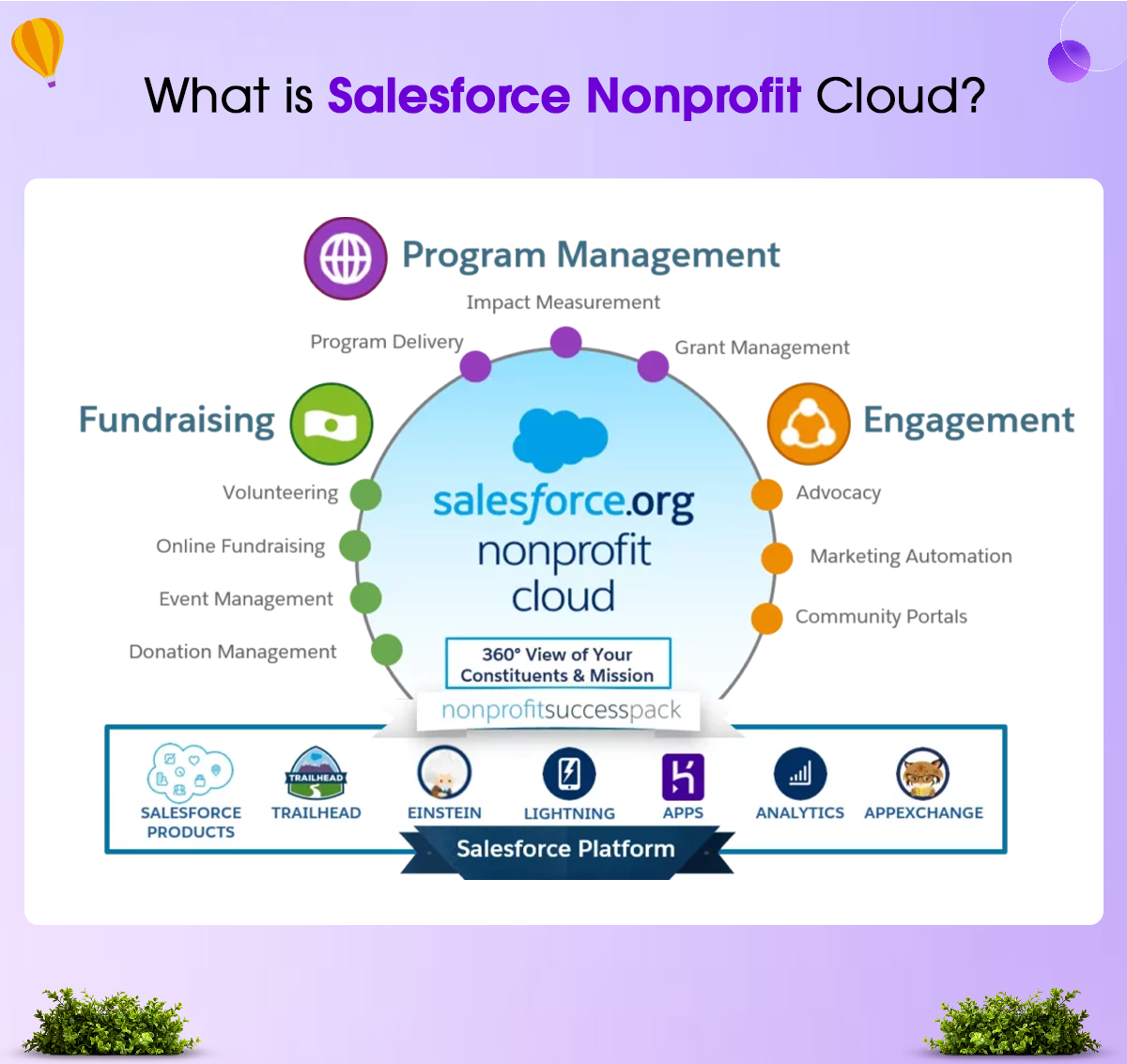
Nonprofit Success Pack (NPSP) has been the go-to Salesforce solution for nonprofits for years. It's an open-source app built on top of Salesforce's Sales Cloud, adding donation tracking, constituent relationship management, and basic fundraising tools. For smaller nonprofits with simpler needs, it still works well.
Salesforce Nonprofit Cloud (NPC) is the newer, more comprehensive platform. It's purpose-built — not layered on top of Sales Cloud — which means the data model is fundamentally different and better suited to how nonprofits actually operate. It includes:
-
Program and Case Management — Track participant journeys, case worker interactions, service delivery, and outcomes in one place
-
Fundraising Tools — Unified donor profiles, recurring gift management, AI-assisted donor risk alerts, and campaign performance dashboards
-
Grantmaking — End-to-end grant lifecycle management, including proposal creation, budget tracking, and compliance reporting
-
Marketing and Engagement — Omnichannel donor journeys across email, SMS, and social media through Marketing Cloud integration
-
HIPAA-Compliant Data Architecture — Critical for health-focused nonprofits handling sensitive client information
-
99.9% uptime SLA — So your campaigns never go dark during peak fundraising periods
Salesforce is now directing new implementations toward Nonprofit Cloud rather than NPSP. If you're starting fresh in 2026, Nonprofit Cloud is almost certainly the better long-term investment — though it comes with higher implementation complexity, which is exactly why the partner you choose matters.
What Does a Salesforce Nonprofit Implementation Partner Actually Do?
The scope varies by partner and by project, but here's what a full-service Salesforce nonprofit implementation typically covers:
-
Discovery and Strategy. Before anyone touches configuration, a good partner spends time understanding your organization. How do you track donors? What does your grant reporting look like? What systems are you replacing? What are your board's reporting requirements? This stage sets the foundation for everything else.
-
Configuration and Customization This is where the actual Salesforce setup happens — building out objects, fields, workflows, automation rules, page layouts, and permission sets. The goal is a system that works the way your team works, not a system they have to work around.
-
Data Migration: Moving your existing data into Salesforce is often the most underestimated part of the project. Duplicates need cleaning, field mapping needs careful planning, and data quality needs validation before anything goes live. Losing donor history during a migration is a serious problem — a good partner treats this step with the same seriousness you should.
-
Integrations: Most nonprofits don't run on Salesforce alone. You've got a payment processor, an email platform, a volunteer management tool, maybe a grant management system. A skilled Salesforce implementation partner connects these, so your team doesn't have to manually transfer data between systems.
-
User Training: A Salesforce system your team doesn't use is a very expensive mistake. Training should be role-specific, practical, and delivered close to go-live — not six weeks before it — so what people learn stays fresh when they need it.
-
Post-Launch Support: Go-live is not the finish line. Real-world use always surfaces edge cases and needs adjustments. A partner who disappears after launch is a red flag that should have been visible earlier in the process.
How to Evaluate a Salesforce Nonprofit Implementation Partner: 7 Questions That Matter
These are the questions worth asking on every discovery call — and the answers you should listen for.
1. Have you worked with nonprofits that look like ours?
Not just "nonprofits in general" — specifically organizations of your size, funding model, and program complexity. A partner who's implemented Salesforce for large healthcare NGOs may not be the right fit for a 12-person community foundation.
2. Who will actually be on our project?
Sales calls often feature senior consultants who then hand the project off to junior staff. Ask specifically who your project manager, lead consultant, and data migration specialist will be — and ask to meet them before you sign.
3. How do you handle scope changes?
They will happen. The question isn't whether the scope will shift; it's whether your partner communicates proactively, documents changes clearly, and prices them fairly.
4. What does your post-go-live support model look like?
Monthly retainer? Ticketing system? Dedicated support hours? "Call us if you need us" is not a support model. Understand exactly what you're getting after launch.
5. Can you walk us through a data migration you've done for a similar organization?
This surfaces real experience versus theoretical knowledge quickly. Good answers include specifics such as the source system, volume, cleanup process, and validation approach.
6. What's your familiarity with Agentforce Nonprofit and Salesforce AI?
In 2026, AI-assisted nonprofit work is no longer a future feature — it's available now. Partners who aren't discussing AI automation for donor stewardship, case triage, or grant proposal drafting are behind the curve.
7. What does a failed Salesforce implementation look like to you — and what causes it?
This is a trust question, not a trick question. Partners who've learned from difficult projects will answer it honestly. Those who claim everything always goes smoothly probably haven't done enough complex work.
Top Salesforce Nonprofit Implementation Partners in 2026
Here's an honest look at the most recognized partners in this space, what they do well, and where they may not be the right fit.
Codleo Consulting
-
Location: Delaware & Dallas, USA
-
Founded: 2019
-
Focus: Nonprofits, Social Sector, SMBs
Codleo is a Salesforce consulting and implementation partner with a strong track record across nonprofit organizations focused on community development, healthcare, education, and social welfare. What makes Codleo particularly relevant for nonprofits exploring global implementation partners is its combination of deep Salesforce expertise across the full product suite and a pricing model that delivers enterprise-quality work at a cost nonprofits can sustain.
Codleo's nonprofit Salesforce work covers Nonprofit Cloud, NPSP, Sales Cloud, Service Cloud, Experience Cloud, Marketing Cloud, and Pardot (Marketing Cloud Account Engagement)—the full stack, not just entry-level tools. They also bring growing capabilities in Agentforce and Salesforce AI, which are increasingly relevant as nonprofits look to automate donor stewardship, case triage, and impact reporting.
They're ISO-certified, CMMI Level 3 appraised, and hold certifications from both Salesforce and Salesforce.org.
Best for: Cost-conscious nonprofits of all sizes looking for full-stack Salesforce implementation expertise, flexible engagement models, and a genuine partnership that extends beyond go-live. Particularly strong for organizations that need both US-based engagement and highly skilled offshore delivery.
Talk to Codleo's nonprofit Salesforce team →
Cloud for Good
-
Location: Asheville, NC (USA)
-
Founded: 2010
-
Focus: Nonprofits, Higher Education, Public Sector
Cloud for Good is widely regarded as the most established Salesforce nonprofit implementation partner in the US market. They've completed over 2,500 Salesforce implementations and work with some of the largest mission-driven organizations in North America. They are a certified B Corporation, a multi-time Salesforce Partner of the Year, and an Inc.500 company.
Their team is deep on Nonprofit Cloud, Education Cloud, Marketing Cloud, and Agentforce, and they bring a level of institutional knowledge about the nonprofit sector that's hard to match. They've worked across healthcare, higher education, social services, environmental advocacy, and international development.
-
Best for: Mid-to-large nonprofits and higher education institutions with complex, multi-cloud requirements and budget to match.
-
Worth knowing: Their depth and reputation come with a higher price point. If you're a smaller organization looking for a more flexible, relationship-driven engagement, they may not be the ideal fit.
Heller Consulting
-
Location: USA
-
Founded: 1996
-
Focus: Nonprofits, Education, Healthcare
Few firms in this space have the history that Heller Consulting brings. Since 1996, they've worked with over 1,500 nonprofits and educational institutions — including The Salvation Army USA, Environmental Defense Fund, and YouthBuild. They are currently deploying Nonprofit Cloud and Agentforce Nonprofit for major organizations across North America.
What makes Heller stand out is their change management expertise. They don't just implement Salesforce — they help organizations build the internal capacity to use it well long after the project ends. They're also notably platform-agnostic; they work with Salesforce, Microsoft, and Blackbaud, which means their recommendations tend to be based on fit rather than preference.
-
Best for: Established nonprofits with large-scale CRM transitions who need a partner with deep experience navigating organizational change.
-
Worth knowing: Their breadth can sometimes mean you're not their smallest or most complex client. Smaller nonprofits may get more personalized attention elsewhere.
Fionta
-
Location: Fully Remote (USA)
-
Founded: 2001
-
Focus: Nonprofits and Associations
Fionta has been in the Salesforce ecosystem since 2006 and brings over 20 years of experience in the nonprofit sector. They've served more than 1,200 nonprofits and associations, including The Amputee Coalition, Prison Fellowship International, and Mental Health America.
Their particular strength is serving nonprofits that also operate as associations or membership organizations — a segment with specific platform needs that not all partners handle well. They're a Classy partner for online fundraising integration and bring real expertise in Nonprofit Cloud, Experience Cloud, and Marketing Cloud Account Engagement (formerly Pardot).
-
Best for: Nonprofits and membership organizations with 50+ staff who need a US-based team and strong association management expertise.
-
Worth knowing: Fionta's focus on established organizations means smaller or newly formed NGOs may not be an ideal client profile for them.
Idealist Consulting
-
Location: USA
-
Founded: ~2004
-
Focus: Nonprofits, Social Impact Organizations
With over 20 years of experience and 15,000+ successfully deployed projects, Idealist Consulting has built a strong reputation for combining technical Salesforce work with a genuine commitment to social impact. They serve organizations in humanitarian, environmental, education, community development, and international development sectors.
-
One thing that genuinely sets them apart: The Idealist Grant, an annual program that donates up to 10% of corporate project revenue to fund nonprofit Salesforce work for organizations that couldn't otherwise afford it. That's not marketing — it's a structural commitment to the sector.
-
Best for: Mission-driven organizations looking for a partner that shares their values, not just their technical requirements.
-
Worth knowing: Their case study library is limited, which makes it harder to evaluate sector-specific depth before the first call.
Agile Cloud Consulting
-
Location: USA
-
Focus: Nonprofits, Health & Human Services
Agile Cloud Consulting has built a portfolio of clients, including Mercy House Global, Prison Fellowship, Free Hearts, and the Wildlife Rescue Association. Their technical breadth is notable — alongside Nonprofit Cloud, they work on Service Cloud, Health Cloud, Experience Cloud, Einstein Analytics, and Tableau.
For nonprofits at the intersection of program delivery and case management, particularly in health and human services, they bring real depth.
-
Best for: Nonprofits with complex program management and case management requirements, especially in health and social services.
Exponent Partners
-
Location: USA
-
Focus: Nonprofits, Social Sector Organizations
Exponent Partners focuses exclusively on nonprofits and social sector organizations — no commercial clients. Their implementation experience spans fundraising, volunteer management, program tracking, and constituent management, and they bring a consulting-first mindset that emphasizes strategy before configuration.
-
Best for: Mid-sized nonprofits who want a partner committed exclusively to the sector, without dividing attention across commercial and nonprofit work.
DNL OmniMedia
-
Location: USA
-
Focus: Small to Mid-Sized Nonprofits
DNL OmniMedia consistently earns recognition as one of the most approachable and affordable Salesforce nonprofit implementation partners for smaller organizations. They've built a reputation for transparent scoping, clear project communication, and ongoing managed services that work for nonprofits without large in-house tech teams.
-
Best for: Smaller nonprofits (under 50 staff) who need a reliable implementation and ongoing support without enterprise-level pricing.
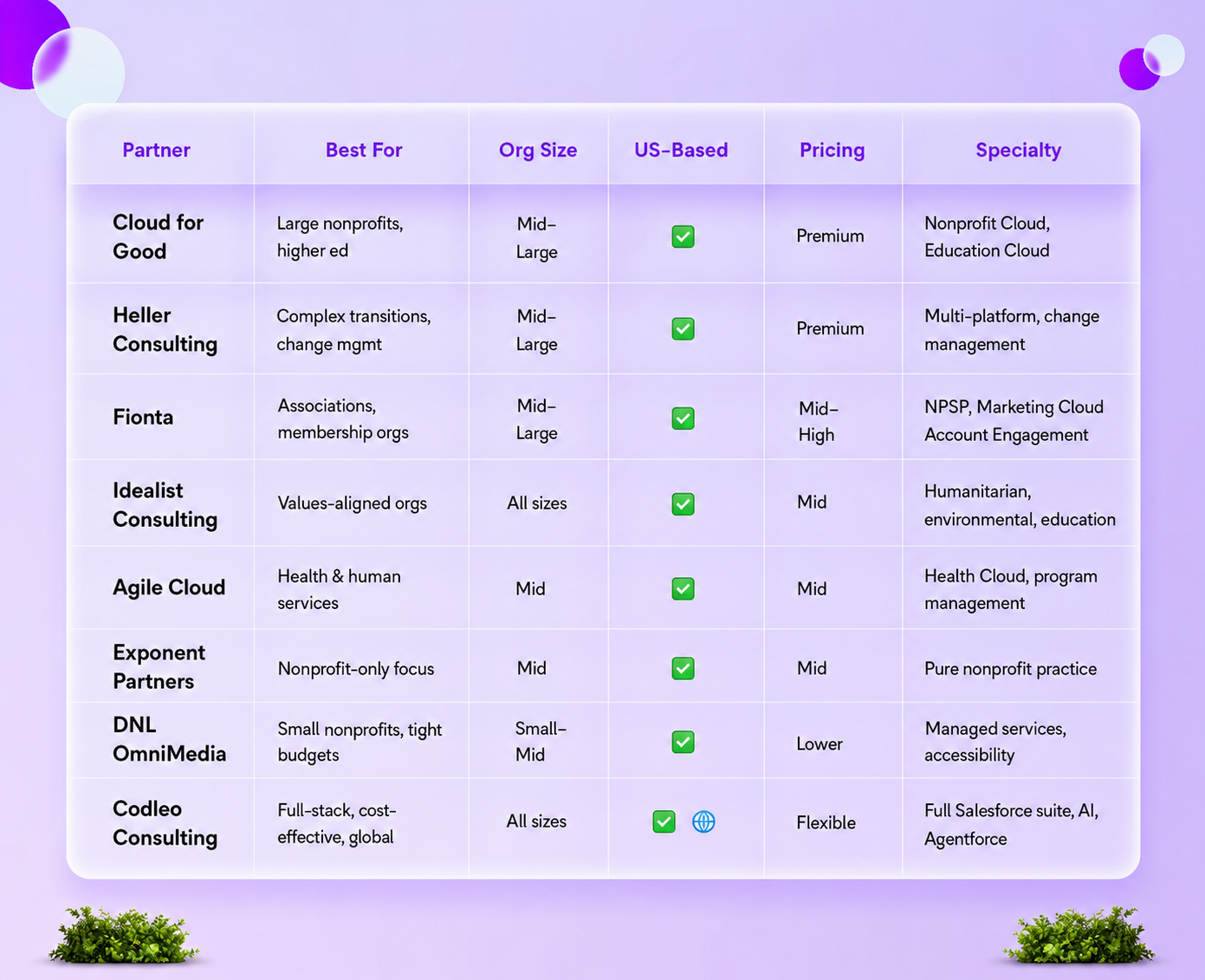
Quick Comparison Table: Which Partner Fits Your Nonprofit?
Red Flags to Watch Out For During the Selection Process
The nonprofit Salesforce implementation market is not without its pitfalls. Here are the warning signs worth taking seriously:
-
They can't name a nonprofit client similar to yours. Generic "we've worked with nonprofits" isn't enough. If they can't point to specific organizations with comparable size, workflow, or mission, that's experience you'll be funding.
-
The senior consultant disappears after signing. You meet an impressive lead on the sales call, and then a junior consultant you've never spoken to runs your project. Ask explicitly who will be on your engagement and get it in the statement of work.
-
They want to configure before they understand. A partner who jumps to configuration without a thorough discovery process is building something based on assumptions rather than your actual workflows.
-
Vague post-launch support. "We'll be available" is not a support model. Ask specifically: How many hours? Through what channel? What's the response SLA? What's the cost?
-
No mention of user adoption. A technically perfect Salesforce system that your team doesn't use is worth nothing. If a partner doesn't mention training, change management, and adoption planning on their own, that's a gap.
-
They don't ask about your data. Data migration is where implementations most often go wrong. A partner who doesn't bring it up early hasn't thought through your project properly.
Salesforce Nonprofit Implementation: Stages, Timelines & What to Expect
Most full Salesforce nonprofit implementations run 6 to 12 months, though simpler NPSP projects can be shorter. Here's a realistic picture of what that timeline looks like:
Stage 1 — Discovery (Weeks 1–4)
This is the most important stage and the most commonly rushed. Your partner should meet with your team to understand your donor management process, program workflows, reporting requirements, existing systems, and organizational goals. The output is a detailed implementation plan and scope document that both sides agree to.
Stage 2 — System Configuration (Weeks 5–12)
The actual Salesforce build happens here: object setup, automation rules, custom fields, record types, permission sets, dashboard templates, email templates, and workflow processes. Expect regular check-ins and demos to catch issues early.
Stage 3 — Integrations (Weeks 10–16)
Connecting your payment processor, email platform, volunteer management tool, grant system, and other software to Salesforce. This stage requires testing every integration to ensure data flows correctly in both directions.
Stage 4 — Data Migration (Weeks 12–18)
Cleaning, mapping, and migrating your existing donor and constituent data. This typically involves multiple rounds of validation — never just a one-time transfer. You should see the migrated data before it's considered final.
Stage 5 — Testing & UAT (Weeks 16–20)
User acceptance testing with your actual team using real scenarios. This is where edge cases surface, and where the last adjustments should be made.
Stage 6 — Training & Go-Live (Weeks 20–24)
Role-based training for everyone who will use the system. Followed by a planned launch, not a scramble.
Stage 7 — Post-Launch Support (Ongoing)
The first 60–90 days after launch are critical. Expect questions, small adjustments, and additional training needs as your team encounters real-world scenarios.
NPSP vs. Nonprofit Cloud: Which One Should Your Organization Choose?
This is one of the most common questions nonprofits ask before starting an implementation — and the answer genuinely depends on where you are.
Choose NPSP if:
-
You're a smaller nonprofit with a limited budget and relatively straightforward donor management needs
-
You have an existing, highly customized NPSP setup that works well and doesn't justify a full rebuild
-
You primarily need basic contact management, donation tracking, and simple reporting
Choose Salesforce Nonprofit Cloud if:
-
You're starting fresh and want to build on Salesforce's current and future investment.
-
You manage complex programs, case management, or service delivery workflows.
-
You need HIPAA-compliant data handling for sensitive client information.
-
You want to leverage Agentforce AI for donor stewardship, case routing, or grant assistance.
-
You're a mid-to-large organization and need multi-cloud capability (Marketing Cloud, Experience Cloud, Service Cloud together)
Salesforce is actively innovating on Nonprofit Cloud and has signaled it's the long-term direction for the platform. For new implementations in 2026, it's almost always the better investment if your organization can support the implementation requirements.
How Codleo Approaches Nonprofit Salesforce Implementation
Most implementation guides end here — with a list of partners and a comparison table. We want to be specific about how we actually work, because that's what helps you make a real decision.
Codleo differs from large US-based firms in a few ways that matter specifically to nonprofits.
-
We implement the full Salesforce stack, not just Nonprofit Cloud. Many partners specialize narrowly. Codleo's team brings hands-on experience across Nonprofit Cloud, NPSP, Sales Cloud, Service Cloud, Experience Cloud, Marketing Cloud, Pardot/Marketing Cloud Account Engagement, and Agentforce. If your organization's needs grow — and they will — you won't need to find a different partner.
-
We engage before we propose. Before any statement of work, we want to understand your workflows, your existing data, and your goals. We've seen too many implementations that were scoped based on assumptions instead of discovery. That's not how we work.
-
Our model makes full-stack expertise accessible. The firms on this list with 20+ years of experience and global operations serve the sector well — but their pricing reflects their overhead. Codleo's delivery model means nonprofits with modest budgets don't have to choose between quality and cost.
-
Post-launch support is not an afterthought. We build ongoing support into engagements because we know go-live is where real usage begins, not where our job ends. We're still in contact with clients 12 months after their implementation because that's when the good questions come.
-
We're ISO certified, CMMI Level 3, and Salesforce.org registered. Not because certifications tell the whole story, but because they represent a commitment to delivery standards that protect you as a client.
If your nonprofit is evaluating Salesforce implementation partners right now, we'd welcome a straightforward conversation — no sales pressure, no pre-packaged pitch—just a genuine discussion about whether we're the right fit for where you are.
Start a conversation with Codleo →
Ready to Talk? Here's What Happens Next
If you've read this far, you're serious about getting your Salesforce implementation right. Here's how to move forward without wasting time:
-
Step 1 — Get clear on your own requirements first. Before you call anyone, document what you need Salesforce to do: which teams will use it, what data you're migrating, which systems need to integrate, and what success looks like 12 months after launch. The clearer you are, the better every vendor conversation will go.
-
Step 2 — Shortlist 2–3 partners. Don't evaluate more than three seriously. Use the comparison table above and the seven evaluation questions to quickly filter down.
-
Step 3 — Ask for references, and actually call them. Not just the references the partner provides — ask for organizations similar to yours and request contact details. A 15-minute call with a prior client tells you more than any sales presentation.
-
Step 4 — Compare statements of work, not just prices. Scope differences explain most price differences. Make sure you're comparing equivalent deliverables before you make a cost-based decision.
-
Step 5 — Talk to Codleo. We'll give you an honest assessment of what your implementation should include, what it should cost, and whether we're the right partner for your specific situation.
Book a free consultation with Codleo's nonprofit Salesforce team →
Codleo Consulting is a Salesforce implementation partner. org-registered partner with offices in Delaware; and Dallas, Texas. We work with nonprofit organizations globally on Salesforce consulting, implementation, integration, and managed services.
 0
0
About the Author

FAQ
A Salesforce nonprofit implementation partner handles the full setup of Salesforce for your organization — from discovery and configuration to data migration, integrations, user training, and post-launch support. They customize the platform to match your specific workflows, whether that's donor management, grant tracking, volunteer coordination, or program reporting. Think of them as the bridge between what Salesforce can do and what your organization actually needs it to do.
Costs vary widely depending on your organization's size, complexity, and the partner you choose. A basic NPSP implementation for a small nonprofit can start around $10,000–$25,000. A full Nonprofit Cloud implementation for a mid-to-large organization with multiple integrations and data migration typically runs $40,000–$150,000 or more. Partners like Codleo offer flexible delivery models that make enterprise-quality implementation accessible at a lower cost than large US-based firms.
Most implementations take between 3 and 12 months, depending on the scope. A straightforward NPSP setup for a small nonprofit can be completed in 8–12 weeks. A full Nonprofit Cloud implementation with multiple system integrations, complex data migration, and multi-team rollout typically takes 6–12 months. Rushing the timeline — especially the discovery and data migration stages — is one of the most common causes of failed implementations.
NPSP (Nonprofit Success Pack) is an older open-source app built on top of Salesforce Sales Cloud. It's suitable for smaller nonprofits with basic donor management needs. Salesforce Nonprofit Cloud is a purpose-built platform with a fundamentally different data model, designed for complex program management, case management, grantmaking, and multi-cloud operations. Salesforce is actively developing Nonprofit Cloud as its long-term direction — for new implementations in 2026, it's almost always the better investment for organizations with room to grow.
Through the Salesforce Power of Us Program, eligible nonprofits receive 10 free Enterprise Edition licenses for core Salesforce products. Additional licenses and premium features, such as Marketing Cloud, Nonprofit Cloud advanced modules, or Agentforce, are available at discounted nonprofit pricing. The licenses are free — but implementation, configuration, and training are not, which is why choosing the right partner is crucial to keeping total costs manageable.
Start by shortlisting partners with proven nonprofit experience — not just general Salesforce work. Ask specifically about organizations similar to yours in size and mission. Then evaluate: Who will actually be on your project (not just the sales lead)? What does their post-launch support look like? How do they handle data migration? Request references and call them. Compare statements of work carefully before making a cost-based decision — scope differences explain most price differences.
Salesforce Nonprofit Cloud is used to manage the full operational picture of a nonprofit in one platform — donor and constituent relationship management, fundraising campaigns, grant application and tracking, program delivery and case management, volunteer coordination, marketing and outreach, and impact reporting. It also supports HIPAA-compliant data handling for health-focused organizations and integrates with Agentforce for AI-assisted automation.
Agentforce is Salesforce's AI agent platform, and Agentforce Nonprofit brings those capabilities to mission-driven organizations. It allows nonprofits to automate donor stewardship workflows, route incoming service requests, assist case managers with recommended next steps, and generate draft grant proposals — all within Salesforce. In 2026, it's one of the fastest-growing parts of the Nonprofit Cloud ecosystem and a meaningful differentiator when choosing a Salesforce implementation partner.
Yes, though it depends on your budget and operational complexity. NPSP remains a practical starting point for smaller nonprofits with limited needs and budgets. Nonprofit Cloud is more powerful but requires higher implementation effort. Some partners, including Codleo and DNL OmniMedia, offer phased implementation approaches that allow smaller organizations to adopt Nonprofit Cloud progressively without taking on the full scope and cost upfront.
The most important question is: Have you worked with nonprofits similar to ours in terms of size and mission? Who specifically will be on our project? How do you handle scope changes mid-project? What does post-go-live support look like — hours, channel, and cost? Can you walk us through a data migration you've done for a similar organization? What's your experience with Agentforce and Salesforce AI? And finally: What does a failed implementation look like to you, and what causes it? That last question tells you more about a partner's maturity than almost anything else.
Data migration involves four core phases: planning (defining what moves, assigning roles, setting quality standards), extraction and cleaning (removing duplicates, standardizing formats, validating completeness), mapping (matching your existing fields to Salesforce's data model), and execution with validation (running the migration and confirming accuracy before decommissioning the old system). A good implementation partner treats data migration as one of the highest-risk parts of the project — because it is. Never accept a migration approach that isn't transparent about its validation process.
Codleo is a Salesforce. org-registered partner and an ISO/CMMI-certified firm with US offices in Delaware and Dallas, Texas, alongside its primary delivery center in India. They offer full-stack Salesforce implementation across Nonprofit Cloud, NPSP, Marketing Cloud, Service Cloud, Experience Cloud, and Agentforce — making them particularly well-suited for nonprofits that need broad capability without the pricing premium of large US-based firms. Their flexible engagement model is especially relevant for cost-conscious nonprofits seeking enterprise-quality outcomes.
 603 D-Mall Netaji Subhash Place, Delhi 110034 IND


