


Publish date:
You may have read that Pardot starts at $1,250 per month. You might even think that's the full story.
It's not.
If you're evaluating Salesforce Pardot (now called Marketing Cloud Account Engagement, though nobody calls it that) for your B2B marketing operations, you're about to discover that the $1,250 monthly price tag is only the tip of an iceberg. The real question isn't "How much does Pardot cost?" It's "What will I actually spend over the next three years to own this platform?"
After analyzing 50+ B2B Pardot implementations, auditing customer deployments across SaaS, fintech, and professional services, and reviewing implementation costs from vendor proposals to actual spend, the pattern is clear: teams that budget only for the license price typically spend 2.5-3.5x more by year three.
This guide takes a different approach. We're not going to sell you on Pardot. We're going to show you exactly how much it costs—including the costs Salesforce doesn't mention in the sales meeting.
Table of Contents
-
What Is Pardot? The Quick Context
-
Pardot Editions 2026: The Four Pricing Tiers Explained
-
Growth Edition: $1,250/month
-
Plus Edition: $2,500/month
-
Advanced Edition: $4,000/month
-
Premium Edition: $15,000/month
-
-
The Hidden Cost of Architecture: What You'll Actually Spend
-
Cost Category 1: Pardot License
-
Cost Category 2: Implementation Services
-
Cost Category 3: Salesforce Dependency
-
Cost Category 4: Hidden Add-Ons
-
Cost Category 5: Optimization & Retainers
-
Cost Category 6: Tech Debt Cleanup
-
Cost Category 7: Internal Team Time
-
-
Real 3-Year TCO Scenarios: What Four Different B2B Teams Actually Spend
-
Scenario A: Lean B2B SaaS
-
Scenario B: Typical Mid-Market B2B
-
Scenario C: Enterprise Multi-Business Unit
-
Scenario D: 2026 Hybrid with Agentforce
-
-
5 Decisions That Cut TCO by $30,000 or More
-
How to Choose Your Edition: A Decision Framework
-
Pardot vs. The Competition: Real TCO Comparison
-
Key Takeaways: Making Your Pardot Decision
-
Final Recommendation: The Pardot Decision Checklist
-
FAQ: The Questions B2B Teams Actually Ask
-
Does Pardot price per user or per organization?
-
Can I negotiate the Pardot price down?
-
Is B2B Marketing Analytics Plus worth it?
-
What's the difference between Plus and Advanced?
-
Is there a free Pardot edition?
-
+ 12 More FAQs...
-
What Is Pardot? The Quick Context
Pardot is Salesforce's B2B marketing automation platform, which was officially renamed Marketing Cloud Account Engagement in April 2022. Despite the rebrand, the core functionality remains unchanged: it's designed to automate lead generation, nurture prospects across long sales cycles, score leads based on engagement, and ultimately hand off qualified opportunities to your sales team.
If you're already on Salesforce, Pardot is the native integration point between marketing and sales. If you're not on Salesforce, adding both creates a significant financial commitment that needs serious TCO modeling before you sign.

Pardot Editions 2026: The Four Pricing Tiers Explained
Pardot offers four distinct editions, each with increasing capabilities, contact limits, and features. Here's what you actually get at each level:
1. Growth Edition: $1,250/month
Best for: Small B2B teams running lean, early-stage SaaS companies, or businesses testing marketing automation for the first time.
What you get:
-
10,000 included prospect records
-
Basic email marketing and automation
-
50 forms and 50 landing pages
-
Lead scoring and grading
-
Prospect tracking
-
Basic reporting (email metrics, ROI reporting)
-
5 Engagement History Dashboard viewers
-
50 automation rules
-
25,000 API calls per day
-
User forum and live best practice calls
What you're missing:
-
Advanced Dynamic Content (personalization requires a $400/month add-on)
-
Multiple scoring categories
-
Multitouch attribution models
-
Custom user roles and permissions
-
External activity integrations
-
Business Units (for managing multiple brands separately)
-
B2B Marketing Analytics (bonus feature in Plus and above)
Realistic annual cost for Growth edition: $15,000 in licensing + implementation time + Salesforce Sales Cloud dependency.

2. Plus Edition: $2,500/month (The Most Popular Option)
Best for: Mid-market B2B companies with 10,000-50,000 prospects, multiple campaign streams, and a need for more sophisticated segmentation and personalization.
What you get (Plus adds to Growth):
-
10,000 included prospect records (additional blocks at $500/month per 10K)
-
Unlimited forms and landing pages
-
Unlimited email campaigns
-
Advanced Dynamic Content (included—no extra fee)
-
Multiple scoring categories (target different buyer personas)
-
Multitouch attribution models
-
100 automation rules
-
10 external activity extensions
-
50,000 API calls per day
-
10 Engagement History Dashboard viewers
-
500 MB file hosting
-
B2B Marketing Analytics (5 licenses included)
Available add-ons for Plus:
-
Dedicated IP Address: $500/month
-
Custom User Roles and Permissions: $500/month
-
Additional contact blocks: $500-$1,500/month per 10K beyond limit
-
B2B Marketing Analytics Plus (advanced AI-driven attribution): $3,000/month
Realistic annual cost for the Plus edition: $30,000 in licensing + $15,000-$25,000 in implementation + add-ons (often another $5,000-$15,000/year by month 6).
3. Advanced Edition: $4,000/month
Best for: Enterprise B2B organizations, companies with multiple brands/products requiring Business Units, or teams that need the architectural flexibility that comes with higher feature ceilings.
What you get (Advanced adds to Plus):
-
10,000 included prospect records (same as Plus)
-
All Plus features
-
Custom Object Integration
-
Business Units (up to 2)
-
150 automation rules
-
20 external activity extensions
-
100,000 API calls per day
-
20 Engagement History Dashboard viewers
-
10 GB file hosting
-
Dedicated IP Address (included)
-
Custom User Roles and Permissions (included)
Realistic annual cost for Advanced edition: $48,000 licensing + $15,000-$30,000 implementation + $20,000-$40,000/year in optimization/tech debt cleanup by year 2-3.
4. Premium Edition: $15,000/month
Best for: Global enterprises, multi-region operations, or organizations managing 75,000+ prospects across multiple independent business units.
What you get (Premium adds to Advanced):
-
75,000 included prospect records
-
All Advanced features
-
Business Units (up to 5)
-
External Activity Active Extensions: 30
-
5 developer sandboxes
-
B2B Marketing Analytics Plus licenses: 5
Realistic annual cost for Premium edition: $180,000 licensing + $50,000-$100,000 implementation + $60,000-$80,000/year ongoing optimization.
The Hidden Cost of Architecture: What You'll Actually Spend
Here's where most Pardot analyses break down. They stop at the license price and ignore the seven cost categories that determine whether you spend $45K or $150K on Pardot in year one.
Cost Category 1: Pardot License (Predictable, Contracted)
This is what we've outlined above. It's stable. It doesn't surprise you.
Year 1-3 pattern: Flat unless you upgrade editions or add contact blocks.
Cost Category 2: Implementation Services (One-Time, Year 1)
The work that turns a blank Pardot instance into a functioning marketing engine.
Real implementation costs range from:
-
$5,000-$10,000 (QuickStart): Basic setup, connector configuration, 2-3 landing pages, simple lead scoring model. Usually generates Year 2 rework costs.
-
$15,000-$25,000 (Tier 2 Architecture): Proper implementation that doesn't generate debt. This is the sweet spot.
-
$30,000-$50,000+ (Enterprise Implementation): Multi-business unit setup, complex integration architecture.

Our recommendation: Budget for Tier 2 ($ 15K–$25 K). The extra investment up front saves $20,000-$40,000 in year 2 cleanup costs.
Cost Category 3: Salesforce Dependency (Mandatory, Recurring)
This is the cost that surprises everyone: Pardot cannot run on its own. You must have Salesforce Sales Cloud licenses.
Per-user costs:
-
Sales Cloud Professional: $80/user/month
-
Sales Cloud Enterprise: $165/user/month
-
Sales Cloud Unlimited: $330/user/month
An 8-person sales and marketing ops team on Enterprise edition pays: 8 users × $165/month × 12 months = $15,840/year.
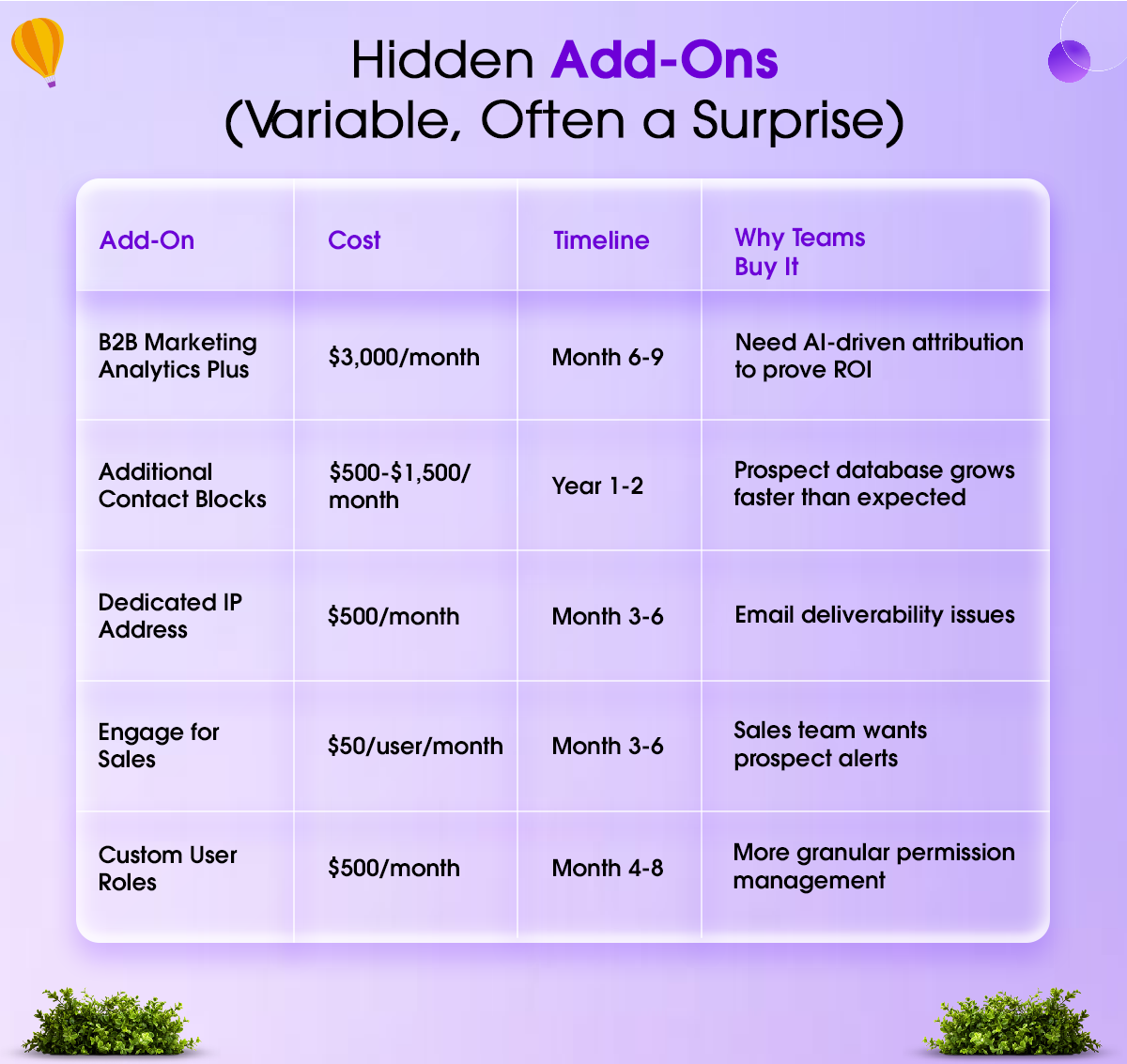
Cost Category 4: Hidden Add-Ons (Variable, Often a Surprise)
Once teams actually use Pardot, additional needs emerge. Most common add-ons by timeline:
Cost Category 5: Optimization & Retainers (Recurring, Year 2+)
After year one, most teams need ongoing support. The honeymoon phase ends, scoring models drift, and automation rules conflict.
Real costs:
-
Retainer approach: $1,500-$5,000/month for ongoing consultant access
-
Project approach: $5,000-$15,000 per quarter for discrete projects
-
Hybrid approach: $2,000-$3,000/month base + project work as needed
Cost Category 6: Tech Debt Cleanup (Cyclical, Every 18-24 Months)
Configuration drift accumulates. Old automation rules create conflicts. Scoring models diverge from reality.
Real costs: $5,000-$15,000 per cleanup cycle
Cost Category 7: Internal Team Time (Huge, Usually Unmeasured)
A marketing operations specialist managing Pardot day-to-day. For mid-market teams: 0.5-1.0 full-time equivalent.
Cost: $40,000-$90,000/year in fully-loaded employee cost
Real 3-Year TCO Scenarios: What Four Different B2B Teams Actually Spend
Here are four realistic scenarios based on actual B2B deployments:
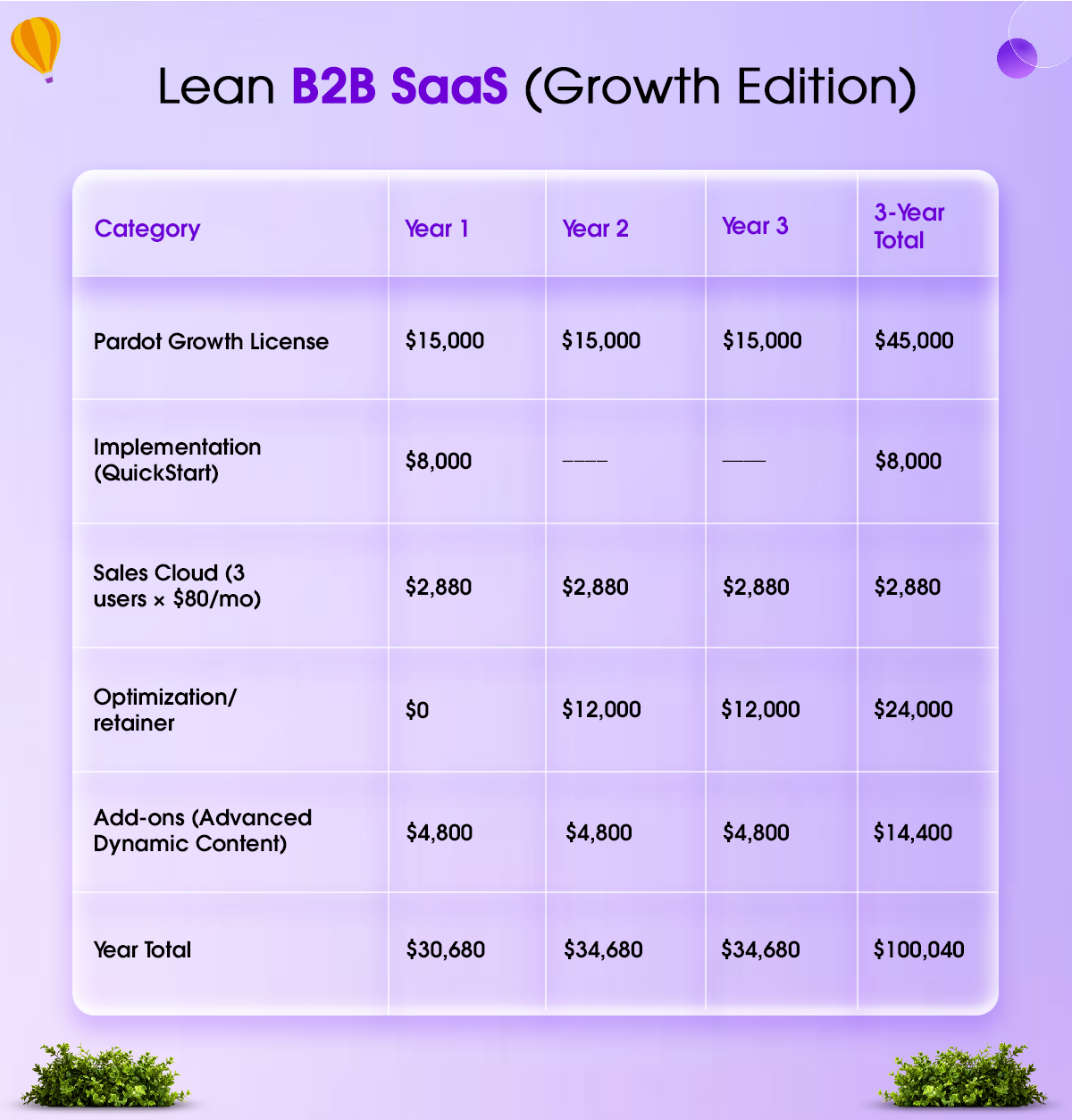
Scenario A: Lean B2B SaaS (Growth Edition)
Team profile: 6-person company, $2M ARR, 8,000 prospects, basic lead scoring
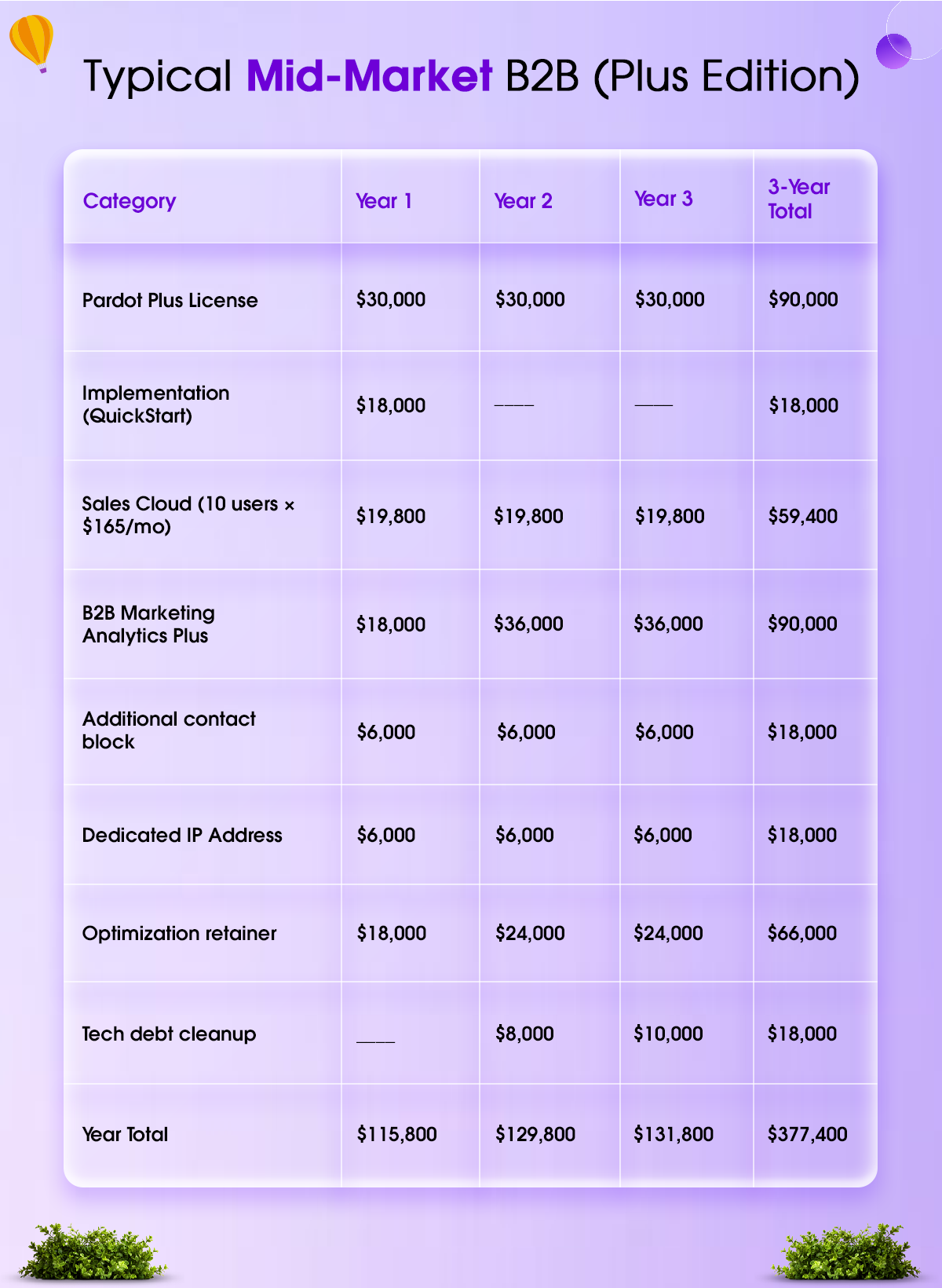
Scenario B: Typical Mid-Market B2B (Plus Edition)
Team profile: 30-person company, $10M ARR, 30,000 prospects, multiple campaign streams
Scenario C: Enterprise Multi-Business Unit (Advanced Edition)
Team profile: 100+ person company, $50M+ ARR, two independent business units, 80,000 prospects
Realistic 3-Year TCO: $636,300 (including implementation, Salesforce dependency, B2BMA Plus, optimization retainers, and tech debt cleanup)
Scenario D: 2026 Hybrid with Agentforce (Plus Edition + Selective AI Agents)
Realistic 3-Year TCO: $508,400 (includes Data Cloud, Agentforce agent licenses, and ongoing optimization)
5 Decisions That Cut TCO by $30,000 or More
Before you sign that contract, these five decisions determine whether your 3-year spend is $145,000 or $280,000:
Decision 1: Audit Before Signing
Investment: $1,500-$7,500 | Saves: $20-50K
Decision 2: Right-Size the Edition
Saves: $10-30K
Decision 3: Negotiate Ceilings, Not Just Discounts
Saves: $10-25K
Decision 4: Bundle Salesforce + Pardot Procurement
Saves: $15-40K
Decision 5: Invest in Year 1 Architecture Quality
Saves: $30-50K over Year 2-3
How to Choose Your Edition: A Decision Framework
Step 1: What's your marketing-sourced pipeline value?
-
Under $500K/year: Skip Pardot entirely
-
$500K-$2M/year: Lean scenario, Growth or Plus
-
$2M-$15M/year: Mid-market scenario, Plus or Advanced
-
$15M+/year: Enterprise scenario, Advanced or Premium
Step 2: How many prospects?
-
Under 10K: Growth edition
-
10K-50K: Plus edition
-
50K-150K: Advanced edition
-
150K+: Premium edition
Step 3: Do you need Business Units?
-
No: Growth, Plus, or Advanced
-
Yes, 2 units: Advanced is mandatory
-
Yes, 3-5 units: Premium is mandatory
Step 4: Integration complexity?
-
Simple (Salesforce + 1 tool): Growth or Plus
-
Moderate (Salesforce + ABM + webinar + CMS): Plus or Advanced
-
Complex (Salesforce + 4+ partners): Advanced
Step 5: Do you need proper attribution?
-
No: Save the $36,000/year.
-
Yes: Budget for B2BMA Plus from year 1
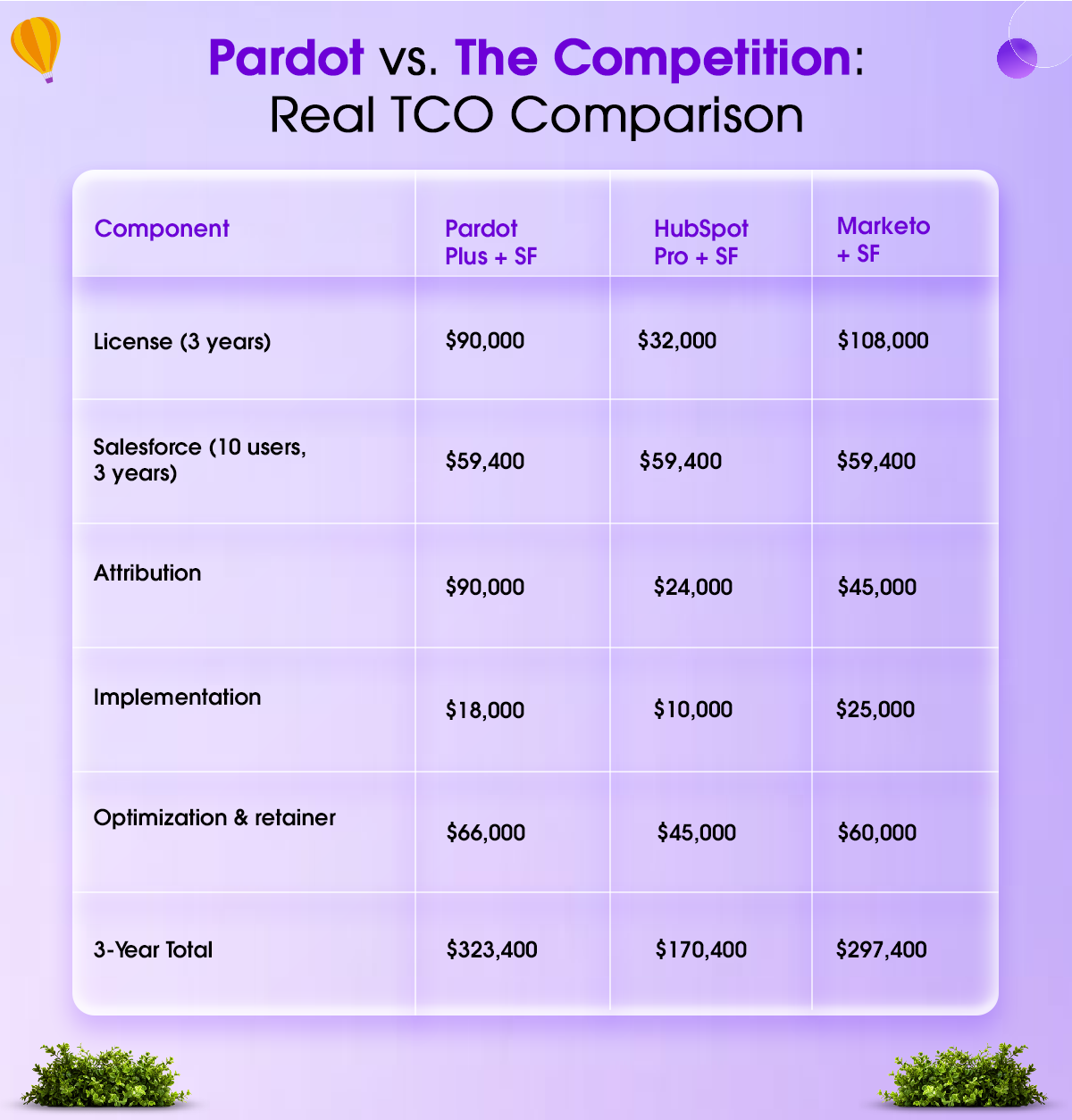
Pardot vs. The Competition: Real TCO Comparison
Key Takeaways: Making Your Pardot Decision
-
Pardot's real cost is 2.5-3.5x the monthly license price , including implementation, Salesforce dependency, add-ons, and ongoing optimization.
-
An audit before signing ($1,500-$7,500) typically saves $20,000-$50,000 by right-sizing your edition and preventing Year 2 mistakes.
-
Plus edition becomes Advanced-equivalent once you add 3-4 add-ons. Advanced is often cheaper.
-
B2B Marketing Analytics Plus ($36,000/year) is critical by year 2 if you need to prove marketing ROI to your CFO.
-
The quality of your Year 1 implementation determines the costs for Years 2-3. A $15,000 Tier 2 implementation saves $30,000-$50,000 compared to a $7,000 QuickStart.
-
Salesforce dependency is mandatory and often unbudgeted. If Sales Cloud isn't already in your budget, add $25,000-$50,000/year.
-
Pardot makes sense only if you have:
-
$1M+ annual marketing-sourced pipeline
-
60+ day sales cycles with multiple touchpoints
-
Salesforce already committed
-
Multiple buyer personas requiring segmentation
-
Internal capacity or budget for ongoing optimization
-
Final Recommendation: The Pardot Decision Checklist
-
Audit completed ($1,500-$7,500): Validates edition selection, implementation scope
-
3-year TCO modeled: All seven cost categories included
-
Salesforce dependency budgeted: Sales Cloud licenses included
-
Implementation tier decided: QuickStart, Tier 2, or Enterprise.
-
Add-on ceiling locked in: Contact blocks, B2BMA pricing negotiated.
-
Salesforce + Pardot bundled: Negotiated together for maximum discount.
-
Success metrics defined: What does "Pardot success" look like for your business?
Your Pardot investment will range from $ 45,000 to $600,000+ over three years. Make sure you know exactly what you're buying before you sign.
Need Expert Help? codleo - Your Pardot Implementation Partner
Making a Pardot investment decision is complex. The pricing models, hidden costs, edition choices, and implementation timelines can feel overwhelming—especially when you're trying to justify the ROI to your CFO.
That's where codleo comes in.
Who We Are: Trusted Pardot Implementation Partner & Consultant
Codleo is a leading Pardot implementation partner and Salesforce consulting firm specializing in B2B marketing automation architecture. We've helped 50+ companies avoid costly mistakes and deploy Pardot implementations that deliver real ROI.
We're not just another Pardot consultant firm. We're architects who understand the intersection of technology, business strategy, and budget reality.
What We Do: End-to-End Pardot Services
-
Pardot Audit — Pre-purchase analysis, TCO modeling, edition right-sizing, implementation roadmap
-
Pardot Implementation — Full setup, connector configuration, automation builds, training
-
Pardot Optimization — Scoring recalibration, automation audits, tech debt cleanup
-
Pardot Migration & Integration — Data migration, custom objects, third-party integrations
-
Lead Management & Scoring — Scoring model design, lead grading, sales handoff workflows
Why Choose codleo? 5 Reasons
-
Real-World Experience — 50+ B2B SaaS, fintech, and enterprise implementations
-
TCO-Focused — We model your 3-year total cost of ownership upfront.
-
Certified Architects — 6+ Salesforce certifications, including MCAE Specialist
-
No Hidden Fees — Fixed-scope with transparent pricing
-
Post-Launch Support — Ongoing optimization and 24/7 support
What Our Clients Say
-
"codleo helped us avoid a $40,000 mistake by right-sizing our edition in the audit phase. Best investment we made." — Marketing Director, SaaS Company ($8M ARR)
-
"We tried implementing Pardot ourselves. Six months in, we were drowning. codleo's cleanup and rebuild made all the difference." — VP Marketing, Fintech Startup
-
"As a Pardot implementation partner, codleo stands out because they care about long-term success, not just closing the project." — CMO, Enterprise B2B Company.
Common Scenarios We Solve
-
Evaluating Pardot vs competitors? Objective comparison + TCO modeling
-
Already on Pardot but struggling? Audit, rebuild, optimize
-
Need a Pardot consultant for a project? Custom scope, fixed timeline, transparent pricing
-
Migrating from another platform? Full migration with data cleanup + validation
-
Building integrations? Sustainable API architecture without technical debt
Our Process: From Discovery to Success
-
Step 1: Discovery Call (15 min, Free) — Understand your situation and goals
-
Step 2: Audit Phase — Detailed analysis + TCO model + roadmap
-
Step 3: Scoped Engagement — Fixed price, fixed timeline, no surprises
-
Step 4: Implementation & Launch — Production-ready Pardot
-
Step 5: Ongoing Optimization — Year 2-3 support + quarterly reviews
The codleo Difference
Most Pardot consultants sell implementations. codleo sells success.
We're transparent about costs. We model your 3-year TCO upfront. We avoid hidden costs that blindside teams in Year 2. And we stay involved through Year 3—when most orgs face tech debt cleanup and need architectural guidance.
If you're evaluating Pardot, we want to be part of that conversation—whether you choose Pardot, a competitor, or no platform at all.
Ready to Get Started?
Three ways to work with codleo:
-
Book a Free 15-Minute Discovery Call — Tell us your situation. We'll tell you whether Pardot makes sense and what the real costs are for your team.
-
Request a Custom Audit Quote — We'll evaluate your situation and provide a fixed-price audit with TCO modeling.
-
Get a Proposal — Already know what you need? We'll scope a fixed-price implementation with transparent pricing.
📞 Ready to make the right Pardot decision?
📅 Schedule a free consultation call.
codleo — Pardot Implementation Partner | Salesforce Consultant | B2B Marketing Automation Architect
50+ B2B companies trust codleo for Pardot strategy, implementation, and optimization
About This Guide
This analysis is based on:
-
50+ B2B Pardot audits across SaaS, fintech, insurance, and professional services
-
Real implementation costs from 2023-2026 deployments
-
Customer feedback from Pardot users via G2, Capterra, and direct interviews
-
Salesforce official pricing and feature documentation
-
TCO modeling frameworks used by B2B RevOps teams
The numbers are conservative estimates based on what teams actually spend, not what they budget for. Most teams underestimate TCO by 30-40%, which is why the hidden cost categories matter so much.
 0
0
About the Author






 603 D-Mall Netaji Subhash Place, Delhi 110034 IND


