


Publish date:
Your customers are already using WhatsApp. In fact, over 2 billion people worldwide send messages on WhatsApp every day. Meanwhile, you're managing customer relationships in Salesforce, collecting data, tracking interactions, and responding to inquiries as quickly as possible. But here's the gap: these two platforms don't talk to each other. Your sales team sends emails. Your support team waits for callbacks. Your marketing department runs campaigns through traditional channels. And somewhere in the middle, your customers are sitting on WhatsApp, expecting an instant reply.
What if you could bridge that gap? What if every WhatsApp message your customer sent came directly into Salesforce, giving your team instant access to their complete history, preferences, and past interactions? What if you could send personalized follow-ups, order updates, and appointment reminders directly to their preferred messaging app—all without your team switching between multiple tools?
This isn't a future possibility. It's happening right now for businesses that have integrated Salesforce with WhatsApp. In this guide, we'll show you exactly how to make it happen for your organization.
Table of Contents
-
Why Salesforce and WhatsApp Integration Matters
-
Understanding the Basics: What This Integration Actually Does
-
All the Methods for Integrating WhatsApp with Salesforce
-
Key Benefits That Impact Your Bottom Line
-
How Salesforce WhatsApp Integration Works (The Technical Side)
-
Integration Methods: Which Path Is Right for You?
-
Implementation Best Practices for a Smooth Rollout
-
Security, Compliance, and Data Privacy Considerations
-
Real-World Use Cases Across Different Industries
-
Common Challenges and How to Overcome Them
-
Measuring Success: Key Metrics to Track
-
Frequently Asked Questions
Why Salesforce and WhatsApp Integration Matters
For years, businesses have operated with fragmented communication systems. Your sales team uses email for outreach. Your customer service team manages phone calls and support tickets. Your marketing department sends promotional messages through email and SMS. Each channel operates independently, resulting in a fragmented customer experience.
WhatsApp changes that equation. It's not just another messaging app. With over 2 billion active users, WhatsApp has become the communication platform of choice for people around the world. In India, WhatsApp reaches over 500 million monthly active users. In Europe and the Americas, it's the second-most popular messaging platform. And across Africa and Southeast Asia, it's often the primary way people communicate.
From a business perspective, WhatsApp offers something remarkable: a 99% open rate. Compare that to email, where open rates hover around 20-30%, and the advantage becomes clear. When you send a message to a customer on WhatsApp, they see it. They read it. And they're far more likely to respond.
But WhatsApp alone isn't enough. You need to know who's sending that message. You need to review their purchase history, past support tickets, preferences, and communication timeline. That's exactly what happens when you integrate WhatsApp with Salesforce. Suddenly, your frontline teams—whether in sales, marketing, or service—have access to complete customer context in real time during a conversation.
Understanding the Basics: What This Integration Actually Does
Before diving into implementation, let's clarify what Salesforce WhatsApp integration actually accomplishes.
At its core, this integration creates a two-way connection between your WhatsApp Business account and your Salesforce CRM. Here's what that means in practice:
-
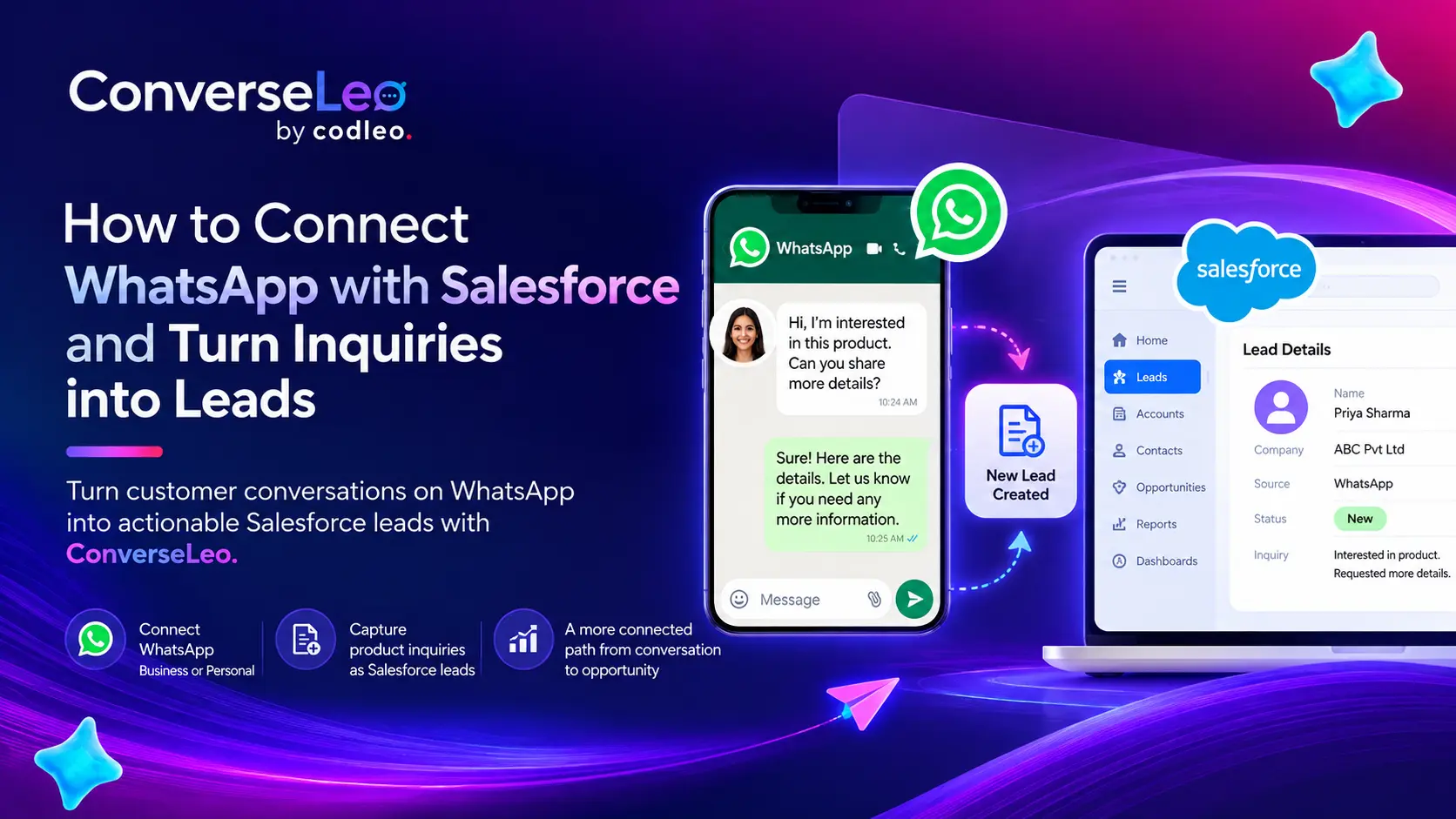
Inbound Messaging: When a customer sends you a message on WhatsApp, it is routed directly to Salesforce. Your team sees the message alongside that customer's complete history—past orders, previous support cases, communication preferences, and more. They can respond right from within Salesforce, without switching applications.
-
Outbound Messaging: Your team can initiate conversations directly from Salesforce. Whether it's sending an order update, scheduling a follow-up, or providing customer support, messages are sent via WhatsApp. The customer sees a personal message on their preferred channel, and the conversation is automatically logged in Salesforce.
-
Automated Responses: You can set up intelligent automations. Welcome messages greet new customers. Away messages let people know when they'll hear back. Template-based messages send order confirmations, appointment reminders, and service updates—all without manual intervention.
-
Unified Contact View: Every WhatsApp conversation syncs back to the customer's record in Salesforce. Nothing gets lost. Nothing gets duplicated. Your team always sees the complete picture of that customer's journey.
The integration isn't a manual workaround or a third-party Band-Aid. It's a seamless connection that treats WhatsApp as a native communication channel within Salesforce, just like email or phone calls.
All the Methods for Integrating WhatsApp with Salesforce
Choosing a connection path comes down to trade-offs: speed, customization, and who owns the plumbing.
Native Enhanced Messaging (Digital Engagement) is the fastest supported channel. It uses Salesforce settings and Omni-Channel routing, allowing admins to manage opt-in/out choices and supervisor whispers. You need the Digital Engagement add-on to use it. This option is ideal for service teams looking for a simple, controlled approach. However, it is not very customizable beyond its built-in features.
Custom-built using the WhatsApp Business API.
I use Meta’s WhatsApp Business API when I want full control. This API supports sending media and contact cards, as well as setting up webhooks and custom automations. To use this option, you need a developer app, tokens, endpoints, retry logic, and logging for scaling.
Third‑party apps (for example, 360 SMS)
Apps like 360 SMS make it easier to set up and add features such as shared consoles, sticky sender, template management, and connections to Marketing Cloud. They take care of most of the behind-the-scenes work, but you should expect to pay for app subscriptions and any conversation fees charged by the channel provider.
How to Set Up Enhanced Messaging for WhatsApp in Salesforce
To set up reliably, start with the right licenses and a verified phone number. Here are the steps I follow.
First, you need Service Cloud with the Digital Engagement add-on and a verified WhatsApp Business Account linked to your Meta Business Account. Make sure you have the phone number and Meta admin credentials ready before starting.
Licensing, prerequisites, and connecting your WhatsApp Business Account
To set up messaging, go to Messaging Settings and turn on Messaging. Create a new channel and select WhatsApp. Accept the terms and click Connect to WhatsApp to begin the linking process.
To set up messaging, go to Messaging Settings and turn on Messaging. Create a new channel and select WhatsApp. Accept the terms and click Connect to WhatsApp to begin the linking process.
Step-by-Step Guide to Set Up Salesforce WhatsApp Messaging
Step 1: Enable Messaging and Configure the WhatsApp Channel
Start by enabling Salesforce Messaging and configuring the WhatsApp channel. Verify all account and channel details before proceeding. Create a welcome greeting that customers receive when they start a conversation. You can configure routing later, so there is no need to set up Omni-Channel flows at this stage. Give the channel a clear, descriptive name and assign an owner to simplify management and reporting as usage grows.
Step 2: Configure Greetings and Compliance Settings
Set up greeting messages and define how customers can opt in or opt out of WhatsApp communications. Keep all approved message templates up to date and ensure they comply with WhatsApp policies. Template messages should only be sent outside the 24-hour customer service window to remain compliant.
Step 3: Test the Messaging Experience
Customer conversations will appear in the Salesforce Service Console, where agents can view delivery and read receipts, transfer conversations, and receive supervisor guidance when needed. Before launching in production, test the complete messaging workflow in a sandbox environment using sample customer records. After testing, document the setup and align with stakeholders on communication standards and customer service guidelines.
Routing WhatsApp Messages with Omni-Channel
An effective routing strategy helps balance workloads, improve response times, and deliver a better customer experience. The routing model should be designed around your team's size, service-level agreements (SLAs), and expected growth in message volume.
Queues vs. Omni-Channel Flows
Use Standard Queues When:
-
Your support team is small.
-
Message volume is predictable.
-
Routing requirements are straightforward.
-
There is little or no need for customer segmentation.
Queues are easy to configure, require minimal maintenance, and are ideal for simple support operations.
Use Omni-Channel Flows When:
-
You need dynamic routing based on business rules.
-
Messages should be assigned based on agents' skills or expertise.
-
Certain customer groups require priority handling.
-
Conversations may need to be transferred between bots and agents.
-
Capacity-based workload balancing is required.
Omni-Channel Flows provide greater flexibility and help automate complex routing scenarios.
Configure the "Messages Routed to Agents and Queues" Flow
Enable Omni-Channel and create a Messaging service channel: Configure skills-based routing, direct-to-agent assignment, and a fallback queue for cases where no agents are available. Create presence statuses such as Available – Messaging so the system can accurately determine agent availability.
Update routing outcomes for different customer segments, such as priority customers and standard customers. The flow should check agent availability first, assign the conversation when possible, or automatically place it into the appropriate queue.
Priority Routing and Advanced Features
For high-priority customers, configure routing rules that attempt to assign conversations to a preferred or specialized agent. If that agent is unavailable, the conversation should automatically move to the designated queue. Agents can monitor delivery and read receipts, while supervisors can observe conversations and provide guidance without interrupting the customer interaction.
Monitor Performance and Balance Workloads
Use capacity-based routing to distribute conversations evenly across agents and prevent overload. Regularly monitor key performance metrics such as:
-
First response time
-
Average handling time
-
Queue wait time
-
Rerouting rate
-
Conversation transcripts
-
Agent workload
Review these insights regularly to optimize staffing, improve routing rules, and enhance the overall customer experience.
Building Your Own WhatsApp Integration: The Custom API Approach
When Standard Solutions Aren't Enough
Sometimes, the native Salesforce WhatsApp channel or off-the-shelf connectors don't give you the control you need. Maybe your message flow is highly specialized. Maybe you're managing complex routing scenarios. Maybe you need messages to land in custom objects that standard integrations don't support. That's when you build your own path—a direct connection between Meta's WhatsApp API and Salesforce that routes messages and data exactly where you need them.
This approach requires development resources, but it gives you complete control over how messages move through your system.
Getting Started: Set Up Your Meta Developer App
Before you write any Salesforce code, you need to establish your connection to WhatsApp through Meta's platform.
Start by creating a Meta developer app. This is your gateway to WhatsApp's API. During setup, select WhatsApp as your use case. Meta will guide you through adding the WhatsApp product to your app.
Once your app is created, Meta generates a test phone number for you. This number becomes your business's WhatsApp identity during testing. You can add your personal phone number to the approved list, which lets you send and receive real test messages while you're building.
Navigate to your app's WhatsApp section and look for the API Setup option. Here's where things get real. Meta generates an access token—a unique credential that proves your app is authorized to send messages on behalf of your business. This token lasts 24 hours, so you'll need a refresh strategy for production. Keep this token safe. Anyone with this token can send messages that appear to be from your business.
Securing Credentials in Salesforce
Now you're ready to tell Salesforce about WhatsApp. But first, store your credentials securely.
In Salesforce, create custom labels for your access token and phone number ID. Custom labels are the right place for sensitive configuration data because they're not visible to regular users and they're encrypted. You can reference them from your Apex code without hardcoding secrets.
Next, add a remote site entry in Salesforce Setup. This tells Salesforce it's okay to make outbound calls to Meta's API at https://graph.facebook.com. Without this, your code won't be able to reach Meta's servers.
With these credentials in place, your Apex code can now send outbound messages to WhatsApp. You can send text, images, documents, or location pins—whatever you need.
The Webhook: Receiving Messages from WhatsApp
Sending messages to WhatsApp is one direction. But you also need messages flowing back into Salesforce. That's where webhooks come in.
A webhook is like a dedicated phone line that WhatsApp uses to notify your Salesforce instance whenever something happens—a customer sends a message, a message is delivered, a message fails. Meta sends these events to a URL you control.
Your webhook needs to do two things: validate Meta requests and process incoming messages.
When Meta first connects to your webhook, it sends a GET request to validate that your endpoint is real and that you're authorized to receive these events. Your webhook code checks the verification token (a secret you defined in Meta) and returns a special "challenge" value. If this validation succeeds, Meta knows your webhook is legitimate and starts sending you events.
Once validation is complete, Meta sends POST requests whenever customers message you. Your webhook receives the payload (including the customer's phone number, message text, and metadata), parses it, and stores the data in Salesforce. You might create a custom message object, update an existing lead or contact, or trigger a process flow—whatever your business needs.
Two Paths Forward: With or Without an Enterprise Service Bus
At this point, you have a choice. You can connect your webhook directly to Salesforce, or you can use a middleware layer for additional protection and reliability.
The Direct Path (Smaller Scale)
If your message volume is moderate and your team is technical, you can create a Salesforce public site specifically for webhook handling. Expose only the webhook class, restrict access to Meta's IP addresses, and require a verification token. For production, we also require a client certificate to ensure encrypted, authenticated communication.
This approach is simple and keeps everything within Salesforce. Your code is lightweight, with fewer moving parts to break.
The Middleware Path (Enterprise Grade)
For higher volumes or stricter security requirements, introduce an Enterprise Service Bus (ESB) such as MuleSoft, Azure Service Bus, or AWS Lambda. The ESB sits between Meta and Salesforce and handles several important jobs:
It terminates the TLS connection from Meta, verifies that the sender's IP address matches Meta's documented ranges, logs every incoming payload for auditing, adds retry logic for failed deliveries, and securely calls Salesforce only when data is valid.
This architecture is more complex to set up, but it gives you enterprise-grade reliability. If Salesforce is temporarily unavailable, the ESB queues the message and automatically retries it. If Meta sends a malformed payload, the ESB logs it without crashing your Salesforce instance.
Tokens, Numbers, and Production Readiness
During testing, Meta's 24-hour access tokens are fine. But for production, you need a long-lived token that doesn't expire. Request this from Meta—it requires your business to be verified and your use case to be approved.
Similarly, switch from Meta's test phone number to a real, production phone number registered with your business. This number needs to be verified with Meta and associated with your WhatsApp Business Account.
Finally, agree on conversation pricing with Meta. They charge per message in most regions. Understand the pricing model for your specific markets (USA, UK, India, etc.) and budget accordingly.
Logging and Reliability
In production, log every interaction. When you send a message, log the response code from Meta. When Meta sends you an event, log the payload. When retries occur, log the attempt. This creates an audit trail that helps you debug problems and ensures you can prove communication happened if there's ever a dispute.
If something fails—a message doesn't deliver, a webhook doesn't respond—you want to know immediately. Set up monitoring and alerting so your team is notified of problems, not your customers.
The Faster Alternative: Third-Party Platforms Like 360 SMS
Building a custom integration gives you ultimate control, but it takes time. For teams that need to launch quickly and don't have the development resources to build from scratch, third-party platforms offer a compelling alternative.
Why Third-Party Platforms Win
A platform like 360 SMS gives you enterprise-grade capabilities without having to build the plumbing yourself. You get WhatsApp and SMS integration, plus other channels, all in one place. Your team can manage all customer conversations from a single view instead of jumping between tools.
The Shared Conversation Workspace
Imagine your support team opening a single dashboard that shows all incoming messages—WhatsApp, SMS, maybe even web chat—in a single thread. This is what 360 SMS delivers.
Each message shows which channel it came from with a clear badge. An SMS message has a different visual indicator than a WhatsApp message. Your team immediately knows how the customer reached you and can tailor their response accordingly.
Better yet, 360 SMS uses a "sticky sender" approach. If Agent A handled a customer's WhatsApp conversation yesterday, Agent A's name and profile stay attached to that conversation today. When the customer sends another message, it automatically goes back to Agent A. This continuity matters. Customers don't have to repeat themselves or explain their situation to a new person. The relationship carries forward.
Automation and Bulk Messaging Without Code
With 360 SMS, you don't need developers to set up messaging automation. You can build automation through Salesforce Flows, Process Builder, or even Reports and Campaigns. Send bulk messages to a list of customers? Build a campaign and route it through 360 SMS. Schedule follow-ups? Create a Flow with a delay step, then use 360 SMS to send the message at the right time. Execute logic based on customer data in Salesforce? Use Flows to make decisions and trigger 360 SMS messaging actions.
This means your business, marketing, and operations teams can build messaging workflows without waiting on engineering.
The platform also supports multimedia—images, PDFs, videos, links. When you need to send a tutorial video to a customer, share it directly via WhatsApp from 360 SMS. When you want to track link clicks, the platform can do that automatically.
WhatsApp Account Setup and Template Management
One of the biggest operational headaches with WhatsApp integration is getting your business verified and your templates approved by Meta. This takes time and expertise.
With 360 SMS, the vendor handles much of this for you. They work with Meta on behalf of their customer base. They know Meta's approval criteria and have established relationships with Meta's teams. They can usually provision a WhatsApp Business Account, obtain a verified phone number, and get templates approved in about four weeks—significantly faster than most organizations can do it on their own.
This alone saves you weeks of frustration and back-and-forth with Meta.
Connecting to Marketing and Sales Tools
360 SMS integrates with Salesforce Marketing Cloud and Pardot, so your WhatsApp conversations automatically sync with your marketing campaigns. When a lead engages with you over WhatsApp, that engagement is attributed to the right campaign. When you send a WhatsApp message to someone already in a Pardot nurture stream, the platforms stay synchronized.
The Web Chat Angle
Many teams also use 360 SMS to power a web chat widget on their website. A visitor clicks the chat button, starts a conversation, and can choose to continue via WhatsApp if they prefer. That conversation flows seamlessly into Salesforce. The visitor becomes a lead, and their entire interaction—from web chat to WhatsApp follow-up—is tracked as one continuous engagement.
Reporting and ROI Measurement
360 SMS provides built-in reporting on message volume, response times, customer satisfaction scores, and campaign attribution. You can see exactly which campaigns drove WhatsApp engagement and which conversations turned into sales.
Choosing Your Path: Custom API vs. Third-Party Platform
Both approaches work. Here's how to decide:
Choose Custom API Integration if:
-
You have a development team with Salesforce expertise
-
You need very specialized message routing or custom data flows
-
You want to integrate WhatsApp with multiple backend systems simultaneously
-
You have the time to build and maintain the integration
Choose a Third-Party Platform if:
-
You need to launch quickly (weeks, not months)
-
You don't have dedicated development resources
-
You want automated template management and WhatsApp provisioning
-
You value operational simplicity over maximum customization
-
You want bundled SMS and WhatsApp on one platform
The hybrid approach is also valid. Some teams use a third-party platform for standard messaging and build a custom integration for specialized workflows. This gives you the speed of a third-party solution with the flexibility of custom code where you need it most.
Implementation Considerations
Whether you choose custom or third-party, a few principles apply:
-
Start in sandbox. Test everything with your personal phone number before you go live. Make sure messages flow correctly, data lands in the right objects, and your automations trigger as expected.
-
Scale plan. If you're sending 100 messages a month today, you might be sending 10,000 next year. Design your architecture to handle growth. If you're using custom APIs, plan for rate limiting and retry logic. If you're using a third-party platform, make sure it can scale with your business.
-
Invest in monitoring. Log everything. Alert on failures. You want to know immediately if messages aren't flowing, not when customers complain.
-
Compliance plan. Regardless of which approach you take, ensure you have proper customer consent, audit trails, and compliance with GDPR, CCPA, and other regulations in your markets.
The bottom line: You have options. If you have the resources and technical expertise, a custom integration gives you complete control. If you want to move faster and reduce operational burden, a platform like 360 SMS is powerful and proven. Either way, the goal is the same—create a seamless connection between your customers on WhatsApp and your business data in Salesforce.
Costs, Limits, and Compliance Watch Closely
Before I flip the switch on any messaging channel, I map fees, limits, and retention rules. That planning saves time and avoids surprises during launch.
-
Licenses and vendor fees: I budget three buckets: Service Cloud + Digital Engagement licensing, Meta conversation pricing by category, and partner or ESB fees for routing and logging. Third‑party apps can speed setup but add subscription costs and per‑conversation charges.
-
24‑hour care window and templates: Meta enforces a 24‑hour customer care window for customer‑initiated chats. Business‑initiated outreach requires approved templates. I build a template catalog early and submit it for approval so campaigns don’t stall.
-
Media, approvals, and retention: The WhatsApp Business API supports media, but businesses must adhere to size and format limits. I coach agents on when to send short videos or PDFs, and I define data retention policies to ensure messages and attachments persist in the correct account records.
Practical checks I run
I monitor delivery and read receipts, use logging or an ESB for retries, and check per‑number throughput so new numbers ramp safely. I align SLAs, presence, and routing with expected response times and revisit costs quarterly to compare native, custom, and app options.
Common Pitfalls and How I Avoid Them
A few simple missteps — like an exposed webhook or missing surge plan — will cost you time and customers. I focus on small controls that stop big problems.
-
Public endpoints and certificates. Without an ESB, I avoid exposing a Force.com public site unless necessary. If I must, I lock down access with a client certificate and validate the verify_token during the GET handshake. That extra step reduces the attack surface and protects account-level credentials.
-
Secure pipelines with an ESB. I prefer an ESB for TLS termination, IP allowlisting, and request logging. It provides retries, clears logs for failed messages, and offers better control over access and routing.
-
Routing, presence, and surge planning. I never skip designing presence statuses, fallback queues, and surge models. I test with simulated loads and set settings so agents don’t get overwhelmed and customers get timely responses.
-
Templates, opt-in, and data hygiene. Template approval can take weeks; I treat it as a gated process and submit early. Admins enforce opt‑in rules, and I document every change to settings so preferences persist. I capture each message and its attachments to the correct record so that future communication stays coherent.
Key Benefits That Impact Your Bottom Line
Let's talk about why this matters for your business. Salesforce and WhatsApp integration delivers tangible benefits across three areas: customer experience, team efficiency, and revenue growth.
Faster Response Times
WhatsApp responses are typically 3 to 5 times faster than email replies. Your support team gets a message: they have the customer's complete context from Salesforce instantly and can respond in seconds—not hours. This speed translates directly into better customer satisfaction. When someone asks a question on WhatsApp, they're expecting a quick answer. You can deliver exactly that.
Improved Customer Engagement
Customers are on WhatsApp. If you want to engage them, meet them where they already are. You're not asking them to check email or visit a website. You're reaching out in an app they use constantly. The result? Higher engagement rates, more conversations, and more opportunities to move customers through your sales pipeline.
Centralized Communication
Before this integration, communication was scattered across channels. Messages came into WhatsApp, but your CRM didn't know about them. Emails went to your inbox, but WhatsApp didn't see them. Service tickets existed separately from customer conversations. The integration brings everything together. Your entire team sees the same customer, from the same perspective, with the same information.
Personalized at Scale
One of the biggest advantages is automation with personalization. You can send thousands of messages to different customers, but each message reflects that individual's history, preferences, and past interactions. Your support agent knows if someone has already called twice about the same issue. Your sales rep knows whether a prospect has visited your website. Your marketing team knows if someone is a repeat purchaser. That context enables personalization that actually moves the needle.
Lead Capture and Nurturing
WhatsApp becomes a lead-generation channel. Customers can reach out directly through WhatsApp to ask questions, request demos, or inquire about products. These messages flow directly into Salesforce as new leads. Your sales team can follow up instantly and guide them through the sales funnel without a single email exchange.
Cost Efficiency
This might seem counterintuitive, but WhatsApp integration actually reduces your operational costs. You're automating routine messages. Your team spends less time typing the same responses over and over. Support conversations that might have required a 20-minute phone call are resolved in a 2-minute WhatsApp exchange. Sales reps close deals faster because they have complete context and can communicate in real time.
How Salesforce WhatsApp Integration Works (The Technical Side)
To implement this successfully, you need to understand the technical architecture. Don't worry—we'll keep this practical and avoid getting lost in jargon.
The Components
There are three main players: WhatsApp, Salesforce, and the connection between them.
WhatsApp provides the WhatsApp Business API, which is the engine that allows businesses (rather than individuals) to send and receive messages programmatically. You access this through Meta's Business Account, which manages all your business applications and accounts.
Salesforce provides the messaging infrastructure through its Service Cloud, which includes a built-in messaging channel specifically designed for this purpose. Salesforce also provides webhooks—essentially, a direct line that receives notifications from WhatsApp the moment something happens.
The connection is where the magic happens. When a customer sends a message to your WhatsApp Business number, that message travels through the WhatsApp Business API to a webhook URL you've configured in Salesforce. Salesforce receives it, creates a new message record, associates it with the correct customer, and delivers it to the right agent. When your agent responds, the message travels back through the API to WhatsApp, and the customer receives it on their phone.
The Setup Process
Here's what the setup involves, at a high level:
First, you create or verify a WhatsApp Business Account through Meta. This is where you register your business information and phone number. The phone number becomes your business's WhatsApp identity.
Next, you configure a WhatsApp channel in Salesforce. This happens in your setup menu, and Salesforce walks you through connecting your Meta Business Account to your Salesforce org. You'll approve terms, verify your phone number, and create a verified business profile.
Then you configure message routing. Incoming WhatsApp messages need to go somewhere in your organization. Do they go to a queue that agents pick up from? Do they route to a specific team? Do they use Omni-Channel for skills-based routing? Salesforce lets you choose, depending on your complexity and volume.
Finally, you set up message templates. WhatsApp restricts outbound messaging outside of a 24-hour conversation window. If you want to send a message after that window closes—like an order confirmation or a follow-up reminder—you need to use a pre-approved template. You'll create these in Salesforce, submit them to Meta for approval (usually takes a few hours), and then use them for automated messaging.
Integration Methods: Which Path Is Right for You?
There are actually three main approaches to Salesforce WhatsApp integration, each with distinct trade-offs.
Option 1: Native Salesforce Service Cloud Integration
This is the built-in, out-of-the-box approach. Salesforce has native support for WhatsApp messaging through its Service Cloud module. You don't need developers. You don't need a third-party platform. You use Salesforce's native configuration tools to connect WhatsApp and start messaging.
-
Pros: Quick to implement (often within hours), low cost, minimal complexity, governed and secure within Salesforce's ecosystem.
-
Cons: Limited customization, less flexibility for complex workflows, and less ability to handle advanced routing or multi-channel scenarios than other approaches.
-
Best for: Small to mid-sized businesses, support teams focused on customer service, simple messaging workflows.
Option 2: Custom Integration Using WhatsApp Business API
This approach means your development team (or a Salesforce consultant) builds a custom connection using Meta's WhatsApp Business API and Salesforce's APIs. Your developers write code that handles the messaging flow, data mapping, and any custom logic your business needs.
-
Pros: Maximum flexibility, can support complex automation, can integrate with other systems simultaneously, scales to high volume, enables advanced routing and logic.
-
Cons: Requires developer expertise, takes longer to implement, higher initial cost, ongoing maintenance responsibility, greater security responsibility.
-
Best for: Large enterprises, organizations with complex business requirements, and organizations that want to integrate WhatsApp with other systems simultaneously.
Option 3: Third-Party Integration Platforms
Companies like Zoko, WATI, 360 SMS, Twilio, and others have built platforms that sit between WhatsApp and Salesforce. These platforms provide pre-built connectors that handle the hard technical work, along with additional features like shared inboxes, team collaboration, advanced analytics, and omnichannel messaging.
-
Pros: Fast implementation, additional features beyond basic messaging, dedicated support from the platform provider, no coding required, easier scalability.
-
Cons: Ongoing subscription costs, less control over the integration, dependent on the third-party platform's reliability and roadmap.
-
Best for: Businesses without dedicated development resources, teams that want additional features beyond basic WhatsApp integration, organizations looking for a managed service rather than in-house management.
Choosing Your Approach
The decision comes down to three factors: time to value, technical complexity, and your internal resources. If you need something live in a few days, native Salesforce is your answer. If you have complex requirements and a development team, custom integration gives you unlimited flexibility. If you want the middle ground with additional features and support, a third-party platform might be the best fit.
Implementation Best Practices for a Smooth Rollout
Whether you choose native integration, custom development, or a third-party platform, certain best practices apply to every implementation.
Start With Clear Business Objectives
Don't implement WhatsApp integration just because it's available. Define exactly what you want to achieve. Are you trying to reduce support ticket volume? Accelerate sales cycles? Increase lead capture? Generate repeat customers through order updates? Each objective changes how you'll configure and measure the integration. Clarity at this stage prevents rework later.
Audit Your Current Data Quality
Your Salesforce data quality directly impacts how well this integration works. If your contact database is full of duplicate or incomplete records, the integration will amplify those problems. Before connecting WhatsApp, audit your data, clean up obvious issues, and establish a data governance process going forward. This is work you should be doing anyway, and Salesforce WhatsApp integration gives you a good reason to do it now.
Map Out Your Message Workflows
Think through the customer journey. When someone sends a WhatsApp to your business, what should happen? Should they get an immediate auto-reply? Should the message go to a specific team? If it's a sales inquiry, should it flow to your sales team? If it's support, should it go to service? If it's a repeat customer, should high-value customers be placed in a VIP queue? Map this out before you implement. It's much easier to design workflows upfront than to redesign them after launch.
Prepare Your Templates
If you're using the native Salesforce approach, you'll need WhatsApp templates for any outbound communication outside the 24-hour window. Start preparing these now—welcome messages, order confirmations, appointment reminders, follow-up messages, etc. Have them written and ready, because submitting them to Meta for approval takes time. Starting this early ensures you won't have delays when you go live.
Train Your Team
This is the most overlooked step, and it's often the most important. Your team might be used to email, phone calls, or support tickets. WhatsApp is different. Messages are shorter, more conversational, and more immediate. Customers expect faster responses. Tone matters more in text. Train your team not just on the tool, but on the communication style. What's appropriate for WhatsApp isn't always appropriate for email, and vice versa.
Set Up Automation Intelligently
Automation is powerful, but it can go wrong. Don't automate everything. Start with obvious, low-risk automations: welcome messages, acknowledgment messages, routing rules. Test these thoroughly. Only gradually add more complex automation as your team gains confidence. Always have a manual override, so your team can step in if an automation isn't working correctly.
Implement a Monitoring Strategy
Once you go live, monitor closely. Track response times, message delivery rates, conversation resolution rates, and customer satisfaction. Are messages reaching customers? Are they being delivered to the right team? Are conversations being resolved? If something breaks, you want to know immediately, not when customers complain.
Security, Compliance, and Data Privacy Considerations
This is non-negotiable. WhatsApp messages contain sensitive customer information, and the integration creates data flows that require careful attention.
End-to-End Encryption
WhatsApp provides end-to-end encryption for all messages on the platform. The data is encrypted on your customer's phone and decrypted on your team's phone, but no one in the middle—not Meta, not WhatsApp, not your internet provider—can read the message. This is a fundamental security feature that WhatsApp provides.
Authentication and Access Control
Within Salesforce, use role-based access controls to ensure that only people who should see customer conversations can access them. Your sales team shouldn't see support tickets. Your support team shouldn't see internal notes that aren't relevant to them. Set up proper permissions within Salesforce to enforce these boundaries.
Data Storage and Retention
When you integrate WhatsApp with Salesforce, the messages are stored in Salesforce. They're not stored on WhatsApp servers (they are on Meta's servers during transmission but not permanently stored there). Think about your data retention policy. How long do you need to keep WhatsApp messages? Do they need to follow the same retention schedule as other customer data? Document this and set up scheduled deletion if needed.
GDPR and Privacy Regulations
If you operate in Europe, GDPR applies. If you operate in California, CCPA applies. If you operate in other regions, similar regulations likely apply. These laws have specific requirements about customer consent, data access, data deletion, and data portability. Before you start sending WhatsApp messages, make sure you have proper consent from customers to contact them on WhatsApp. Have a clear way for customers to opt out.
Compliance Documentation
If you operate in regulated industries—such as healthcare, finance, or insurance—you may need to maintain audit trails and documentation for your integration. Salesforce provides audit logs for all activities. Use them. Enable audit logging for WhatsApp-related activities. This creates a record that you can point to during compliance audits.
Template Approval Process
Meta reviews and approves WhatsApp templates to prevent spam. When you submit a template, Meta's automated systems scan it for compliance with WhatsApp's policies. Make sure your templates are clear, relevant, and don't appear promotional (unless they're promotional messages, which have different rules). A template rejection can delay your launch, so get this right.
Real-World Use Cases Across Different Industries
To understand how this works in practice, let's look at how different types of businesses are using the Salesforce WhatsApp integration.
Retail and E-Commerce
A fashion retailer integrated WhatsApp with Salesforce to send order updates, shipping notifications, and delivery confirmations. Instead of customers having to wonder where their package is, the retailer proactively sends a WhatsApp message with tracking information. When a customer has a question, they WhatsApp the retailer directly, and the team responds instantly. The result? Reduced support calls, faster issue resolution, and higher customer satisfaction. The retailer also uses WhatsApp to send personalized product recommendations based on purchase history stored in Salesforce.
Healthcare and Telemedicine
A healthcare provider uses the Salesforce WhatsApp integration to send appointment reminders. Instead of phone calls or emails that patients might miss, they receive a WhatsApp message 24 hours before their appointment. Patients can confirm right there or request a reschedule. If they don't show up for the appointment, the provider can follow up immediately with a message. Missed appointments are down significantly. Additionally, after an appointment, patients can ask follow-up questions via WhatsApp, and the provider's team responds with guidance, reducing unnecessary office visits.
Real Estate
A real estate brokerage uses WhatsApp to nurture leads. A prospect sees a property listing, clicks a link, and their information goes into Salesforce. The agent immediately sends them a personalized WhatsApp message with details about the property, additional photos, and an offer to schedule a showing. When the prospect responds with questions, the agent answers instantly. What used to take days via email now happens in minutes via WhatsApp. Properties are being shown to more qualified buyers, and sales cycles are shorter.
Manufacturing and B2B
A manufacturing company uses Salesforce WhatsApp integration to communicate with business customers. When an order ships, the customer gets a WhatsApp message with order details and tracking information. When a delivery is about to happen, they get advance notice. If there's an issue with an order, the sales rep proactively reaches out on WhatsApp, the customer responds, and the issue is resolved before it becomes a major problem. For B2B, this transforms the relationship—it feels more personal and responsive.
Financial Services
A financial advisory firm uses WhatsApp to send appointment confirmations and market updates. Clients receive a WhatsApp message with monthly investment summaries. They can ask questions directly, and the advisor responds. Important policy information is sent via WhatsApp, with the understanding that the customer will see it. Compliance is maintained because all messages are logged in Salesforce, creating a complete audit trail.
Common Challenges and How to Overcome Them
Even with proper planning, challenges will emerge. Here's how to handle them.
Challenge: Template Approval Delays
When you submit a template to Meta, approval usually takes a few hours, but occasionally can take longer. The template might be rejected if it appears too promotional or violates Meta's policies.
Solution: Prepare all templates well in advance of your launch date. Have multiple templates ready (different versions of the same message, designed differently). If one is rejected, you have backups. Keep your templates professional, clear, and not overly promotional. Meta is more likely to approve straightforward, helpful messages than hard-sell marketing content.
Challenge: Rate Limiting and Conversation Windows
WhatsApp restricts how many messages you can send in an hour (based on your account's quality score). It also limits outbound messaging to 24 hours after a customer initiates contact. Outside that window, you need templates.
Solution: Plan your messaging strategy around these constraints. Use the 24-hour window wisely—that's when you can send custom messages without templates. For longer-term communications, rely on templates. Monitor your quality score and avoid behaviors that harm it, like sending unsolicited messages or ignoring customer reports.
Challenge: Data Sync Issues
Occasionally, messages might not sync correctly between WhatsApp and Salesforce. A customer sends a message, but it doesn't appear in Salesforce. Or a response goes out but doesn't get recorded.
Solution: Set up monitoring and alerting. Regularly audit your message logs. If sync issues occur, most are temporary and resolve on their own, but you need to know if there's a pattern. Work with your Salesforce consultant or third-party integration provider to troubleshoot. Most issues stem from incorrect webhook configurations, which can be fixed.
Challenge: Team Adoption
Your team might be hesitant to adopt a new communication channel. They're used to email and phone calls.
Solution: Invest in training. Show your team how WhatsApp saves them time. Highlight a few early wins—customers who responded faster, issues that resolved more quickly. Make it easy to use. If the tool requires extra steps, adoption will suffer. Keep it as simple as possible. You might also start with a pilot group—your top performers or most enthusiastic team members—and let them demonstrate the value to others.
Measuring Success: Key Metrics to Track
You can't improve what you don't measure. Here are the metrics that matter for Salesforce WhatsApp integration.
Response Time
How long does it take from the moment a customer sends a WhatsApp message to the moment your team responds? Track this. Ideally, you're responding within minutes, not hours. This metric is critical for demonstrating the value of WhatsApp—it's where this channel truly shines compared to email.
Conversation Resolution Rate
What percentage of WhatsApp conversations result in a resolved issue or completed sale? A high resolution rate means customers are getting what they need. A low resolution rate suggests customers are being handed off to other channels or are not getting satisfactory answers.
Customer Satisfaction (CSAT)
After a WhatsApp conversation, ask the customer how satisfied they were with the conversation. A simple survey—"How would you rate this conversation?"—gives you direct feedback. WhatsApp conversations often generate higher satisfaction than other channels because of the speed and personalization.
Message Volume and Trends
How many messages are you sending and receiving? Is volume growing month over month? Are certain times of day busier? This data helps you allocate resources and understand customer demand.
Lead Quality and Conversion
If you're using WhatsApp for lead generation, track the quality of leads coming through this channel and how many convert to customers. Compare this to leads from other channels. WhatsApp-originated leads often convert better because the customer has already initiated contact.
Cost Per Conversation
Calculate how much it costs you to handle each WhatsApp conversation, including system costs, team time, and overhead. Compare this to the cost of handling the same conversation via phone or email. Most organizations find WhatsApp conversations significantly cheaper.
Opt-In Rates
What percentage of your customer base has opted into receiving WhatsApp messages from you? A growing opt-in rate indicates that customers want this communication channel.
Frequently Asked Questions
Q: Do I need the WhatsApp Business App or the WhatsApp Business Platform?
A: They're different tools for different purposes. The WhatsApp Business App is a mobile app for small businesses to manage customer chats on their phone. The WhatsApp Business Platform is an API-based solution that enables large organizations to integrate with CRM systems, automate messaging, and scale support operations. For Salesforce integration, you need the WhatsApp Business Platform (accessed through Meta's Business API).
Q: How much does Salesforce WhatsApp integration cost?
A: The cost depends on your approach. Native Salesforce integration requires the Digital Engagement add-on license (an additional cost per user, around $10-$50 depending on the edition). The WhatsApp Business Platform itself is free to connect—you only pay for messages sent (typically $0.005-$0.10 per message, depending on your region and message type). If you use a third-party platform, add their subscription cost on top of that.
Q: Can I send promotional messages via WhatsApp?
A: Sort of. WhatsApp distinguishes between different message types. Marketing messages (promotional content) can only be sent within 24 hours of the customer contacting you, or via pre-approved templates if sent after that window. Service messages (account updates, appointment confirmations, order information) don't have these restrictions. Transactional messages (password resets, confirmations) also have more flexibility. Plan your messaging accordingly.
Q: How long does implementation take?
A: Using native Salesforce integration, you can be up and running in hours to days. You need to set up your business account, verify your number, connect to Salesforce, and configure routing. With third-party platforms, add a few days for onboarding. Custom API-based integration typically takes 2-4 weeks, depending on complexity.
Q: What happens if a customer doesn't respond for a long time?
A: WhatsApp conversations don't expire, but there's a 24-hour window. Within 24 hours of the customer's last message, you can send custom messages. After 24 hours, you need to use a template. You can always reopen a conversation if the customer messages you again, and you'll have that full 24-hour window to send custom messages.
Q: Can I integrate WhatsApp with Salesforce if I don't have Service Cloud?
A: Native WhatsApp integration in Salesforce does require the Messaging module, which typically means Service Cloud. However, you can always use a custom API integration or third-party platform even without Service Cloud. Those solutions have more flexibility in which Salesforce editions they support.
Q: Is WhatsApp integration secure?
A: Yes. WhatsApp uses end-to-end encryption. Messages are encrypted on the sender's phone and decrypted on the recipient's phone. When messages are stored in Salesforce, they benefit from Salesforce's security infrastructure. Follow best practices for access control, authentication, and compliance, and your integration will be secure.
Q: How do I handle customer data and privacy?
A: You must obtain customer consent before sending them marketing or promotional messages on WhatsApp. Service messages (such as order updates or appointment confirmations) usually don't require explicit consent when they're transactional. You must provide an easy way for customers to opt out. Ensure your integration complies with GDPR, CCPA, and other relevant regulations. Document everything and maintain audit trails.
Q: What if WhatsApp is down? Can customers still reach me?
A: If WhatsApp is down, messages can't flow through that channel. However, Salesforce WhatsApp integration is designed to be resilient. Messages queue on WhatsApp's servers and are delivered once WhatsApp is back up. Your Salesforce system remains operational. It's good practice to have multiple communication channels available (email, phone, WhatsApp) so customers can always reach you.
Q: Can I send rich media like images and videos?
A: Absolutely. WhatsApp supports images, videos, documents, location pins, and more. Salesforce integration supports sending these rich media types. Just be mindful of file size limits—WhatsApp has restrictions on how large files can be.
Q: How do I choose between native Salesforce integration and a third-party platform?
A: Ask yourself: Do I need additional features beyond basic WhatsApp messaging? Do I have the technical resources to implement a custom solution? Do I need this live immediately, or can I wait a few weeks? Do I prefer managed service or in-house management? If you want speed, simplicity, and the fewest moving parts, go native. If you want additional features or a managed service, consider a third-party platform.
The Future of Salesforce and WhatsApp Integration
As of 2026, Salesforce WhatsApp integration is table stakes for customer-centric organizations. It's no longer a nice-to-have feature. It's an expectation. Customers expect to reach you where they already are and to receive immediate responses.
The integration landscape is evolving. Agentic AI is becoming more sophisticated, which means your WhatsApp automations can handle increasingly complex scenarios without human intervention. Real-time data sync is becoming standard, ensuring that everything in your CRM is instantly reflected in customer conversations. Multi-channel orchestration is improving, allowing you to coordinate messaging across WhatsApp, email, SMS, and other channels from a single platform.
But the fundamentals remain the same: customers want to be heard, understood, and to receive fast responses. Salesforce WhatsApp integration delivers exactly that.
Your Next Steps
If you're ready to implement Salesforce WhatsApp integration, here's what to do:
-
Define Your Business Objective: What do you want to achieve? Sales acceleration? Support efficiency? Lead capture? Be specific.
-
Audit Your Current Setup: Evaluate your Salesforce instance, data quality, and existing processes. Identify any gaps.
-
Choose Your Integration Method: Native Salesforce, custom API, or third-party platform? Each has trade-offs.
-
Build Your Implementation Plan: Timeline, team involvement, training, testing, launch.
-
Prepare Your Content: Templates, message workflows, automation rules.
-
Train Your Team: This is where adoption happens or fails.
-
Monitor and Optimize: Once live, track metrics and continuously improve.
This is complex work, but it doesn't have to be your burden alone. At Codleo, we've helped dozens of organizations successfully implement Salesforce and WhatsApp integrations. We understand the technical, business, and people sides of implementation. We know where integrations typically go wrong and how to build them right from the start.
If you'd like a free consultation to discuss your specific requirements, your current Salesforce setup, and the best path forward for WhatsApp integration, reach out to our Salesforce consulting team today. We'll walk through your use case, answer your questions, and provide a clear roadmap to success.
The businesses that are winning in 2026 aren't just using Salesforce and WhatsApp separately. They're integrating them, automating them, and building customer experiences that feel personal, responsive, and genuinely valuable.
It's time to do the same.
 0
0
About the Author


 603 D-Mall Netaji Subhash Place, Delhi 110034 IND


