


Publish date:
A production line goes down at 2 AM. A sales rep walks into a client meeting without the latest account history. A support ticket sits unresolved for six hours because three different systems have three different versions of the same customer record. This is the world Agentforce was built to fix — autonomous AI agents that act inside your CRM instead of just suggesting what you should do next.
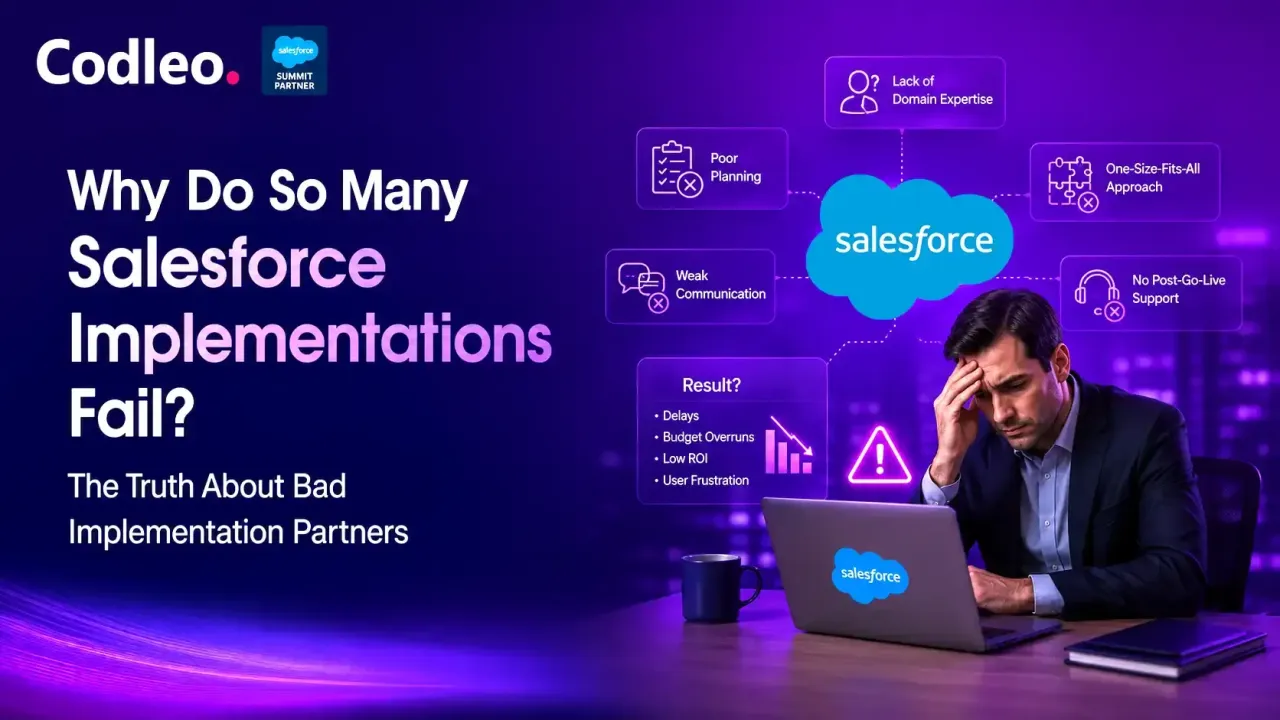
But here's what almost nobody selling you Agentforce will tell you upfront: the platform rarely fails. Implementations do. Salesforce's own adoption numbers tell the story — despite genuine product capability, a large share of orgs that buy Agentforce never get it fully live, or get it live and quietly stop using it within six months. The gap isn't technology. It's everything that happens between "we bought the license" and "our agents are actually running in production."
This guide breaks down exactly where Agentforce implementations go wrong, why it happens, and what separates the rollouts that scale from the ones that get shelved.
Most Agentforce implementation failures come down to nine repeatable mistakes: no strategic alignment, unclean data, shallow integrations, weak governance, poor change management, over-customization, unrealistic timelines, uncontrolled Flex Credit spend, and picking the wrong implementation partner. None of these are Agentforce's fault — they're planning and execution gaps. Fix them upfront with a phased, KPI-driven rollout and a partner who's actually deployed Agentforce at scale, and you avoid 90% of the pain enterprises report in the first year.
Table of Contents
-
Why Most Agentforce Rollouts Stall Before They Scale
-
The Real Cost of Getting It Wrong
-
Challenge 1: Chasing Technology Before Strategy
-
Challenge 2: Data That Isn't Ready for AI
-
Challenge 3: Shallow Integration With Your Existing Stack
-
Challenge 4: Underestimating AI Governance & Compliance
-
Challenge 5: Skipping Change Management
-
Challenge 6: Over-Customization and Feature Creep
-
Challenge 7: Unrealistic Timelines and Budgets
-
Challenge 8: Hidden Costs — Flex Credits and Scaling Spend
-
Challenge 9: Choosing the Wrong Implementation Partner
-
A Practical Framework for a Rollout That Actually Works
-
Agentforce Around the World: USA, UAE, and Europe
-
FAQs
-
Final Thoughts
Why Most Agentforce Rollouts Stall Before They Scale
Agentforce is Salesforce's agentic AI layer — agents that don't just recommend an action, they take it. Draft the email, escalate the case, update the opportunity, trigger the workflow. That's a meaningfully different animal than a chatbot or a copilot, and it changes what "implementation" actually means.
With a normal Salesforce feature, a bad rollout means low adoption. With Agentforce, a bad rollout means an autonomous system acting on bad data, with no one watching closely enough to catch it before it damages a customer relationship or breaks a compliance boundary. The stakes are higher, which is exactly why the failure modes below matter more here than they did for previous Salesforce launches.
The Real Cost of Getting It Wrong
Before the challenges, it's worth being blunt about what a failed or stalled Agentforce implementation actually costs:
-
Wasted license spend — you're paying for Flex Credits and platform access whether agents are running or shelved.
-
Trust erosion — one bad automated response to a customer, and your sales and service teams quietly go back to doing everything manually.
-
Compounding technical debt — rushed configurations get patched instead of rebuilt, and every future AI initiative inherits the mess.
-
Opportunity cost — the competitor who got their rollout right six months before you did is now closing deals faster and resolving cases in half the time.
None of that is inevitable. It's avoidable, and almost every failure traces back to one of the nine issues below.
Challenge 1: Chasing Technology Before Strategy
-
What happens: Teams turn Agentforce on because it's the newest capability in Salesforce, not because a specific business outcome demanded it. Agents get deployed for whatever use case is easiest to configure, not the one that actually moves a KPI.
-
Why it fails: An agent that automates a low-friction, low-value task looks like progress on a dashboard but does nothing for revenue, retention, or cost. Leadership eventually asks "what did we actually get for this," and nobody has a clean answer.
-
How to fix it: Before a single agent gets built, run a cross-functional session with sales, service, marketing, and IT to name 3–5 measurable outcomes — average case resolution time, lead response time, deal cycle length, first-contact resolution rate. Every agent you build should trace back to one of those numbers. If it doesn't move a KPI you already track, don't build it yet.
Challenge 2: Data That Isn't Ready for AI
-
What happens: Agentforce's reasoning and recommendations are only as good as the Salesforce data underneath them. Most orgs — even mature ones — are carrying years of duplicate accounts, inconsistent picklists, stale opportunity stages, and free-text fields with no standardization.
-
Why it fails: An agent grounded in fragmented data doesn't just underperform — it confidently produces wrong answers. That's arguably worse than no automation at all, because a wrong AI-generated summary or recommendation looks authoritative even when it's junk.
How to fix it:
-
Run a full data audit before implementation, not after.
-
Deduplicate accounts and contacts, standardize picklists, and fill critical missing fields.
-
Where data lives across multiple systems, unify it through Salesforce Data Cloud or an ETL/MuleSoft layer before agents go live.
-
Set an ongoing data hygiene cadence — this isn't a one-time cleanup, it's a maintenance discipline.
Challenge 3: Shallow Integration With Your Existing Stack
-
What happens: Agentforce gets deployed as an isolated layer, disconnected from Service Cloud, Marketing Cloud, or the third-party tools your teams actually live in — ERP systems, contact center platforms, ticketing tools.
-
Why it fails: An agent that can't see inventory, policy history, or a customer's full interaction record is working with half a picture. It produces recommendations that look plausible but miss context a human rep would have caught instantly.
-
How to fix it: Design the integration architecture before configuration begins, not after. Use native Salesforce connectors where possible, MuleSoft or equivalent middleware for everything else, and map data flows end-to-end so an agent triggered in Service Cloud can see what happened in Sales or Marketing an hour earlier.
Challenge 4: Underestimating AI Governance & Compliance
-
What happens: Agents get deployed with unclear rules around what data they can access, what actions they're allowed to take autonomously, and how their decisions get logged.
-
Why it fails: This is where regulatory exposure lives — GDPR, HIPAA, CCPA, sector-specific rules — especially in healthcare, financial services, and insurance. A single ungoverned agent handling sensitive customer data can turn into an audit finding, or worse, a breach.
How to fix it:
- Define an AI governance framework before rollout: what data agents can touch, what actions require human approval, what gets logged and reviewed.
- Set escalation thresholds — agents should hand off to a human the moment confidence drops or the interaction touches a sensitive category.
- Run periodic audits of agent decisions, not just system uptime.
Challenge 5: Skipping Change Management
-
What happens: Agentforce launches to end users with a one-line email and a login link. No training, no explanation of what changed in their daily workflow, no clarity on what the agent will and won't do for them.
-
Why it fails: Reps who don't trust the system quietly route around it — manual overrides everywhere, inconsistent usage, and within a few months the "AI transformation" is being used by a fraction of the team it was built for.
-
How to fix it: Treat this like any major process change, because it is one. Bring in team leads early so they can co-own the rollout instead of just receiving it. Run role-specific training that shows people exactly how the agent changes their day — not generic feature tours. Communicate clearly that Agentforce is there to remove repetitive work, not replace judgment calls that still need a human.
Challenge 6: Over-Customization and Feature Creep
-
What happens: In the rush to prove ROI fast, teams try to automate every workflow and ship every available feature in the first release.
-
Why it fails: The result is a bloated, hard-to-maintain system, a longer QA cycle, and users who are overwhelmed by change all at once instead of adapting gradually. Technical debt piles up before the foundation is even stable.
-
How to fix it: Start with a minimum viable rollout — one or two high-impact use cases, launched cleanly, measured, and only then expanded. Approve new use cases at defined phase gates, not on an ad hoc "let's just add this too" basis. This single discipline is the difference between a rollout that compounds well and one that collapses under its own scope.
Challenge 7: Unrealistic Timelines and Budgets
-
What happens: Leadership expects Agentforce to be "on" in a few weeks because that's how simple Salesforce feature toggles used to work. Discovery, data cleanup, integration testing, and training all get compressed or skipped.
-
Why it fails: Rushed configuration means skipped testing, which means bugs and bad automation surface in front of real customers. Fixing those in production takes longer than doing it right the first time — and damages internal confidence in the whole initiative.
-
How to fix it: Plan in clear phases: discovery and data audit, pilot build, testing, phased rollout, post-launch monitoring. A realistic enterprise Agentforce implementation typically runs 8–16 weeks depending on scope and data readiness — set that expectation with stakeholders on day one, not after the first missed deadline.
Challenge 8: Hidden Costs — Flex Credits and Scaling Spend
-
What happens: Agentforce billing runs on Flex Credits, consumed per agent action. Teams that don't model usage carefully get a very different bill in month three than they expected in month one.
-
Why it fails: Without usage governance, cost scales invisibly — every additional agent, every additional automated action, adds consumption that nobody's tracking until finance flags it.
-
How to fix it: Model expected action volume before launch, set usage alerts and caps where Salesforce allows it, and review consumption monthly against the ROI each agent is supposed to be delivering. If an agent's cost-per-resolved-case is higher than what a human rep costs, that's a signal to re-scope it, not to ignore it.
Challenge 9: Choosing the Wrong Implementation Partner
-
What happens: Businesses hand Agentforce implementation to a generalist team — internal staff stretched thin, or a partner whose Salesforce experience predates the agentic AI shift.
-
Why it fails: Agentforce implementation isn't the same skill set as a standard Salesforce configuration project. It requires prompt design experience, Data Cloud fluency, governance frameworks, and a track record of actually operating agents in production — not just switching them on.
-
How to fix it: Vet partners specifically on Agentforce delivery history, not general Salesforce certifications alone. Ask for real examples of agents they've taken live, how they handled data readiness, and how they structured governance. This is exactly the kind of work Codleo focuses on — pairing Agentforce configuration with the data, integration, and governance groundwork that determines whether a rollout actually sticks.
A Practical Framework for a Rollout That Actually Works
Here's what separates implementations that scale from the ones that stall, laid out as a phase-by-phase comparison:
PhaseWhat FailsWhat Works
Discovery
-
What fails: Skipped or rushed; use cases picked by convenience
-
What works: Cross-functional KPI mapping before any configuration starts
Data readiness
-
What fails: Assumed "good enough"
-
What works: Full audit, dedup, and standardization before go-live
Architecture
-
What fails: Agentforce bolted on as an isolated layer
-
What works: Native integration across Sales, Service, Marketing Clouds and third-party systems
Governance
-
What fails: Defined only after an incident
-
What works: Access rules, escalation thresholds, and audit logging set before launch
Rollout
-
What fails: Big-bang, all features at once
-
What works: MVP first, phased expansion at defined gates
Adoption
-
What fails: One-time announcement
-
What works: Role-specific training, team-lead buy-in, ongoing support
Cost control
-
What fails: Reviewed only when finance flags it
-
What works: Usage modeled and reviewed monthly against ROI
Teams that follow something close to this sequence consistently report faster time-to-value and far fewer post-launch fire drills than teams that treat Agentforce as a feature toggle. For organizations weighing whether to build this capability in-house or bring in dedicated Agentforce implementation services, this framework is a useful gut-check either way — if your plan is missing more than one or two of the "what works" columns, that's where the risk sits.
Agentforce Around the World: USA, UAE, and Europe
While Agentforce implementation challenges are largely universal, regional context shifts the emphasis:
-
United States — The largest and most mature Agentforce deployment base. US enterprises face the most competitive pressure to move fast, which is exactly why over-customization and unrealistic timelines (Challenges 6 and 7) show up disproportionately here. Regulatory exposure under HIPAA (healthcare) and CCPA (California) also raises the governance bar for US-based rollouts.
-
UAE and Gulf region — Rapid Salesforce adoption across finance, real estate, and government-linked enterprises, often paired with multilingual customer bases. Data residency and cross-border data handling add an extra governance layer that needs to be scoped early, not retrofitted.
-
Europe — GDPR makes governance and data lineage non-negotiable from day one. European teams that skip Challenge 4 don't just risk poor agent performance — they risk regulatory penalties. Data minimization principles also mean the data-quality work in Challenge 2 needs to double as a compliance exercise.
Wherever you're implementing from, the underlying discipline is the same: strategy before configuration, clean data before automation, governance before scale.
FAQs
What is the biggest challenge in Agentforce implementation?
Misalignment between Agentforce agents and actual business KPIs is the most common root cause — teams deploy agents because the technology is available, not because a specific outcome demanded it.
How long does a typical Agentforce implementation take?
Most enterprise rollouts take 8–16 weeks from discovery through phased launch, depending on data readiness and integration complexity. Rushed timelines under 4 weeks are a common cause of failed pilots.
Does Agentforce work with messy or fragmented Salesforce data?
Agentforce can technically run on any data, but poor data quality directly produces poor agent output. A data audit and cleanup phase before launch is considered essential, not optional.
How much does Agentforce cost to run?
Agentforce is billed through Flex Credits consumed per agent action, so cost scales with usage. Without usage monitoring, spend can grow faster than expected — modeling volume before launch is critical.
Do I need a specialized partner for Agentforce implementation, or can my internal Salesforce admin handle it?
A general Salesforce admin can configure basic Agentforce features, but production-grade rollouts — with governance, integration, and prompt design — typically require Agentforce-specific implementation experience to avoid the common pitfalls above.
Final Thoughts
Agentforce genuinely can transform how a business runs — automated case resolution, smarter sales workflows, real-time customer insight. But every one of the challenges above proves the same point: the platform isn't what determines success. Planning, data discipline, and governance are.
If you're evaluating an Agentforce rollout — or you're mid-implementation and already hitting some of the friction points above — Codleo works specifically on this: strategy-first Agentforce implementations built around clean data, real integration, and governance that holds up under scrutiny, for teams across the US and globally. Worth a conversation before your next phase, not after the next fire drill.
 0
0
About the Author




 603 D-Mall Netaji Subhash Place, Delhi 110034 IND


